



About this worksheet
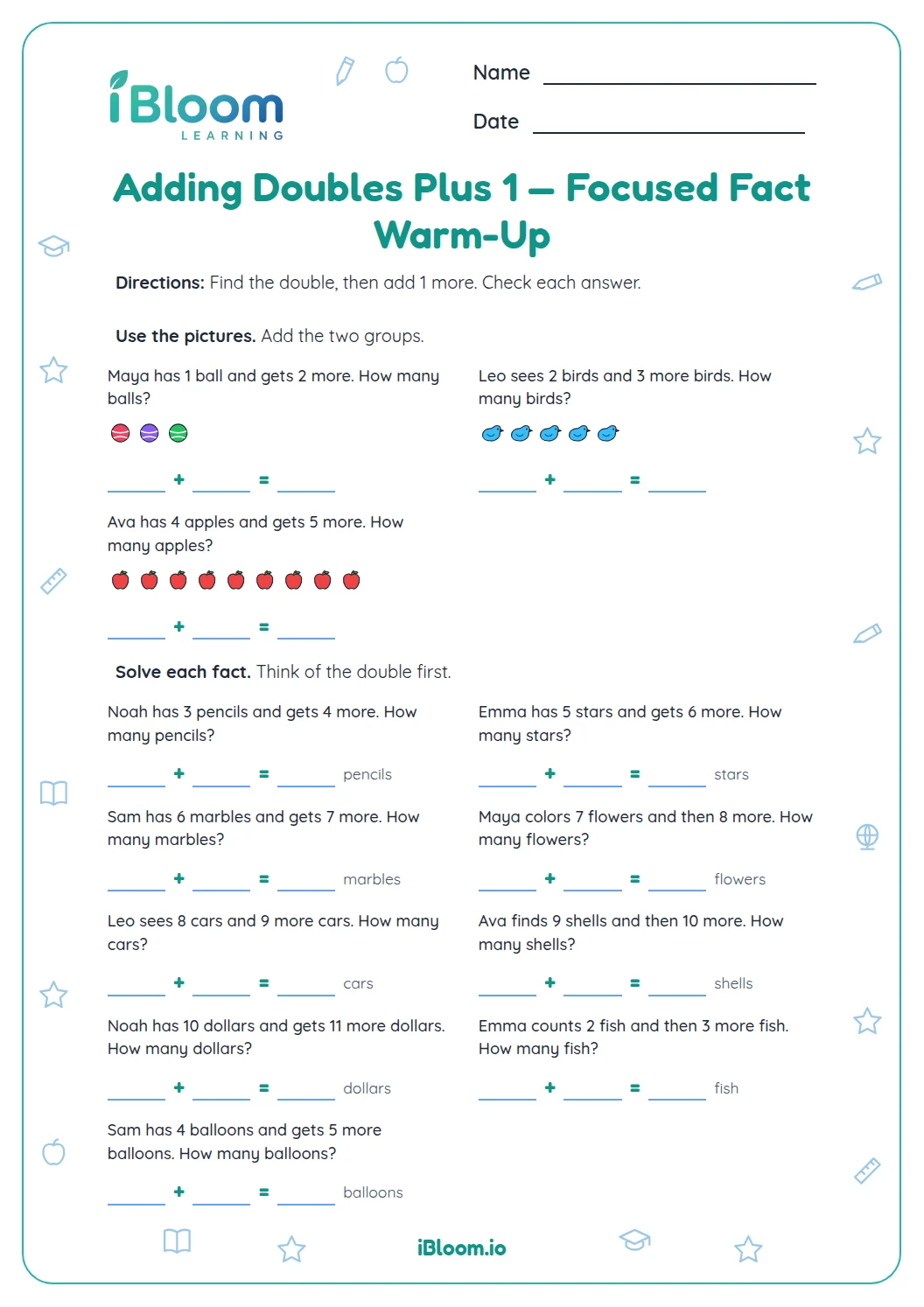
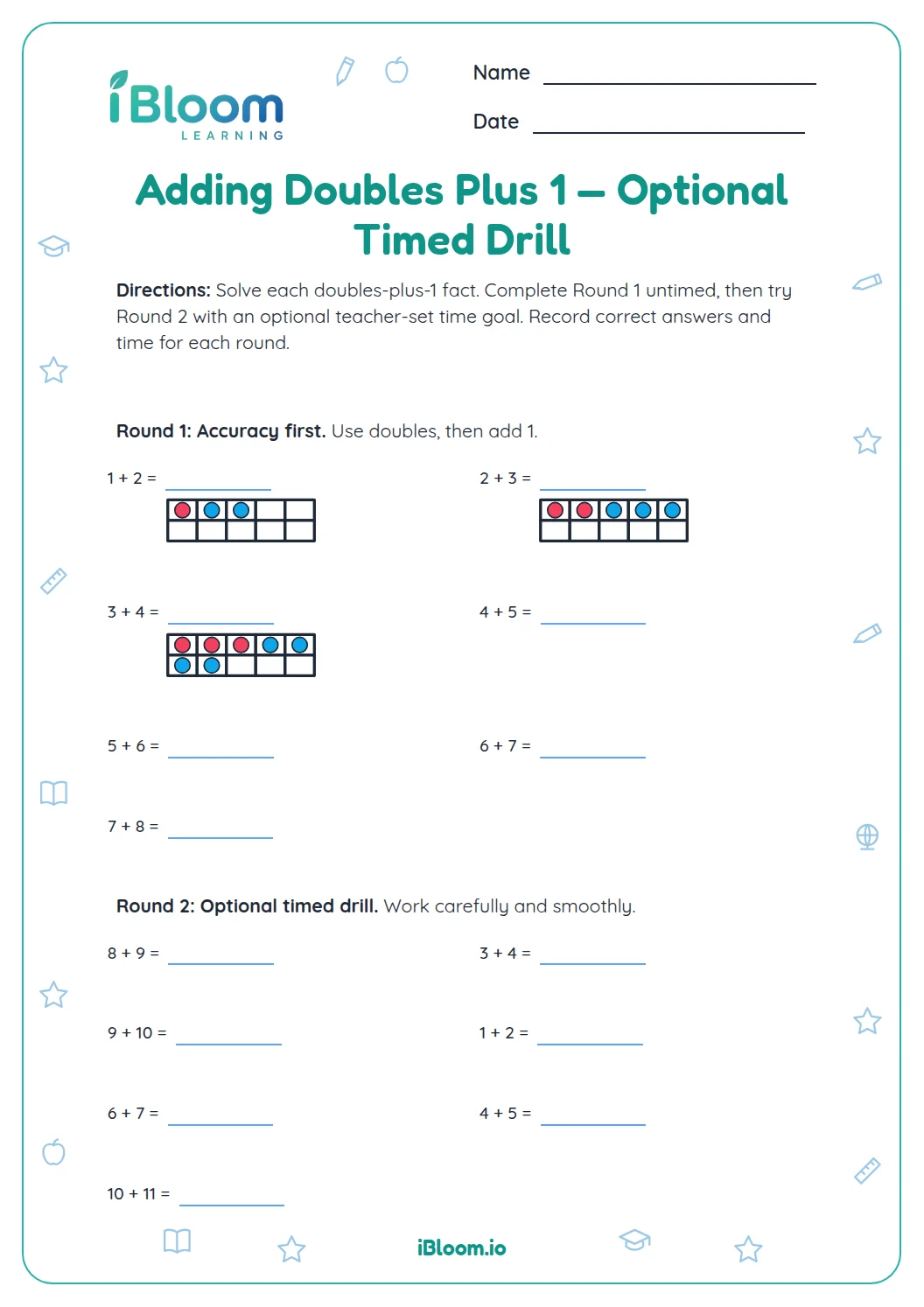
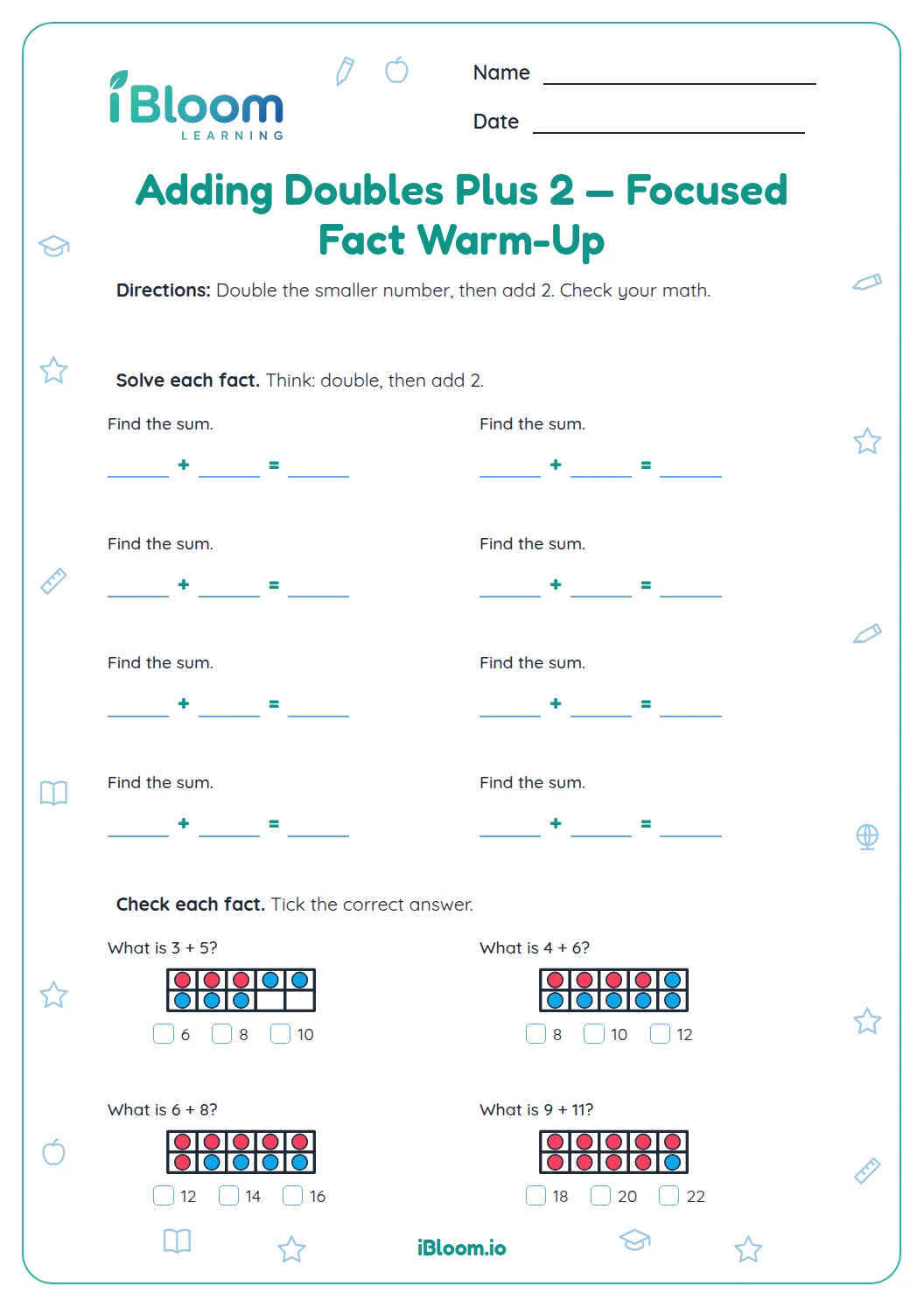
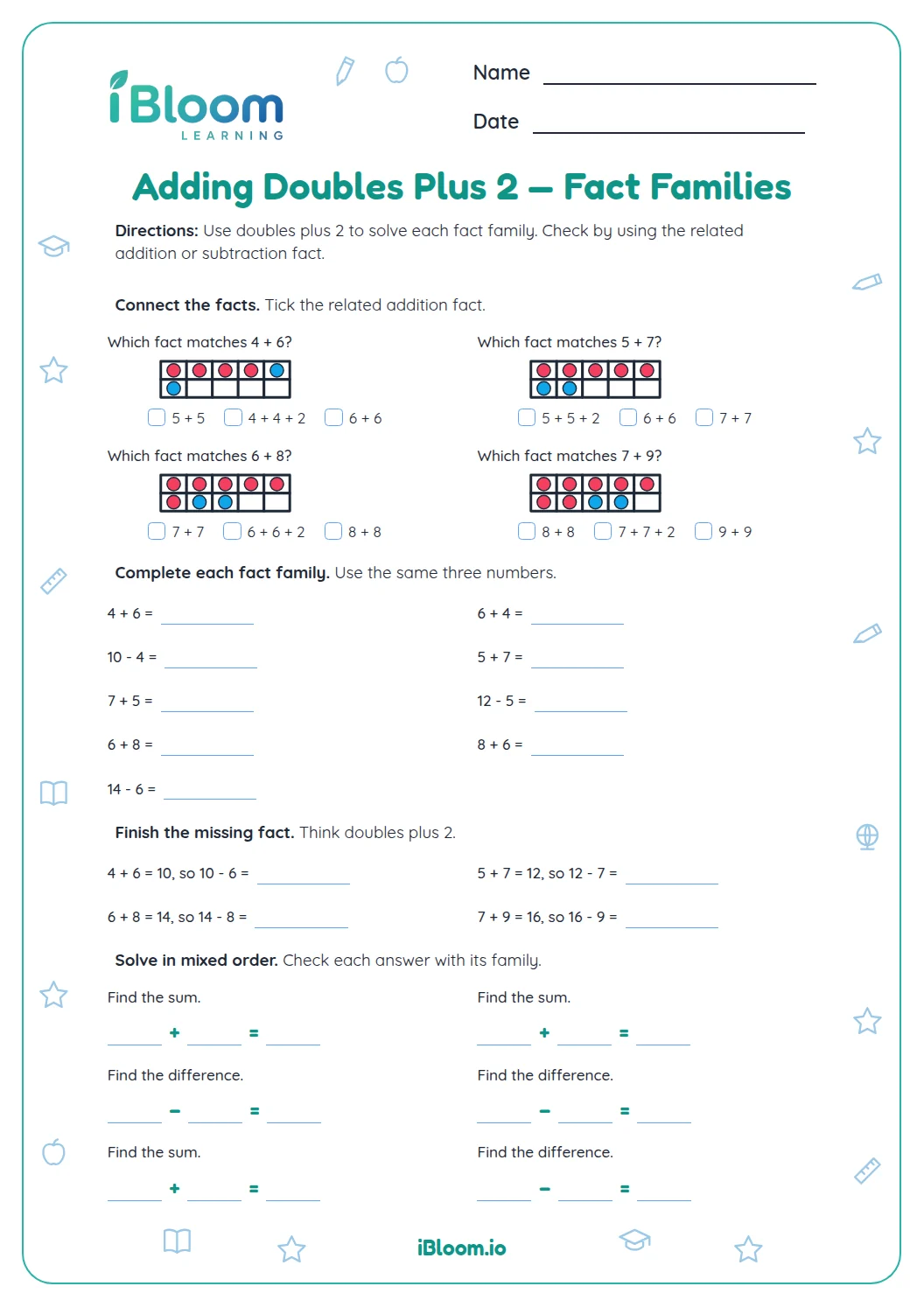
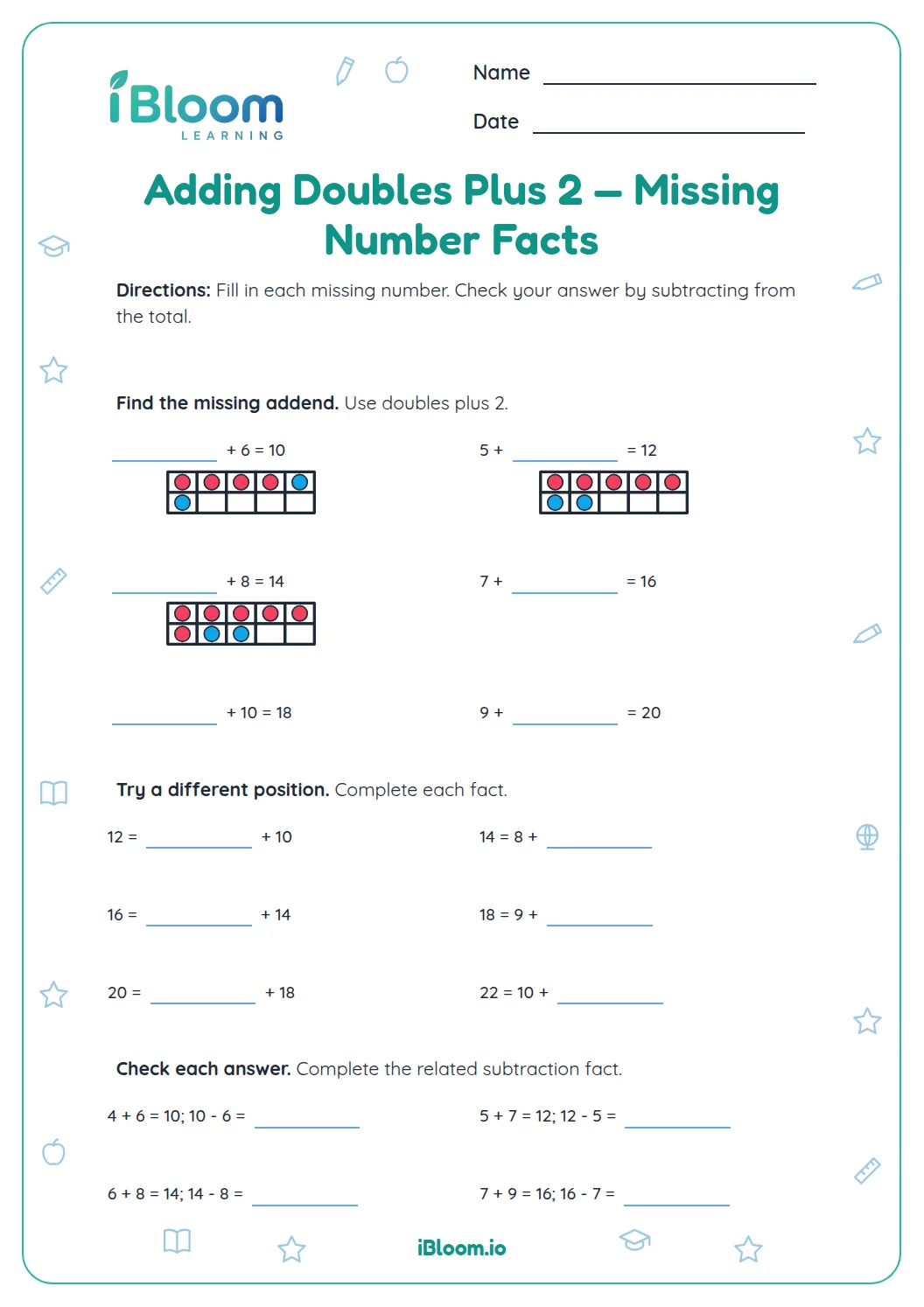
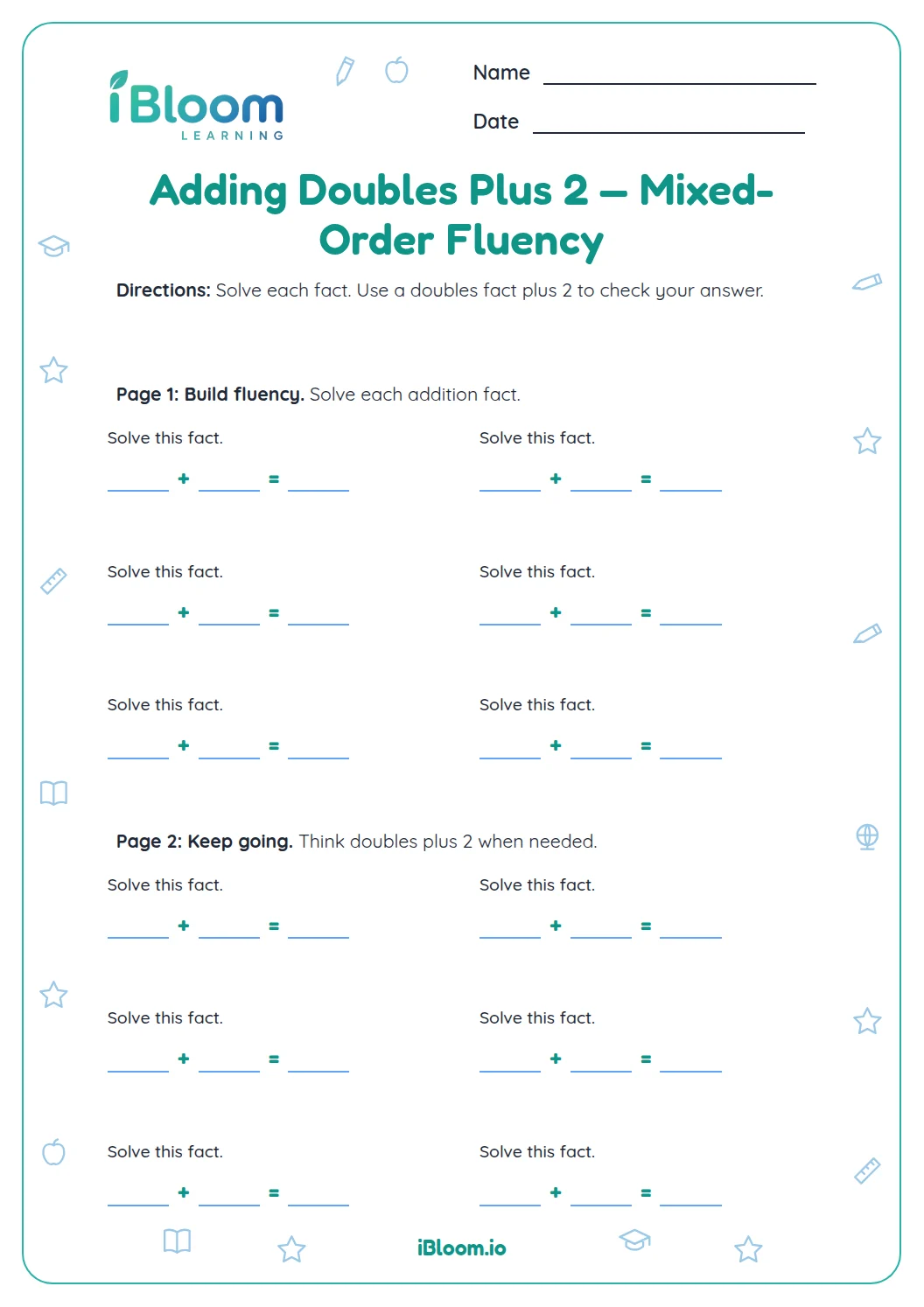
This free printable gives Grade 1 and Grade 2 students 20 doubles-plus-one addition and reasoning questions. Children use a familiar double to work out its neighboring fact, then check sums in a multiple-choice section and two written sections. For example, 6 + 7 is one more than 6 + 6. The facts stay within 19 to include useful larger doubles, while the strategy applies across the set. The work aligns with Common Core addition fluency standards 1.OA.C.6 and 2.OA.B.2.
Aligned to 1.OA.C.6 and 2.OA.B.2
What is in each part of the fact check?
Part A has six facts to solve. Part B asks students to correct six mistaken sums. Part C checks whether they can explain how a known double helps, and Part D gives four final sums using the related double.
- Part A: solve six doubles-plus-one facts
- Part B: correct six incorrect sums
- Part C: choose the reasoning that uses a known double
- Part D: finish four mixed facts
How does a nearby double help?
When one addend is exactly one more than the other, add the smaller number twice and then add one. This keeps the second addend relationship visible instead of counting every object from one.
- 16 + 7 is one more than 6 + 6.
- 26 + 6 = 12
- 312 + 1 = 13
- 4So 6 + 7 = 13.
How can children check an answer?
Say the related double out loud, then add one. If the fact is 9 + 10, start with 9 + 9 = 18 and add one to make 19. A quick second check is to reverse the addends: the sum stays the same.
How to use this worksheet
- 1Read the two addends and notice which is one greater.
- 2Double the smaller addend.
- 3Add one to that double.
- 4Choose or write the resulting sum.
- 5Use the answer key to check, then redo any missed fact using the double strategy.
Common mistakes and quick fixes
The mistake
Doubling the larger addend instead of the smaller one.
The fix
Circle the smaller addend and write its double first, then add one.
The mistake
Adding only one to the smaller addend.
The fix
The whole double-plus-one fact includes the smaller addend twice; write that double before adding one.
The mistake
Choosing an answer that is one less than the double.
The fix
Compare the sum to the double: the answer must be exactly one greater.
Common Core alignment
Use strategies such as known doubles to add within 20.
On this sheet: Children use a known double as an easier sum to solve its neighboring addition fact.
Show the official wordingHide the official wording
Add and subtract within 20, demonstrating fluency for addition and subtraction within 10. Use strategies such as counting on; making ten (e.g., 8 + 6 = 8 + 2 + 4 = 10 + 4 = 14); decomposing a number leading to a ten (e.g., 13 - 4 = 13 - 3 - 1 = 10 - 1 = 9); using the relationship between addition and subtraction (e.g., knowing that 8 + 4 = 12, one knows 12 - 8 = 4); and creating equivalent but easier or known sums (e.g., adding 6 + 7 by creating the known equivalent 6 + 6 + 1 = 12 + 1 = 13).
Build fluency with addition facts within 20.
On this sheet: The sheet gives repeated practice with sums of two one-digit addends.
Show the official wordingHide the official wording
Fluently add and subtract within 20 using mental strategies. By end of Grade 2, know from memory all sums of two one-digit numbers.
What to practice next
Make more practice
Further reading
Questions parents and teachers ask
What is a doubles-plus-one fact?
It is an addition fact whose addends differ by one, such as 6 + 7. The smaller addend can be doubled first: 6 + 6 = 12, then one more makes 13. The sheet repeats this relationship so children can use a known fact to solve a nearby one.
What grades can use this worksheet?
The worksheet is labeled for Grades 1–2. First graders can use the nearby-double strategy to add within 20, while second graders can use it as focused practice for addition fact fluency. Children may use counters or a number line before working mentally.
How many questions are included?
There are 20 questions across four parts: six sums, six error corrections, four strategy choices, and four final facts. Students first calculate, then check incorrect work, choose an explanation that uses a known double, and finish with independent facts. The separate key lists each answer.
Are the sums within 20?
Every sum on this page is 19 or less. The questions use single-digit addends, including 9 + 10, so students can practice the doubles-plus-one pattern within 20. Children who are still learning the strategy can use counters or say the matching double before adding one.
What does the answer key show?
The separate key lists the sum for all 20 questions, including six initial facts, six corrected sums, four strategy choices, and four final facts. Ask the child to explain one answer with a double, such as 8 + 9 as 8 + 8 plus one. This shows how the strategy supports the answer.