

About this worksheet
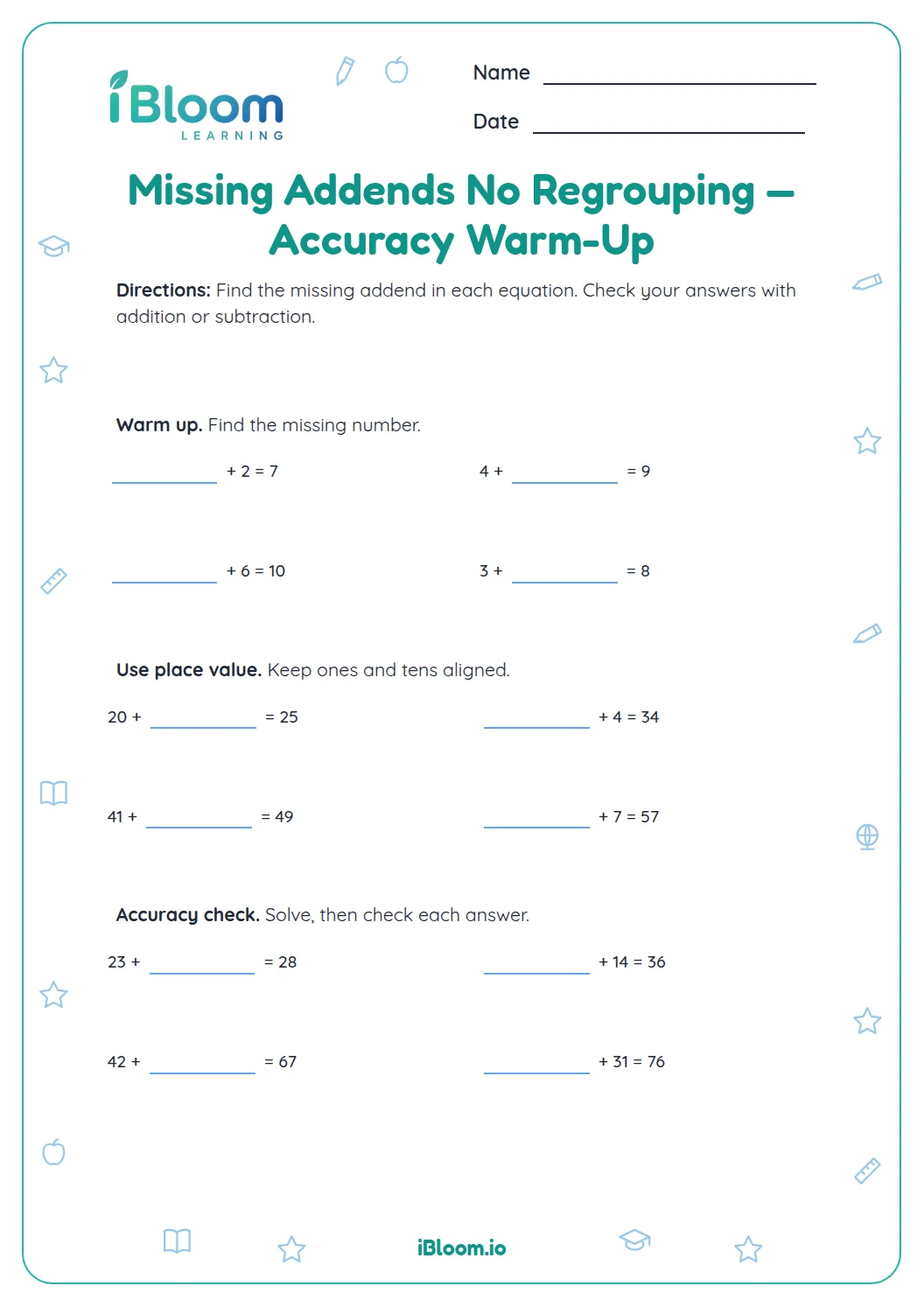
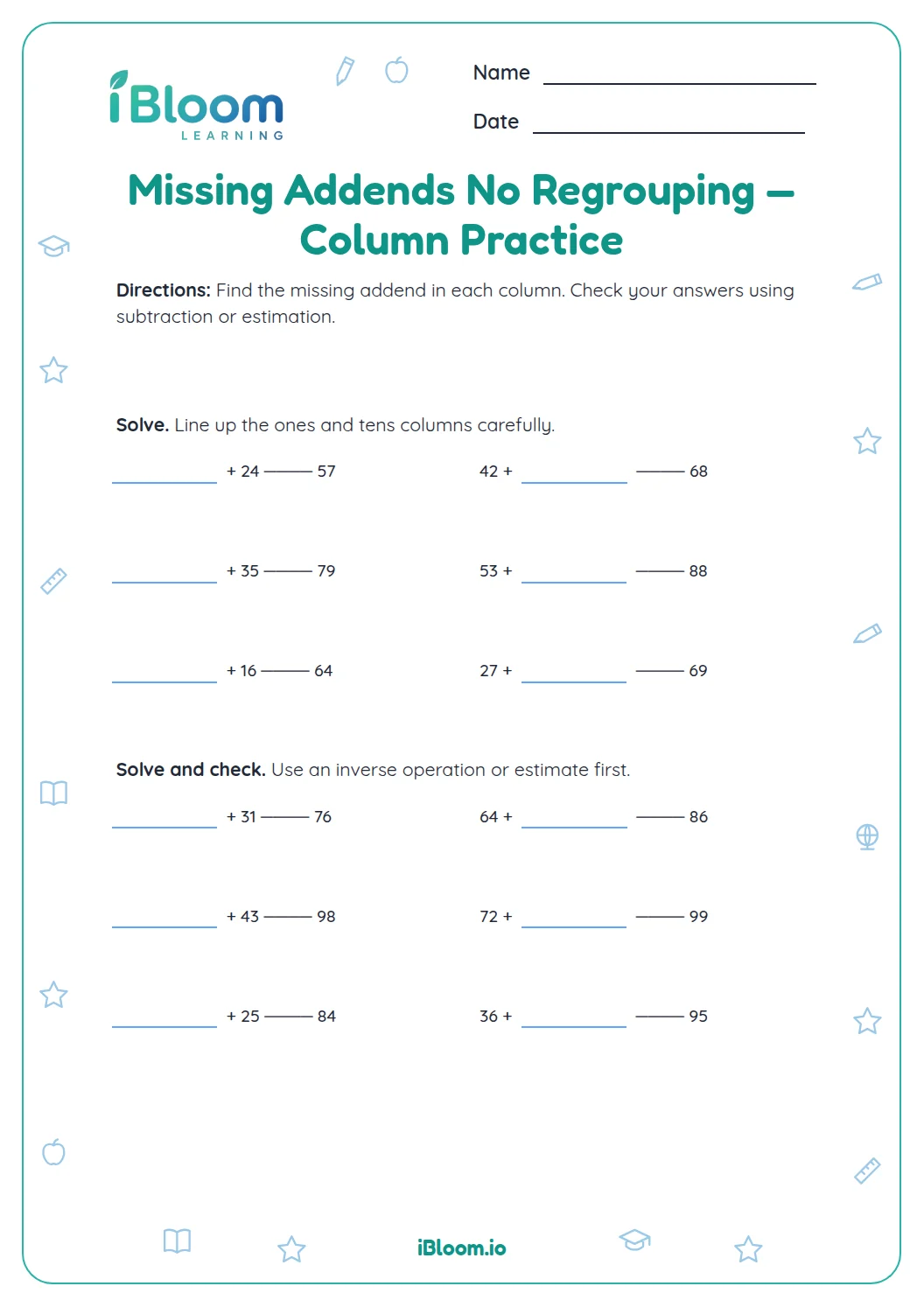
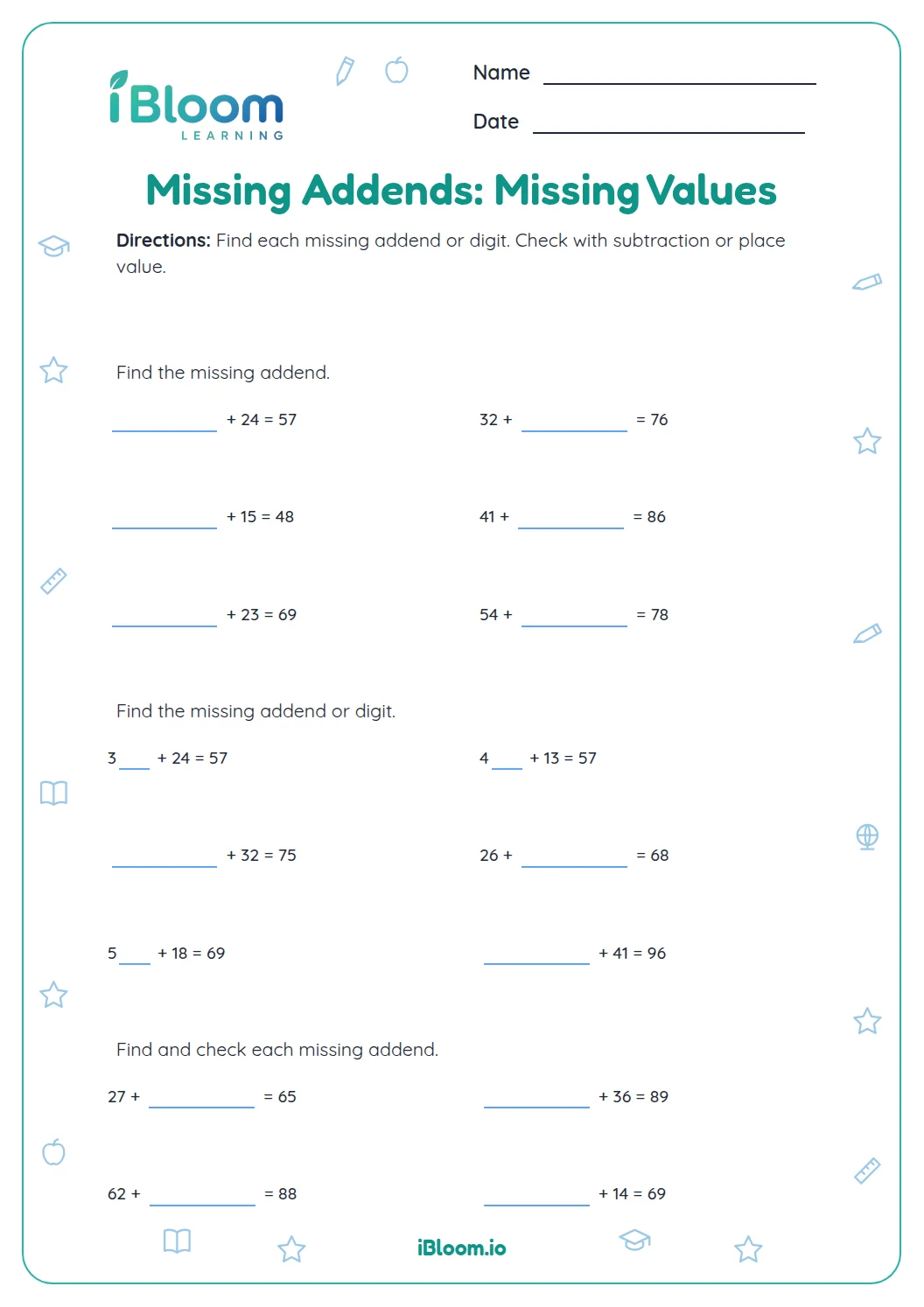
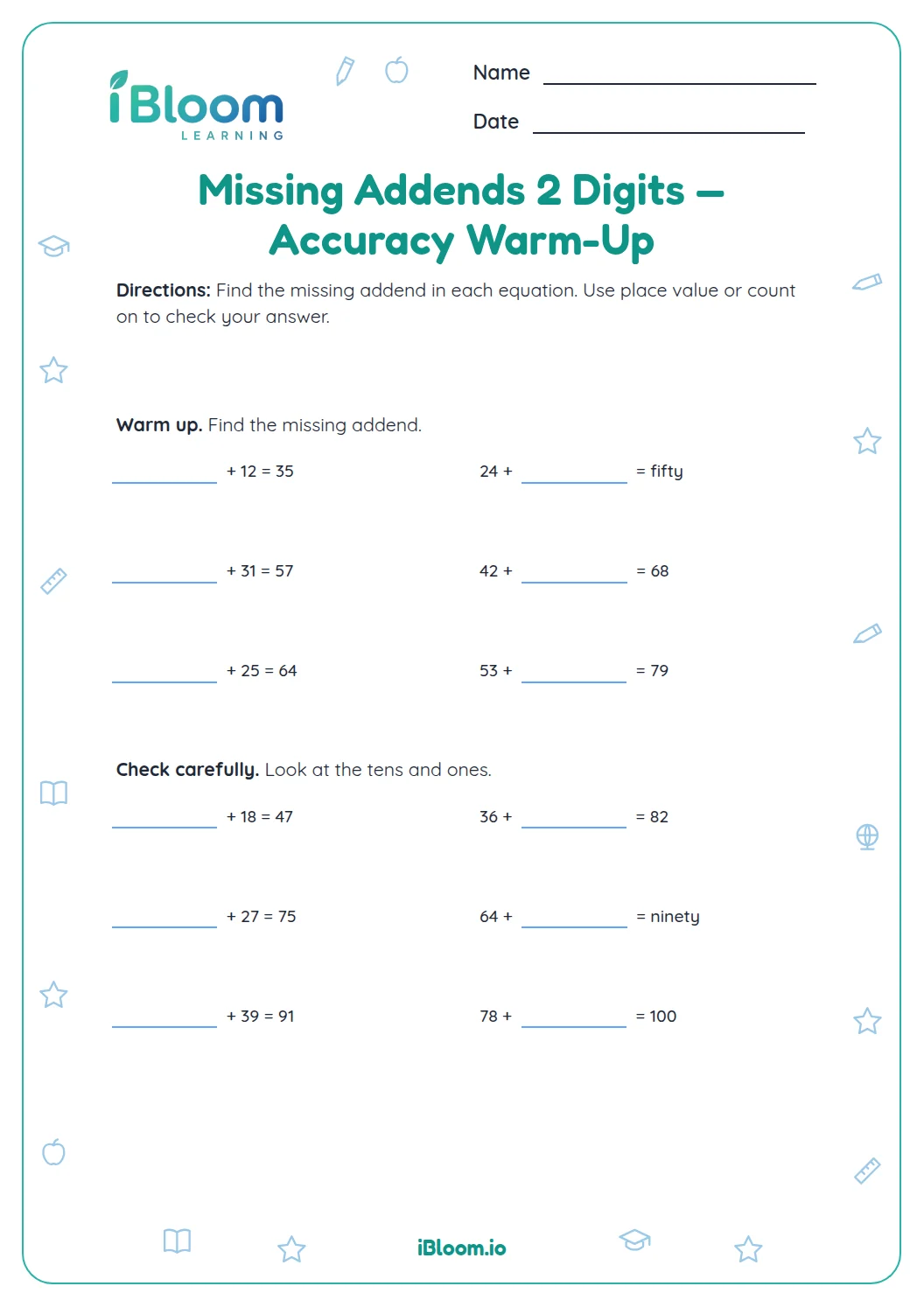
This two-part worksheet helps students find missing addends in two-digit sums without regrouping. First, they judge whether a student’s proposed answer is correct; then they solve eight equations themselves. The correction items focus attention on the relationship between an addend and the total. The page aligns with CCSS 2.NBT.B.5 strategies for addition and subtraction within 100.
Aligned to 2.NBT.B.5
What is in each part?
Part A asks students to check eight proposed missing addends by substituting and adding. Part B gives eight new equations to solve. Every subtraction is within 100 and does not require regrouping.
- Check each proposal by adding it to the known addend
- Use subtraction to find each missing value in Part B
How do you check a proposed addend?
Put the proposed number back into the equation. If the sum matches the total, the proposal is correct. If it is one too small or too large, use subtraction to find the exact missing value.
- 141 + ___ = 68; proposed answer: 26.
- 2Check: 41 + 26 = 67, not 68.
- 3So the proposal is incorrect; 68 − 41 = 27.
How do you solve the equations?
Use the inverse relationship: total minus known addend equals the missing addend. Check by adding the two addends back together.
How to use this worksheet
- 1Read the full addition equation.
- 2For Part A, test the proposed number by adding it to the known addend.
- 3Choose yes only when the sum equals the total.
- 4For Part B, subtract the known addend from the total.
- 5Add your answer back to check.
Common mistakes and quick fixes
The mistake
Subtract the total from the known addend.
The fix
The total is the bigger amount: total minus known addend gives the missing part.
The mistake
Accept an answer that is close.
The fix
Test it in the original equation; the total must match exactly.
The mistake
Subtract each digit without keeping place value aligned.
The fix
Subtract ones from ones and tens from tens, then check by addition.
Common Core alignment
This page practices missing addends without regrouping through short, focused questions.
Use place value strategies to add or subtract within 100.
On this sheet: Use place value strategies to add or subtract within 100.
Show the official wordingHide the official wording
Fluently add and subtract within 100 using strategies based on place value, properties of operations, and/or the relationship between addition and subtraction.
What to practice next
Make more practice
Further reading
Questions parents and teachers ask
How do you check a proposed missing addend?
Add the proposed number to the known addend. If the sum matches the total, it is correct; otherwise, subtract the known addend from the total. In question 2, 41 + 26 = 67, so 26 does not make 68. Then verify with addition.
What does “no regrouping” mean?
The subtraction for each missing addend can be done in each place without trading a ten. For example, 68 − 41 subtracts 1 one from 8 ones and 4 tens from 6 tens. Students can focus on the inverse relationship between addition and subtraction.
Why are some proposed answers only one away?
A one-away proposal gives students a clear error to test. Substituting it into the equation shows whether it reaches the total. Some proposals are correct, too, so students need to calculate each one rather than decide from how plausible the number looks.
What is different about Part B?
Part B has eight new equations instead of repeating the equations from Part A. Students subtract the known addend from the sum, then add the result back to confirm it. This gives them another chance to use the same inverse relationship.
Is an answer key included?
Yes. The separate key marks each Part A proposal yes or no and gives the missing addend for all eight Part B equations. Check an answer by adding both addends to see whether they make the sum shown in the equation.