





About this worksheet
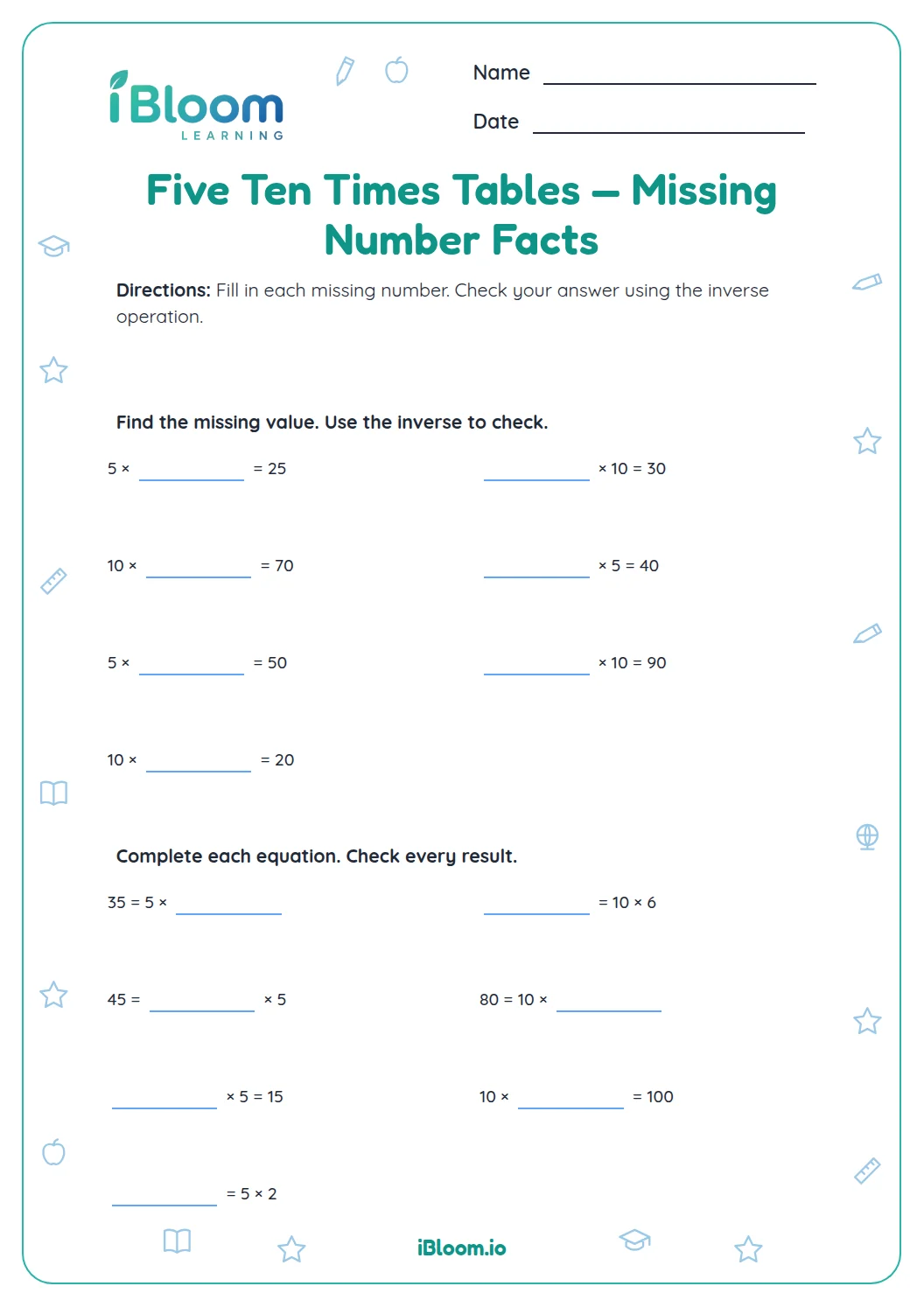
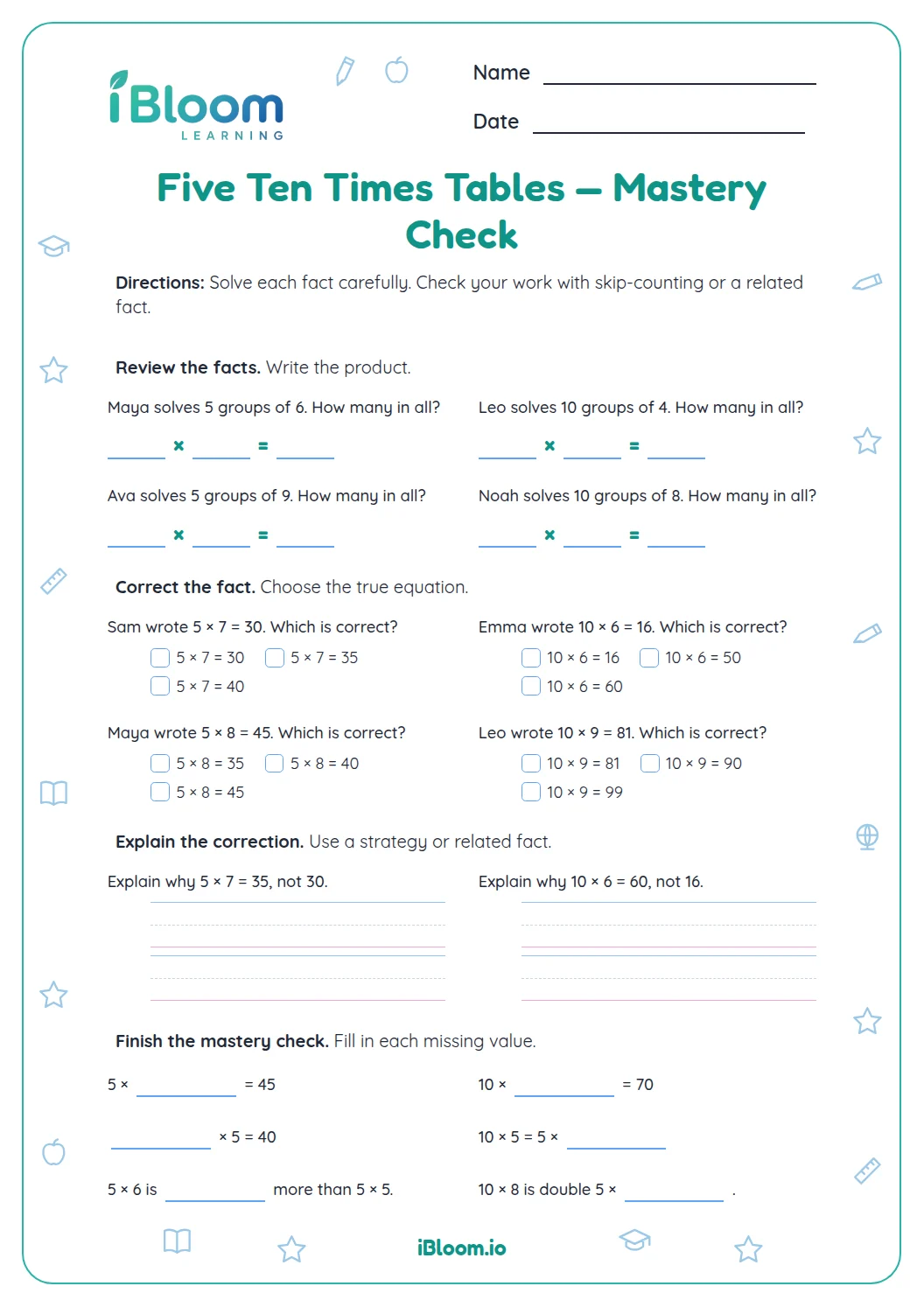
This optional timed drill gives Grade 3 students 16 horizontal facts from the 5 and 10 times tables. Part A mixes facts with a factor of 5; Part B moves to facts with a factor of 10. Students can complete the pages without a timer, then check every product with the answer key.
Aligned to 3.OA.C.7
How can skip counting help with 5s?
Count by fives once for each group. For 5 × 4, four groups of five give 5, 10, 15, 20.
- 1q1 is 5 × 4 = 20.
What pattern appears in 10s products?
A whole-number factor times 10 has the same number of tens as the factor. For example, 10 × 7 is 7 tens, or 70.
How to use this worksheet
- 1Work through the 5s facts in Part A.
- 2Use skip counting by fives or equal groups to check a product.
- 3Solve Part B, where each fact has a factor of 10.
- 4If desired, time a second attempt after practicing.
- 5Compare each answer with the key and circle facts to revisit.
Common mistakes and quick fixes
The mistake
Adding the factors instead of multiplying.
The fix
Draw or imagine equal groups of the factor.
The mistake
Stopping a skip-count one group early.
The fix
Count one number for each group, including the first.
The mistake
Treating a timer as part of the score.
The fix
Use the timer only if it helps; accuracy comes first.
Common Core alignment
This worksheet practices the listed Common Core skill through the questions on the page.
Build fluency with mixed multiplication facts from the 5 and 10 times tables.
On this sheet: The worksheet asks students to practice this skill directly.
Show the official wordingHide the official wording
Fluently multiply and divide within 100, using strategies such as the relationship between multiplication and division (e.g., knowing that 8 × 5 = 40, one knows 40 ÷ 5 = 8) or properties of operations. By the end of Grade 3, know from memory all products of two one-digit numbers.
What to practice next
Make more practice
Further reading
Questions parents and teachers ask
How should students approach 5s and 10s drill?
Build fluency with mixed multiplication facts from the 5 and 10 times tables. Read each direction, solve one item at a time, and use the answer key to review the reasoning. The page gives 16 questions across two parts, so an adult can pause between sections and discuss any tricky item.
How many questions are on the worksheet?
There are 16 questions on this two-page worksheet, followed by a separate answer key. The questions move from a focused first part to a second part that asks students to apply the same skill in a new way.
Is an answer key included?
Yes. A separate answer key lists a response for every question, including sample responses where students can write different correct answers. Use it after the learner has tried the page, then revisit any item that needs another explanation.
How long does this worksheet take?
Plan for about 15 minutes, with more time if the learner wants to explain a strategy or revise a written response. The questions are divided into two parts, which makes it easy to complete one section at a time.
What should I do when an answer differs from the key?
First check whether the response still meets the question’s directions. For a fixed answer, compare the calculation or grammar clue; for a writing item, use the sample as a model and check that the response includes the requested details.