


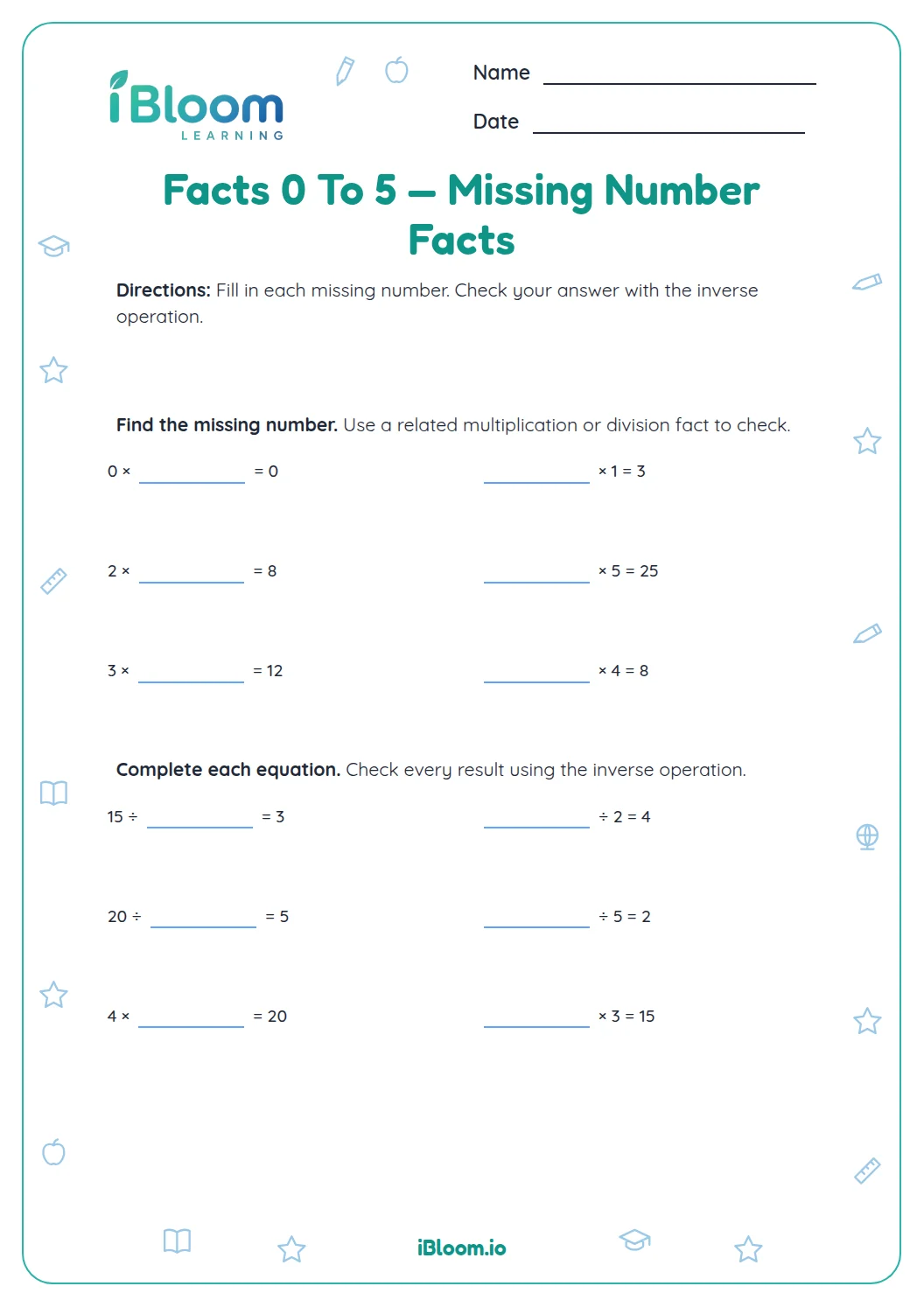
About this worksheet
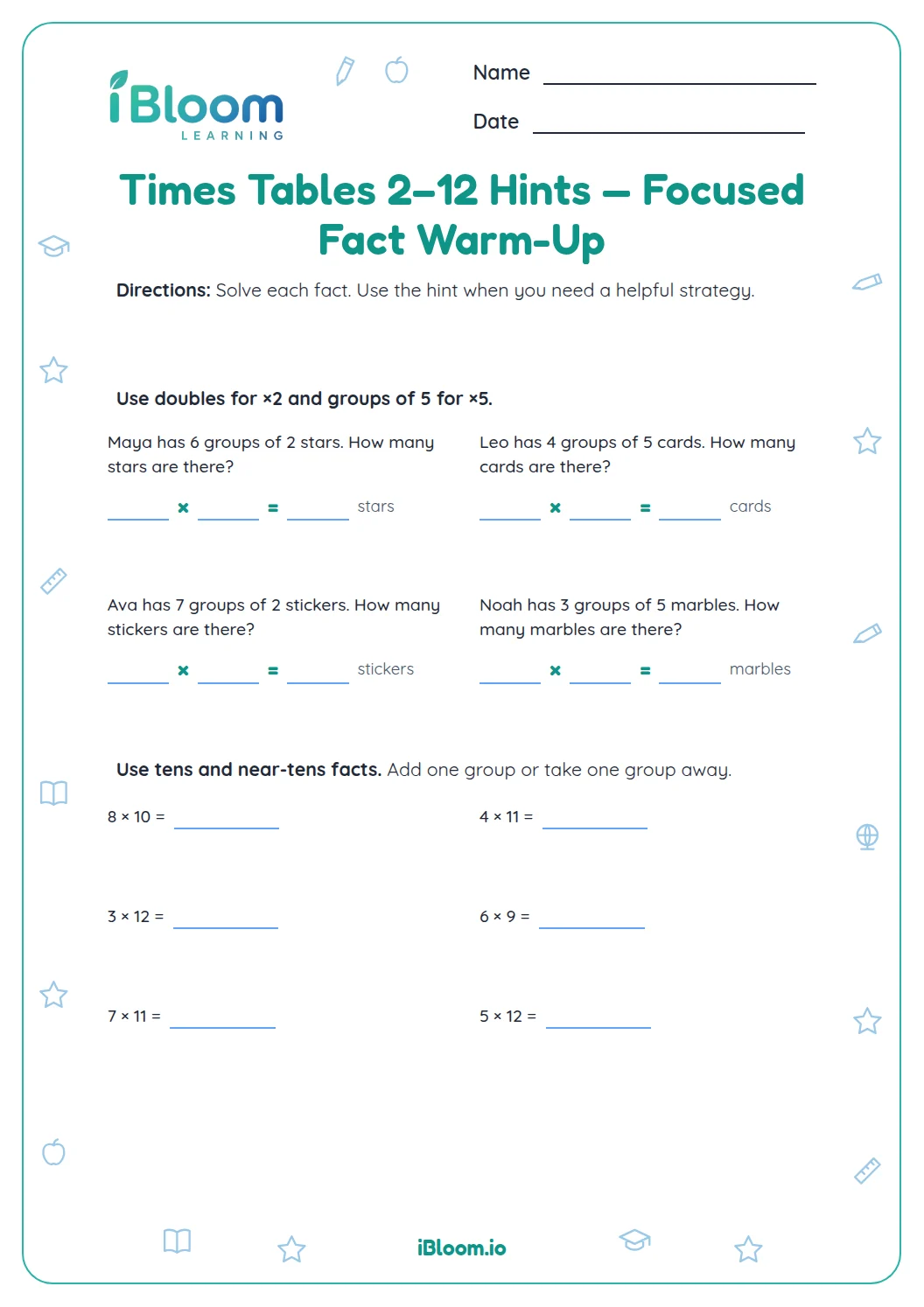
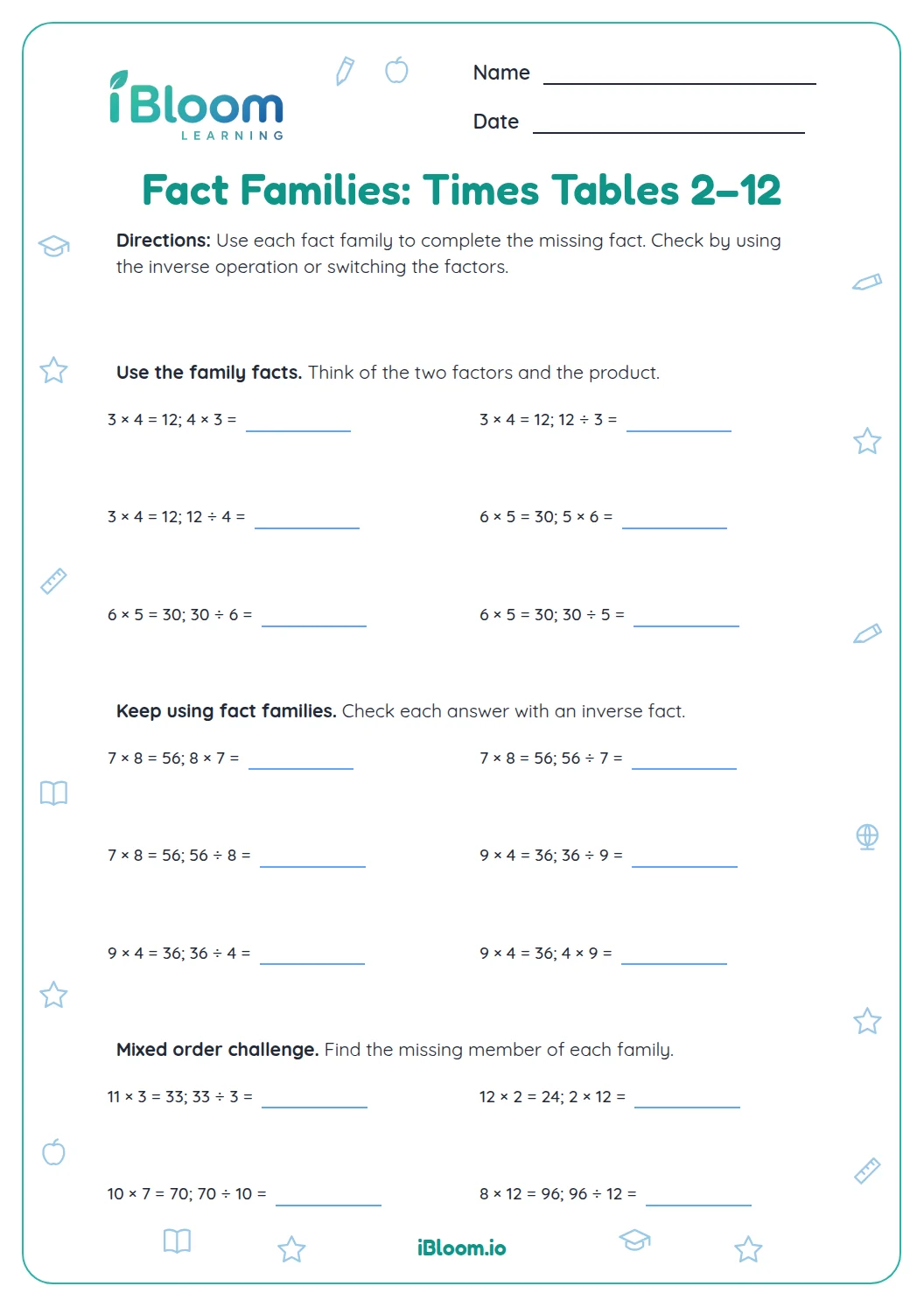
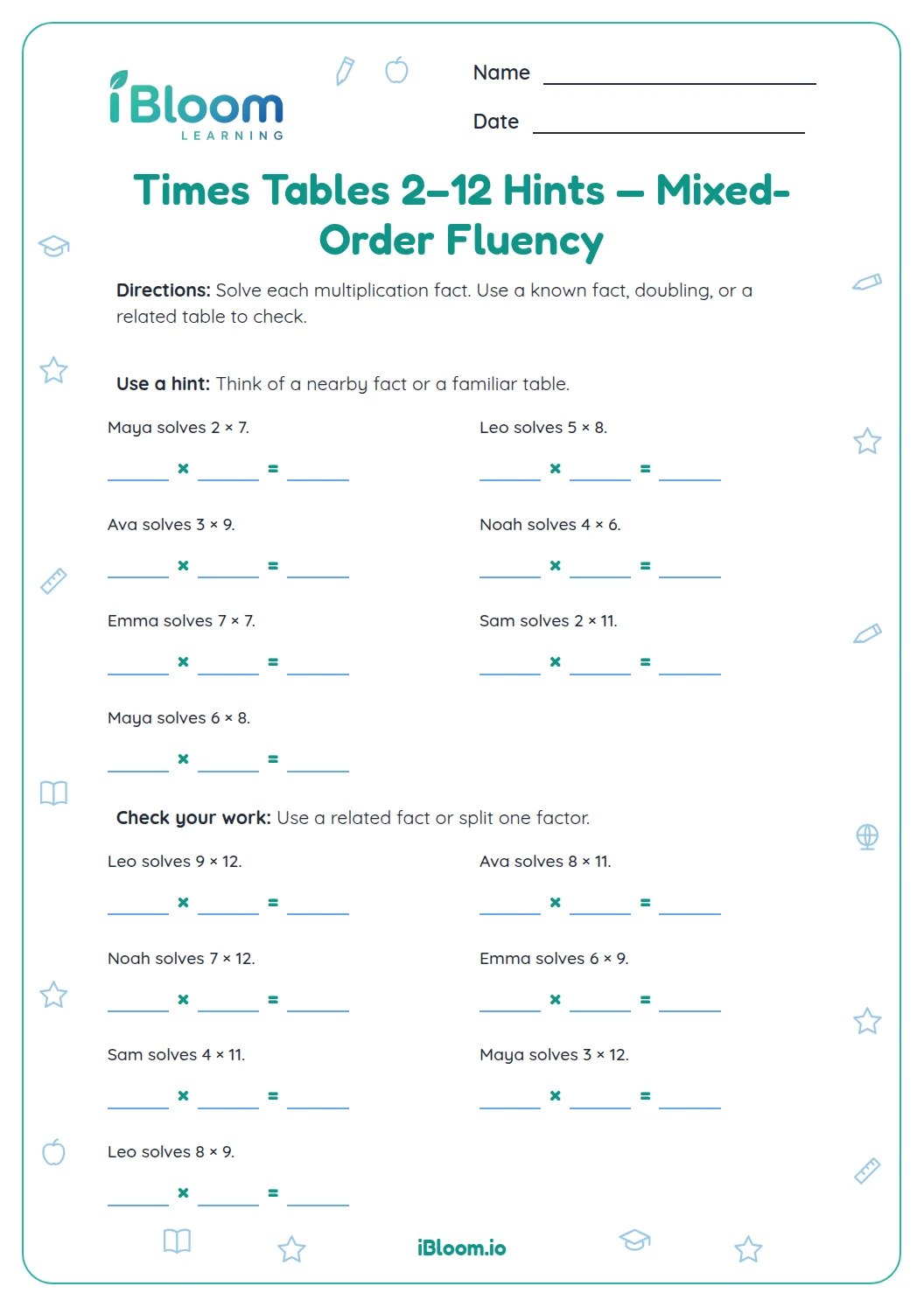
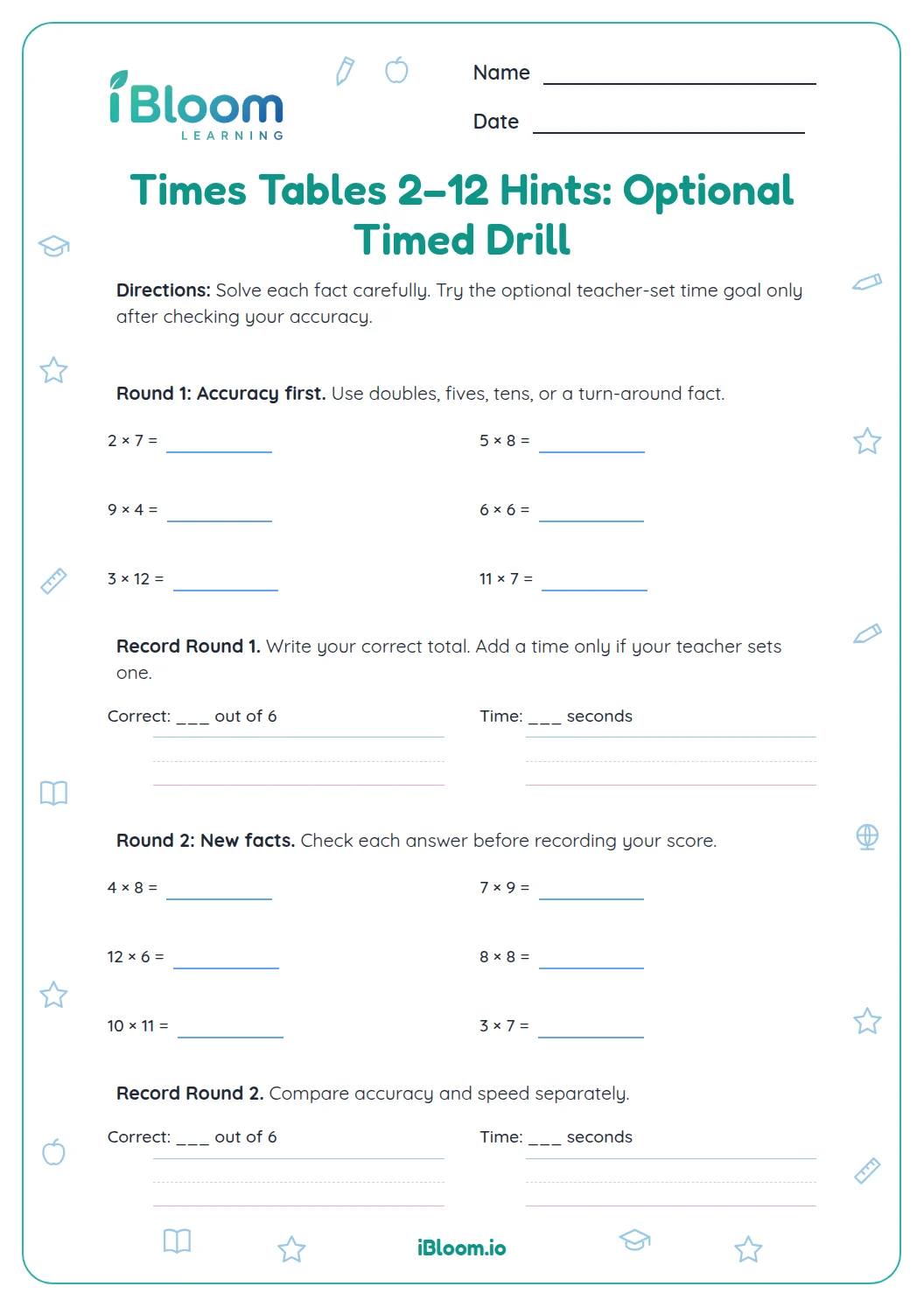
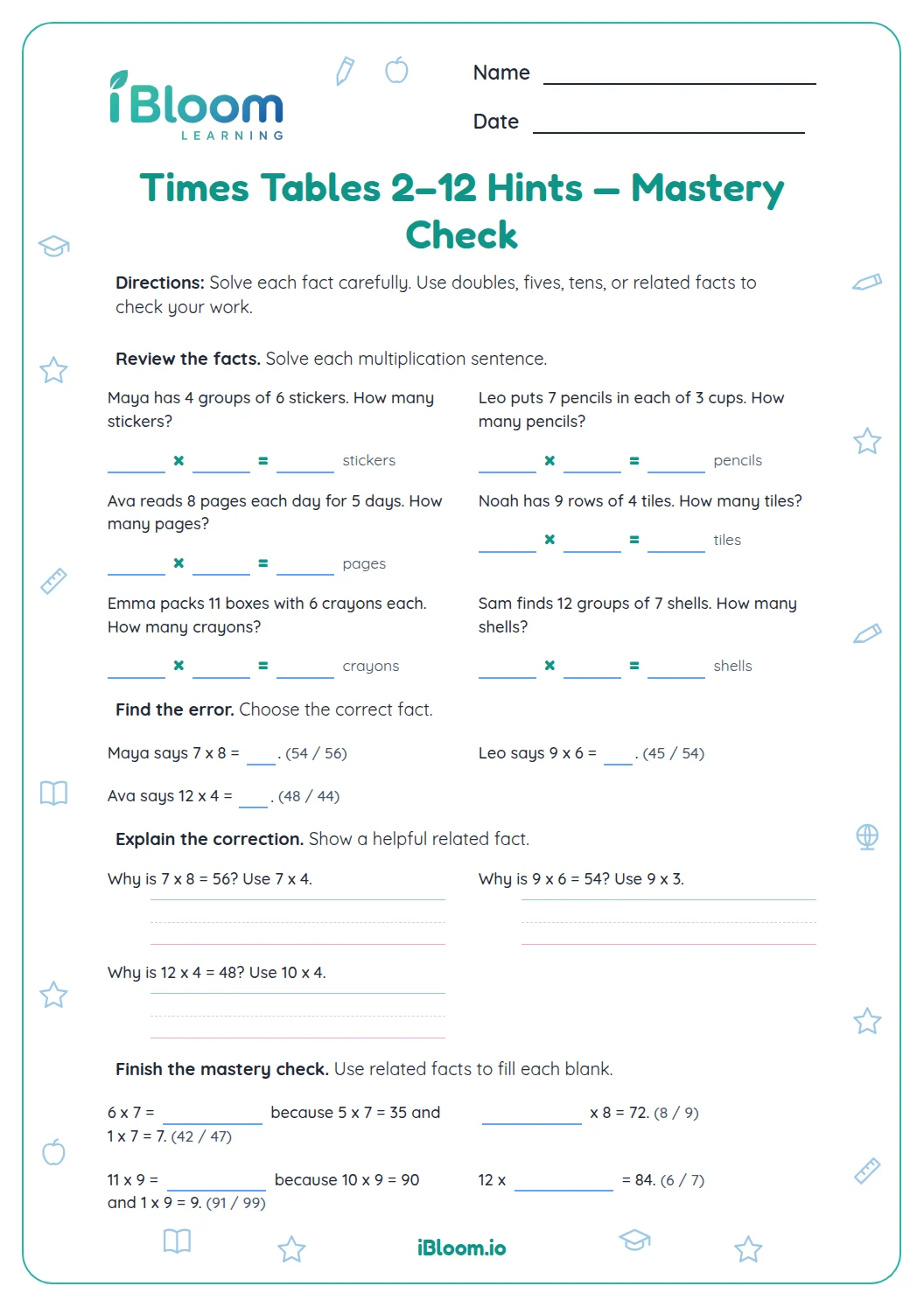
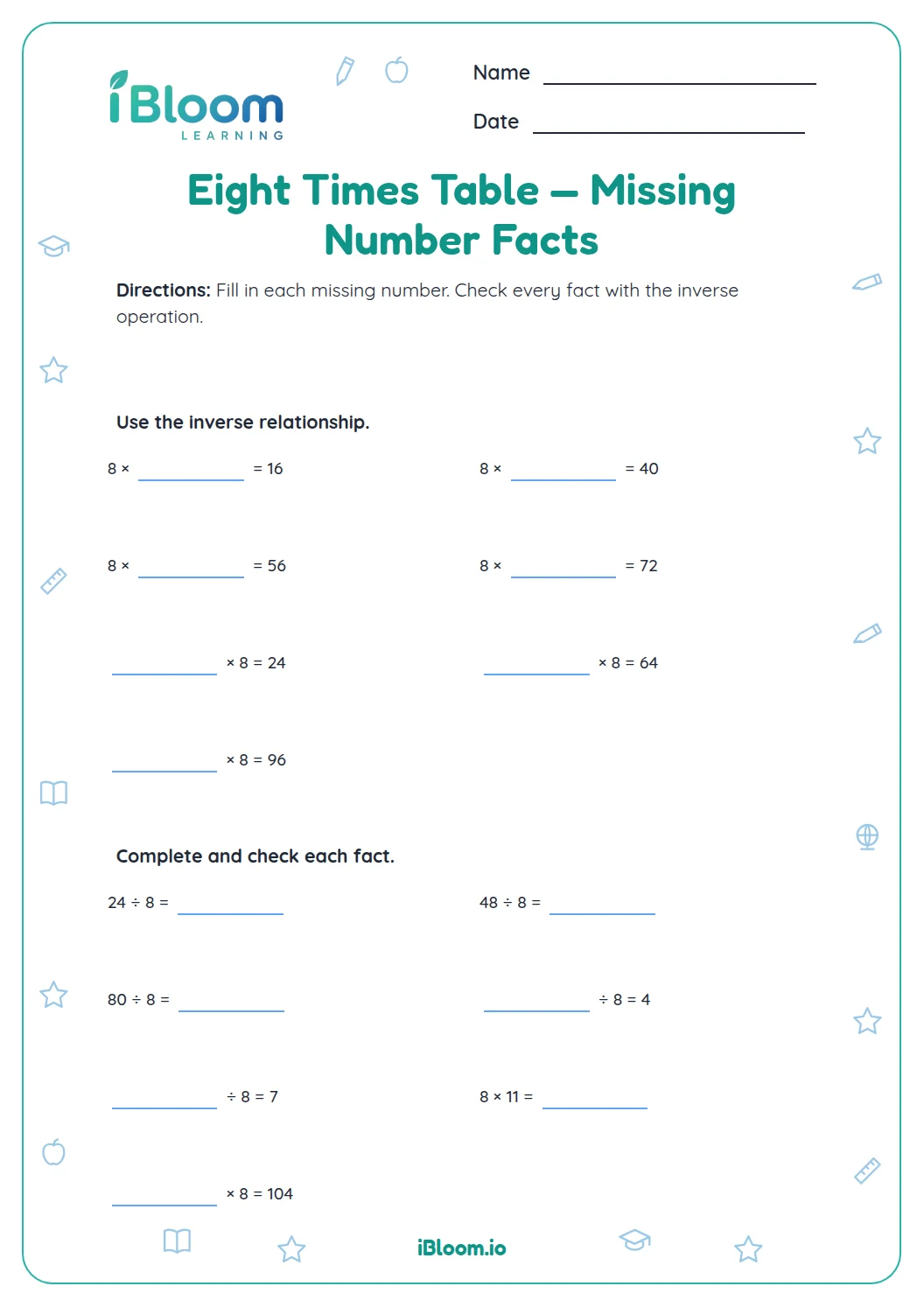
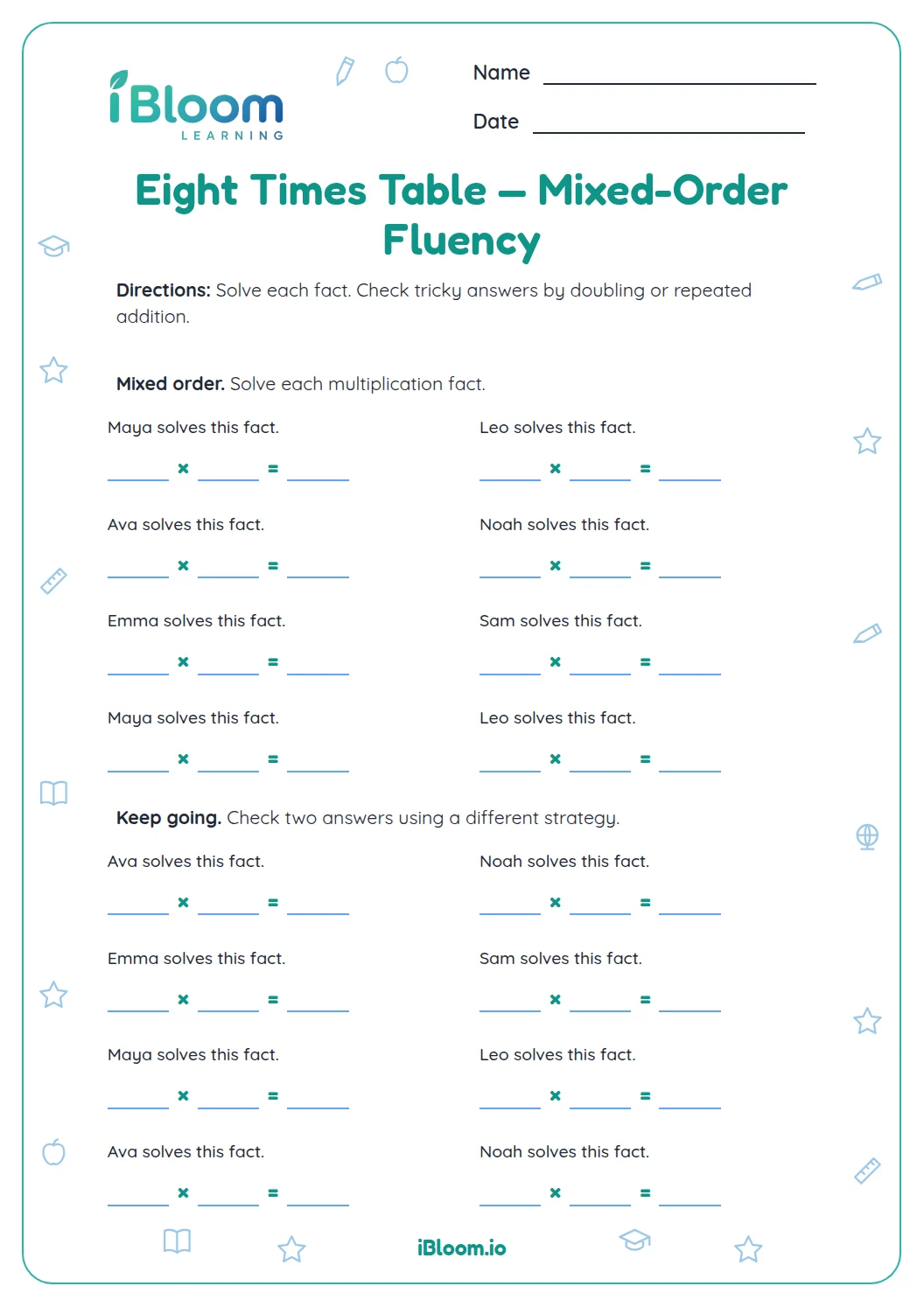
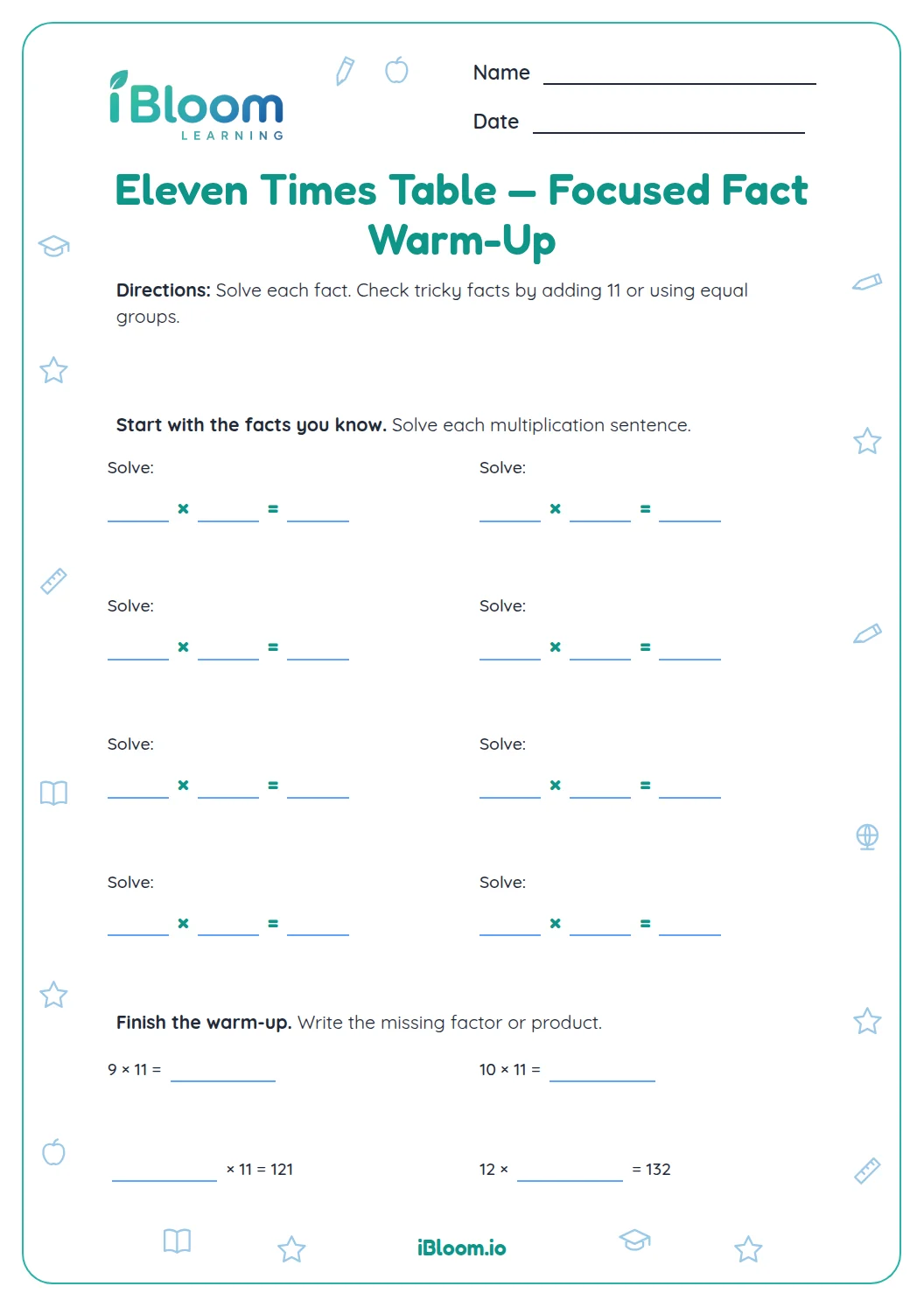
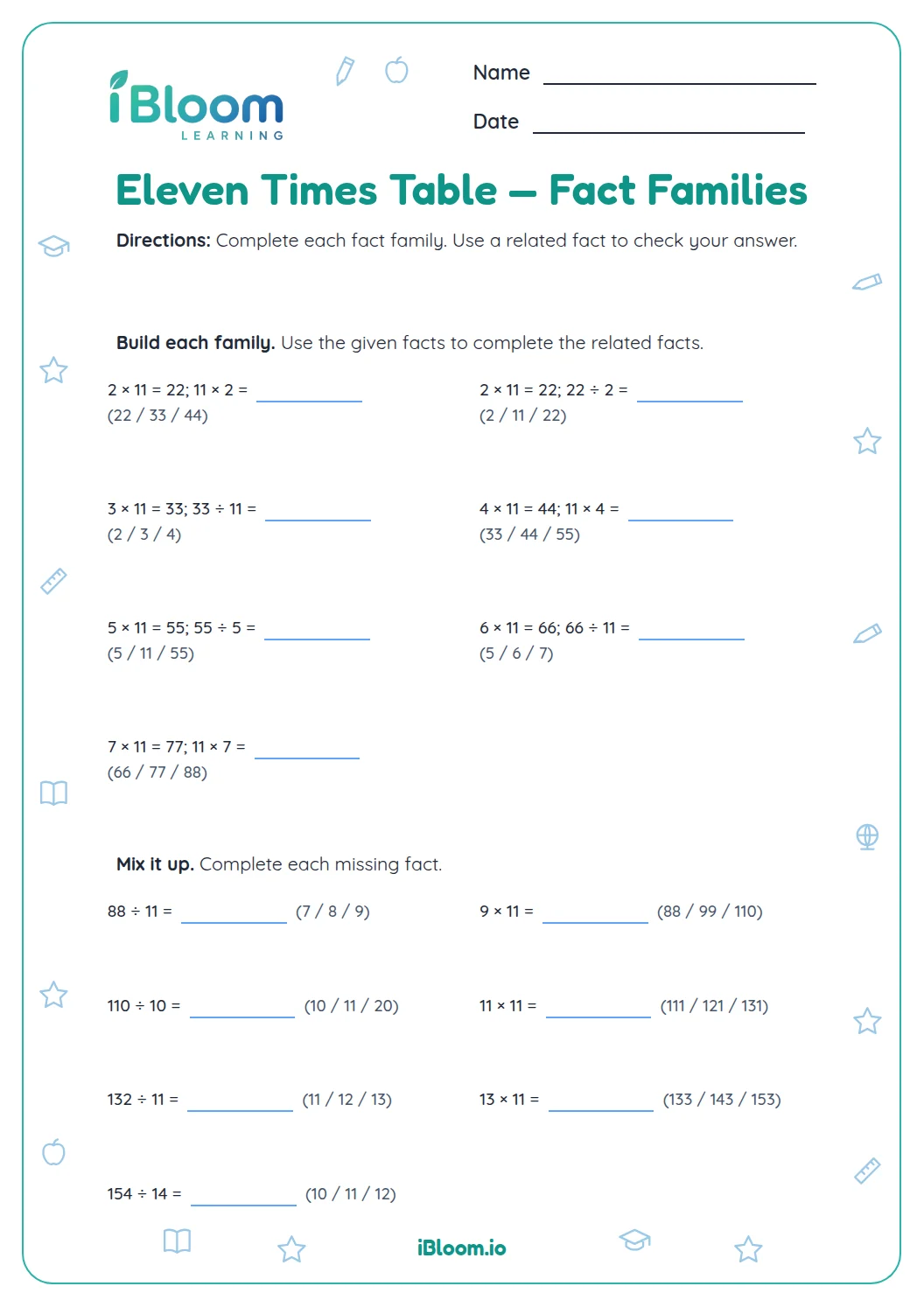
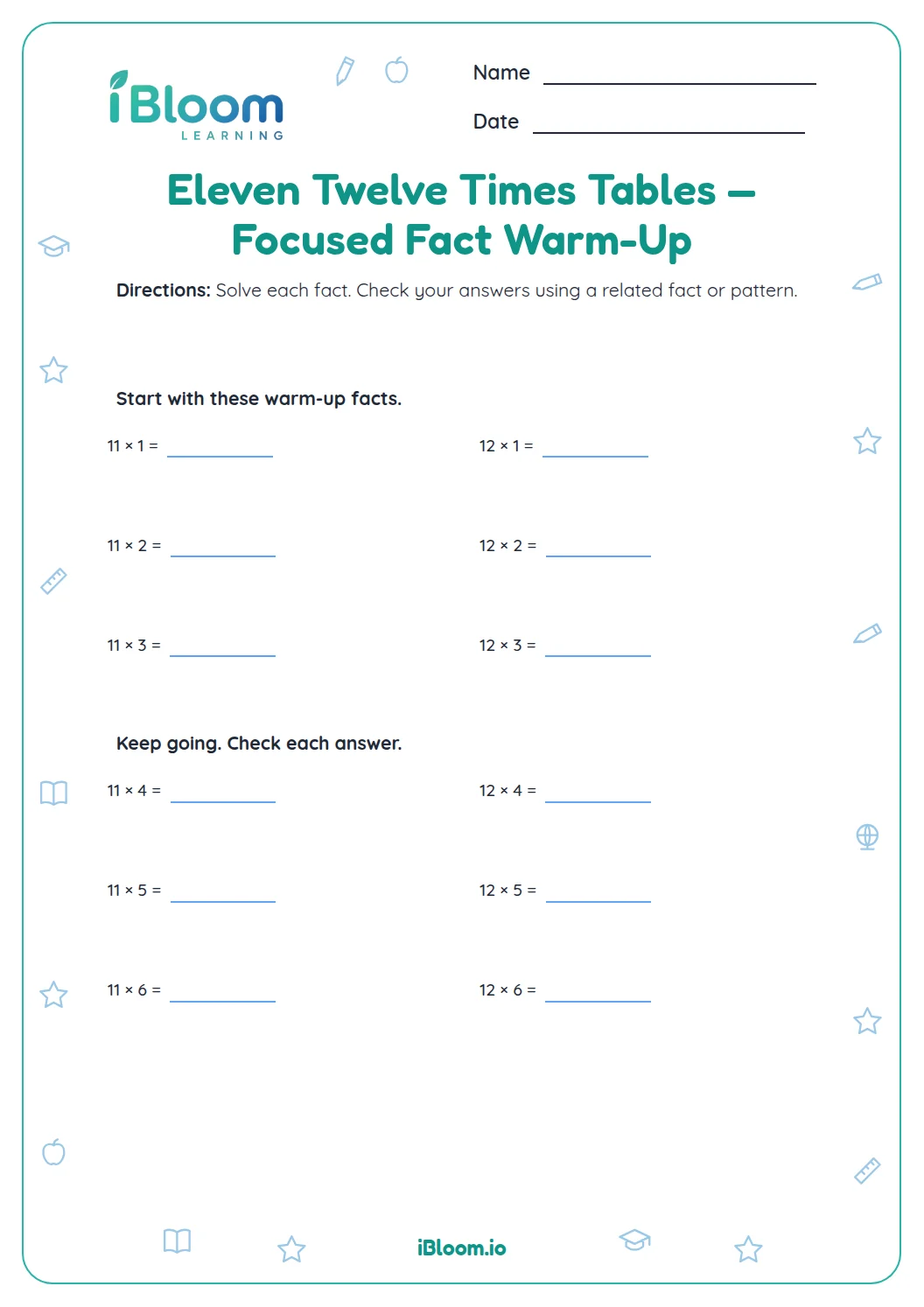
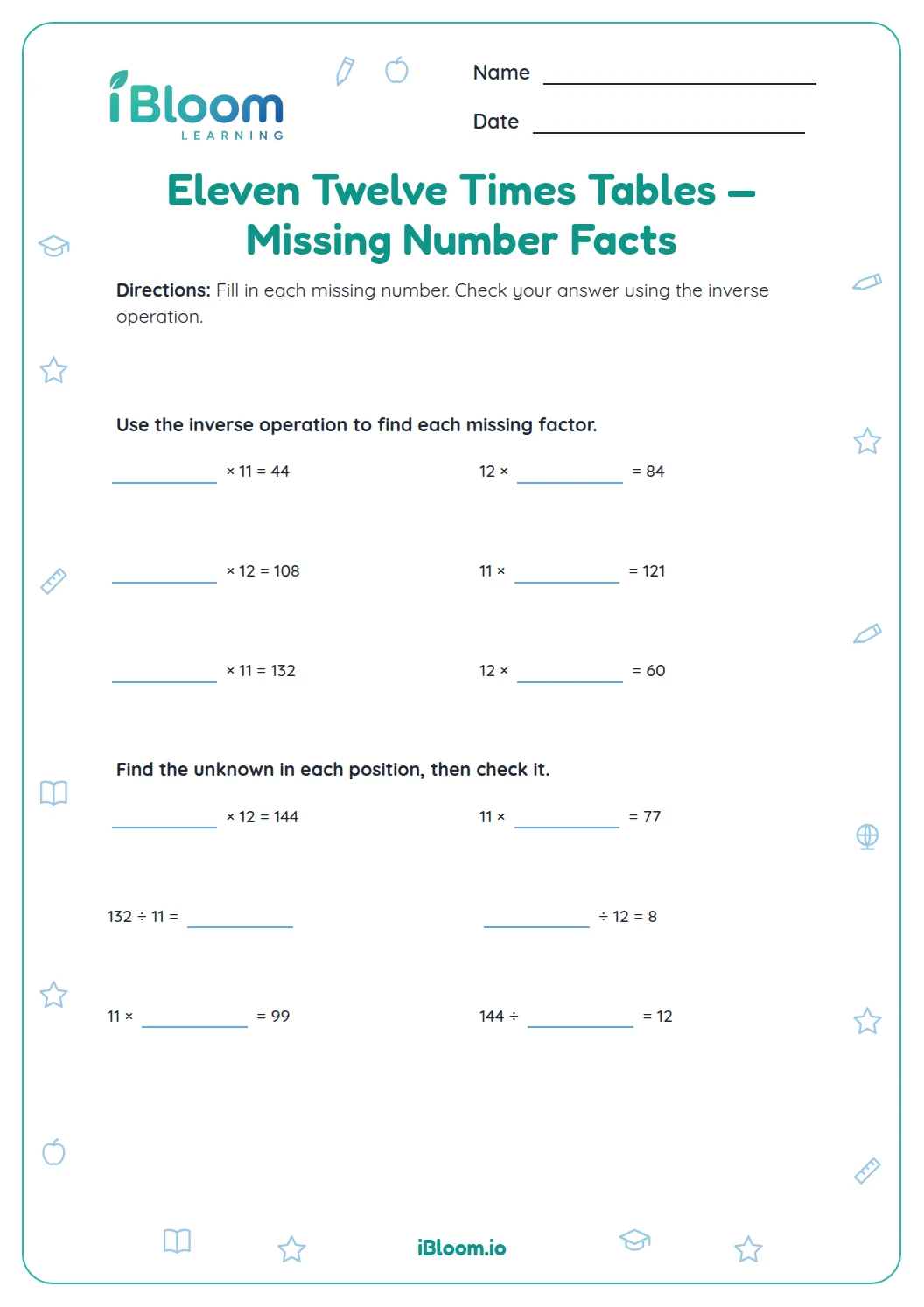
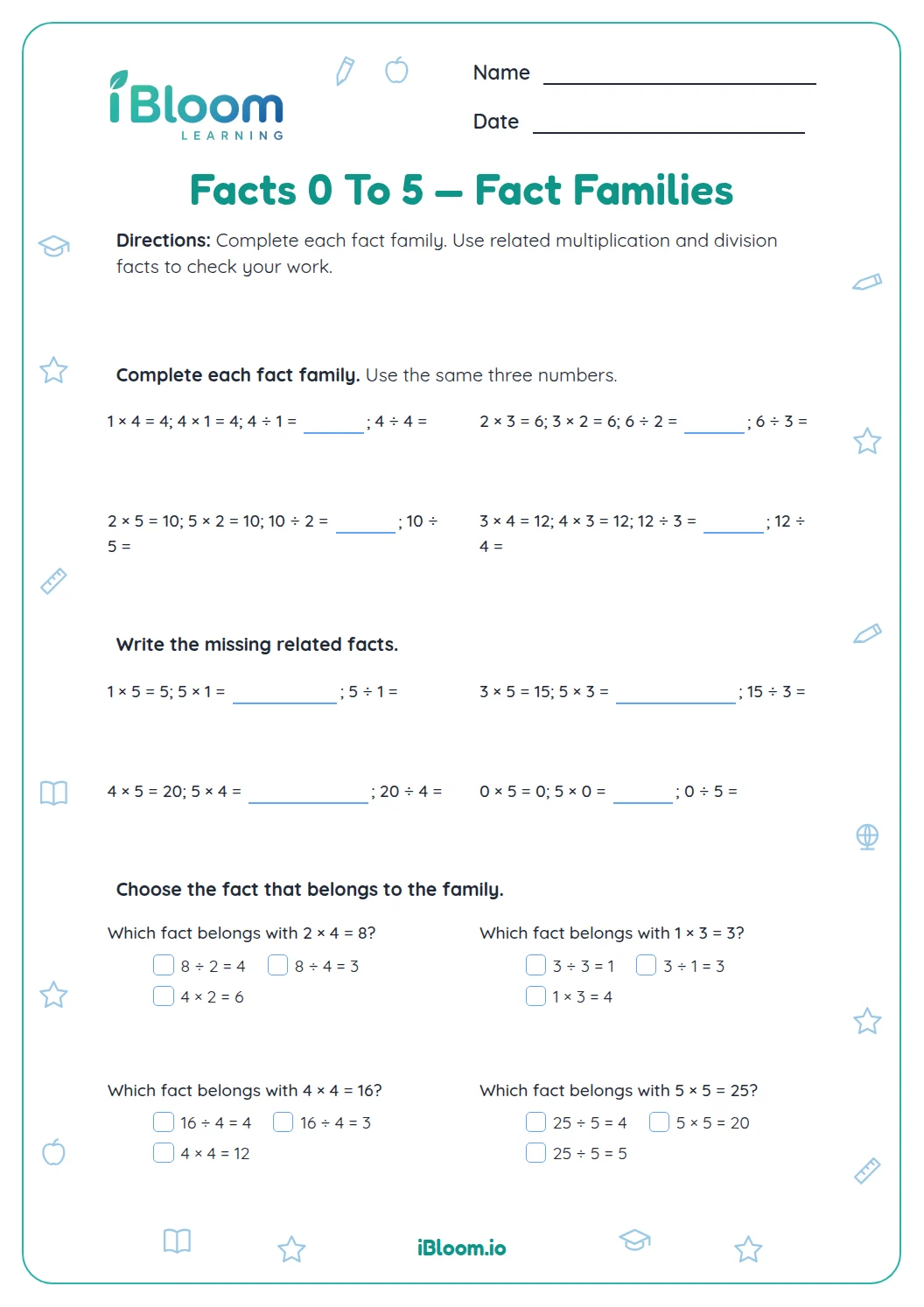
This Grade 3 worksheet practices multiplication facts from the 2 through 12 tables. Across 20 equations, students find missing factors and products, then check each blank with multiplication or a related division fact. Products stay within 100, and a separate answer key is included.
Aligned to 3.OA.C.7
How do you find a missing factor?
Read the full equation first: the blank may be a factor or the product. When a factor is missing, think of the related division fact. For 6 × ___ = 42, ask 42 ÷ 6.
A known fact can also help. If you know 5 × 8 = 40, then 6 × 8 is one more group of 8, or 48.
- 16 × ___ = 42
- 242 ÷ 6 = 7
- 3Check: 6 × 7 = 42
What changes across the questions?
Part A mixes missing factors and products. Part B continues the varied blanks, and Part C finishes with four more facts. Products remain within 100 throughout.
- Some blanks hide the first factor
- Some blanks hide the second factor
- Some blanks hide the product
Mental-math hints
Use doubles for facts such as 6 × 7 = 3 × 7 doubled. Use 10 groups plus 2 more groups for a ×12 fact. For any missing factor, divide the product by the known factor to check.
A quick fact strategy
- 1Read the full equation and locate the blank.
- 2Decide whether the missing value is a factor or product.
- 3For a factor, divide the product by the known factor.
- 4For a product, recall or build the multiplication fact.
- 5Multiply to check that both sides match.
Multiplication fact slips
The mistake
Filling a missing factor with the product.
The fix
Check whether the blank is before or after the equals sign, then estimate the size of a factor.
The mistake
Reading 8 × 12 as 8 + 12.
The fix
Say “8 groups of 12” and recall or build the multiplication fact.
The mistake
Using the wrong division partner when checking.
The fix
Divide the product by the factor that is already shown.
Common Core alignment
The focus is multiplication and related division facts with products at or below 100.
Fluently multiply and divide within 100.
On this sheet: Students recall products within 100 and use related division to find missing factors.
Show the official wordingHide the official wording
Fluently multiply and divide within 100, using strategies such as the relationship between multiplication and division (e.g., knowing that 8 × 5 = 40, one knows 40 ÷ 5 = 8) or properties of operations. By the end of Grade 3, know from memory all products of two one-digit numbers.
What to practice next
Make more practice
Further reading
Questions parents and teachers ask
Which times tables appear?
The missing factors and products use factors from 2 through 12. Products stay at or below 100, and the blank changes position so students must read each whole equation. Students can check the blank by substituting the value into the original fact.
Are all the blanks missing factors?
No. Some blanks are factors and others are products. For a missing factor, use the related division fact; for a missing product, recall or build the multiplication fact. Students can check the blank by substituting the value into the original fact.
How can a student check a missing factor?
Multiply the known factor by the value placed in the blank. For 6 × ___ = 66, the missing factor is 11 because 6 × 11 equals 66. Students can check the blank by substituting the value into the original fact.
What mental strategy can help with a times-12 fact?
Think of 12 groups as 10 groups plus 2 groups. For 7 × 12, calculate 7 × 10 and 7 × 2, then combine 70 and 14 to get 84. Students can check the blank by substituting the value into the original fact.
Is a timer needed?
No. Students can work for accuracy and use a strategy to check each answer. The separate answer key lists all 20 missing factors and products. Students can check the blank by substituting the value into the original fact. Students can check the blank by substituting the value into the original fact.