







About this worksheet
This Grade 2 reading worksheet replaces the old single-question sheet with an original paired informational passage about two school gardens. Part A checks key details; Part B asks learners to sort unique and shared details as if completing a Venn diagram; Part C builds written comparison and evidence skills. The separate key includes sample responses while allowing other answers supported by the text.
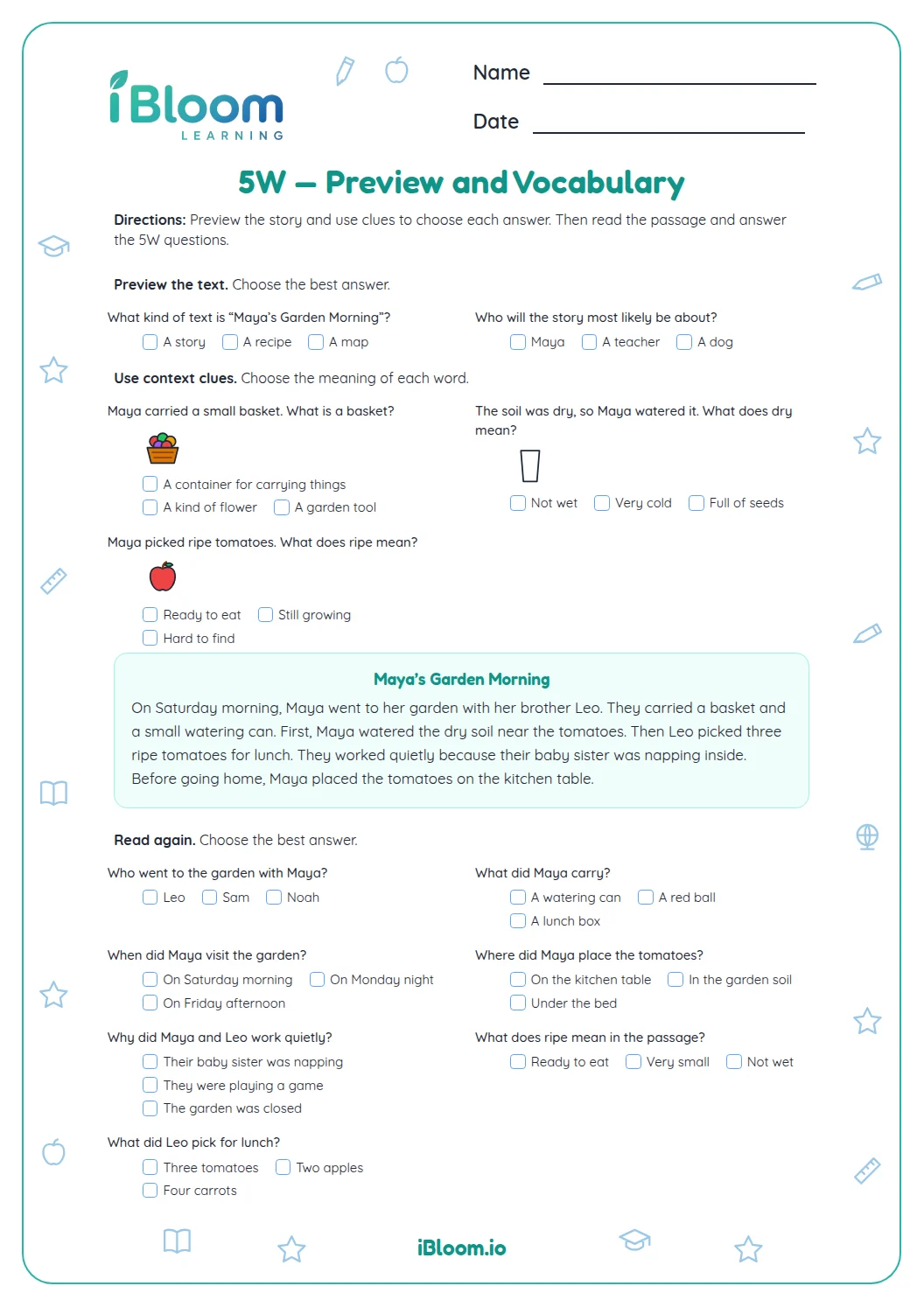
What details describe each garden?
The passage gives facts about where each garden grew, what was planted, and how each child cared for it. Part A helps readers locate those details before comparing.
- 1Find the sentence about Omar’s plants.
- 2It says he planted cherry tomatoes.
- 3Record “cherry tomatoes.”
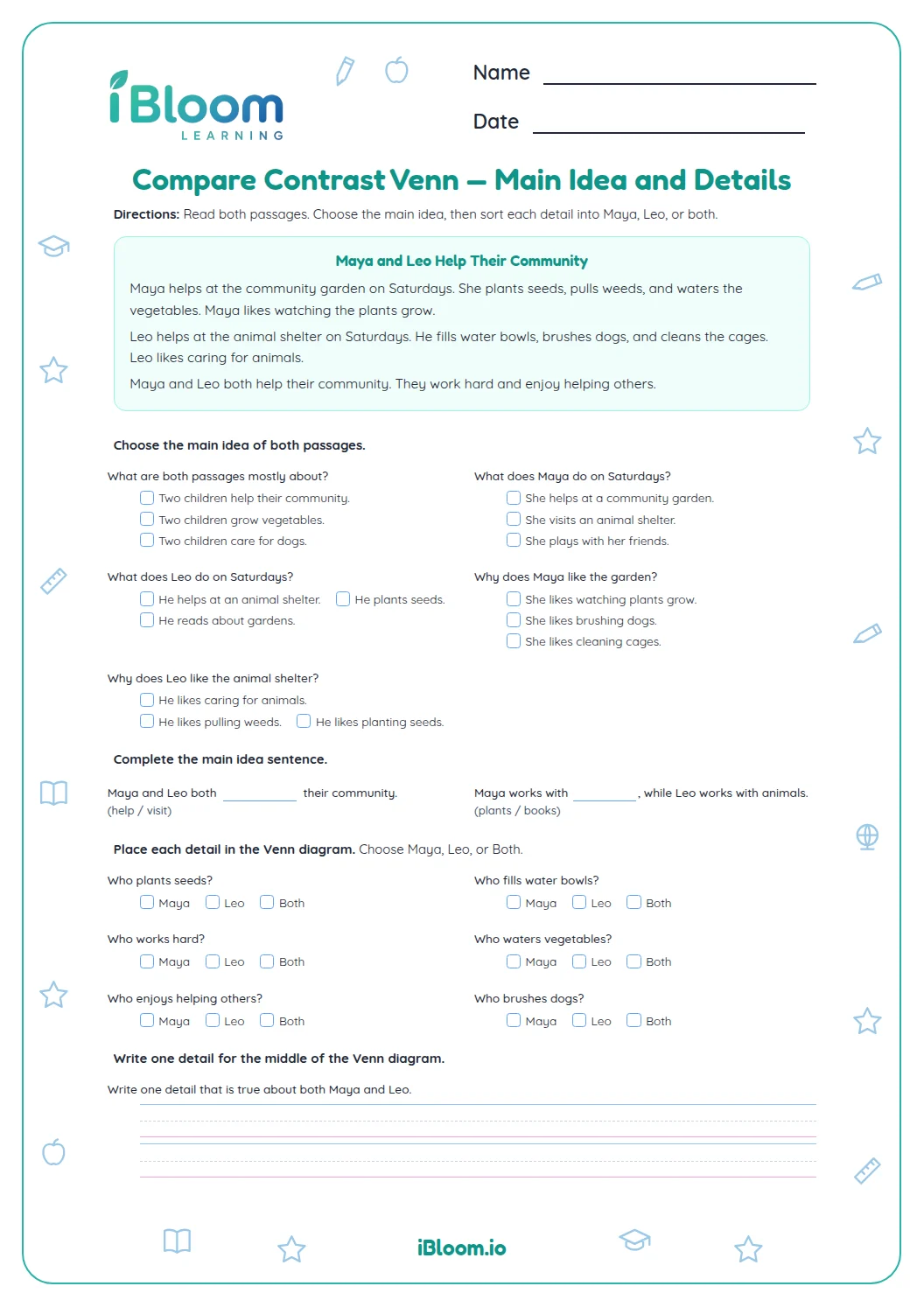
How do you sort details in a Venn diagram?
Put a fact about only Lena in Lena’s circle, and a fact about only Omar in Omar’s circle. Put a fact true about both in the overlapping middle. For example, Lena grew lettuce, Omar grew tomatoes, and both pulled weeds by hand.
How can a reader support a comparison?
Part C asks for complete thoughts and passage clues. A strong answer names a similarity or difference and points to the detail that shows it. In question 14, keeping journals is a similarity; growing different plants is a difference.
How to use this worksheet
- 1Read the passage once for the main topic: two children’s gardens.
- 2On Part A, return to the passage to find each fact.
- 3Sort details: Lena only, Omar only, or both.
- 4For Part C, answer in a sentence and use a detail from the passage.
- 5Check open responses against the sample key; accept accurate text-based answers.
Common mistakes and quick fixes
The mistake
Putting a detail about one child in the shared middle.
The fix
Ask whether the sentence is true about Lena, Omar, or both.
The mistake
Giving an opinion instead of a passage detail.
The fix
Point to the sentence that supports the answer and restate its fact.
The mistake
Listing a difference without naming both sides.
The fix
Use a comparison frame: “Lena ___, but Omar ___.”
What to practice next
Make more practice
Further reading
Questions parents and teachers ask
What does this worksheet practice?
This Grade 2 printable gives learners focused practice with read about lena and omar’s gardens, sort details into a venn diagram, and explain similarities and differences with text evidence. The answer key is included as a separate set of pages, so an adult can check each response after the child finishes.
How should we begin?
Read the one-line direction together and model the first item aloud. Point to each object or number as you say it, then let the learner try the next one independently before checking the key. The examples use familiar school and home situations, and a grown-up can read the directions aloud before independent work begins.
How long will it take?
Plan for about 15 to 20 minutes, with time to talk through any missed items. A younger learner can complete one part at a time and return to the next part after a short break. The examples use familiar school and home situations, and a grown-up can read the directions aloud before independent work begins.
Can I print just the practice pages?
Yes. The answer key follows the worksheet pages, so you can print the practice pages for the learner and keep the key nearby for checking. The pages are designed for ordinary home or classroom printing. The examples use familiar school and home situations, and a grown-up can read the directions aloud before independent work begins.
What if an answer is incorrect?
Ask the learner to explain how they decided, then point back to the model, picture, or passage clue. Let them try again before showing the answer. Correcting the reasoning helps the skill stick better than copying a number. The examples use familiar school and home situations, and a grown-up can read the directions aloud before independent work begins.
Is an answer key included?
Yes. A separate answer key gives the response to each numbered item. For open-ended written answers, the key provides an example; accept another response when it is supported by the worksheet text. The examples use familiar school and home situations, and a grown-up can read the directions aloud before independent work begins.