


About this worksheet
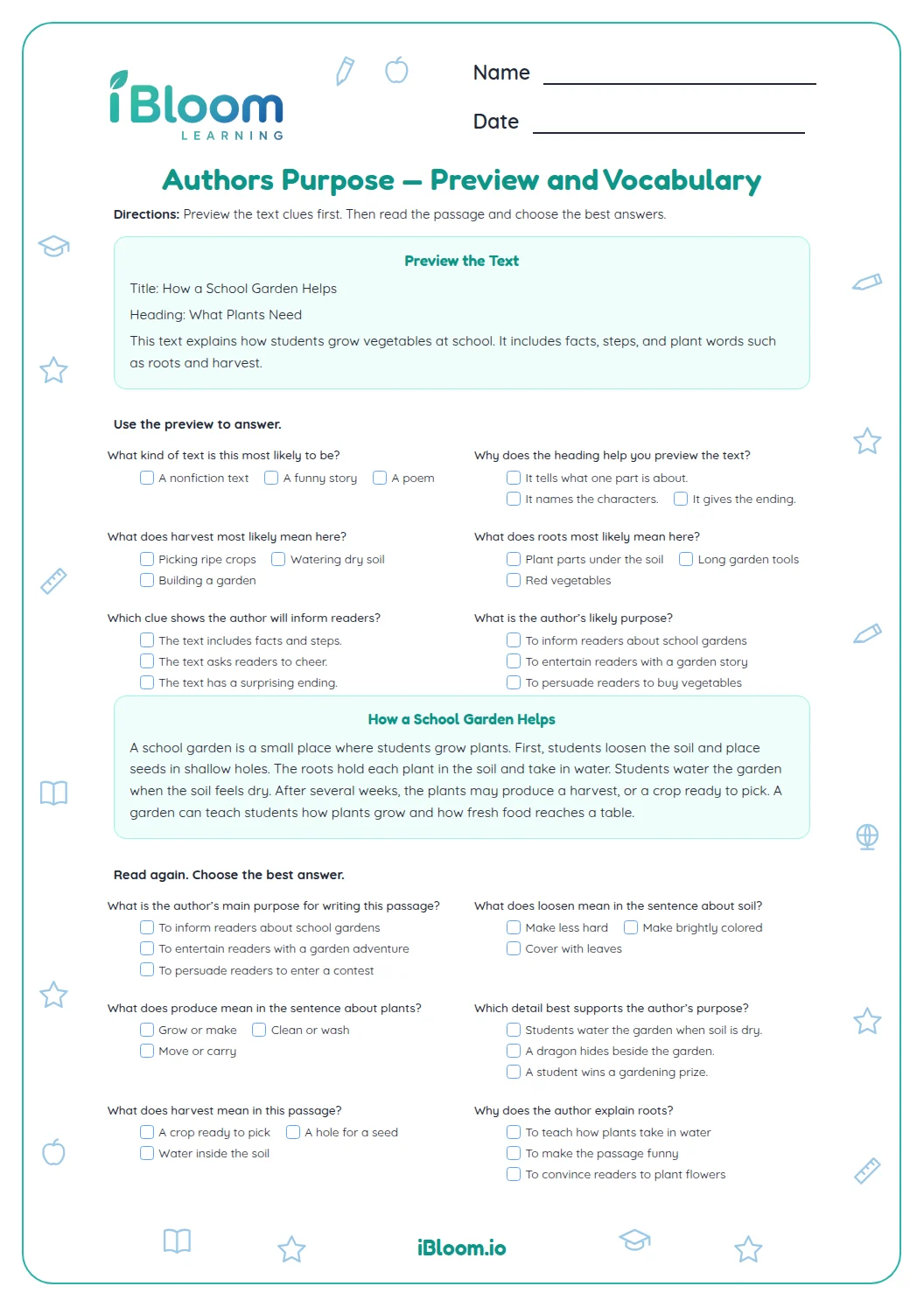
This Grade 3 printable uses a short persuasive passage about turning an empty school lot into a reading garden. Students identify the author’s goal, audience, opinion, request, and supporting details, then explain their thinking in complete responses. The questions ask students to state an author’s goal and support their thinking with direct evidence from the text. A separate answer key includes sample responses for open-ended items.
How can a reader tell why an author wrote?
Look at what the author wants readers to think or do. A persuasive writer often states an opinion, gives reasons, and asks readers to take action. This passage asks the principal to approve a reading garden.
- 1“Our school should turn the empty lot into a garden.”
- 2The word should signals an opinion.
- 3The request to ask the principal shows the writer wants change.
Which details support the author’s purpose?
A detail is useful when it explains a reason for the proposal. Benches and a book shelf support the idea that the garden would help readers. Students should connect each answer to a specific sentence.
What will students practice on the page?
Part A asks students to identify purpose, audience, opinion, and a direct request. Part B asks for evidence-based explanations, ending with a purpose statement supported by two passage details.
How to use this worksheet
- 1Read the passage once to understand the proposal.
- 2Reread and mark the author’s opinion and request.
- 3For each choice, check whether the passage actually says it.
- 4Use a passage detail when explaining an answer.
- 5Finish by stating the purpose and linking two details to it.
Common mistakes and fixes
The mistake
Naming the topic, such as gardens, instead of the reason for writing.
The fix
Ask what the author hopes readers will think or do.
The mistake
Choosing a detail as the purpose.
The fix
Turn the detail into a goal: the author uses it to persuade readers.
The mistake
Giving an opinion without text evidence.
The fix
Point to a sentence that supports the explanation.
What to practice next
Make more practice
Further reading
Questions parents and teachers ask
How do I explain an author’s purpose?
State the author’s goal and connect it to details in the passage. Here, the writer wants the school to approve a reading garden; the proposed benches, shade trees, and book shelf are reasons supporting that request. A strong answer names the goal rather than only the topic.
What passage do students read?
Students read “A Reading Garden for Our School,” a short proposal about changing an empty lot beside the library. It describes how students and families could use the space and ends with a request to ask the principal for approval. The passage is 130 words and includes a clear opinion, reasons, and a direct request.
How many questions are included?
The worksheet has 14 questions: eight multiple-choice items and six written responses. Students identify the audience, opinion, and request before explaining how details support the author’s purpose. The questions progress from identifying clues to explaining their connection. This mix lets students show understanding in both selected and constructed answers.
Does the answer key give sample responses?
Yes. The key gives answers to the choice questions and sample responses for the six open-ended items. Other responses are also reasonable when they accurately explain the passage and use relevant details as evidence. The sample answers are guides, not the only acceptable wording.
How long should this worksheet take?
Plan for about 20 to 25 minutes to read the passage, answer the questions, and write explanations. A student who needs more time can complete the multiple-choice questions first and return to the longer evidence responses afterward. The written items ask students to return to the passage for support.