


About this worksheet
This free Grade 3 printable uses an original story about Nia planting beans in a neighborhood garden. Children find where and when the story happens, identify details about weather and place, then explain how those details affect events and mood. Fourteen questions include multiple-choice, short-answer, and written-response practice, with a separate answer key. It practices CCSS RL.3.1 by asking readers to refer to story details when they answer.
Aligned to RL.3.1
Which details tell where and when a story happens?
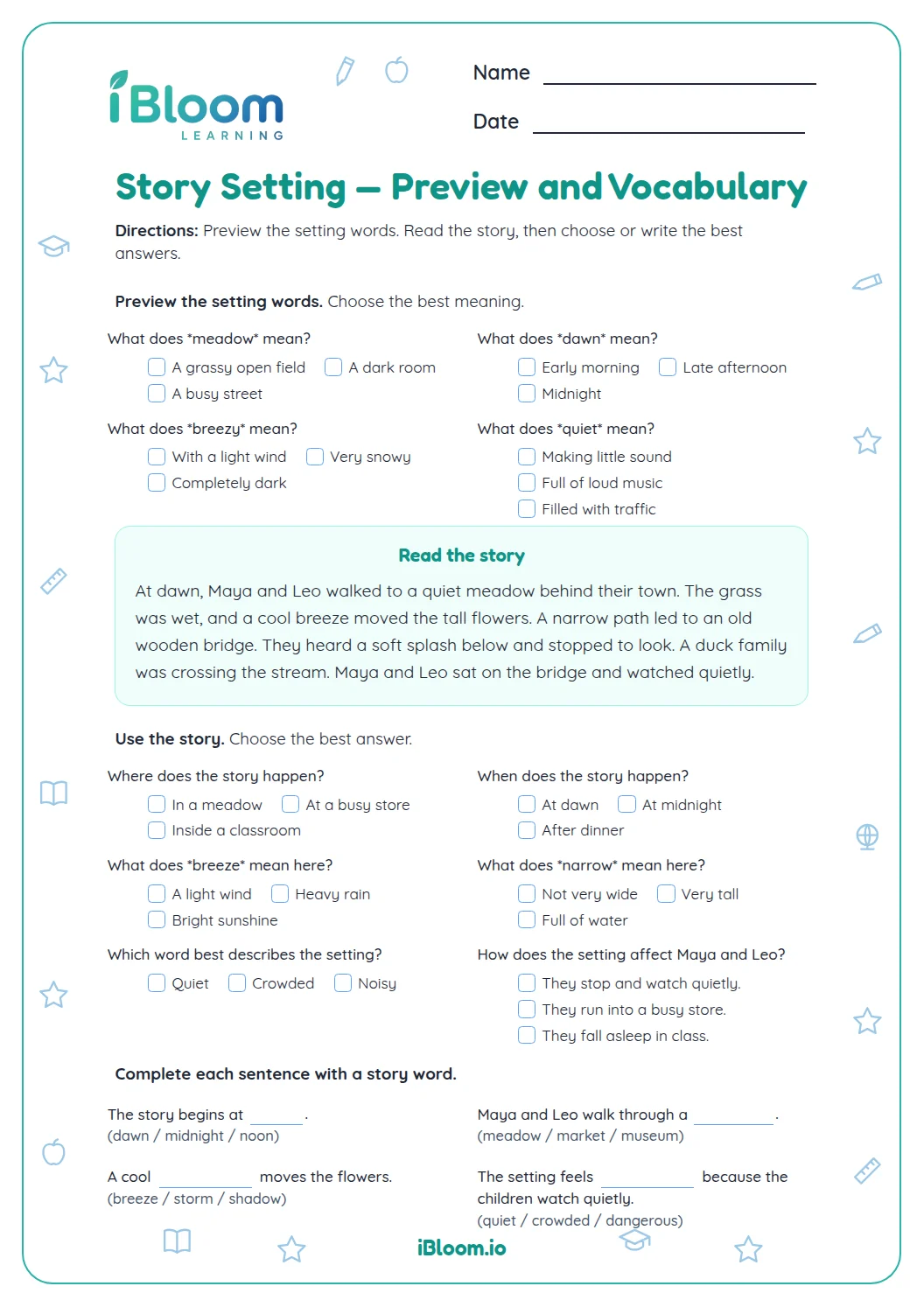
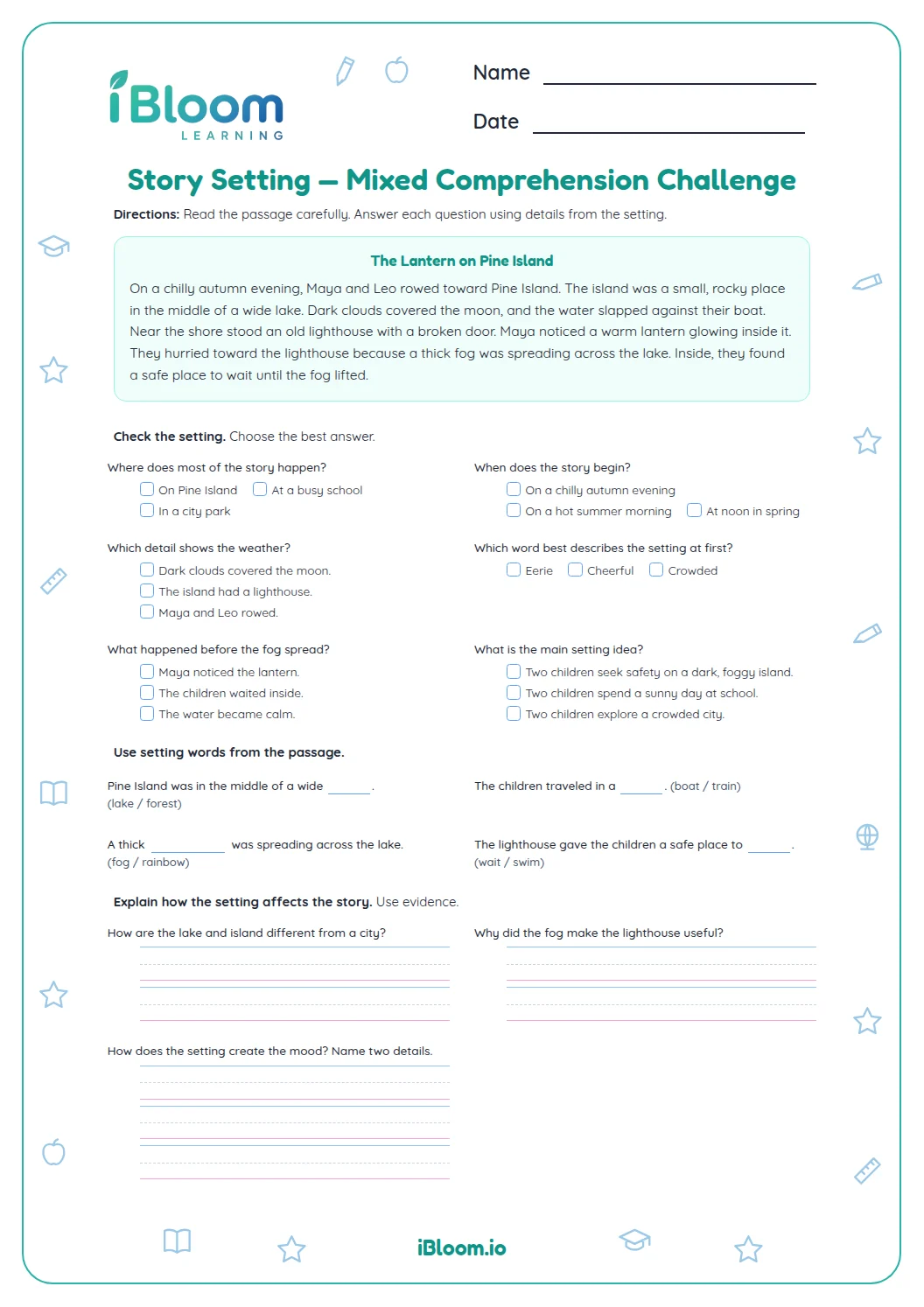
Setting includes the place and time of a story. Readers can look for direct clues, such as a city bus, a garden gate, or “Saturday morning.” Weather and nearby places can add more information.
On the sheet, question 1 asks where Nia arrives on Saturday morning, while question 2 asks when the story begins. Both answers come directly from the opening paragraph.
- 1Question: Where does Nia arrive on Saturday morning?
- 2Text clue: “the community garden’s blue gate”
- 3Answer: Nia arrives at the community garden.
How can setting change what a character does?
A setting detail can affect a plan. In Nia’s story, damp soil and soggy packets slow the planting. The nearby shed gives her a dry place to get help, and later sunlight makes the soil easier to work.
- Name the setting detail.
- Find the event connected to it.
- Explain the connection in a complete sentence.
How can a reader support a written response?
A strong response answers the question and points to a detail in the story. For example, sunlight reaches the beds at the end, which supports the idea that the ending feels hopeful. Children can use a short quote or paraphrase rather than retelling the whole passage.
How to use this worksheet at home or in class
- 1Read the story once to understand what Nia is trying to do.
- 2Underline one clue about place and one clue about time.
- 3Answer the setting questions with a specific word or phrase from the story.
- 4For Part B, connect a weather or place detail to an event.
- 5Use a complete sentence for questions that ask how or why.
- 6Check each written answer against the passage and answer key.
Common mistakes and quick fixes
The mistake
Naming the garden but not the neighborhood clues.
The fix
Include a second detail, such as the apartment buildings or passing bus.
The mistake
Retelling an event without explaining the setting’s effect.
The fix
Use a link word such as because, so, or when.
The mistake
Calling the mood “happy” without evidence.
The fix
Name the detail that creates the feeling, such as sunlight reaching the beds.
Common Core alignment
This worksheet asks readers to answer questions using details from a story.
Answer questions about a story and point to details that support each answer.
On this sheet: Questions ask children to use explicit details from the passage in short and written responses.
Show the official wordingHide the official wording
Ask and answer questions to demonstrate understanding of a text, referring explicitly to the text as the basis for the answers.
What to practice next
Make more practice
Further reading
Questions parents and teachers ask
What is setting in a story?
Setting is where and when a story takes place. In Nia’s story, the setting includes a neighborhood community garden on a cool Saturday morning. Details such as apartment buildings, a passing bus, damp soil, and clearing clouds help readers picture the place and time.
How many questions are on this worksheet?
There are 14 questions after the passage. The first six ask readers to find setting clues, and the next eight ask them to explain how those details affect events, feelings, or mood. Several questions ask for a complete sentence supported by the story.
What does the answer key include?
The separate answer key gives direct answers and sample responses for open-ended questions. Children may phrase a supported response differently, so compare the idea and its story evidence rather than requiring the sample wording exactly. Ask the child to point to the sentence that supports the answer, then reread the relevant detail together.
What should a written response include?
A written response should answer the question and include a setting detail from the passage. For example, to explain why Nia can plant at the end, a child might mention that the clouds open and sunlight dries the soil. One or two clear sentences are enough.
Can this worksheet be used for a small reading group?
Yes. Read the passage together, then ask each child to mark one clue about place and one about time. Children can answer the first questions independently and discuss the later questions by pointing to the sentence that supports each idea.