





About this worksheet
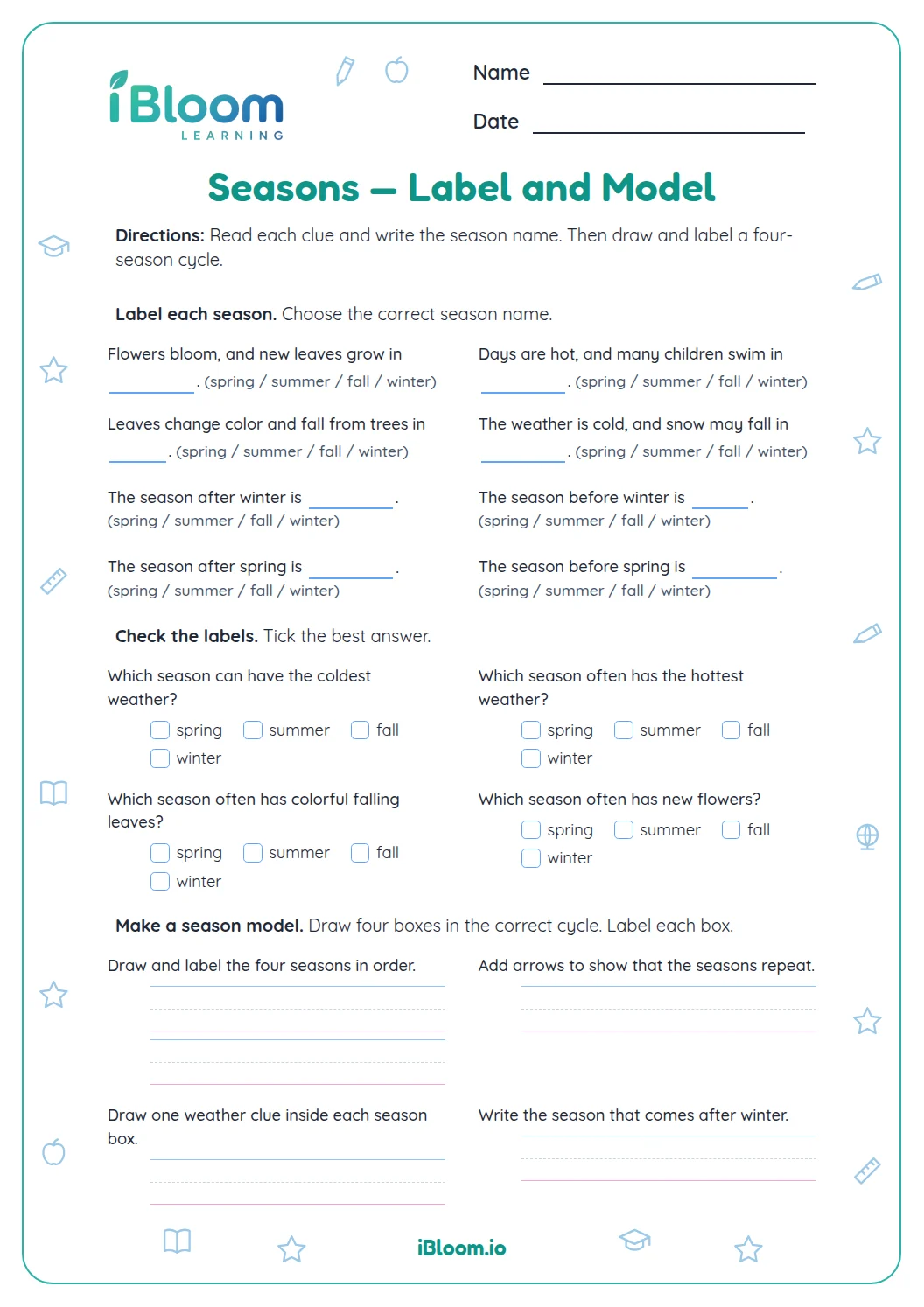
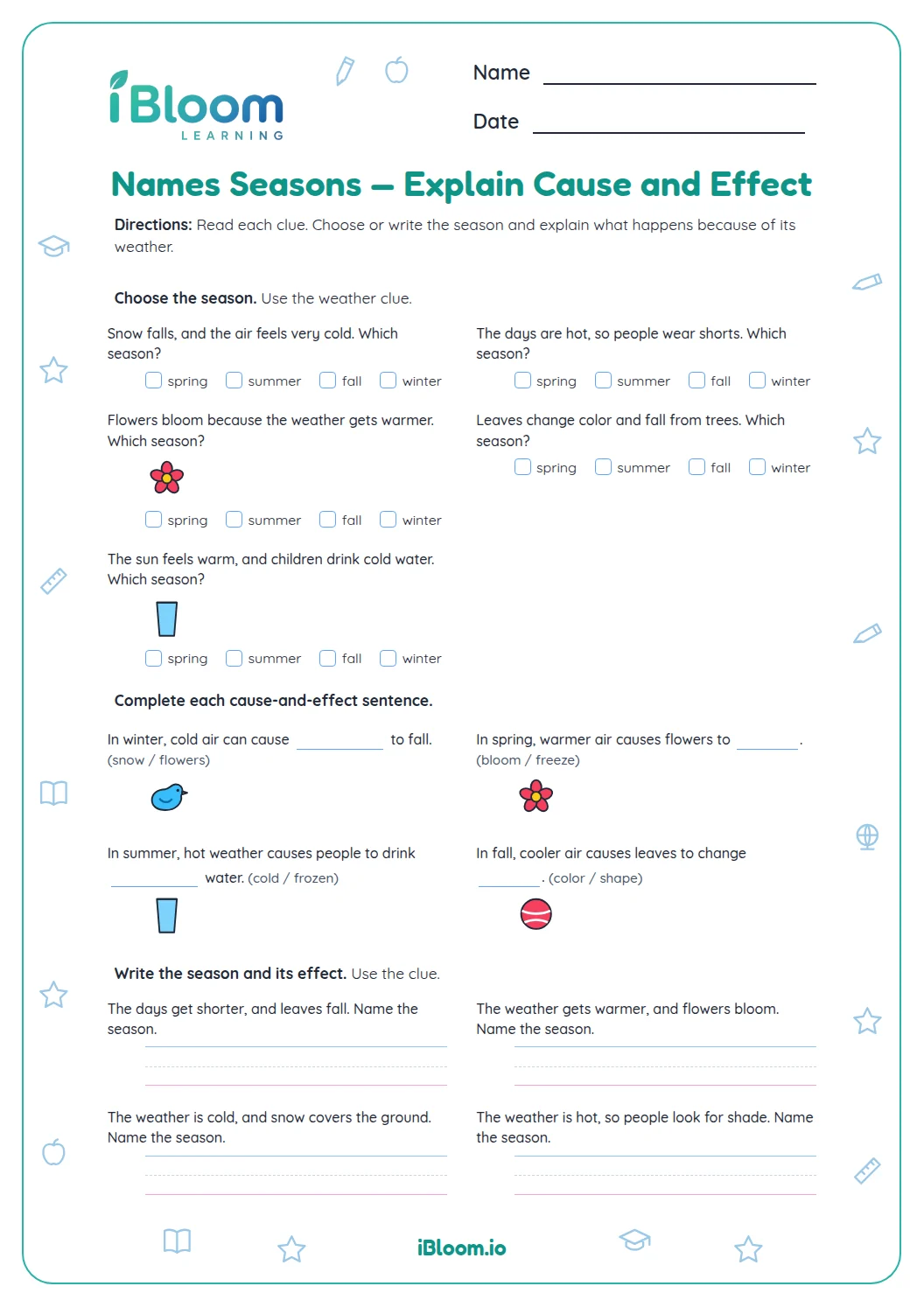
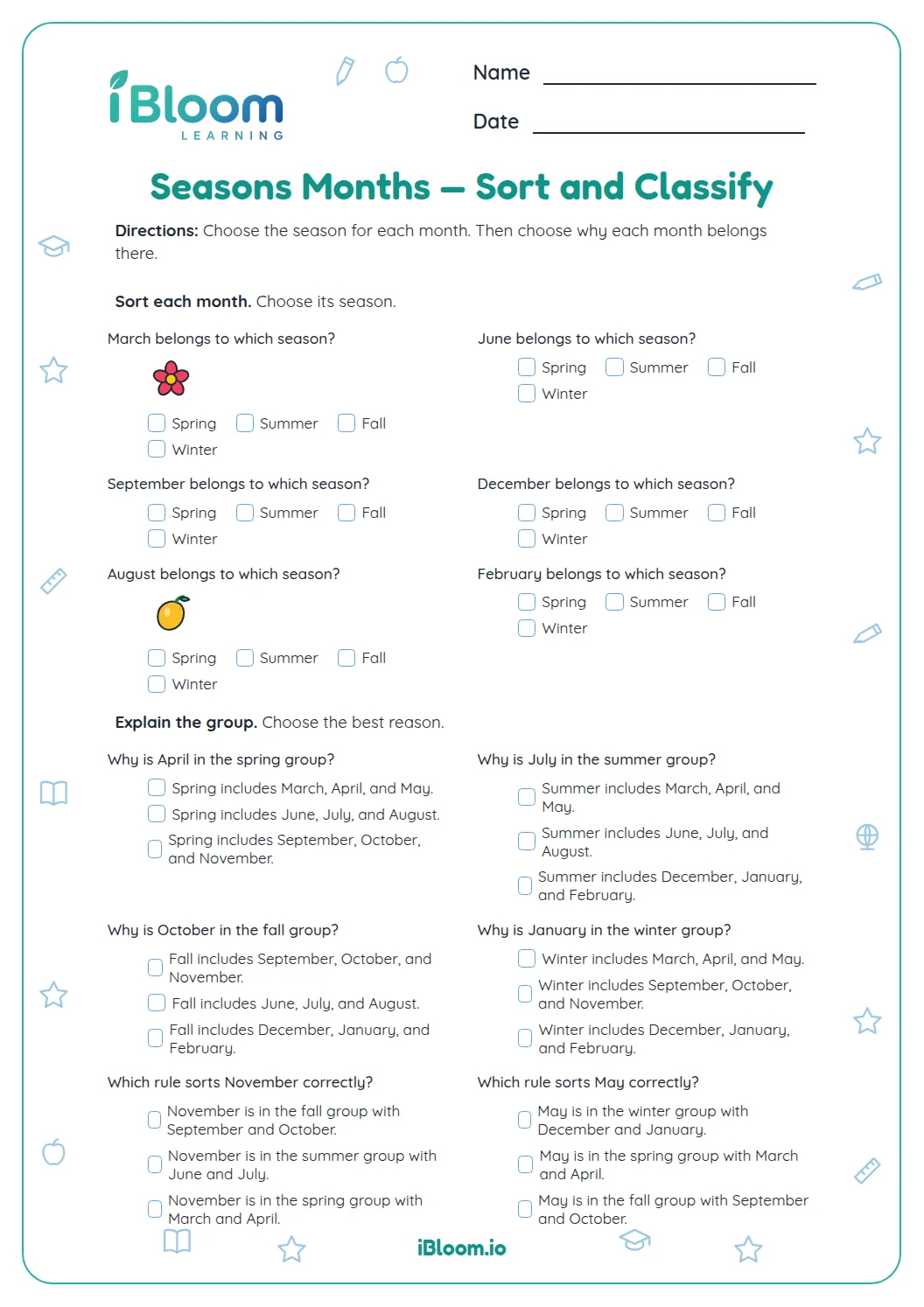
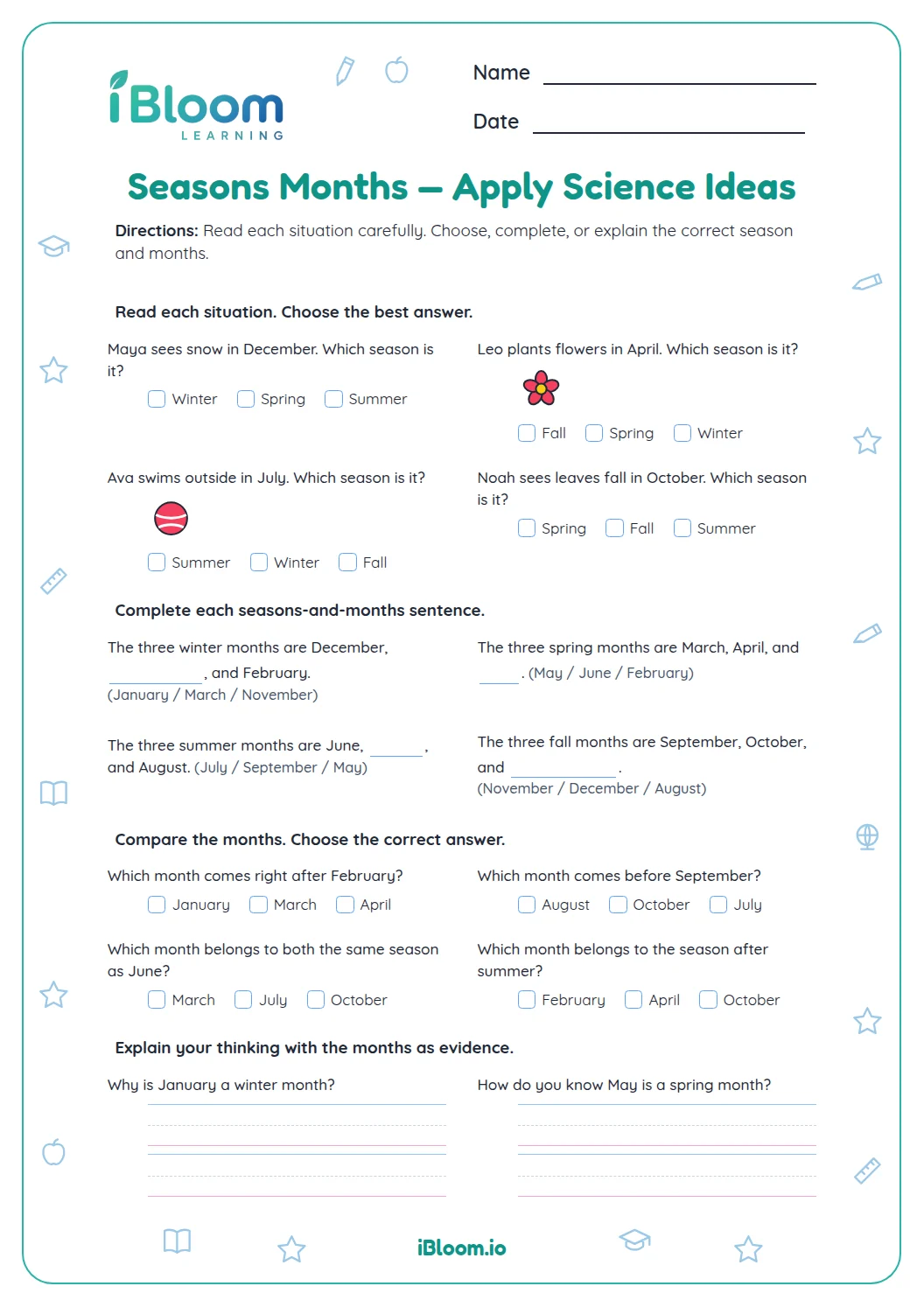
This Grade 1 science worksheet offers 16 questions about seasonal patterns, including weather, clothing, changing leaves, and the amount of daylight. Children use observations to identify likely seasons and explain a clue. The page connects to NGSS 1-ESS1-2, which asks students to relate daylight observations across the year to the time of year. A separate answer key supports review.
Aligned to 1-ESS1-2
What changes from season to season?
Weather, plant changes, and daylight can provide clues about the time of year. In many places, winter days are shorter than summer days; leaves may change and fall in autumn; and new growth often appears in spring. Local patterns can vary, so children should focus on observations in each question.
How can an observation support a season answer?
A season clue is strongest when it comes from something a student can observe. Weather, changing leaves, and the time the Sun rises and sets can be recorded and compared. Daylight lasts longer in summer than winter in many places, while local weather can vary.
- 1Clue: It gets dark earlier than in summer.
- 2Compare daylight across the year.
- 3Earlier sunsets can be a fall clue.
- 4Answer: fall
How does daylight help us compare seasons?
Children can notice when the Sun rises and sets at different times of year. Comparing those observations helps connect daylight length with seasons. The questions ask children to use this pattern alongside weather and plant clues, rather than treating one kind of weather as proof everywhere.
How to use this worksheet
- 1Read the whole question and underline the observation clue.
- 2Decide whether it describes weather, plants, clothing, or daylight.
- 3Compare that clue with familiar seasonal patterns.
- 4For written answers, name the season or give one clear observation.
- 5Use the answer key to discuss more than one reasonable observation.
Common mistakes and quick fixes
The mistake
Using a favorite season as evidence.
The fix
Point to an observable clue in the question, such as leaves falling or a shorter day.
The mistake
Assuming every place has the same weather.
The fix
Use the specific clue in the prompt and remember local weather can vary.
The mistake
Mixing up a weather event and a season.
The fix
A rainy day is weather; use several clues or the daylight pattern to infer a season.
Curriculum alignment
The NGSS performance expectation below connects yearlong daylight observations with seasons.
Connect observations of daylight with the time of year.
On this sheet: Children compare daylight and seasonal observations across the year.
Show the official wordingHide the official wording
Make observations at different times of year to relate the amount of daylight to the time of year.
What to practice next
Make more practice
Further reading
Questions parents and teachers ask
Does every place have snowy winters?
No. Winter weather differs from place to place. The questions use clues such as shorter daylight, cold weather, or snow, but children can also discuss what they observe where they live. Focus on the pattern the prompt names, and avoid treating one weather event as universal.
What does daylight have to do with seasons?
The amount of daylight changes across the year. Observing sunrise and sunset at different times helps children notice that summer days are often longer than winter days. The worksheet includes questions about comparing daylight as one kind of seasonal evidence.
Can more than one clue point to the same season?
Yes. Cooler air and falling leaves can both point toward fall, while longer days and warm weather can point toward summer. Ask your child to name the exact clue used in an answer so you can see how the reasoning works.
How should I help with the written responses?
Invite your child to name a season or give one observable clue, then ask what makes that clue useful. For example, a response might say that summer days are longer than winter days. The answer key includes sample wording for the open response.
Is an answer key included?
Yes. A separate key gives answers for all 16 questions, including a sample response for the open-ended item. Some written observations can vary, so accept another clear, accurate observation that supports the same seasonal idea. Ask your child to explain the clue or step used, then check the matching item in the key.