Free printable practice
Water Cycle Practice Activities
Printable Grade 2 water cycle activities help children label, sequence, and explain evaporation, condensation, precipitation, and collection.
Free printable worksheet PDFs
Preview every available page, then download the free worksheet PDF for home, homeschool, tutoring, or classroom practice.
Preview the exact activity before downloading it.
 Water Cycle — Sort and ClassifyPrintable Grade 2 water cycle activities help children label, sequence, and explain evaporation, condensation, precipitation, and collection. This sort and classify worksheet provides a distinct, age-appropriate way to practise the same lesson.Grade 2Free PDF preview
 Water Cycle — Label and ModelPrintable Grade 2 water cycle activities help children label, sequence, and explain evaporation, condensation, precipitation, and collection. This label and model worksheet provides a distinct, age-appropriate way to practise the same lesson.Grade 2Free PDF preview
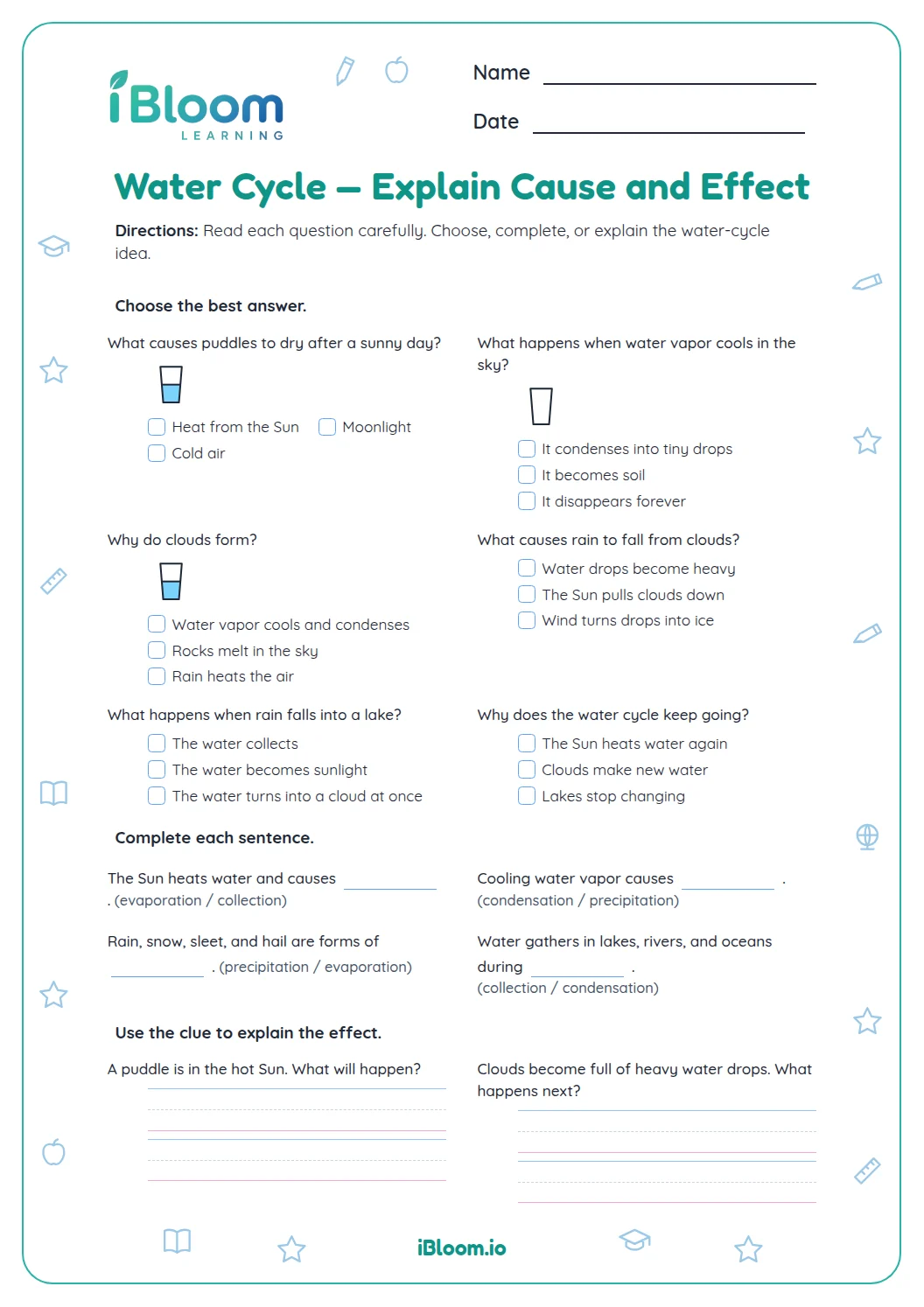 Water Cycle — Explain Cause and EffectPrintable Grade 2 water cycle activities help children label, sequence, and explain evaporation, condensation, precipitation, and collection. This explain cause and effect worksheet provides a distinct, age-appropriate way to practise the same lesson.Grade 2Free PDF preview
 Water Cycle — Apply Science IdeasPrintable Grade 2 water cycle activities help children label, sequence, and explain evaporation, condensation, precipitation, and collection. This apply science ideas worksheet provides a distinct, age-appropriate way to practise the same lesson.Grade 2Free PDF preview
 Water Cycle — Science Reasoning ReviewPrintable Grade 2 water cycle activities help children label, sequence, and explain evaporation, condensation, precipitation, and collection. This science reasoning review worksheet provides a distinct, age-appropriate way to practise the same lesson.Grade 2Free PDF preview
Practice that builds confidence
What the water cycle includes
These Grade 2 Earth Science water cycle worksheets help children understand how water moves between land, bodies of water, and the sky. Students practise key vocabulary such as evaporation, condensation, precipitation, and collection while connecting each word to a real part of the cycle.
The printable activities include labelled diagrams, sequencing tasks, matching exercises, short explanations, and picture-based questions. Children learn to follow arrows, describe changes in water, and explain the cycle in simple scientific language.
Grade 2 learners are ready to see the water cycle as a repeating pattern, not a one-time event. The worksheets build from observing familiar weather and puddles to naming the main processes: the sun warms water, water vapor rises, clouds form, rain or snow falls, and water gathers again in oceans, lakes, rivers, or soil.

How the practice progresses
Children begin with picture clues and simple labels, then move to ordering steps and completing short sentences. Diagrams with arrows help them see direction and cause: heat leads to evaporation, cooling leads to condensation, and heavy clouds can lead to precipitation. Some pages ask students to use vocabulary in context instead of only memorizing definitions.
A simple parent routine
At home, start by looking out a window or discussing the day’s weather. Ask, “Where could this water go next?” Then complete one worksheet section together, reading each science word aloud. Afterward, have your child draw a tiny water drop and tell its journey from a lake to a cloud and back to the ground.

Classroom uses for teachers
Teachers can use these printables during a Grade 2 Earth Science unit, in science centers, for vocabulary review, or as a follow-up to a classroom demonstration with a cup of water, sunlight, or a cloudy-day observation. The mix of diagrams, matching, and written responses supports whole-group lessons, partner talk, and independent notebook work.

Common errors to watch for
Many children think clouds are made of smoke or that evaporation only happens when water boils. Others may confuse condensation and precipitation, or leave out the collection stage. Encourage students to point to evidence in the picture: rising arrows, cloud droplets, falling rain, and water collecting on the ground.
Free printable PDF download
Use this grade 2 water cycle worksheet page to preview the activity, print it, or download it as a PDF for quick practice. It works well for homework, homeschool lessons, tutoring, morning work, revision, and classroom centers.
Answers and answer key support
After the child completes the worksheet independently, parents and teachers can use the answer support or answer key information to check the work, review mistakes, and choose the next practice step.
Why iBloom worksheets help
These activities give children repeated chances to connect words, images, and explanations. A child-friendly strategy is to say: “Heat up, rise up, cloud up, fall down, gather again.” This rhythm helps students remember the cycle while still using accurate science vocabulary.
Helpful answers
Frequently asked questions
What water cycle words should a Grade 2 student know?
Most Grade 2 learners should become comfortable with evaporation, condensation, precipitation, and collection. They should also understand words such as water vapor, clouds, rain, lake, river, ocean, and cycle.
How do these worksheets help children understand evaporation?
The activities connect evaporation to heat from the sun and show water changing into water vapor and rising. Picture arrows and sentence prompts help children explain that evaporation can happen from puddles, lakes, rivers, and oceans.
Can these water cycle pages be used without a science experiment?
Yes. The diagrams, matching tasks, and sequencing questions can stand alone. A quick weather discussion or a look at puddles, clouds, or rain outside can make the worksheet practice even more meaningful.
What is a common mistake children make with the water cycle?
Children often mix up condensation and precipitation. A helpful reminder is that condensation forms clouds from tiny water droplets, while precipitation is water falling from clouds as rain, snow, sleet, or hail.
Are these worksheets suitable for science centers?
Yes. Teachers can place the pages in a science center with crayons, vocabulary cards, or a simple water cycle diagram. Students can label parts, order steps, and explain the journey of a water drop.
Is this grade 2 water cycle worksheet free?
Yes. You can preview it for free and use the printable worksheet for home or classroom practice.
Can I download this grade 2 water cycle worksheet as a PDF?
Yes. Use the worksheet download option to save a printable PDF, or print the worksheet directly from the page.
Does this grade 2 water cycle worksheet include answers or an answer key?
When the activity has fixed answers, iBloom includes answer support so parents and teachers can check the completed worksheet.