Free printable practice
Earths Surface Practice Activities
Printable Grade 2 earth science worksheets help children identify land, water, landforms, and changes on Earth’s surface.
Free printable worksheet PDFs
Preview every available page, then download the free worksheet PDF for home, homeschool, tutoring, or classroom practice.
Preview the exact activity before downloading it.
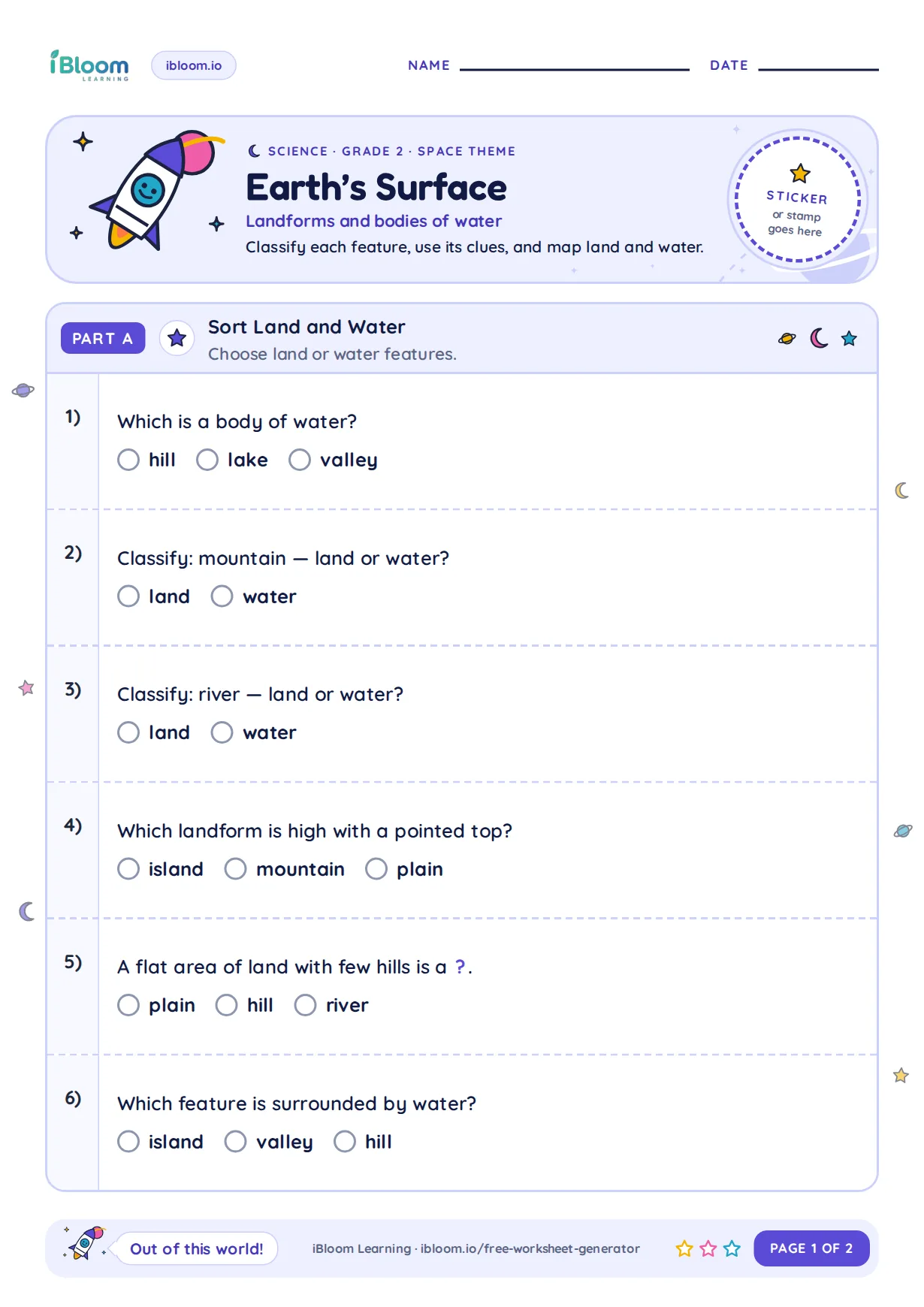 Earths Surface — Sort and ClassifyPrintable Grade 2 earth science worksheets help children identify land, water, landforms, and changes on Earth’s surface. This sort and classify worksheet provides a distinct, age-appropriate way to practise the same lesson.Grade 2Free PDF preview6 pages
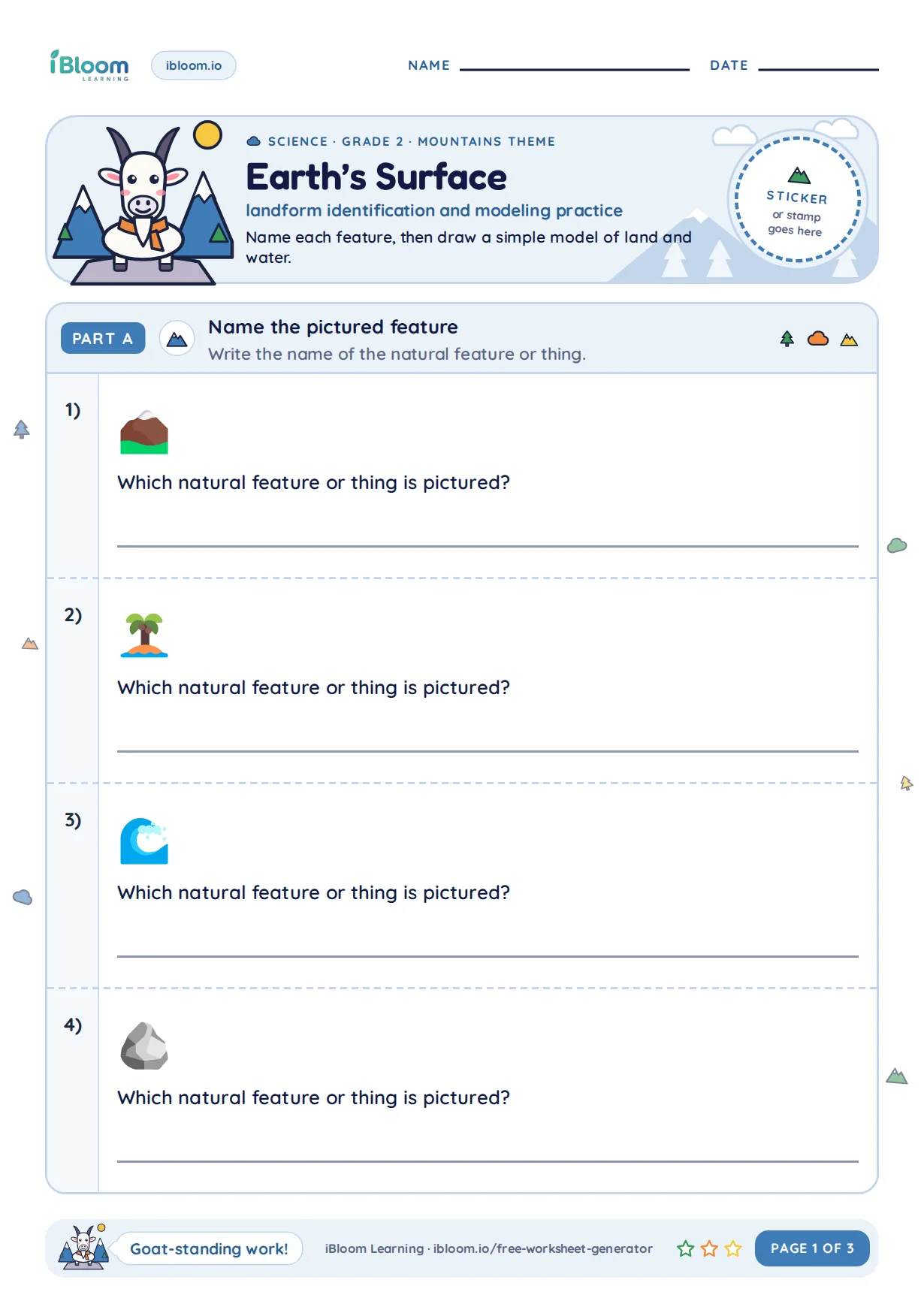 Earths Surface — Label and ModelPrintable Grade 2 earth science worksheets help children identify land, water, landforms, and changes on Earth’s surface. This label and model worksheet provides a distinct, age-appropriate way to practise the same lesson.Grade 2Free PDF preview
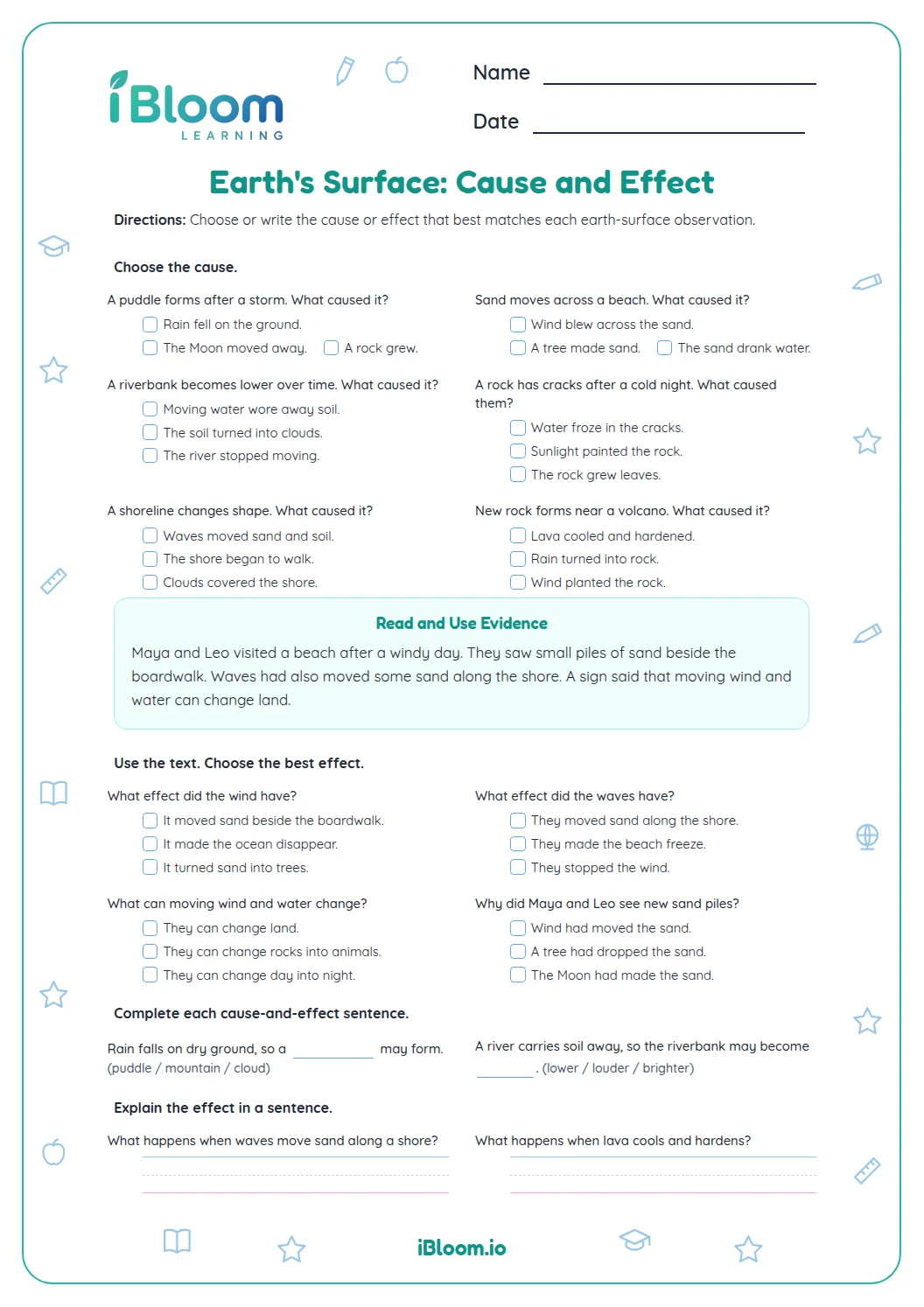 Earths Surface — Explain Cause and EffectPrintable Grade 2 earth science worksheets help children identify land, water, landforms, and changes on Earth’s surface. This explain cause and effect worksheet provides a distinct, age-appropriate way to practise the same lesson.Grade 2Free PDF preview
 Earths Surface — Apply Science IdeasPrintable Grade 2 earth science worksheets help children identify land, water, landforms, and changes on Earth’s surface. This apply science ideas worksheet provides a distinct, age-appropriate way to practise the same lesson.Grade 2Free PDF preview
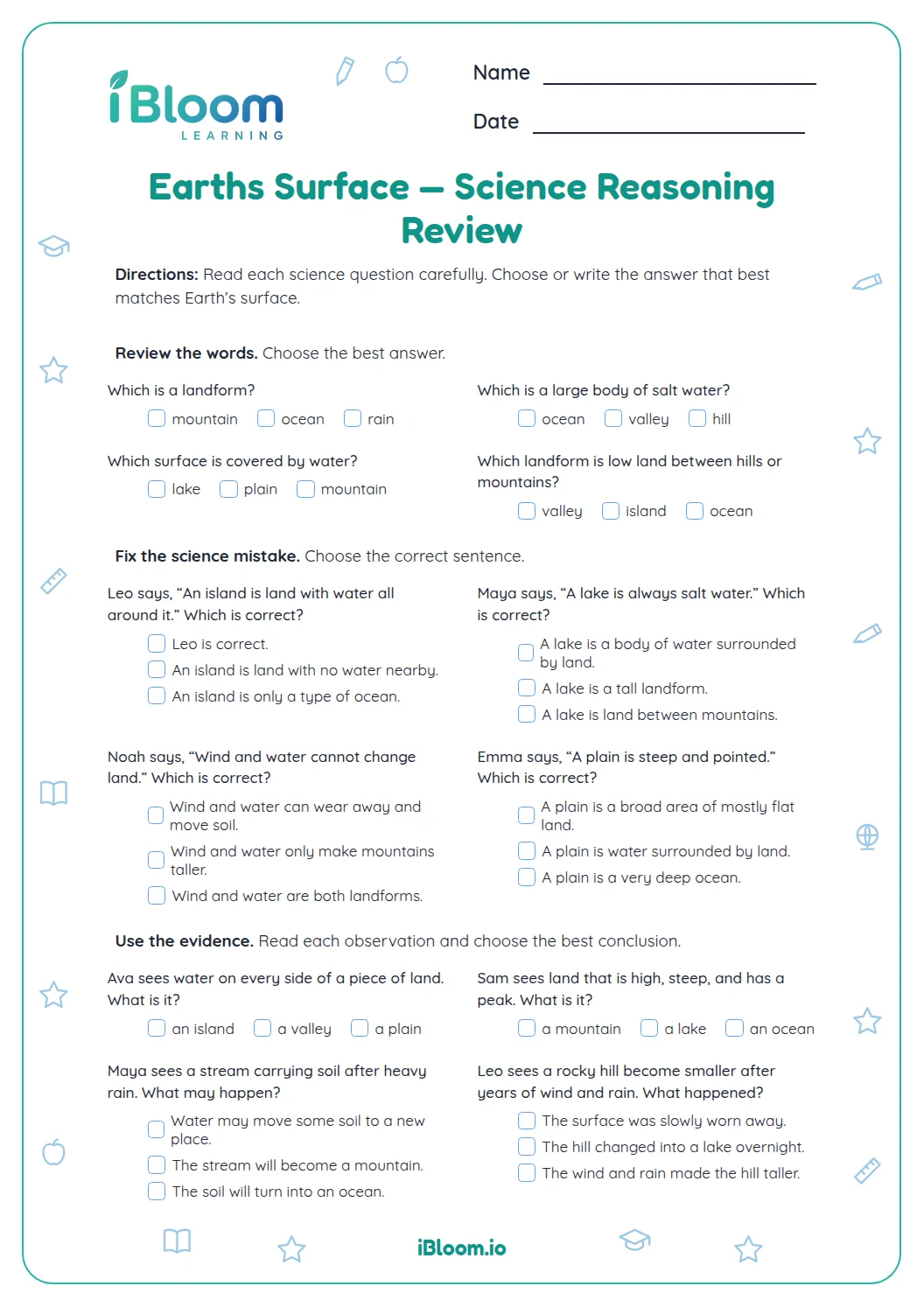 Earths Surface — Science Reasoning ReviewPrintable Grade 2 earth science worksheets help children identify land, water, landforms, and changes on Earth’s surface. This science reasoning review worksheet provides a distinct, age-appropriate way to practise the same lesson.Grade 2Free PDF preview
Practice that builds confidence
What children learn about Earth’s surface
These Grade 2 Earth’s surface worksheets help children observe and describe the land and water features that make up our planet. Students practise using science words such as landform, mountain, valley, plain, hill, river, lake, ocean, and coast while noticing how Earth’s surface can look different from place to place.
The printable activities include clear pictures, labeling tasks, matching exercises, sorting questions, and short written responses. Children build confidence by connecting real-world examples to simple diagrams and by explaining what they see in complete, age-appropriate sentences.
Second graders begin by recognizing that Earth’s surface is made of land and water. These worksheets guide them to compare common landforms and bodies of water, describe visible features, and use correct vocabulary. A child may identify a mountain as high land, a valley as low land between higher areas, or a river as moving water that flows across land.

Building from pictures to explanations
The practice moves from direct visual recognition to simple reasoning. Students may label a scene, match a word to a feature, sort land and water examples, or answer a short question such as why a coast has both land and ocean. This progression helps children move beyond naming objects and toward describing patterns on Earth’s surface.
Parent routine for at-home practice
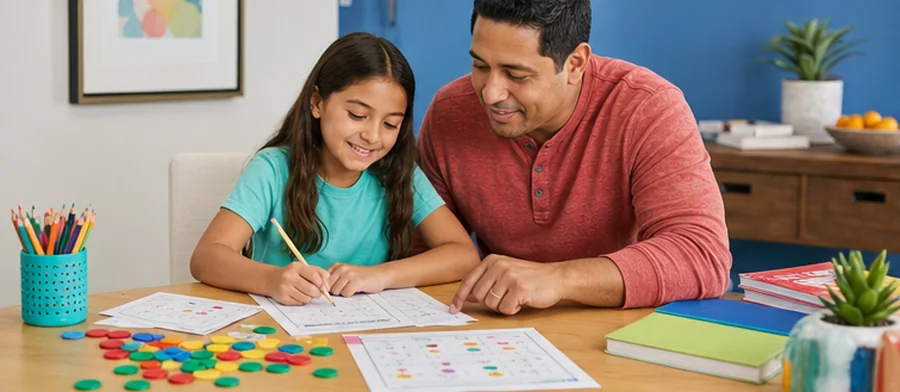
Choose one worksheet and read the directions together. Ask your child to point to each feature before writing an answer: “Show me the hill. Now show me the river.” After the page, look out a window, use a family photo, or open a simple map and ask, “What land or water features can we find?” Keep the focus on observation, not memorizing long definitions.
Classroom uses for teachers
Teachers can use these printables for an Earth science mini-lesson, science centers, early finisher work, or a quick check after discussing landforms and water features. Picture-based pages are useful for partner talk, while short-response items help students practise explaining science ideas with evidence from an image.

Common errors to watch for
Children may confuse hills and mountains, lakes and oceans, or rivers and lakes. Some may call every raised landform a mountain or every body of water a river. Encourage them to compare features: Is the water moving or still? Is it surrounded by land? Is the land very high or gently raised?
Free printable PDF download
Use this grade 2 earth's surface worksheet page to preview the activity, print it, or download it as a PDF for quick practice. It works well for homework, homeschool lessons, tutoring, morning work, revision, and classroom centers.
Answers and answer key support
After the child completes the worksheet independently, parents and teachers can use the answer support or answer key information to check the work, review mistakes, and choose the next practice step.
Why iBloom worksheets help
Each worksheet keeps the science focus clear and age-appropriate, with uncluttered visuals and varied question types. A helpful child-friendly strategy is: look closely, name the feature, then tell one thing about it. This simple routine supports careful observation and stronger science vocabulary.
Helpful answers
Frequently asked questions
What does Earth’s surface mean for Grade 2 students?
At this level, Earth’s surface means the land and water found on our planet, including features such as hills, mountains, valleys, plains, rivers, lakes, oceans, and coasts.
Do these worksheets focus more on landforms or bodies of water?
They include both. Children practise identifying landforms as well as water features, then compare how they look and where they may appear in a scene or simple diagram.
How can I help my child if they mix up rivers and lakes?
Ask whether the water looks like it is flowing across the land or sitting in one place. A river flows, while a lake is usually a still body of water surrounded by land.
Can these pages be used without a science textbook?
Yes. The worksheets use familiar pictures and simple language, so they can support a lesson, review a topic already introduced, or provide extra practice at home.
What writing skills are included in the activities?
Children may label pictures, write short answers, and describe one visible feature. The writing is designed to support science vocabulary rather than lengthy composition.
Is this grade 2 earth's surface worksheet free?
Yes. You can preview it for free and use the printable worksheet for home or classroom practice.
Can I download this grade 2 earth's surface worksheet as a PDF?
Yes. Use the worksheet download option to save a printable PDF, or print the worksheet directly from the page.
Does this grade 2 earth's surface worksheet include answers or an answer key?
When the activity has fixed answers, iBloom includes answer support so parents and teachers can check the completed worksheet.