Free printable practice
Weathering Erosion Practice Activities
Grade 2 science worksheets help children observe how weathering breaks rocks apart and erosion moves soil, sand, and rock from place to place.
Free printable worksheet PDFs
Preview every available page, then download the free worksheet PDF for home, homeschool, tutoring, or classroom practice.
Preview the exact activity before downloading it.
 Weathering Erosion — Sort and ClassifyGrade 2 science worksheets help children observe how weathering breaks rocks apart and erosion moves soil, sand, and rock from place to place. This sort and classify worksheet provides a distinct, age-appropriate way to practise the same lesson.Grade 2Free PDF preview
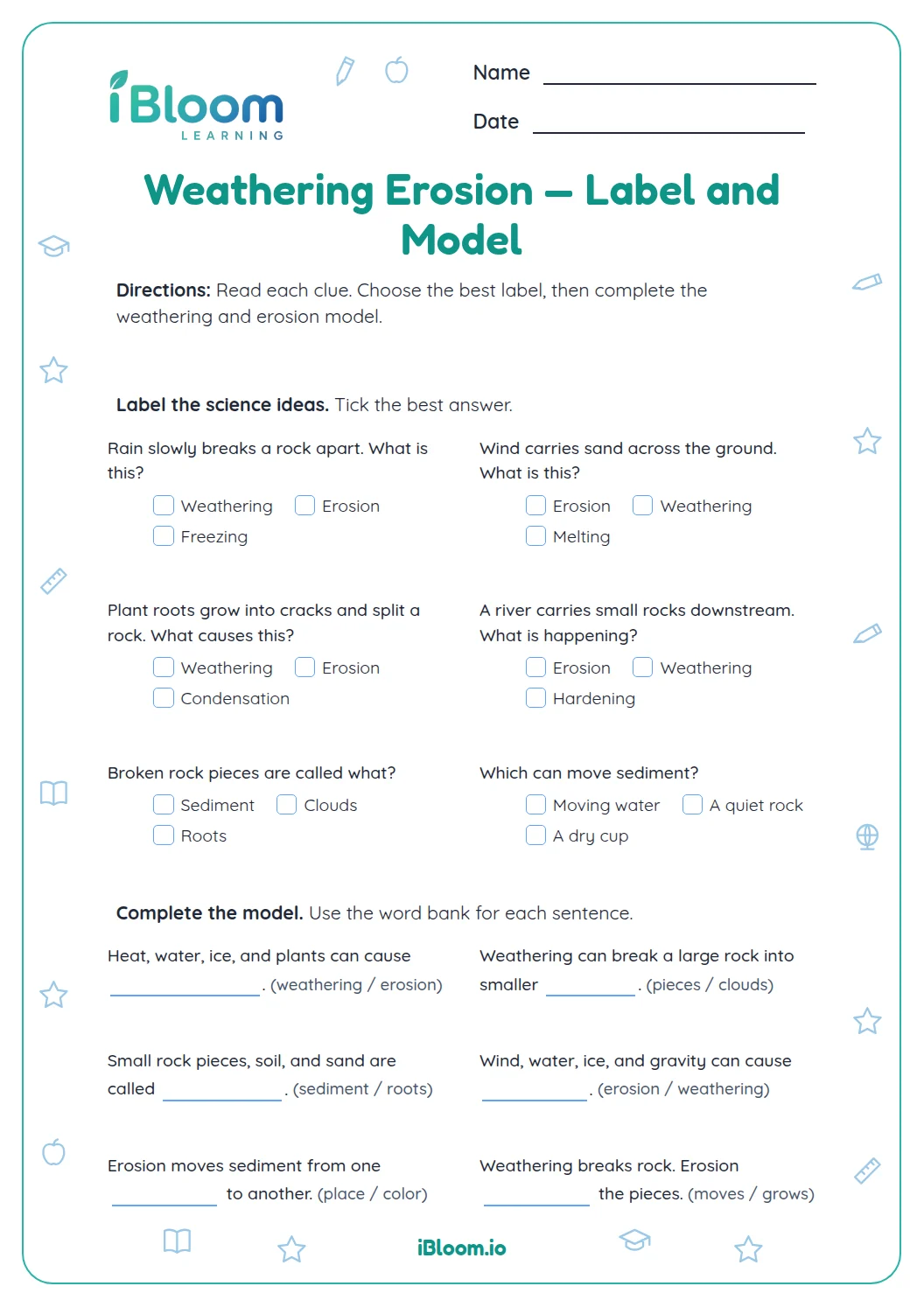 Weathering Erosion — Label and ModelGrade 2 science worksheets help children observe how weathering breaks rocks apart and erosion moves soil, sand, and rock from place to place. This label and model worksheet provides a distinct, age-appropriate way to practise the same lesson.Grade 2Free PDF preview6 pages
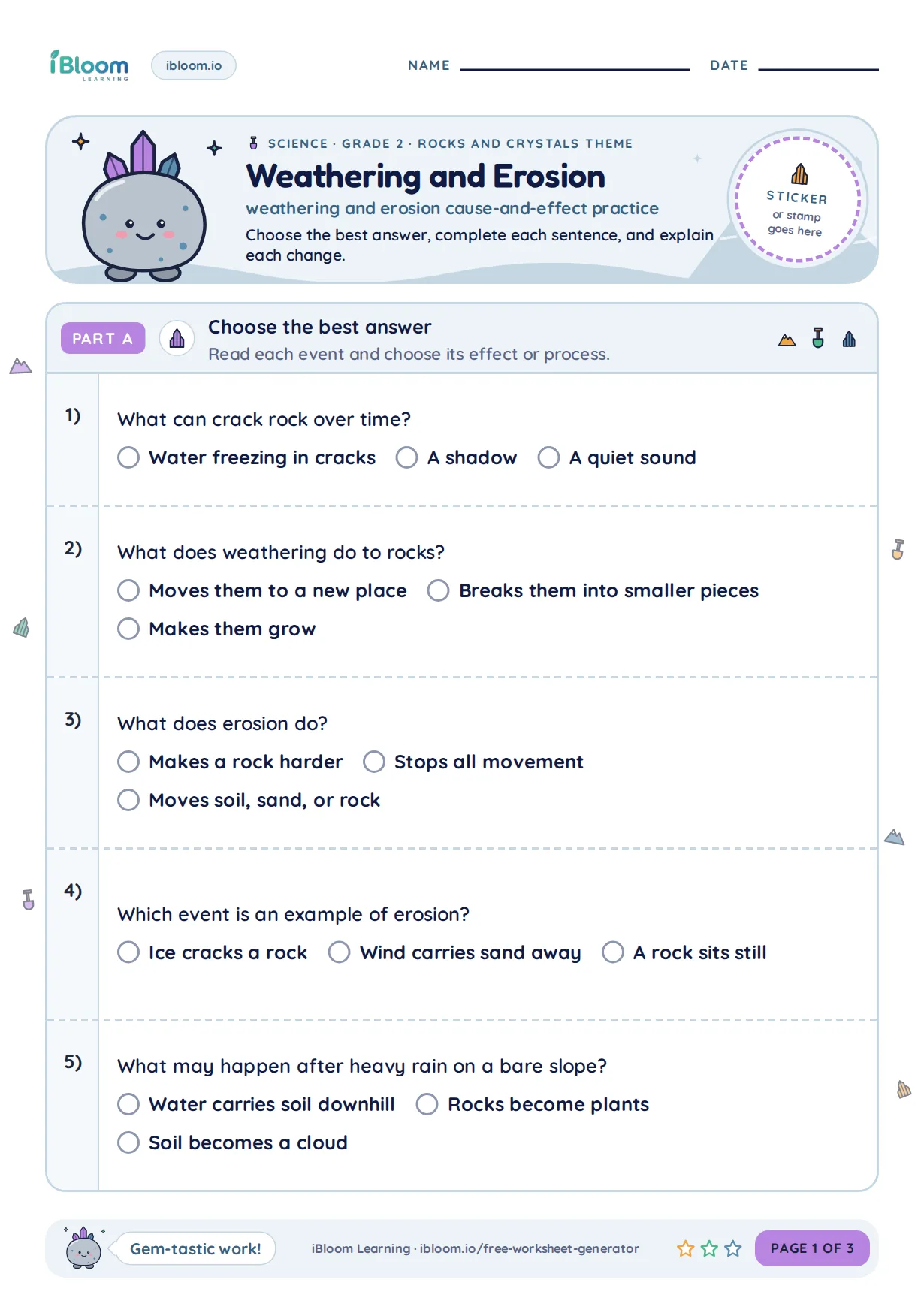 Weathering Erosion — Explain Cause and EffectGrade 2 science worksheets help children observe how weathering breaks rocks apart and erosion moves soil, sand, and rock from place to place. This explain cause and effect worksheet provides a distinct, age-appropriate way to practise the same lesson.Grade 2Free PDF preview4 pages
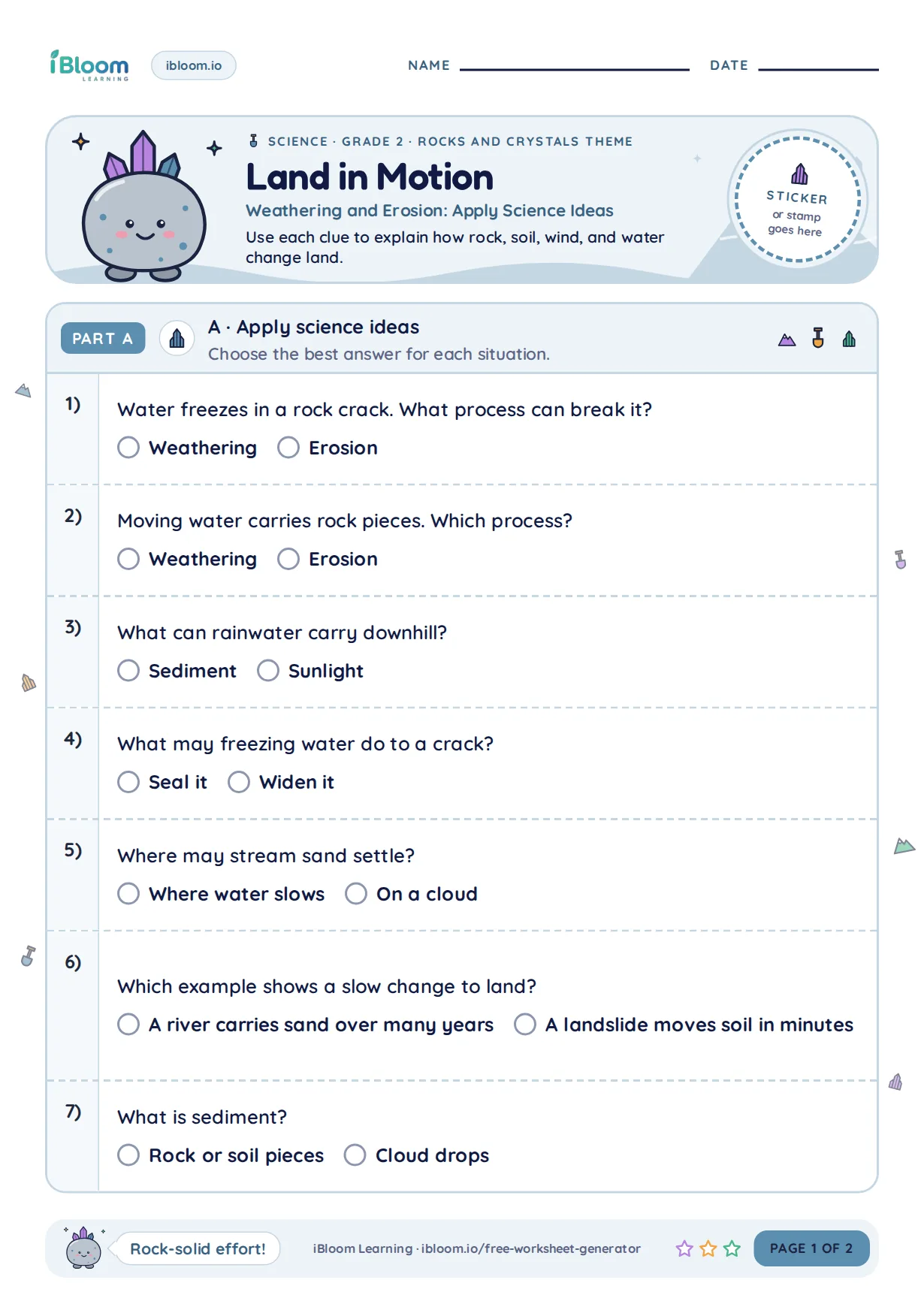 Weathering Erosion — Apply Science IdeasGrade 2 science worksheets help children observe how weathering breaks rocks apart and erosion moves soil, sand, and rock from place to place. This apply science ideas worksheet provides a distinct, age-appropriate way to practise the same lesson.Grade 2Free PDF preview
 Weathering Erosion — Science Reasoning ReviewGrade 2 science worksheets help children observe how weathering breaks rocks apart and erosion moves soil, sand, and rock from place to place. This science reasoning review worksheet provides a distinct, age-appropriate way to practise the same lesson.Grade 2Free PDF preview
Practice that builds confidence
What children learn
These Grade 2 earth science worksheets help children understand how land changes over time. Students practise telling the difference between weathering, which breaks rocks into smaller pieces, and erosion, which moves those pieces by wind, water, ice, or gravity.
The printable activities include picture-based sorting, short explanations, cause-and-effect questions, and real-world landform examples. Children use simple science vocabulary while connecting the ideas to rain, rivers, beaches, hills, and everyday outdoor observations.
Weathering and erosion can sound similar, so these worksheets build the ideas separately first. Children learn that weathering happens when rocks crack, crumble, or wear down. Erosion happens when the broken material is carried away. A cracked sidewalk, smooth river stones, muddy water after rain, and sand blowing across a beach are all useful examples for Grade 2 learners.

Skill progression in the activities
The practice moves from observing pictures to explaining processes. Students may identify whether a scene shows breaking or moving, match words to meanings, complete simple sentences, and answer questions such as, “What caused the soil to move?” This helps them use evidence from an image instead of guessing from a single word.
Parent routine for home practice
Take a short outdoor walk after reading one worksheet page together. Ask your child to find one place where something looks worn down and one place where soil, sand, or leaves have been moved. Use simple prompts: “What changed it?” “Did it break, move, or both?” Then return to the page and label the example as weathering or erosion.

Classroom uses for teachers
Teachers can use these printables during an earth science unit, in science centers, or as a follow-up to a video, soil tray model, or schoolyard observation. The picture questions work well for partner talk because students can point to evidence: water flowing, wind blowing, rocks breaking, or dirt collecting at the bottom of a slope.

Common errors to watch for
Many children call every land change erosion. Remind them to ask, “Is it breaking apart, or is it being carried away?” Another common mix-up is thinking weathering means weather like sunny or cloudy. In this science topic, weathering means the wearing down or breaking of rock and earth materials.
Free printable PDF download
Use this grade 2 weathering and erosion worksheet page to preview the activity, print it, or download it as a PDF for quick practice. It works well for homework, homeschool lessons, tutoring, morning work, revision, and classroom centers.
Answers and answer key support
After the child completes the worksheet independently, parents and teachers can use the answer support or answer key information to check the work, review mistakes, and choose the next practice step.
Why iBloom worksheets help
iBloom worksheets keep the language clear while still using correct vocabulary such as weathering, erosion, wind, water, soil, rock, and sediment. The activities give repeated practice with varied scenes, so children learn the concept rather than memorizing one example. A helpful child-friendly strategy is: “Break it or take it?” If nature breaks the rock, it is weathering. If nature takes the pieces somewhere else, it is erosion.
Helpful answers
Frequently asked questions
What is the main difference between weathering and erosion for Grade 2 students?
Weathering breaks rocks or earth materials into smaller pieces. Erosion moves those pieces from one place to another by wind, water, ice, or gravity.
Do these worksheets use real-world examples?
Yes. The activities connect the ideas to familiar scenes such as rain washing soil, river rocks becoming smooth, wind moving sand, and slopes losing dirt.
Are these worksheets suitable before doing a hands-on erosion model?
Yes. They can introduce key vocabulary before a model, or they can be used afterward to help children explain what they observed.
What vocabulary should my child know for this topic?
Helpful words include weathering, erosion, rock, soil, sand, sediment, wind, water, ice, crack, break, move, and carry.
How can I help if my child mixes up the two terms?
Use the question “break it or take it?” If the material is breaking apart, it is weathering. If it is being carried away, it is erosion.
Is this grade 2 weathering and erosion worksheet free?
Yes. You can preview it for free and use the printable worksheet for home or classroom practice.
Can I download this grade 2 weathering and erosion worksheet as a PDF?
Yes. Use the worksheet download option to save a printable PDF, or print the worksheet directly from the page.
Does this grade 2 weathering and erosion worksheet include answers or an answer key?
When the activity has fixed answers, iBloom includes answer support so parents and teachers can check the completed worksheet.