Free printable practice
Behavioral Adaptations Practice Activities
Grade 3 science worksheets that help children identify, explain, and compare animal behaviors that support survival.
Free printable worksheet PDFs
Preview every available page, then download the free worksheet PDF for home, homeschool, tutoring, or classroom practice.
Preview the exact activity before downloading it.
 Behavioral Adaptations — Sort and ClassifyGrade 3 science worksheets that help children identify, explain, and compare animal behaviors that support survival. This sort and classify worksheet provides a distinct, age-appropriate way to practise the same lesson.Grade 3Free PDF preview
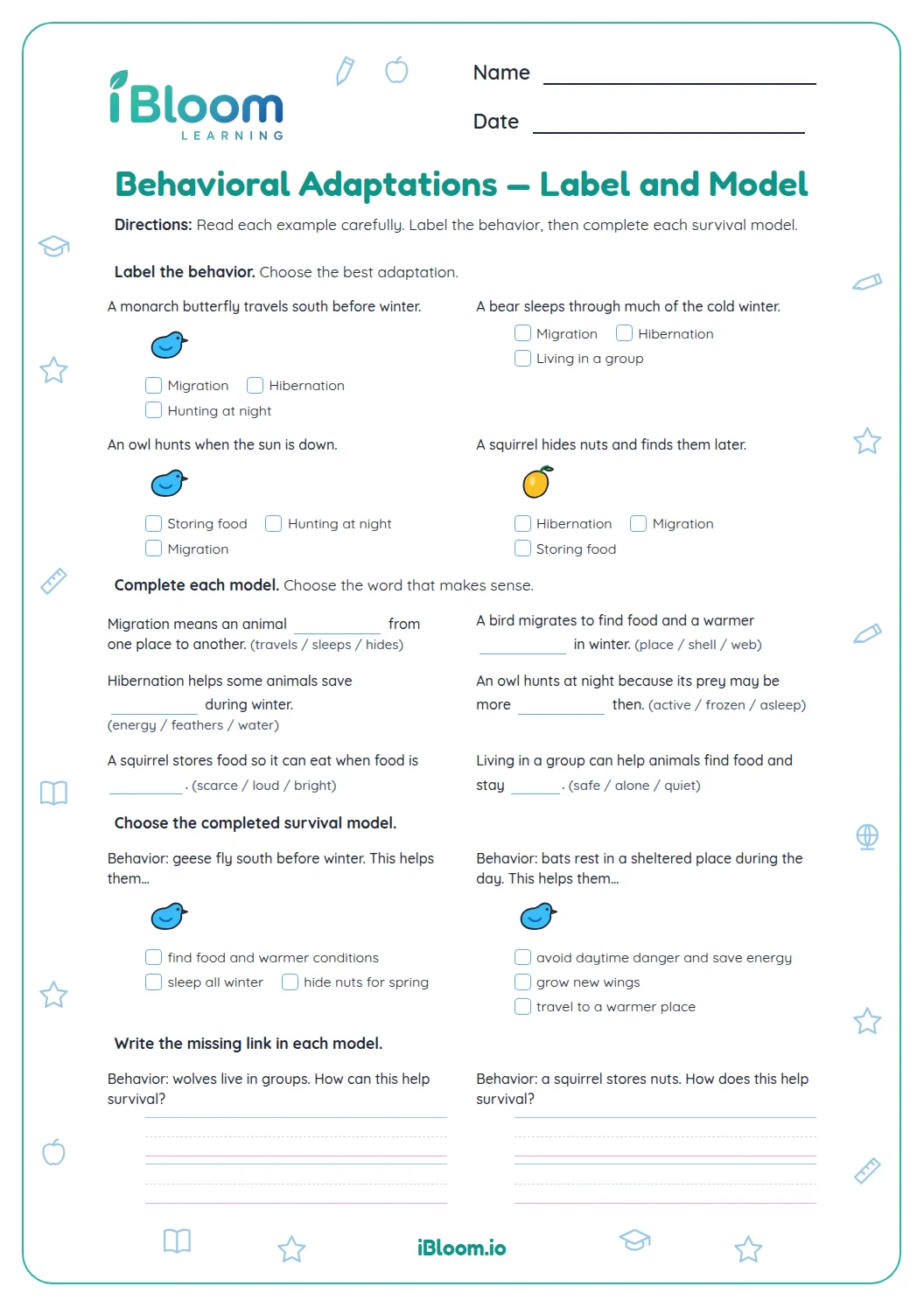 Behavioral Adaptations — Label and ModelGrade 3 science worksheets that help children identify, explain, and compare animal behaviors that support survival. This label and model worksheet provides a distinct, age-appropriate way to practise the same lesson.Grade 3Free PDF preview
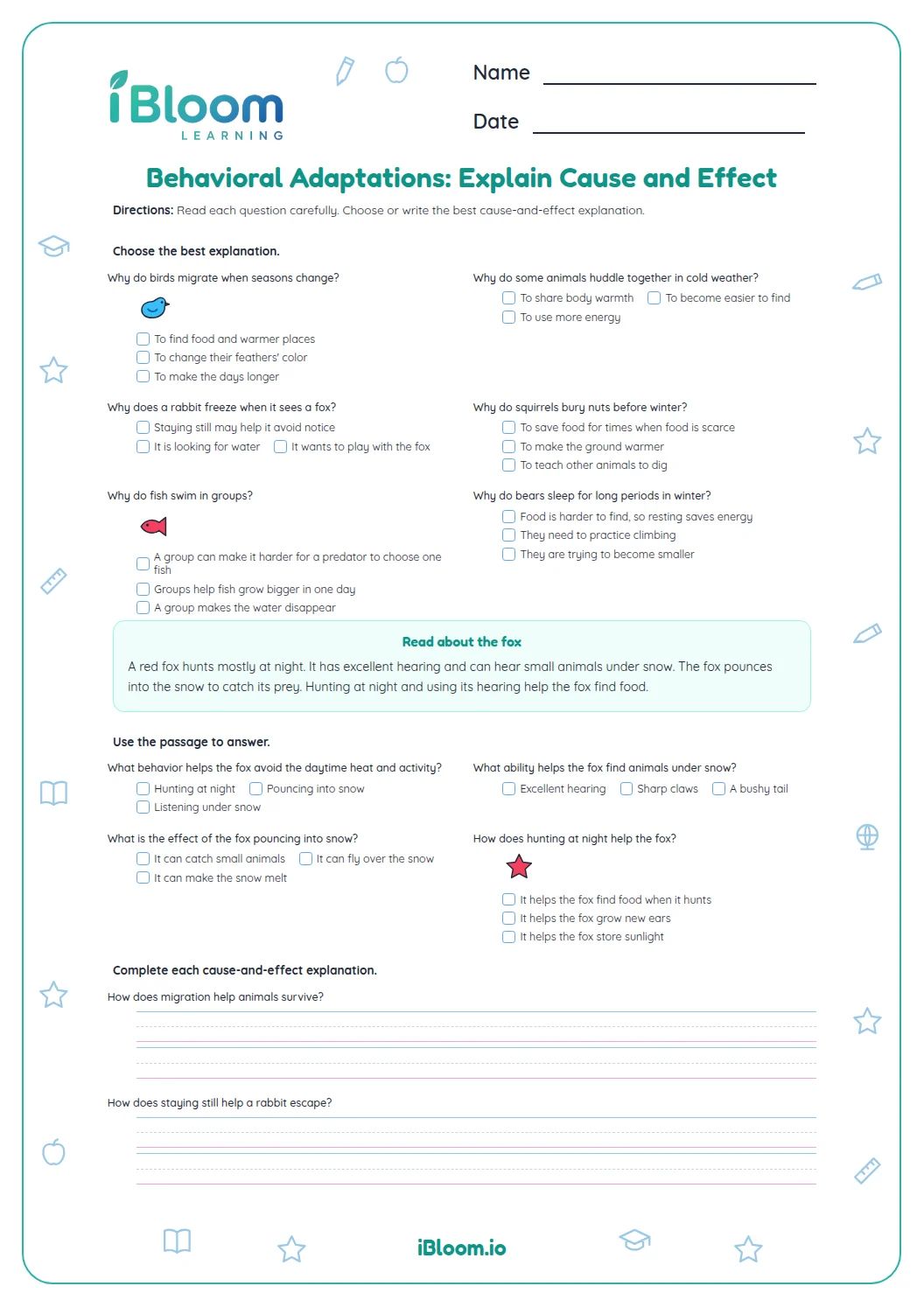 Behavioral Adaptations — Explain Cause and EffectGrade 3 science worksheets that help children identify, explain, and compare animal behaviors that support survival. This explain cause and effect worksheet provides a distinct, age-appropriate way to practise the same lesson.Grade 3Free PDF preview
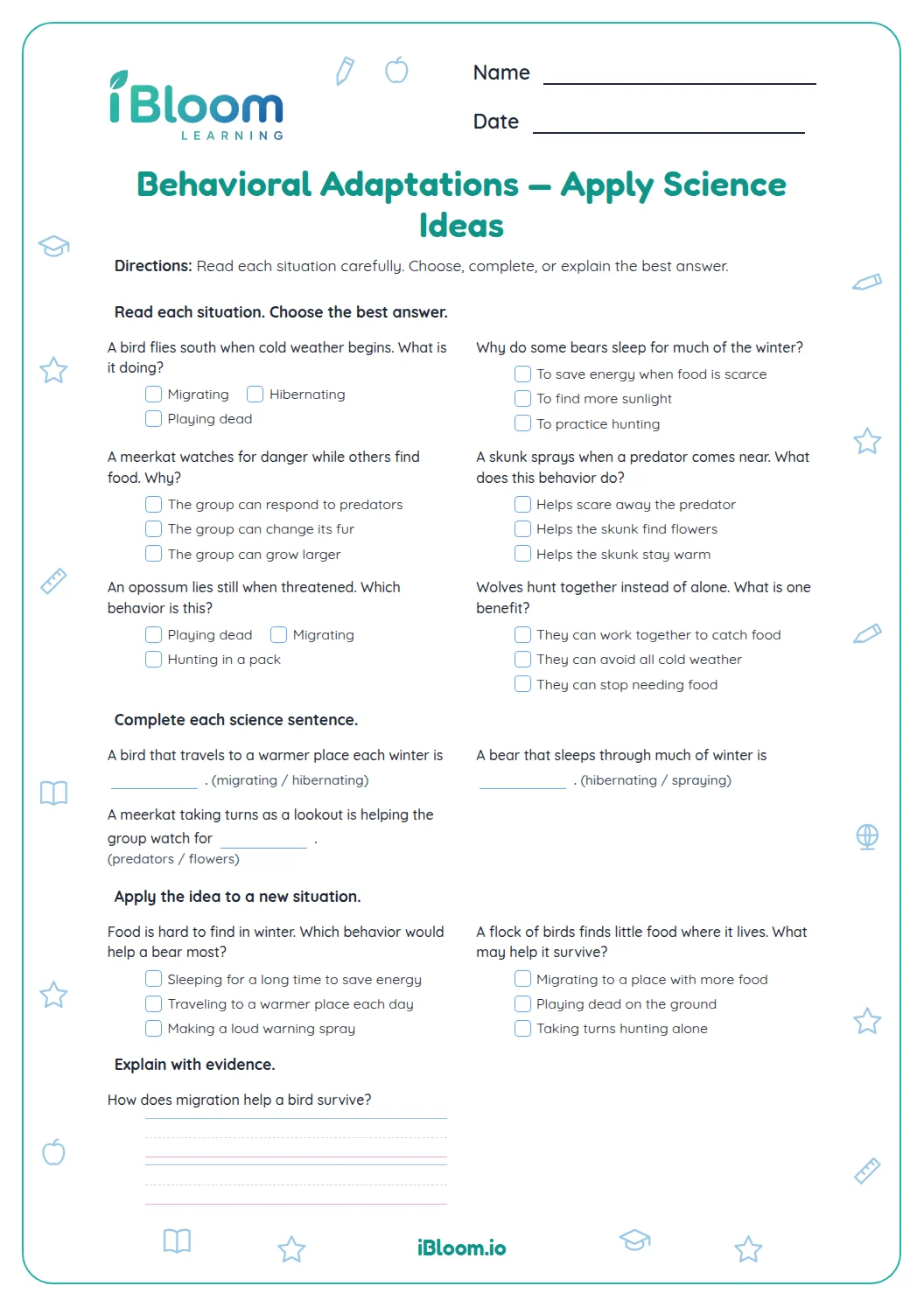 Behavioral Adaptations — Apply Science IdeasGrade 3 science worksheets that help children identify, explain, and compare animal behaviors that support survival. This apply science ideas worksheet provides a distinct, age-appropriate way to practise the same lesson.Grade 3Free PDF preview6 pages
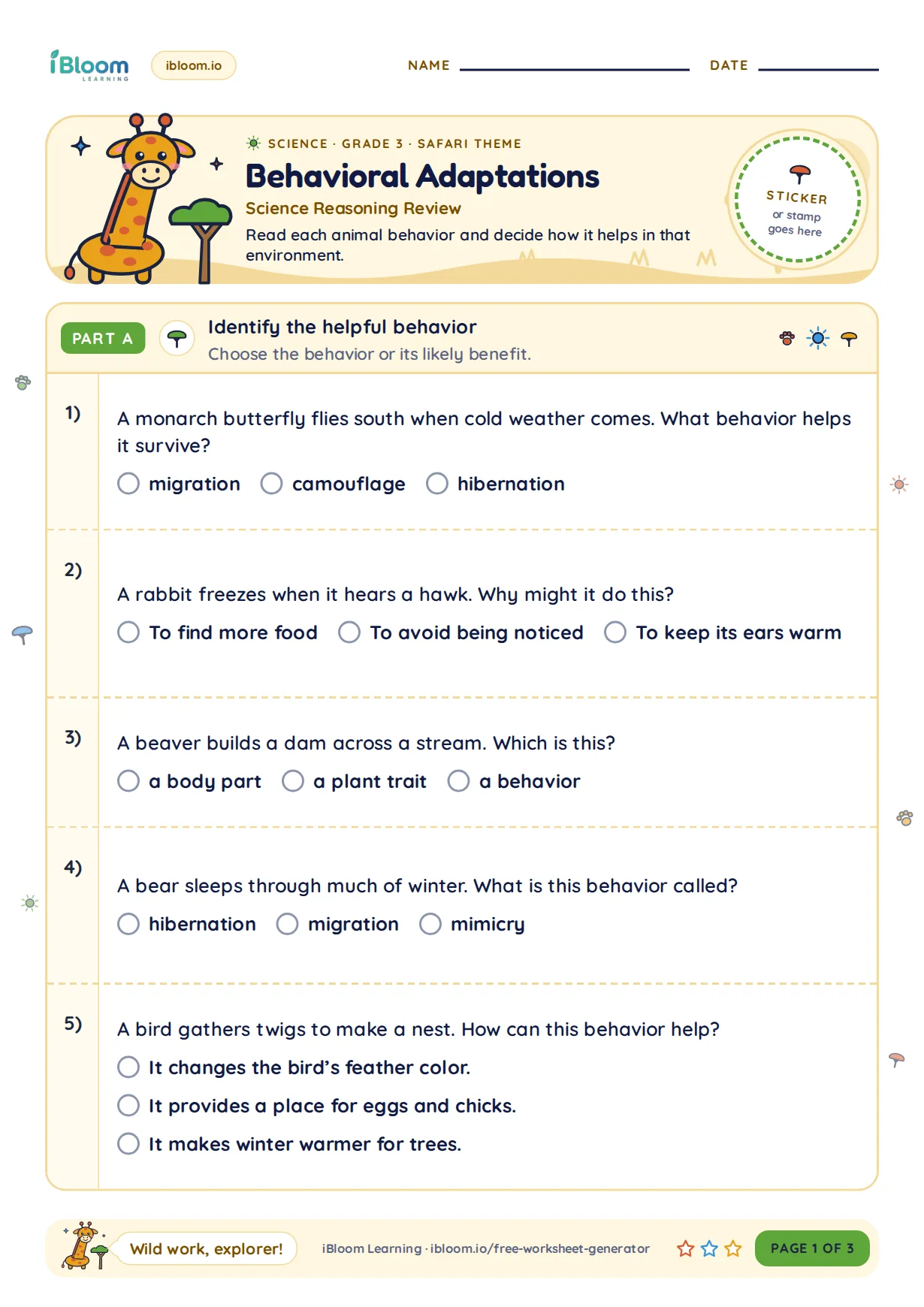 Behavioral Adaptations — Science Reasoning ReviewGrade 3 science worksheets that help children identify, explain, and compare animal behaviors that support survival. This science reasoning review worksheet provides a distinct, age-appropriate way to practise the same lesson.Grade 3Free PDF preview
Practice that builds confidence
What children learn
These Grade 3 science worksheets help children understand behavioral adaptations: the actions living things use to survive, find food, stay safe, reproduce, or respond to seasonal changes. Students practise recognizing behaviors such as migration, hibernation, camouflage-related actions, group living, hunting patterns, and caring for young.
The printable activities include reading prompts, sorting tasks, matching examples to purposes, short-answer explanations, and picture-based questions. Children learn to connect each behavior with a survival need rather than simply memorizing animal facts.
Behavioral adaptations are things animals do, not body parts they have. A bird flying south for winter, a bear resting through cold months, wolves hunting in packs, and a parent bird feeding chicks are all behaviors that help living things meet needs. These worksheets guide Grade 3 learners to name the behavior, describe what is happening, and explain how it helps the animal survive.

Building from examples to explanations
The practice begins with familiar animal actions and moves toward cause-and-effect thinking. Children may sort behaviors by purpose, such as getting food, avoiding danger, keeping warm, or caring for young. They also compare similar behaviors: migration is movement to a better place, while hibernation is a low-activity state used when food or warmth is limited.
A simple parent routine
At home, choose one animal from a book, video, or backyard observation. Ask: “What does it do?” “Why might that help?” and “Is that a behavior or a body feature?” Have your child answer in one complete sentence: “A ___ ___ so that ___.” For example, “A goose migrates so that it can find warmer weather and food.” This routine builds science vocabulary while keeping the focus on evidence.

Classroom uses for teachers
Teachers can use these pages during a Living Things unit, as science centers, partner reading, warm-ups, or exit tickets after a lesson on survival needs. The mix of sorting, matching, and written responses helps students show understanding in more than one way. The worksheets also support discussion: students can defend why a behavior belongs in a category and revise their thinking after hearing classmates’ evidence.

Common mistakes to watch for
Many children confuse physical adaptations with behavioral adaptations. A thick coat, sharp claws, or webbed feet are body structures; swimming, digging, hiding, or traveling in groups are actions. Another common error is giving a vague reason, such as “it helps the animal.” Encourage students to explain the exact need: food, safety, warmth, shelter, or caring for young.
Free printable PDF download
Use this grade 3 behavioral adaptations worksheet page to preview the activity, print it, or download it as a PDF for quick practice. It works well for homework, homeschool lessons, tutoring, morning work, revision, and classroom centers.
Answers and answer key support
After the child completes the worksheet independently, parents and teachers can use the answer support or answer key information to check the work, review mistakes, and choose the next practice step.
Why iBloom worksheets help
iBloom activities keep the language clear while still asking children to think like young scientists. Each task encourages a child-friendly strategy: spot the action, ask what problem it solves, then explain the survival benefit. With repeated examples across different animals, students build flexible understanding they can apply to new living things.
Helpful answers
Frequently asked questions
What is a behavioral adaptation for Grade 3 students?
A behavioral adaptation is an action an animal does that helps it survive, such as migrating, hibernating, hunting in a group, hiding from predators, or caring for its young.
How do these worksheets help children avoid confusing body parts with behaviors?
The activities ask children to decide whether an example is an action or a body feature. This helps them see that sharp claws or thick fur are physical adaptations, while digging, swimming, or traveling in groups are behaviors.
Do the worksheets include migration and hibernation?
Yes. The practice includes common survival behaviors such as migration and hibernation, with questions that focus on why animals use these behaviors when seasons, food, or temperature change.
Can these pages be used without a full science textbook lesson?
Yes. The worksheets use clear examples and prompts, so they can support a short lesson, review activity, science center, or home practice after a basic introduction to animal survival needs.
What should my child include in a strong written answer?
A strong answer names the behavior and explains its purpose. For example: “Penguins huddle together to stay warm,” or “Some birds migrate to find food and warmer weather.”
Is this grade 3 behavioral adaptations worksheet free?
Yes. You can preview it for free and use the printable worksheet for home or classroom practice.
Can I download this grade 3 behavioral adaptations worksheet as a PDF?
Yes. Use the worksheet download option to save a printable PDF, or print the worksheet directly from the page.
Does this grade 3 behavioral adaptations worksheet include answers or an answer key?
When the activity has fixed answers, iBloom includes answer support so parents and teachers can check the completed worksheet.