Free printable practice
Parts Of Plant Practice Activities
Grade 3 science worksheets for identifying plant parts and explaining how roots, stems, leaves, flowers, fruits, and seeds help a plant live.
Free printable worksheet PDFs
Preview every available page, then download the free worksheet PDF for home, homeschool, tutoring, or classroom practice.
Preview the exact activity before downloading it.
 Parts Of Plant — Sort and ClassifyGrade 3 science worksheets for identifying plant parts and explaining how roots, stems, leaves, flowers, fruits, and seeds help a plant live. This sort and classify worksheet provides a distinct, age-appropriate way to practise the same lesson.Grade 3Free PDF preview
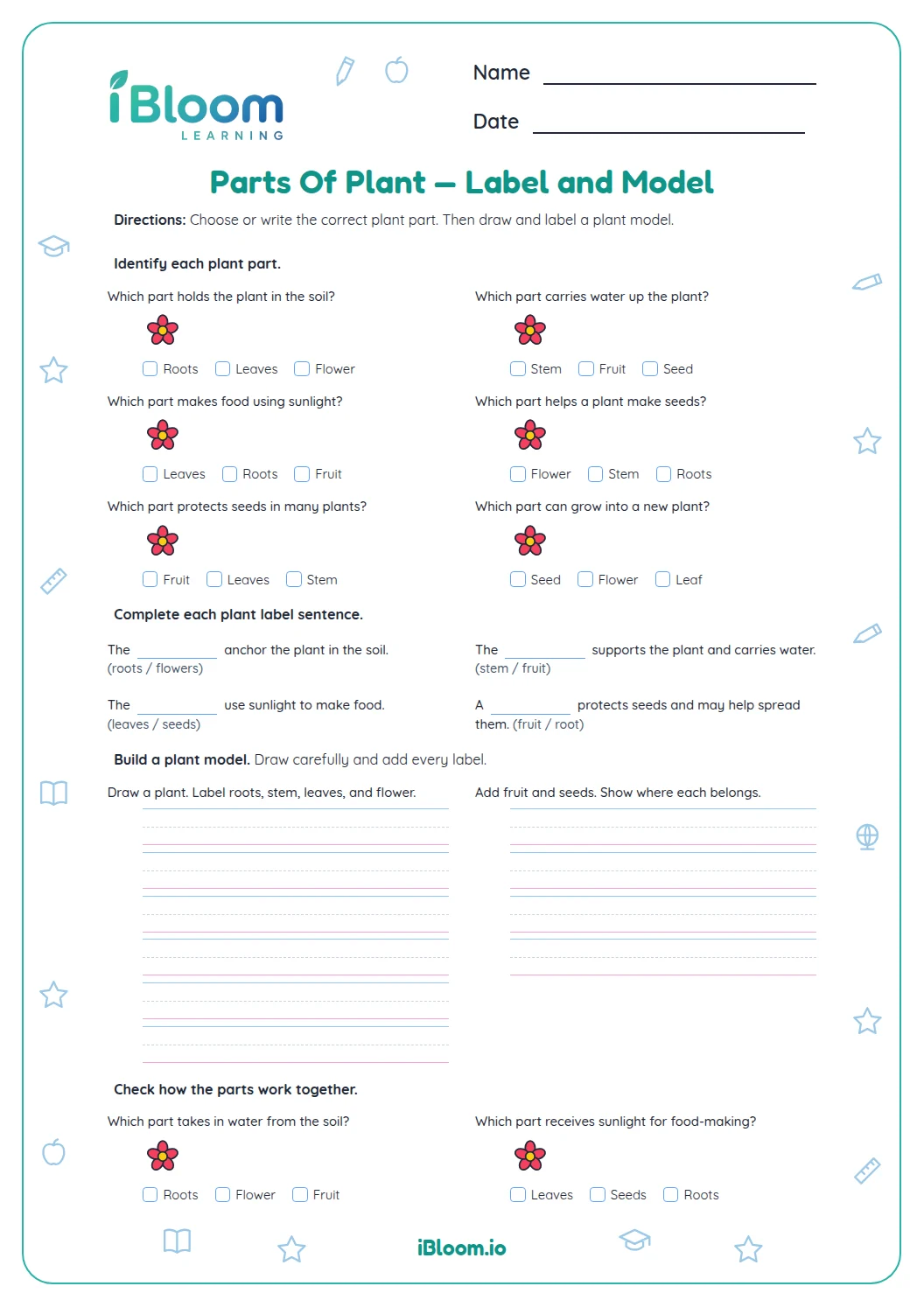 Parts Of Plant — Label and ModelGrade 3 science worksheets for identifying plant parts and explaining how roots, stems, leaves, flowers, fruits, and seeds help a plant live. This label and model worksheet provides a distinct, age-appropriate way to practise the same lesson.Grade 3Free PDF preview
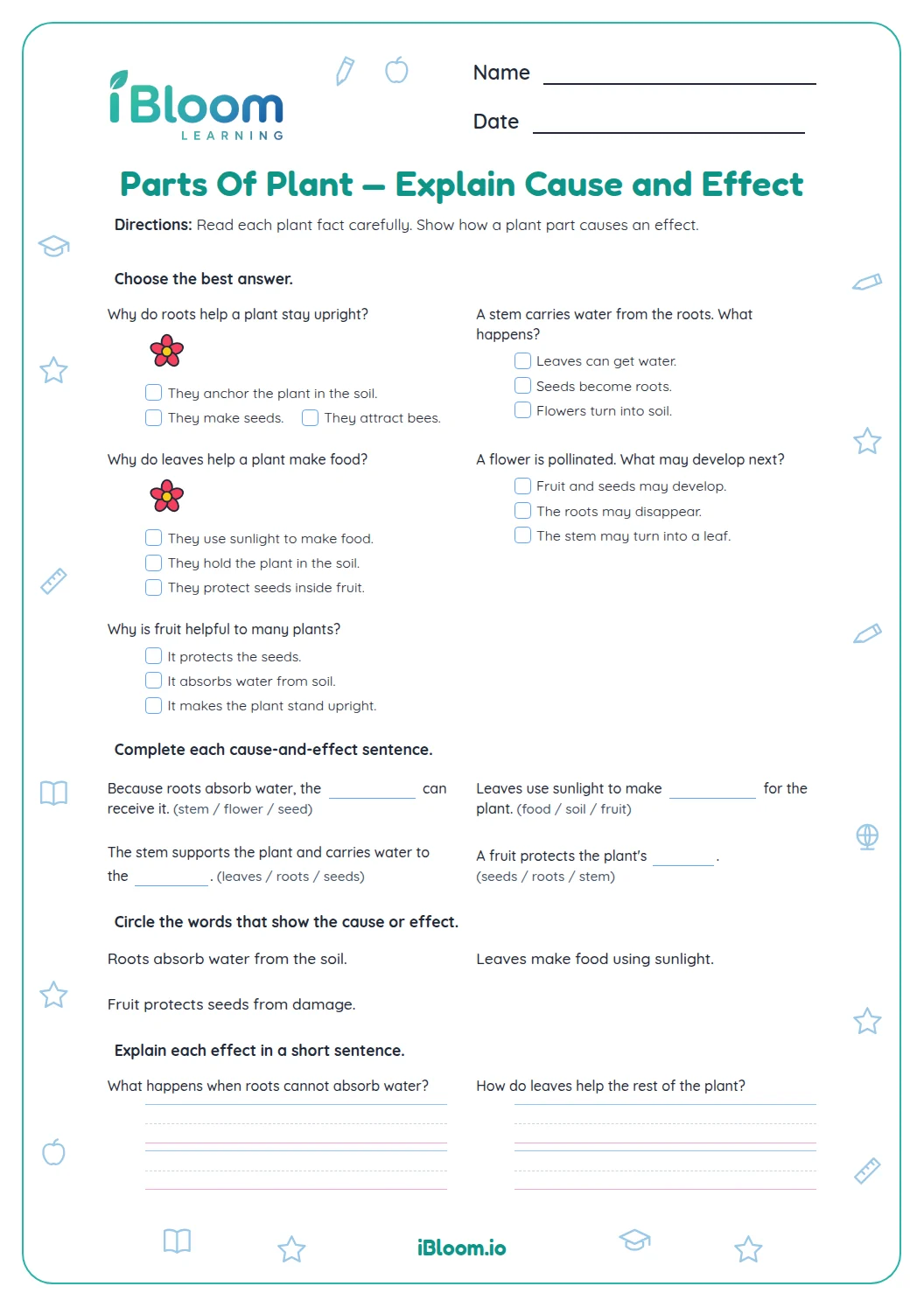 Parts Of Plant — Explain Cause and EffectGrade 3 science worksheets for identifying plant parts and explaining how roots, stems, leaves, flowers, fruits, and seeds help a plant live. This explain cause and effect worksheet provides a distinct, age-appropriate way to practise the same lesson.Grade 3Free PDF preview
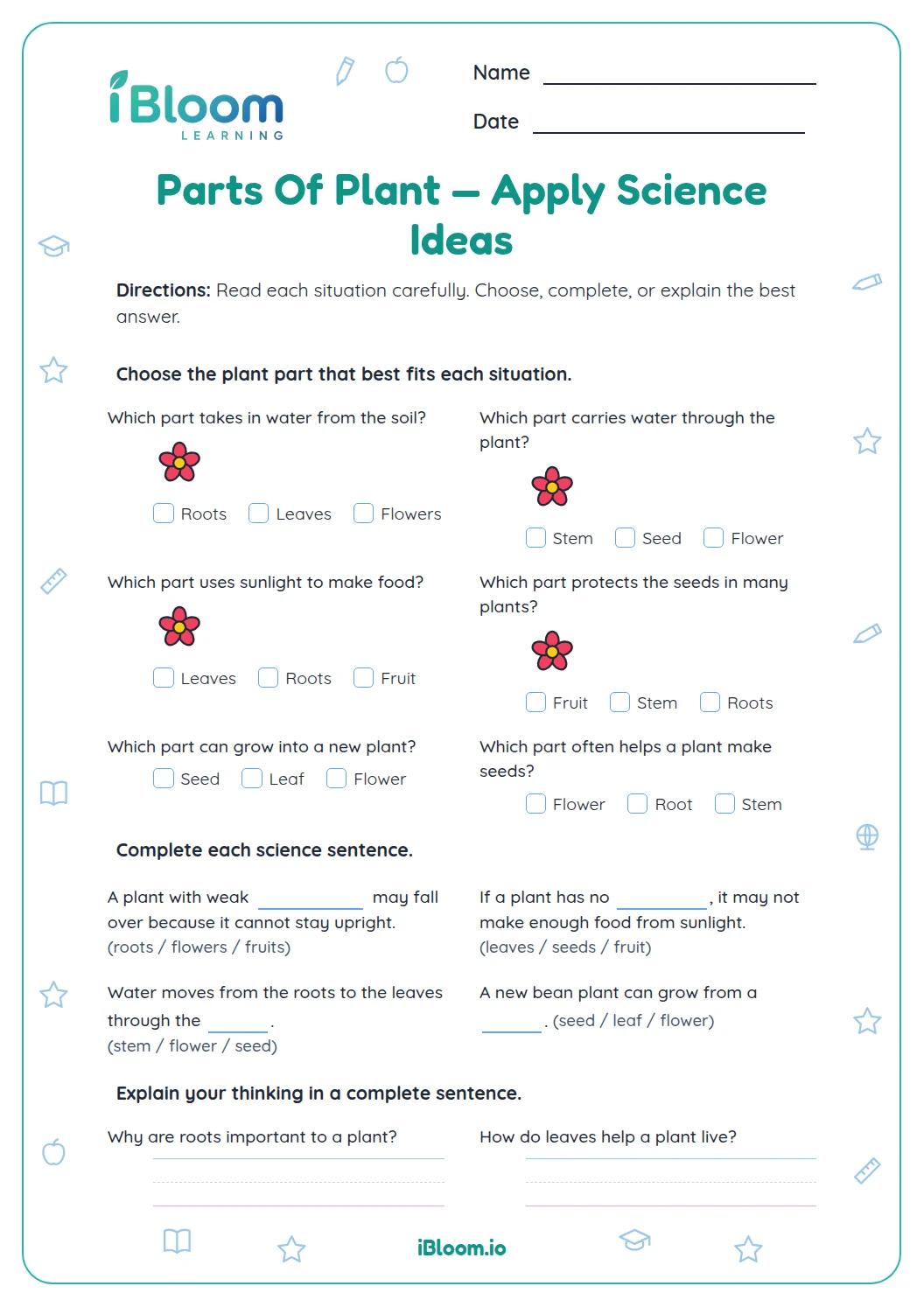 Parts Of Plant — Apply Science IdeasGrade 3 science worksheets for identifying plant parts and explaining how roots, stems, leaves, flowers, fruits, and seeds help a plant live. This apply science ideas worksheet provides a distinct, age-appropriate way to practise the same lesson.Grade 3Free PDF preview4 pages
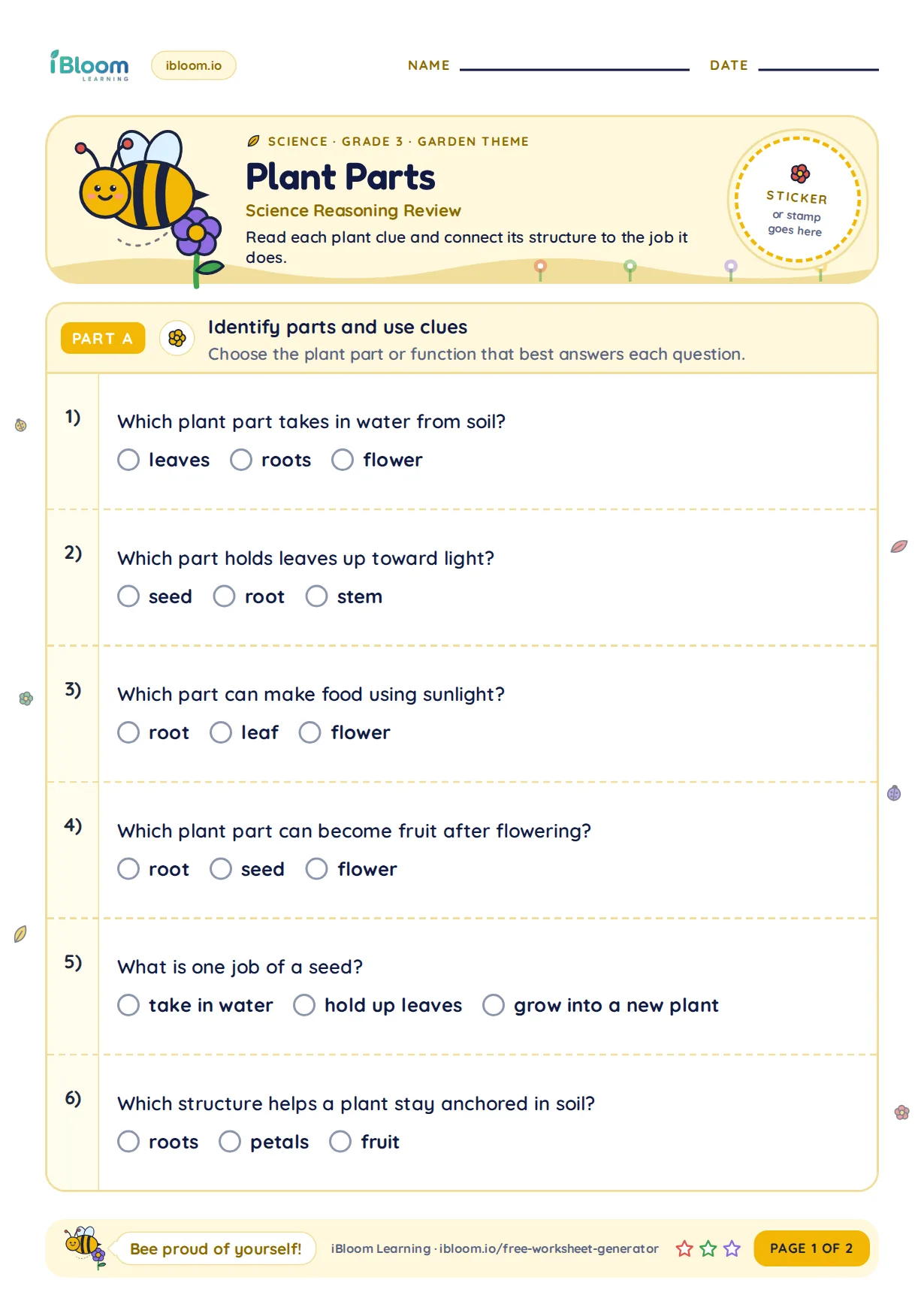 Parts Of Plant — Science Reasoning ReviewGrade 3 science worksheets for identifying plant parts and explaining how roots, stems, leaves, flowers, fruits, and seeds help a plant live. This science reasoning review worksheet provides a distinct, age-appropriate way to practise the same lesson.Grade 3Free PDF preview
Practice that builds confidence
Build the plant system
These Grade 3 science worksheets help children study the main parts of a plant within the Living Things unit. Students practise naming visible plant structures and connecting each part to its job, such as roots taking in water or leaves helping the plant make food.
The printable activities include plant diagrams, labeling tasks, matching exercises, short explanations, and observation-style questions. Children move beyond memorizing names to seeing a plant as a living system with parts that work together.
Parts of plant practice should help children see more than a picture with labels. In these worksheets, students identify roots, stems, leaves, flowers, fruits, and seeds, then describe what each part does. Useful vocabulary includes absorb, support, transport, make food, protect, and reproduce. A clear diagram lets children connect the word “root” to the underground part and the word “stem” to the structure that holds leaves and flowers up.

From naming to explaining
The skill progression begins with recognizing plant parts, then moves to matching each part with a function. Children may label a diagram, choose the correct word from a word bank, or write a short sentence such as “The stem carries water to the leaves.” This helps Grade 3 learners practise science language while building the idea that living things have structures that help them survive.
A parent routine at home
Use one houseplant, vegetable, or flower as a real example before the worksheet. Ask your child to point to the roots if visible, trace the stem with a finger, count leaves, and notice whether there is a flower, fruit, or seed. Then complete one printable page and end with a quick oral check: “Which part takes in water?” “Which part holds the plant upright?” Keep the focus on explaining, not just spelling the labels.

Classroom uses for teachers
Teachers can use these pages in science centers, small-group review, notebook work, or as a follow-up after observing real plants. A cut-and-match activity works well for partners, while a labeled diagram can become evidence in a Living Things folder. The worksheets also support quick checks for students who can name a part but are not yet secure with its function.

Common mix-ups to watch for
Students often confuse roots and stems because both can look like lines in a diagram. Remind them that roots usually grow down and take in water, while stems usually hold the plant up and move water through the plant. Children may also think every plant has a bright flower or fruit at all times, so use examples that show plants can look different at different stages.
Free printable PDF download
Use this grade 3 parts of a plant worksheet page to preview the activity, print it, or download it as a PDF for quick practice. It works well for homework, homeschool lessons, tutoring, morning work, revision, and classroom centers.
Answers and answer key support
After the child completes the worksheet independently, parents and teachers can use the answer support or answer key information to check the work, review mistakes, and choose the next practice step.
Why iBloom worksheets help
The iBloom pages use simple plant illustrations, direct prompts, and Grade 3-friendly vocabulary so children can practise accuracy without being overloaded. A helpful strategy for students is: name it, point to it, tell its job. If they can do all three, they understand the plant part.
Helpful answers
Frequently asked questions
What plant parts do these Grade 3 worksheets cover?
They focus on the main plant parts children commonly study in Grade 3: roots, stems, leaves, flowers, fruits, and seeds, along with the basic job of each part.
Do students only label diagrams?
No. Labeling is included, but the activities also ask children to match parts to functions and write or choose short explanations about how each part helps the plant.
How can I help my child understand roots and stems?
Show a real plant if possible. Explain that roots usually grow downward and take in water, while the stem holds the plant upright and helps move water to other parts.
Are these worksheets suitable for a Living Things unit?
Yes. They fit well in a Grade 3 Living Things lesson because they show how a plant’s structures help it live, grow, and reproduce.
Can teachers use these for science centers?
Yes. The printable pages work for independent centers, partner matching tasks, small-group reteaching, or a quick check after a plant observation activity.
Is this grade 3 parts of a plant worksheet free?
Yes. You can preview it for free and use the printable worksheet for home or classroom practice.
Can I download this grade 3 parts of a plant worksheet as a PDF?
Yes. Use the worksheet download option to save a printable PDF, or print the worksheet directly from the page.
Does this grade 3 parts of a plant worksheet include answers or an answer key?
When the activity has fixed answers, iBloom includes answer support so parents and teachers can check the completed worksheet.