




About this worksheet
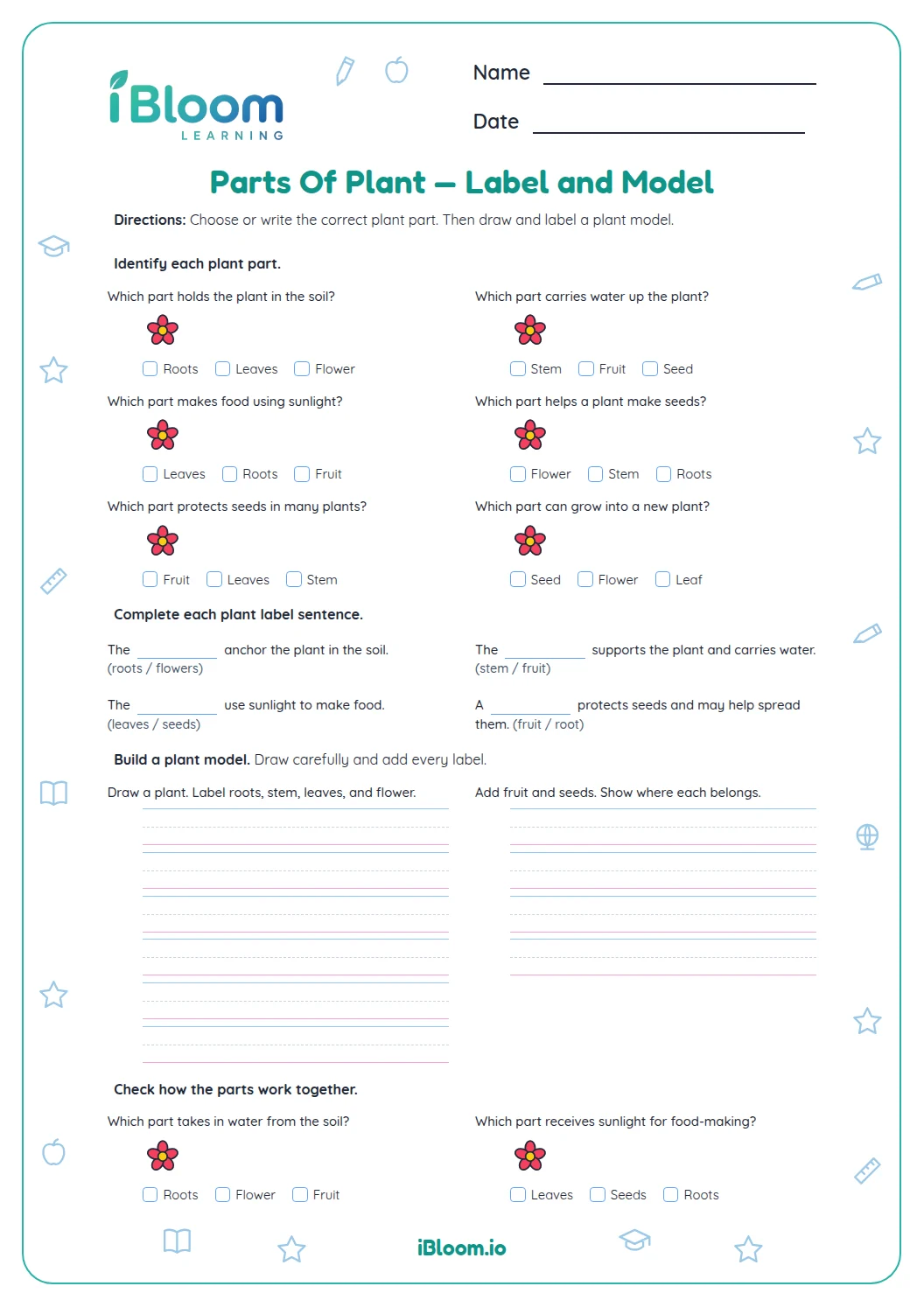
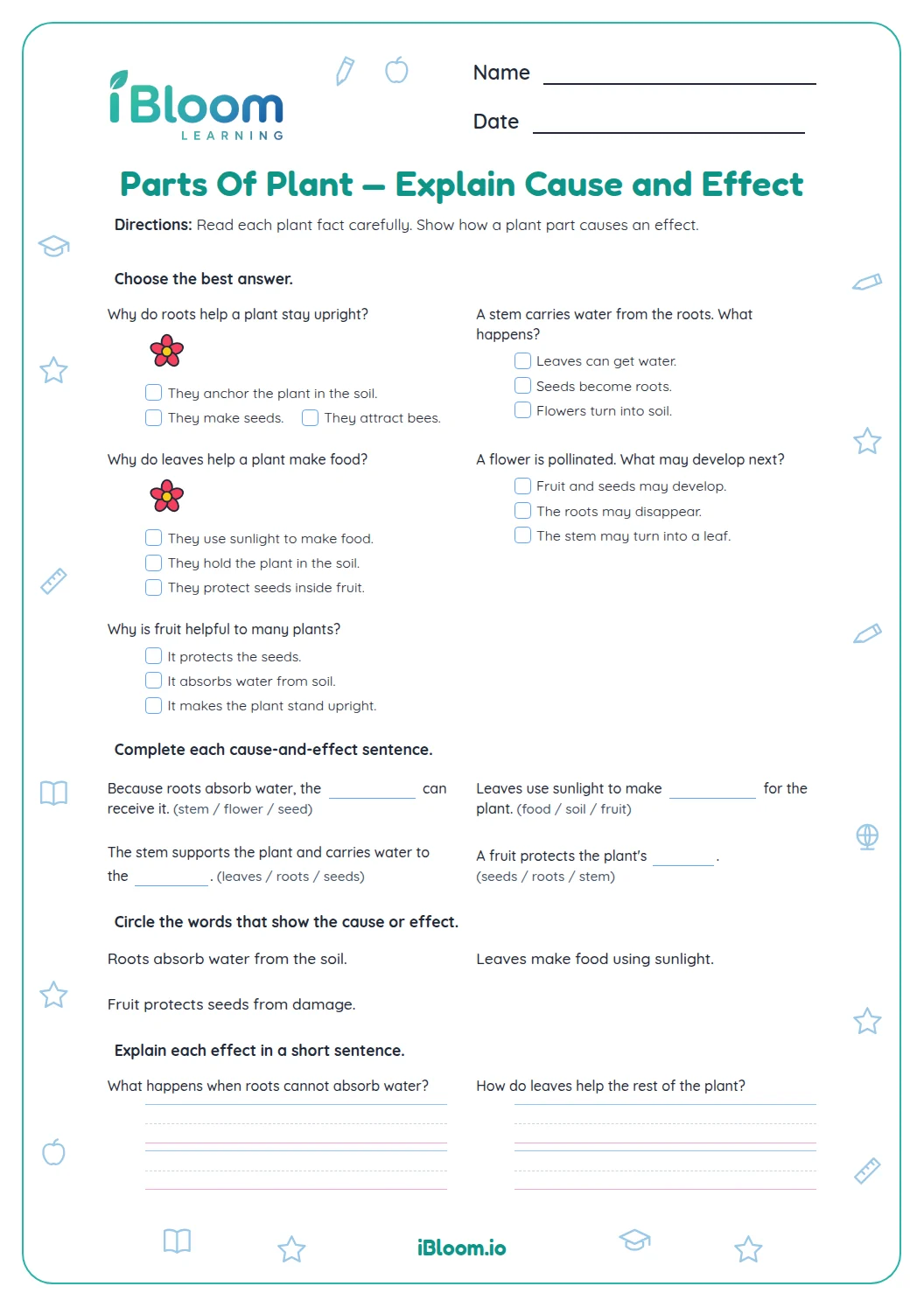
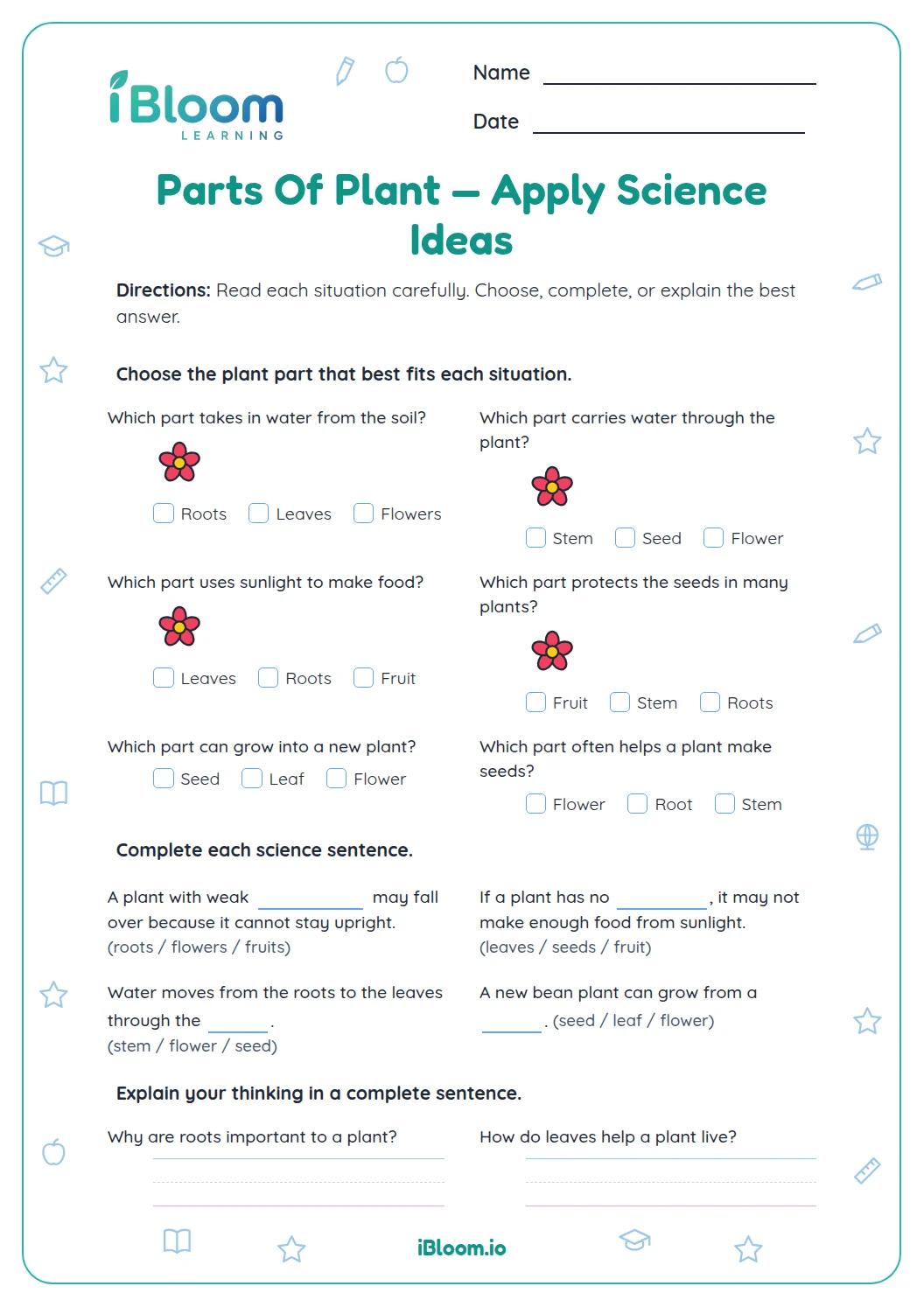
This free printable Grade 3 science worksheet helps students reason about how plant structures do different jobs. Across 14 questions, they identify roots, stems, leaves, flowers and seeds, then use clues about water, sunlight, support and new plants to connect each structure to its function. A separate answer key is included. The science ideas align with NGSS 4-LS1-1, which asks students to use evidence to explain how structures support survival, growth, behavior and reproduction.
Aligned to 4-LS1-1
How do roots, stems, leaves, flowers, and seeds help a plant?
Each plant part has a job. Roots take in water and help anchor a plant. A stem supports leaves and flowers and carries materials through the plant. Leaves use light to make food. Flowers can help a plant reproduce, and seeds can grow into new plants.
Question 7 gives a clue about a plant wilting when soil dries. The answer is roots: they take in water from soil. Connecting a structure to the clue is the main reasoning move on this sheet.
- 1Clue: a plant wilts after soil dries
- 2Ask which part takes in water from soil
- 3Answer: roots
How can a clue help identify a plant structure?
Look for what changed and what the plant can no longer do well. A plant in darkness may struggle to use light to make food, which points to leaves. A plant without support points to the stem. A seed forming after flowering links flowers with reproduction.
What questions are on the printable?
The worksheet has two parts: identify plant structures and their jobs, then reason from evidence and structure-function links. The answer key follows the worksheet.
- Part A: identify a plant part from its function or clue
- Part B: reason from evidence and structure-function links
How to work through the sheet
- 1Read the whole question before choosing a plant part.
- 2Recall the basic jobs of roots, stems, leaves, flowers, and seeds.
- 3Underline the clue about water, light, support, or reproduction.
- 4Connect that clue to the structure that does the job.
- 5Use the answer key to review any missed connection.
Plant-part mix-ups to watch for
The mistake
Naming leaves when asked what absorbs water from soil.
The fix
Roots contact the soil and take in water; leaves use light to make food.
The mistake
Saying the stem anchors the plant.
The fix
Roots help anchor the plant; the stem supports its leaves and flowers.
The mistake
Calling a seed the flower.
The fix
A flower is involved in reproduction; a seed can grow into a new plant.
Next Generation Science Standards alignment
Use evidence to connect plant structures with their functions.
On this sheet: Students connect plant structures to functions using clues about growth and reproduction.
Show the official wordingHide the official wording
Construct an argument that plants and animals have internal and external structures that function to support survival, growth, behavior, and reproduction.
What to practice next
Make more practice
Further reading
Questions parents and teachers ask
Which plant structures appear in the questions?
The sheet covers roots, stems, leaves, flowers, and seeds. Students match each structure with a function, including taking in water, supporting leaves, using sunlight, and growing into a new plant. The questions move from direct identification to clues about how a plant responds.
Does the printable include an answer key?
Yes. The answer key is printed on separate pages and gives a response for each of the 14 questions. Students can complete both worksheet pages first, then compare their choices with the key and revisit any structure-function connection that needs another look.
What does the colored-water question show?
The question asks students to identify evidence that water taken up by roots moves through the plant. Colored water moving from roots into the stem is the relevant observation. The other choices describe a flower or upright stem without showing water movement.
How can I help a student who mixes up roots and stems?
Ask what the clue describes. Roots take in water and help anchor a plant in soil; stems support leaves and flowers and carry materials through the plant. Have the student name the job first, then choose the structure that performs it.
Which science standard is listed?
The page lists NGSS 4-LS1-1, which focuses on using evidence to explain how structures support living things. The questions use plant examples and ask students to connect visible or described structures with functions related to growth and reproduction. The standard is linked below.