Free printable practice
Inherited Traits Practice Activities
Grade 3 science worksheets help children identify inherited traits in animals, plants, and people and separate them from learned or acquired characteristics.
Free printable worksheet PDFs
Preview every available page, then download the free worksheet PDF for home, homeschool, tutoring, or classroom practice.
Preview the exact activity before downloading it.
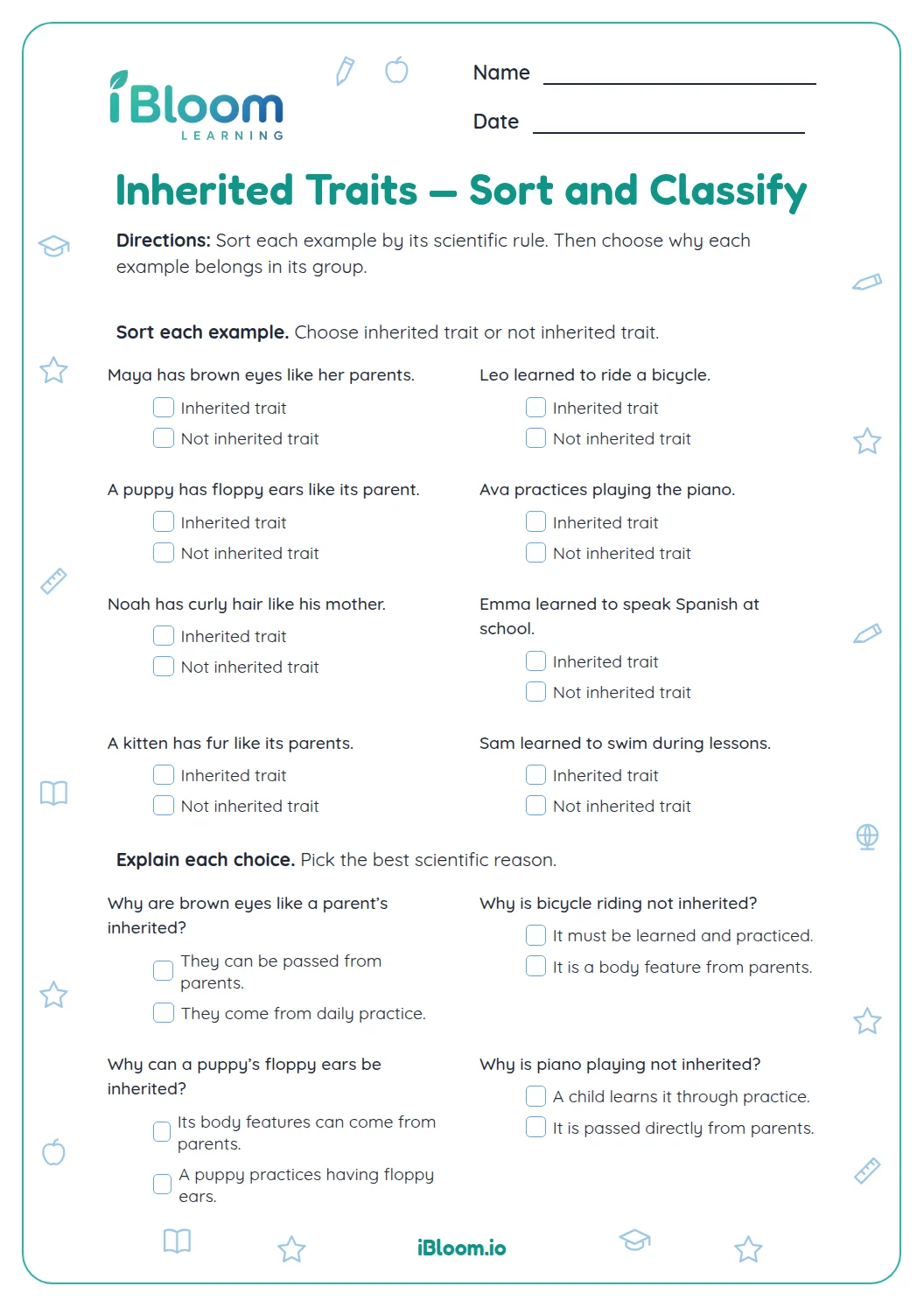 Inherited Traits — Sort and ClassifyGrade 3 science worksheets help children identify inherited traits in animals, plants, and people and separate them from learned or acquired characteristics. This sort and classify worksheet provides a distinct, age-appropriate way to practise the same lesson.Grade 3Free PDF preview4 pages
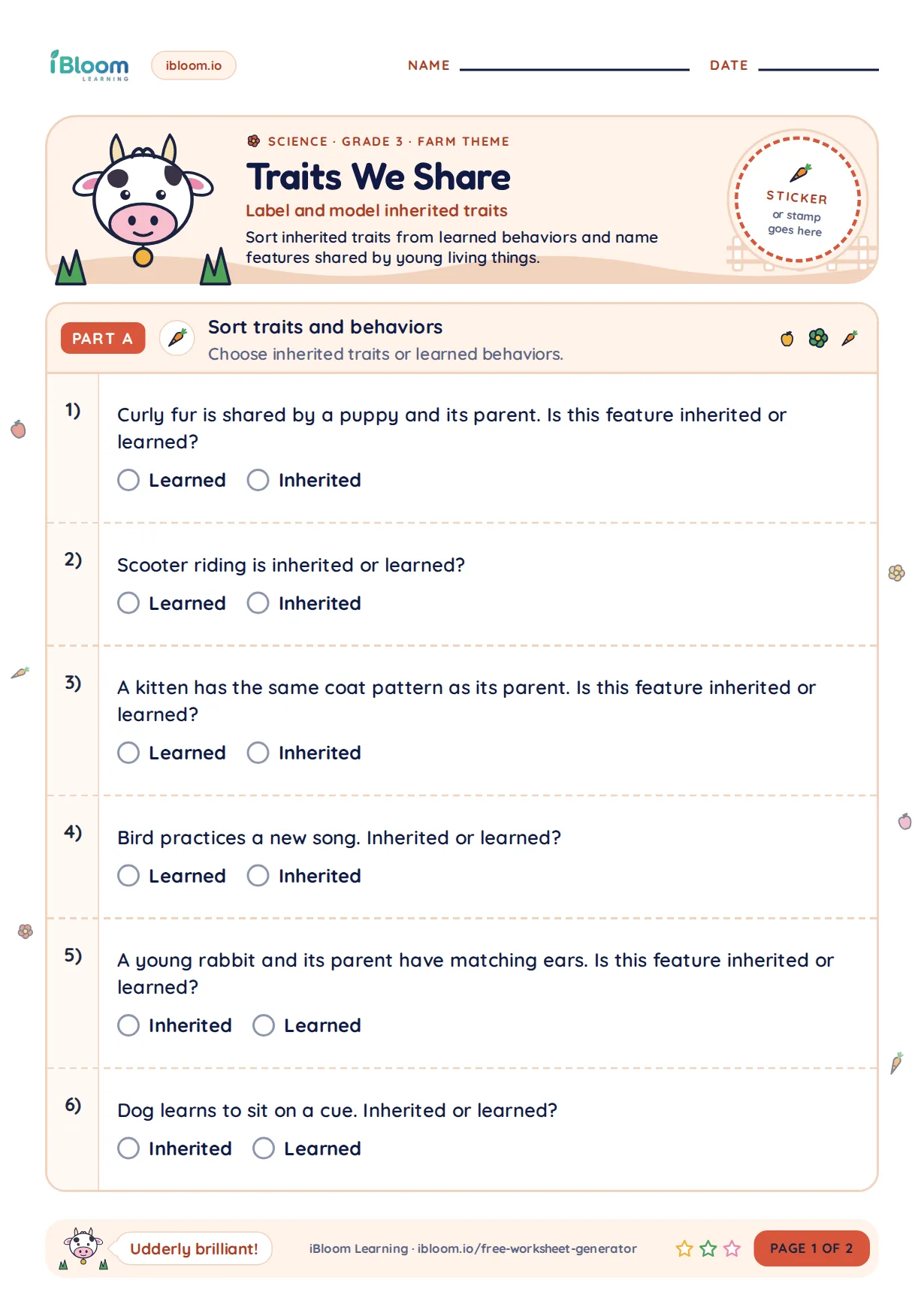 Inherited Traits — Label and ModelGrade 3 science worksheets help children identify inherited traits in animals, plants, and people and separate them from learned or acquired characteristics. This label and model worksheet provides a distinct, age-appropriate way to practise the same lesson.Grade 3Free PDF preview
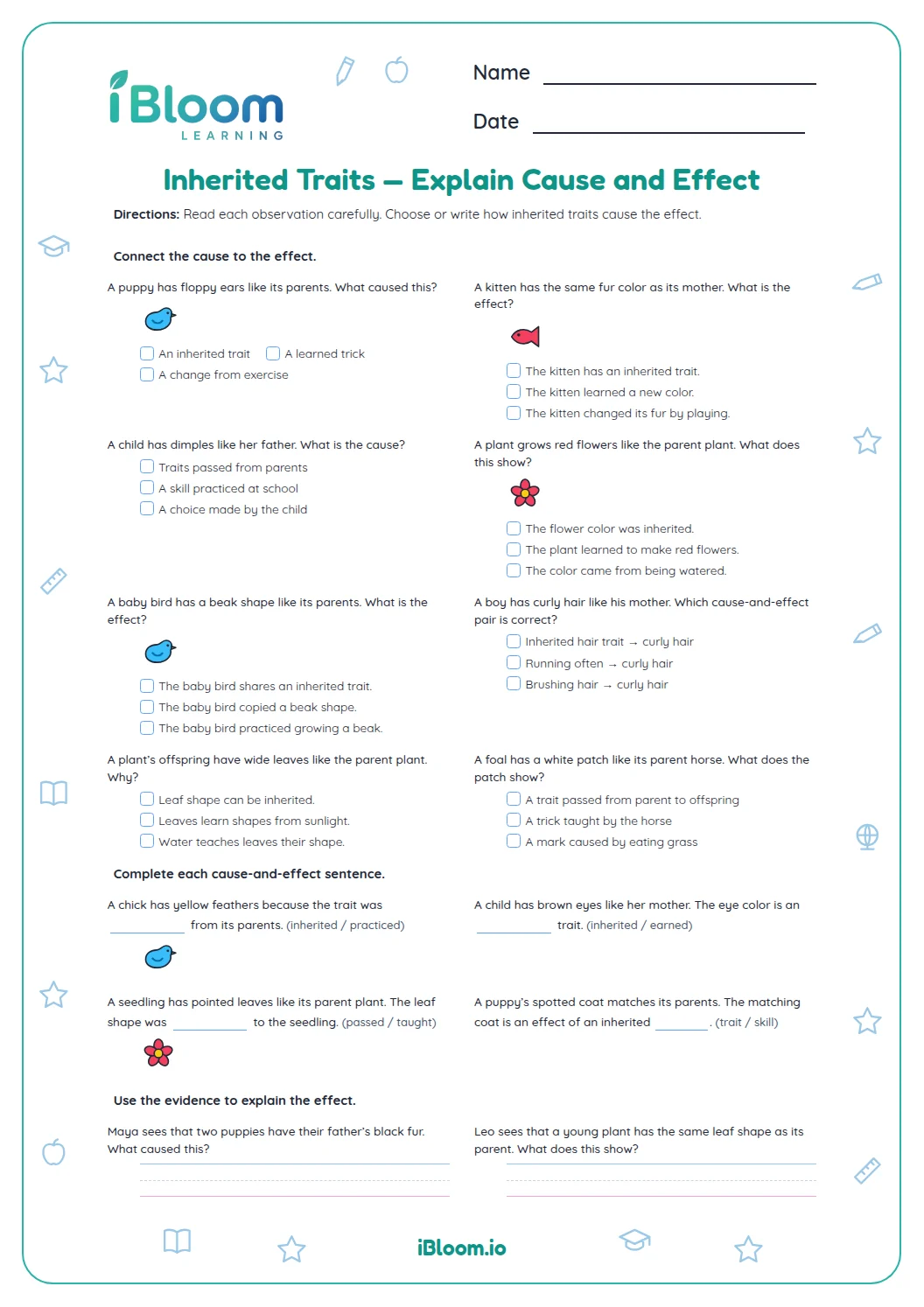 Inherited Traits — Explain Cause and EffectGrade 3 science worksheets help children identify inherited traits in animals, plants, and people and separate them from learned or acquired characteristics. This explain cause and effect worksheet provides a distinct, age-appropriate way to practise the same lesson.Grade 3Free PDF preview
 Inherited Traits — Apply Science IdeasGrade 3 science worksheets help children identify inherited traits in animals, plants, and people and separate them from learned or acquired characteristics. This apply science ideas worksheet provides a distinct, age-appropriate way to practise the same lesson.Grade 3Free PDF preview4 pages
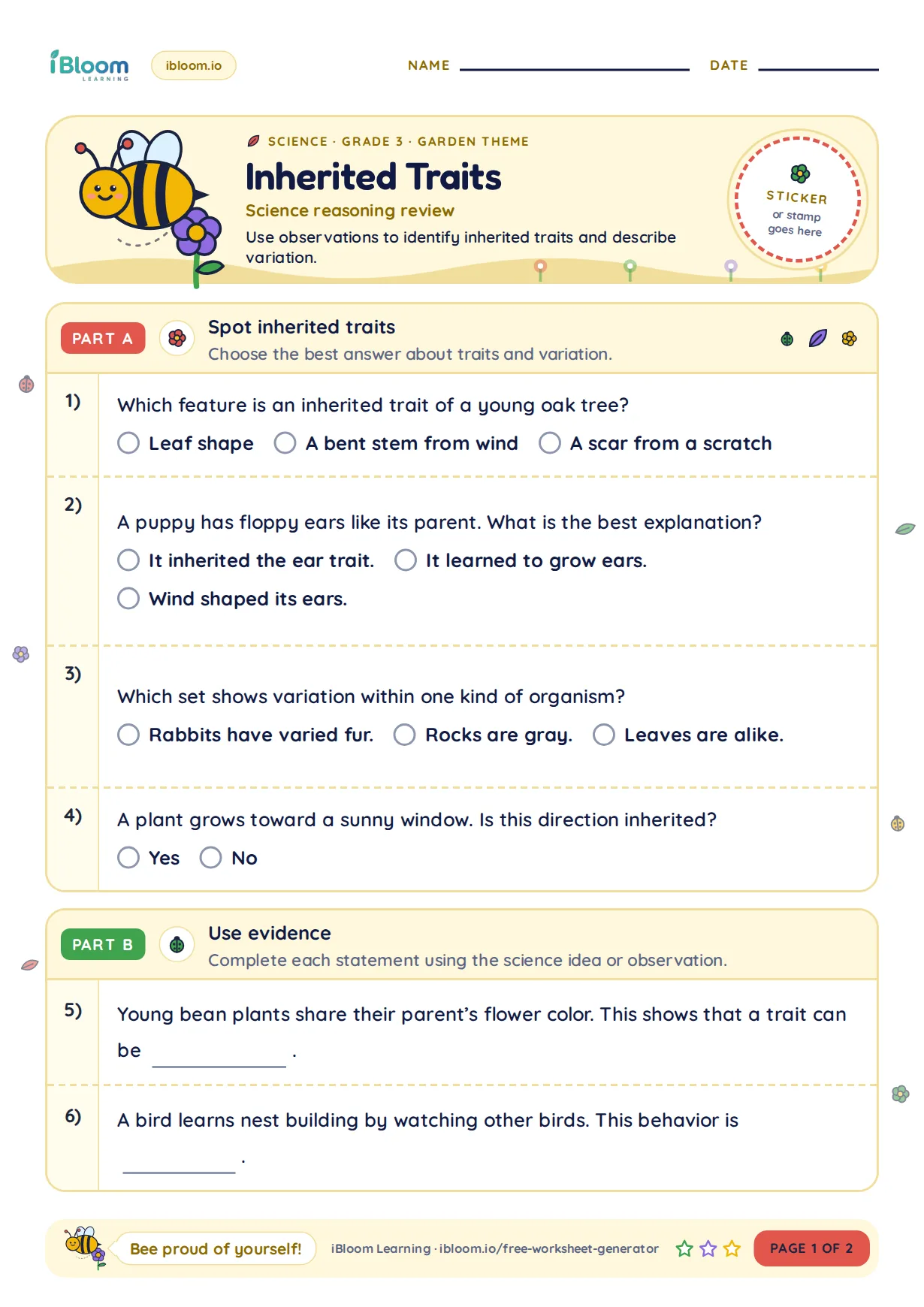 Inherited Traits — Science Reasoning ReviewGrade 3 science worksheets help children identify inherited traits in animals, plants, and people and separate them from learned or acquired characteristics. This science reasoning review worksheet provides a distinct, age-appropriate way to practise the same lesson.Grade 3Free PDF preview
Practice that builds confidence
What students learn
These Grade 3 science worksheets give children clear practice with inherited traits: characteristics passed from parents to offspring. Students look at people, animals, and plants, then decide which features come from parents and which are learned or changed by the environment.
The printable activities include sorting, matching, short explanations, picture-based observations, and simple comparison tasks. Children practise using vocabulary such as offspring, parent, trait, inherit, variation, learned behavior, and acquired trait while building careful evidence-based reasoning.
In the Living Things unit, inherited traits help children understand why young organisms resemble their parents but are not exact copies. A puppy may have a coat color like one parent, a plant may have a similar leaf shape, and a child may share eye color or dimples with family members. Worksheets guide students to notice patterns across generations without assuming every similarity is inherited.

Building the concept step by step
Activities usually begin with familiar examples, then move to comparisons between inherited traits, learned behaviors, and acquired traits. Students may sort “fur color,” “flower color,” and “ear shape” separately from “riding a bike,” “a broken branch,” or “a scar.” This progression helps them see that inherited traits are present because of information passed from parents, while learned behaviors come from practice and acquired traits happen during life.
A simple parent routine
At home, choose one animal, plant, or family-safe example and ask three questions: What do you observe? Could this trait be passed from parents? What evidence makes you think so? Keep the focus on observable features such as hair type, pet markings, seed shape, or plant height. If a child is unsure, have them say, “I need more evidence,” rather than guess.
Classroom uses
Teachers can use these printables for science centers, notebook pages, partner discussions, or quick checks after a lesson on living things. Picture sorts work well for small groups because students can explain their choices aloud. Short-answer items support science writing by requiring a claim such as “This is inherited” followed by a reason.
Common errors to watch for
Many third graders think any family habit is inherited. Remind them that speaking a language, liking a sport, or knowing how to read is learned. They may also think all environmental effects are inherited; a clipped plant leaf or an animal’s injury is not passed to offspring. Height and size can be tricky because both inheritance and environment may play a role, so encourage careful wording.
Free printable PDF download
Use this grade 3 inherited traits worksheet page to preview the activity, print it, or download it as a PDF for quick practice. It works well for homework, homeschool lessons, tutoring, morning work, revision, and classroom centers.
Answers and answer key support
After the child completes the worksheet independently, parents and teachers can use the answer support or answer key information to check the work, review mistakes, and choose the next practice step.
Why iBloom worksheets help
iBloom activities use varied examples, not just one organism, so children build a flexible understanding of traits. A helpful child-friendly strategy is: “Born with it, passed from parents, or learned later?” Saying this before each answer slows students down and turns the worksheet into real scientific thinking.
Helpful answers
Frequently asked questions
What are inherited traits for Grade 3 students?
Inherited traits are characteristics passed from parents to offspring, such as an animal’s fur color, a plant’s flower color, or a person’s natural hair type.
How do these worksheets distinguish inherited traits from learned behaviors?
Students compare examples and decide whether a trait is passed from parents or gained through practice. For example, eye color is inherited, while playing the piano is learned.
Do the activities include both plants and animals?
Yes. The practice includes living things such as animals, plants, and people so children see that inheritance applies across many organisms.
What mistakes should I watch for when my child works on inherited traits?
Children often label habits, skills, injuries, or preferences as inherited. Ask them whether the feature was passed from parents or developed during the organism’s life.
How can teachers use these inherited traits printables in class?
They work well for science centers, partner sorts, notebook responses, review lessons, and quick checks after teaching inherited traits, acquired traits, and learned behaviors.
Is this grade 3 inherited traits worksheet free?
Yes. You can preview it for free and use the printable worksheet for home or classroom practice.
Can I download this grade 3 inherited traits worksheet as a PDF?
Yes. Use the worksheet download option to save a printable PDF, or print the worksheet directly from the page.
Does this grade 3 inherited traits worksheet include answers or an answer key?
When the activity has fixed answers, iBloom includes answer support so parents and teachers can check the completed worksheet.