




About this worksheet
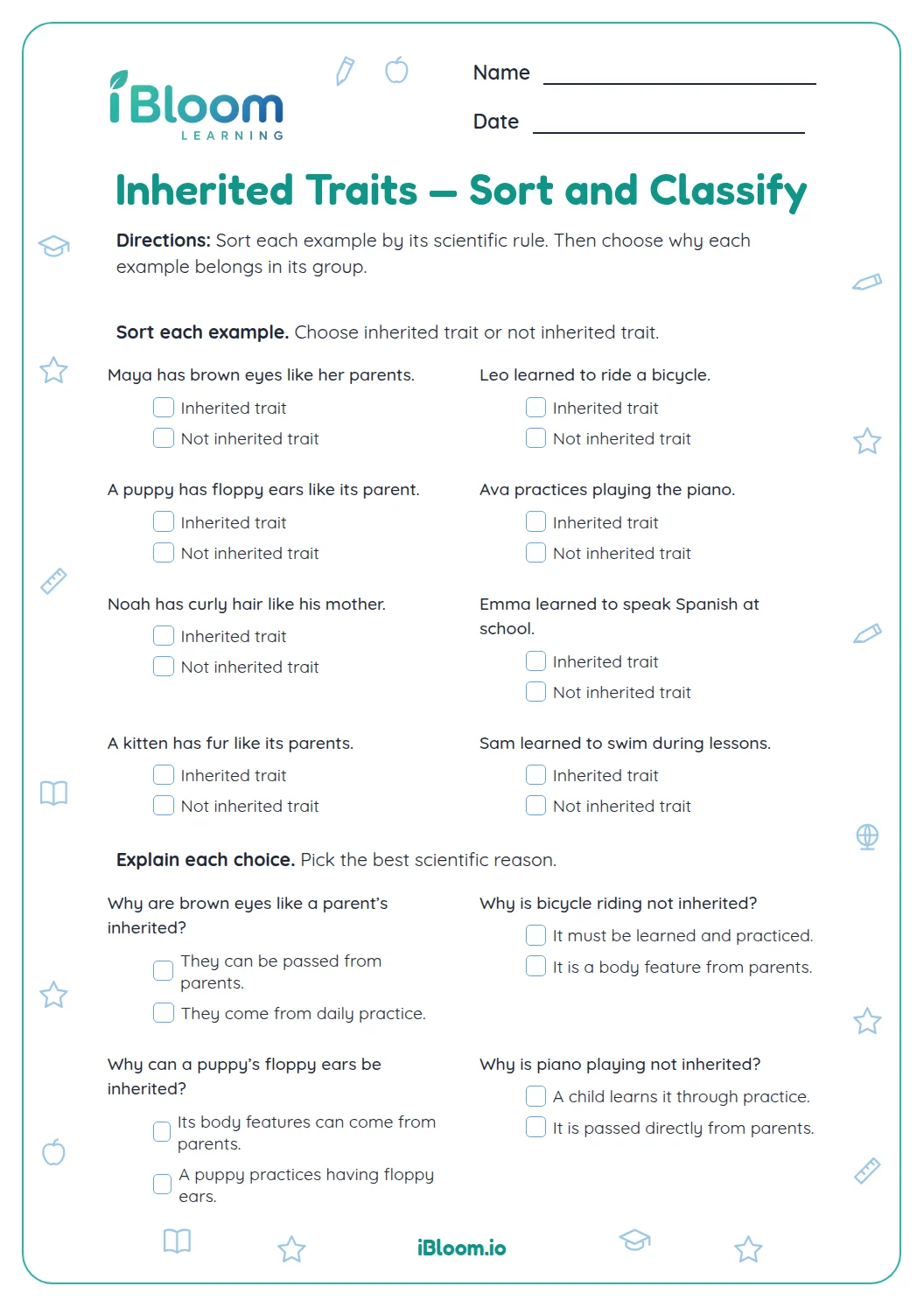
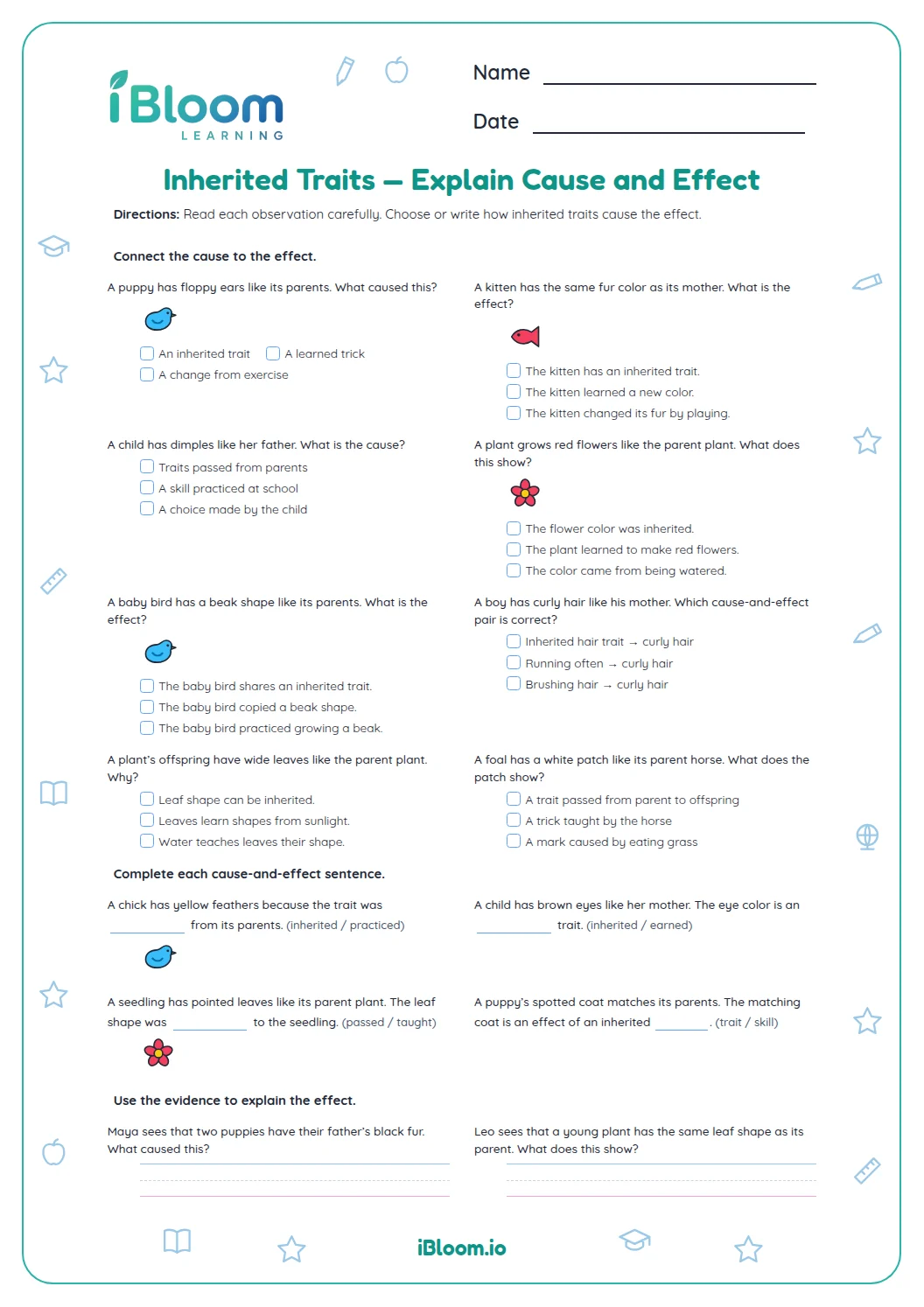
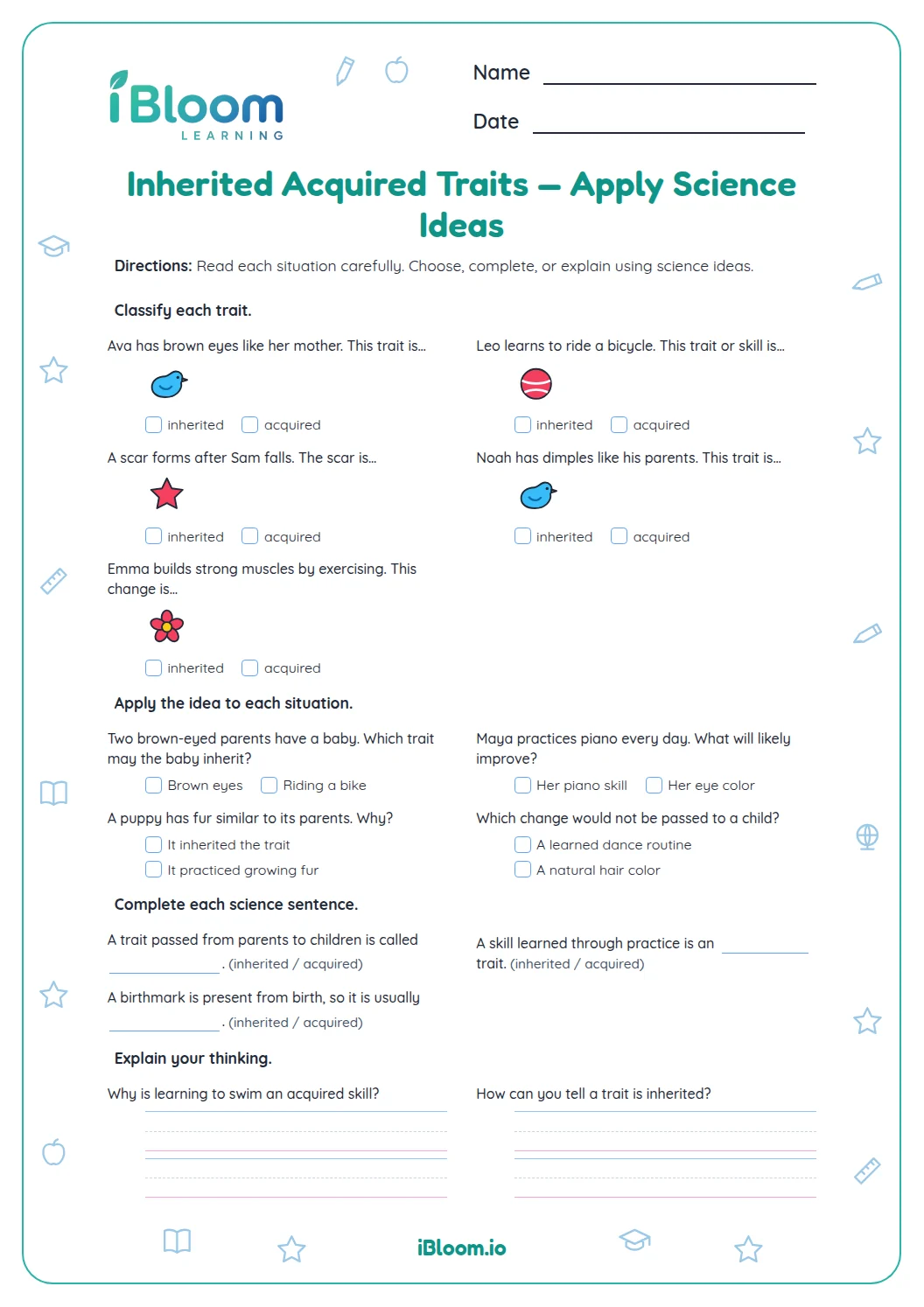
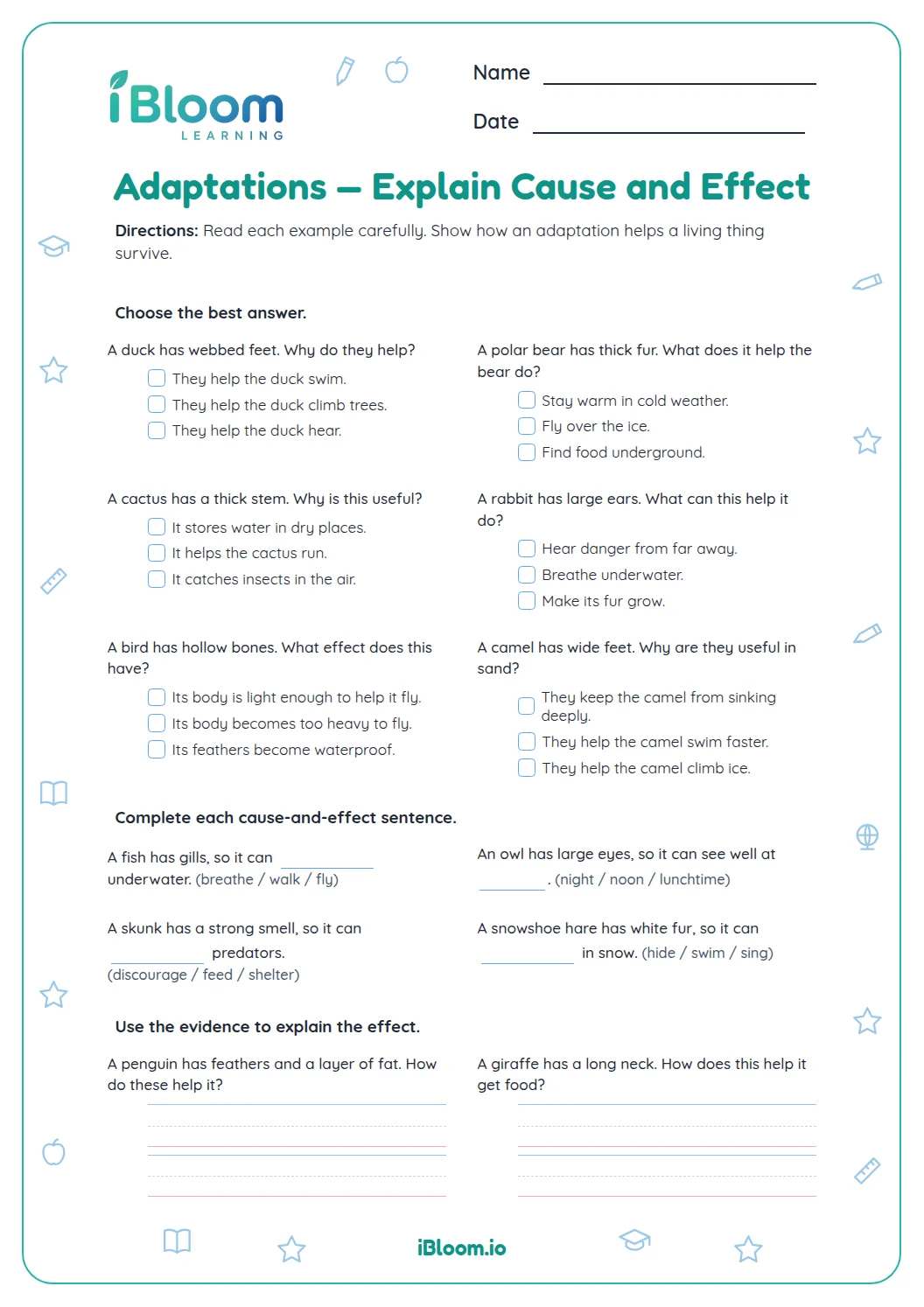
This Grade 3 science worksheet helps children distinguish inherited traits from learned behaviors. Children sort examples involving puppies, birds, rabbits, and plants, name shared features, and explain how young living things can resemble their parents. The 14 prompts build from classification to short explanations, with a separate answer key. The activity practices noticing observable similarities in living things.
How can we tell inherited traits from learned behaviors?
Inherited traits are features young organisms receive from parents. Learned behaviors come from experience or practice. A young rabbit’s ears are a feature; learning to follow a cue is a behavior.
In question 1, curly fur is a body feature shared by puppy and parent. Children decide whether that feature comes from inheritance or learning.
- 1A puppy has the same curly fur as its parent dog.
- 2The example describes a body feature passed from parent to young.
- 3Answer: inherited
Which features can children compare?
Children can look for visible similarities, such as fur, feathers, leaves, or flower color. A feature is easier to discuss when the prompt names both the young organism and its parent.
What does the worksheet ask children to explain?
The model items ask children to connect a parent’s feature with the same feature in its young. They choose the missing label, such as inherited trait or offspring, from the given choices.
How can I use this worksheet?
- 1Read whether each example describes a feature or an action.
- 2Ask whether practice or experience is involved.
- 3For shared-trait questions, name the feature directly.
- 4Explain that inherited traits pass from parents to young.
- 5Check each response with the answer key.
Common mistakes and quick fixes
The mistake
Calling every behavior inherited
The fix
Ask whether the organism had to practice or learn it.
The mistake
Naming an organism instead of its trait
The fix
State the feature, such as curly fur or leaf shape.
The mistake
Confusing a shared feature with an identical organism
The fix
Describe only the particular trait that is alike.
What to practice next
Make more practice
Questions parents and teachers ask
What is an inherited trait?
An inherited trait is a feature passed from parents to their young. This sheet uses visible similarities such as fur, feathers, leaf shape, and flower color. Children identify those traits and connect them in simple parent-to-young models. Read each clue carefully and use the answer key to check the specific example and the idea it represents.
What is a learned behavior?
A learned behavior develops through experience or practice. This worksheet contrasts those actions with inherited features, using examples such as riding a scooter, practicing a song, and responding to a training cue. Read each clue carefully and use the answer key to check the specific example and the idea it represents.
How many questions are included?
There are 14 multiple-choice questions in three parts. Children classify inherited features and learned behaviors, identify similarities between parent and young organisms, and complete models that connect traits to offspring. Read each clue carefully and use the answer key to check the specific example and the idea it represents.
What does the model practice?
The model connects a feature in a parent to the same feature in its young through inheritance. Questions use models of fur and bird beak shape, then ask learners to complete parent, trait, and offspring relationships. Read each clue carefully and use the answer key to check the specific example and the idea it represents.
Is there a drawn diagram to label?
The worksheet uses short model statements with answer choices for labels. Children select terms for parent, inherited feature, or young organism, then use the answer key to check each relationship. Read each clue carefully and use the answer key to check the specific example and the idea it represents.