




About this worksheet
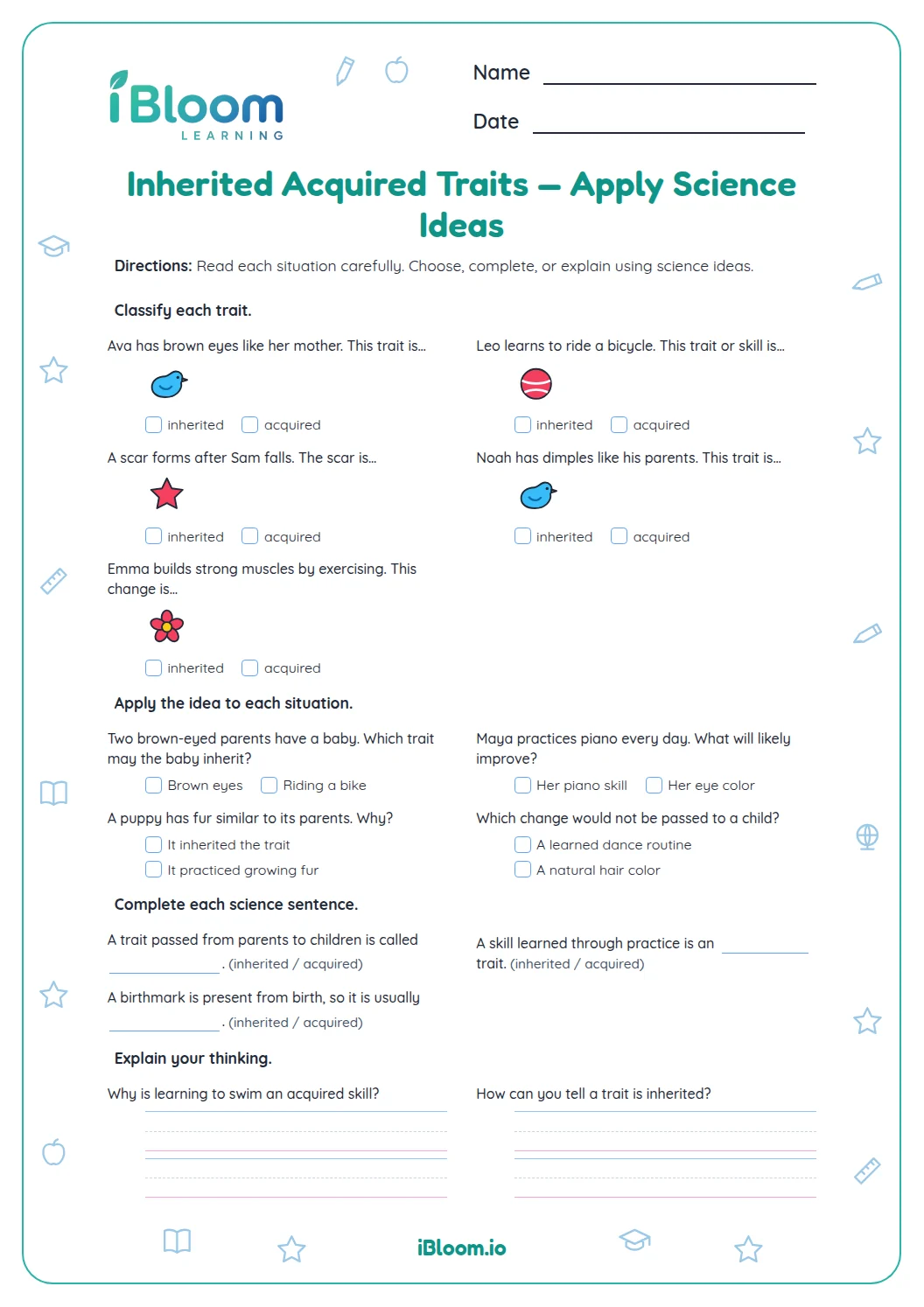
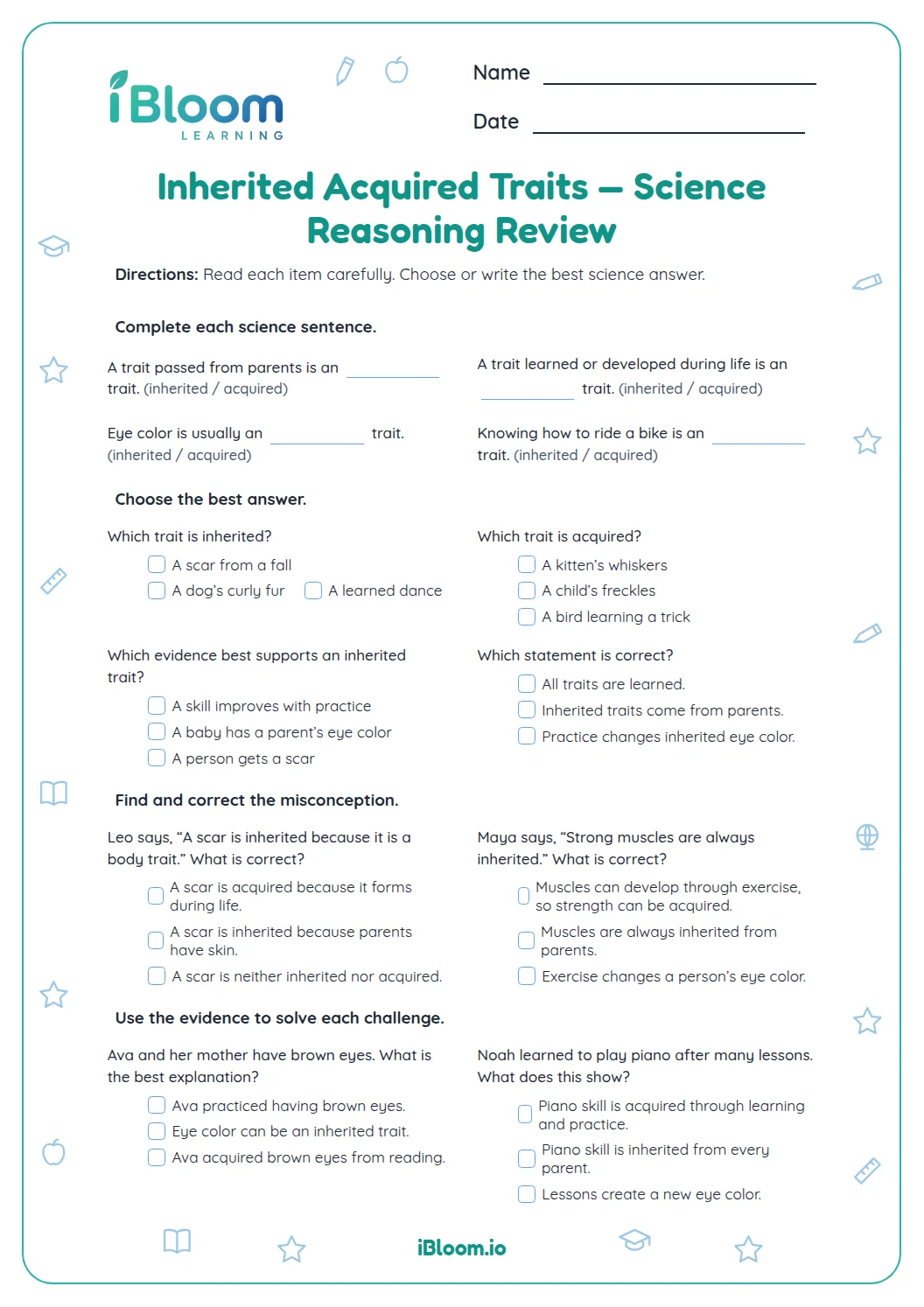
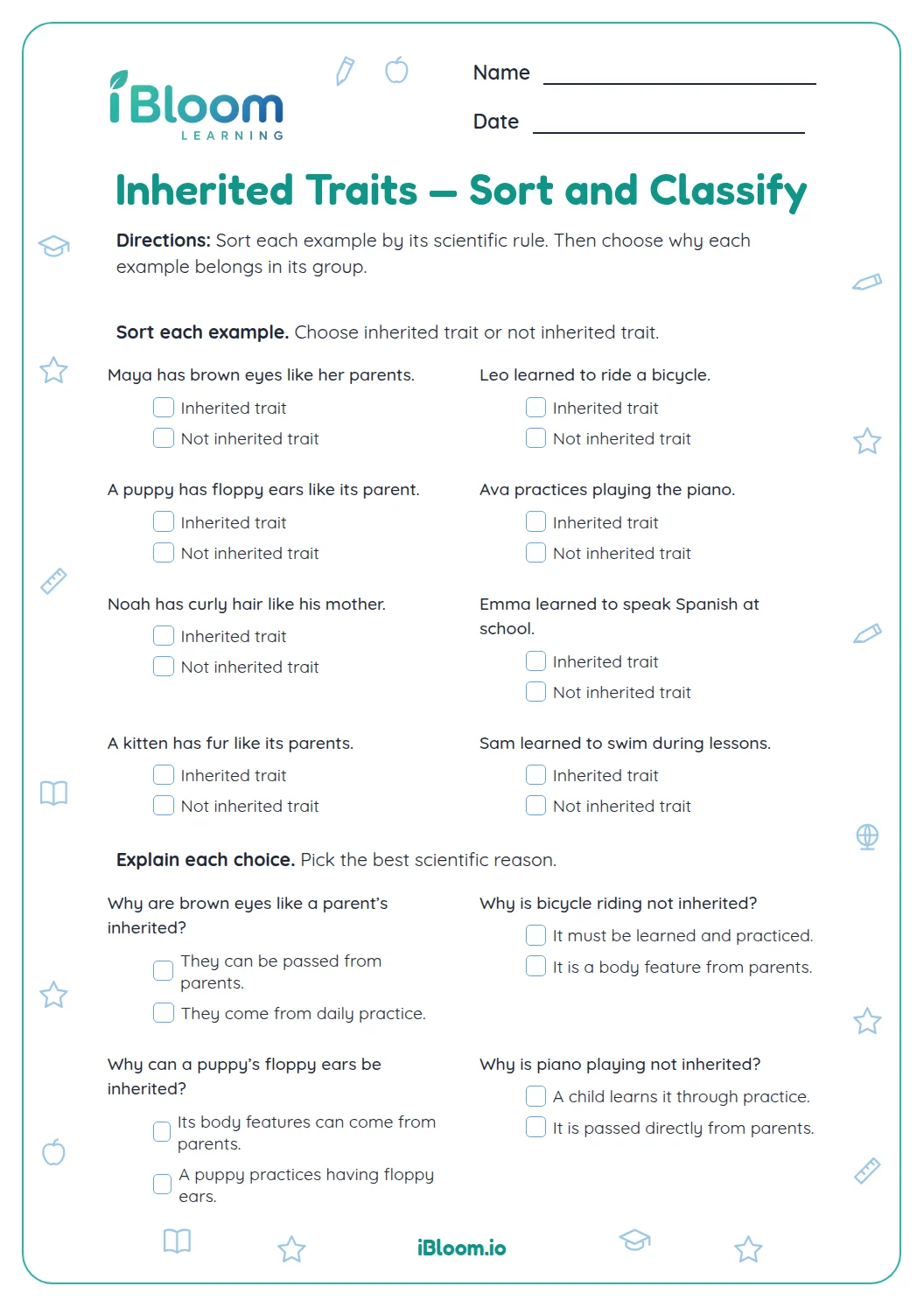
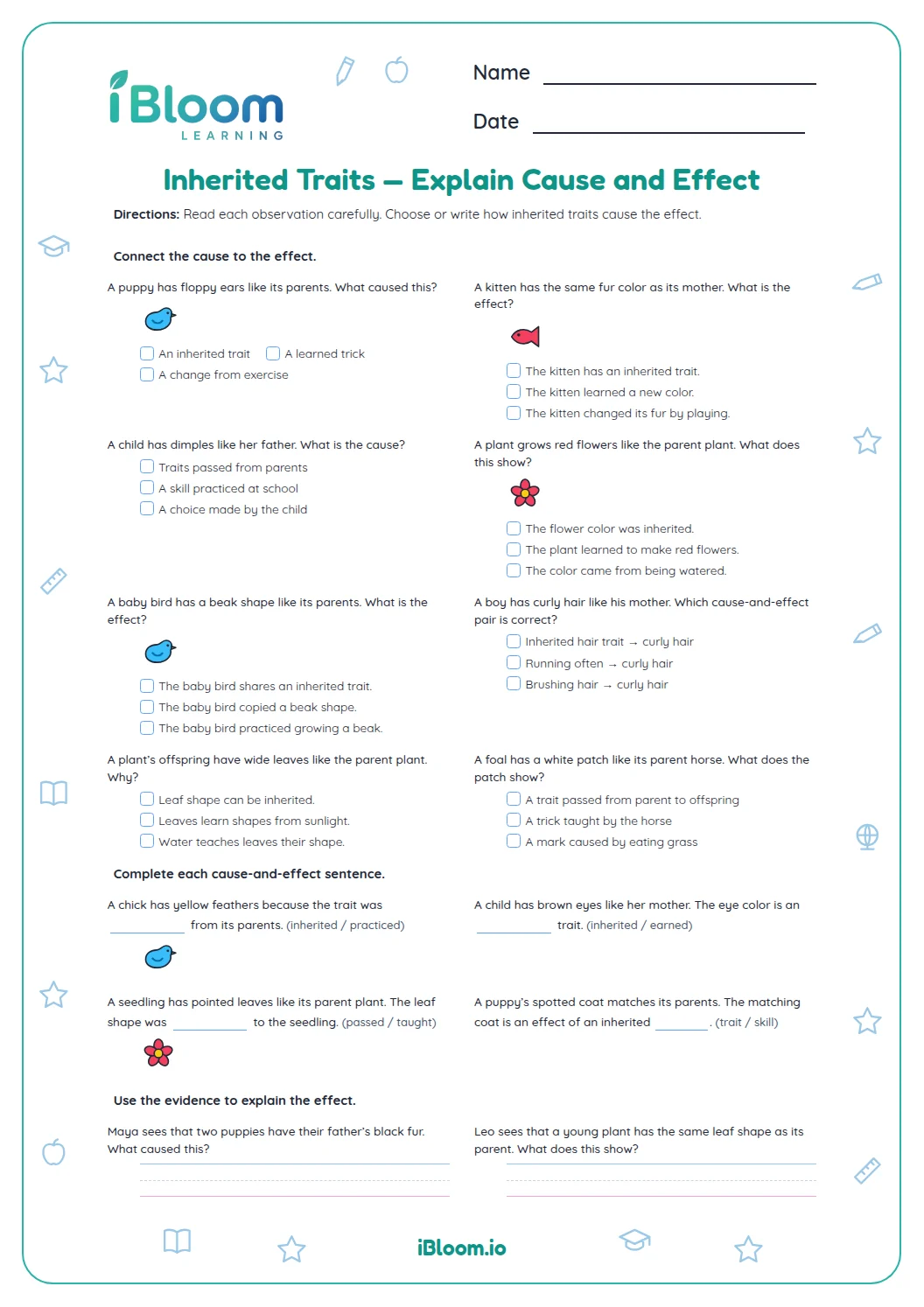
This free Grade 3 science worksheet asks children to connect traits with their causes. Six multiple-choice questions distinguish inherited features, learned skills and changes caused by the environment. Four written responses then ask children to use observations as evidence, including bean plants that receive different amounts of water and grass growing with or without light. The environmental comparisons practice NGSS 3-LS3-2 by supporting explanations with evidence. A separate answer key gives correct choices and brief model explanations. Children should name both a likely cause and the clue that supports it.
Aligned to 3-LS3-2
What is the difference between inherited and acquired traits?
Inherited traits are passed from biological parents to offspring, such as a kitten’s natural coat color. Acquired characteristics develop during life, including a scar after an injury or a skill learned through practice. The environment includes conditions such as water, light and opportunities to learn.
Some characteristics reflect both inheritance and environment. A plant’s growth can depend on the kind of plant it is and the conditions in which it grows. Focus on the specific evidence in each question instead of treating all traits as having only one cause.
How does the plant example show cause and effect?
Question 7 compares two bean plants of the same kind. They start at the same height and receive the same light and soil, but one gets very little water. The observed difference in growth supports an explanation involving water.
- 1Starting conditions: same kind, height, light and soil
- 2Changed condition: one plant gets very little water
- 3Observation: that plant grows less
- 4Sample explanation: Less water limited growth; the plant with little water grew less.
What makes a written answer strong?
A useful explanation names the cause and an observation that supports it. “Practice” alone is too short for the ball-catching question; explain that the puppy caught the ball only after daily practice.
Part B includes water and growth, practice and learning, light and grass color, and inherited curly fur. The key offers one concise explanation per question. Accept other wording that uses the same evidence correctly.
How to use this worksheet
- 1Discuss inherited as passed from biological parents and acquired as developed during life.
- 2Have your child choose an answer for each Part A situation.
- 3Read each Part B example and identify the cause and the supporting clue.
- 4Ask your child to connect a cause with evidence using because.
- 5Compare each explanation with the key, checking the scientific idea rather than exact wording.
Mistakes to notice and ways to help
The mistake
Calling a dog’s trick inherited because its parent can do the trick.
The fix
Look for evidence of training: the dog learned the trick through practice.
The mistake
Saying the short bean plant must be a different kind of plant.
The fix
Reread the starting conditions: both are the same kind, and the water supply differs.
The mistake
Writing only “sunlight” for the grass explanation.
The fix
Name the observed result too: shaded grass became pale while nearby sunlit grass stayed green.
NGSS alignment
Use evidence to explain how water, light and learning can influence traits.
On this sheet: Children explain environmental changes using observations about plant growth, grass color, learning and injury.
Show the official wordingHide the official wording
Use evidence to support the explanation that traits can be influenced by the environment.
What to practice next
Make more practice
Further reading
Questions parents and teachers ask
Are learned skills acquired traits?
Yes. In this worksheet, acquired characteristics include skills developed through experience and practice. The puppy learns to catch a ball after daily practice, so that ability is acquired. Ask your child to point to the practice clue rather than deciding from the animal’s appearance or its parents’ skills.
Can a trait have both inherited and environmental influences?
Yes. Many characteristics reflect both inherited information and environmental conditions. Plant growth is a useful example: the kind of plant matters, and so do water and light. This worksheet asks children to explain the particular change described, using the evidence supplied about conditions before and after it.
Why do the bean plants have the same light and soil?
Those matching conditions make the water difference easier to investigate. The plants also begin as the same kind and height. When the plant with little water grows less, children have evidence that water supply influenced growth. A good answer names both the water difference and the growth result.
Does the grass question prove that all pale grass lacks light?
No. The question supports an explanation for the particular patch described. It says grass beneath a box became pale while nearby grass in sunlight stayed green. Children use that comparison to explain the effect of less light here, rather than guessing a cause from color alone.
How should I mark the written explanations?
Accept a scientifically sound explanation that names a cause and uses an observation from the question. The key gives sample wording for all four written responses. A child can use different words, but “it changed” alone needs a specific detail about growth, color, learning or inherited fur.