




About this worksheet
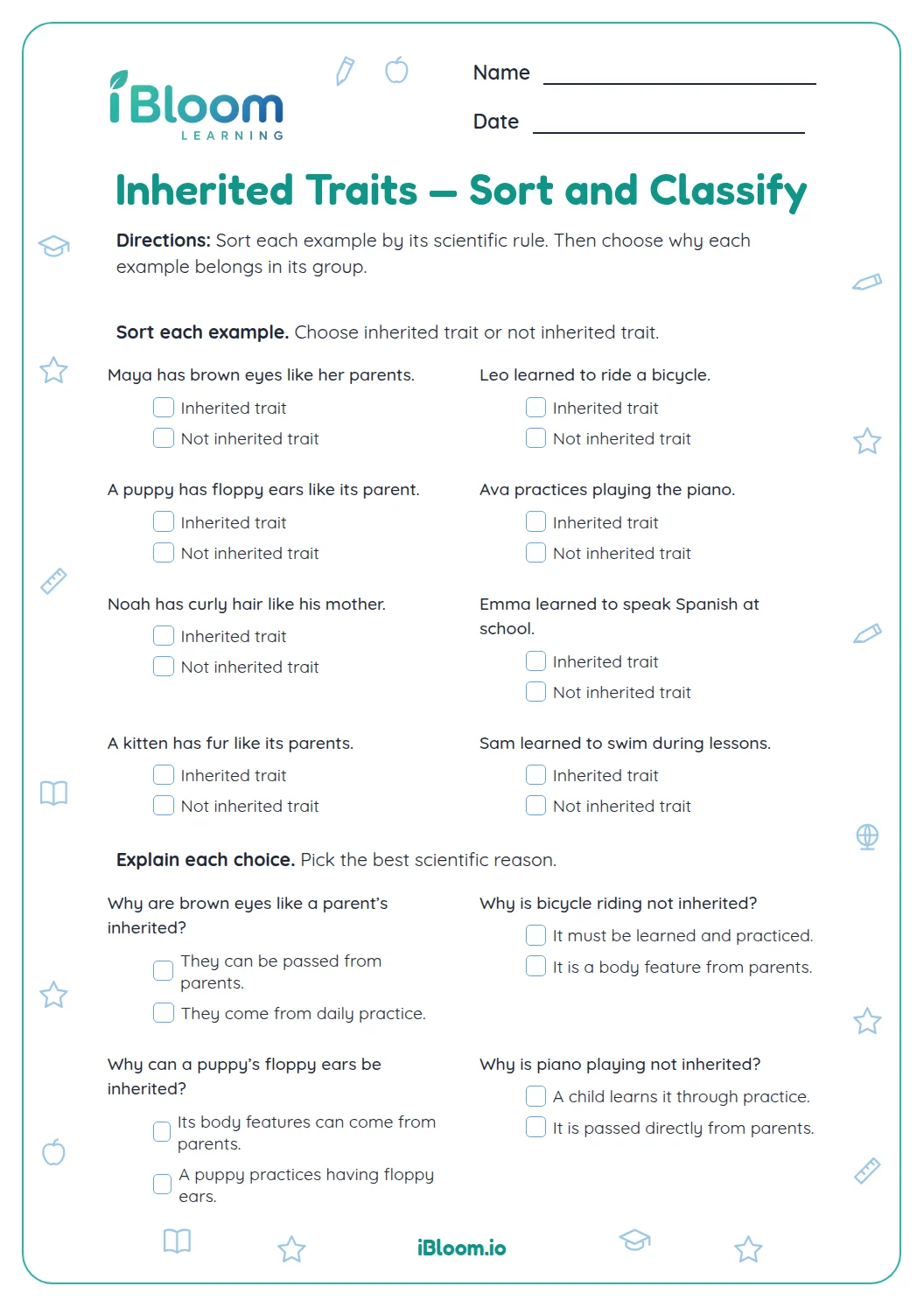
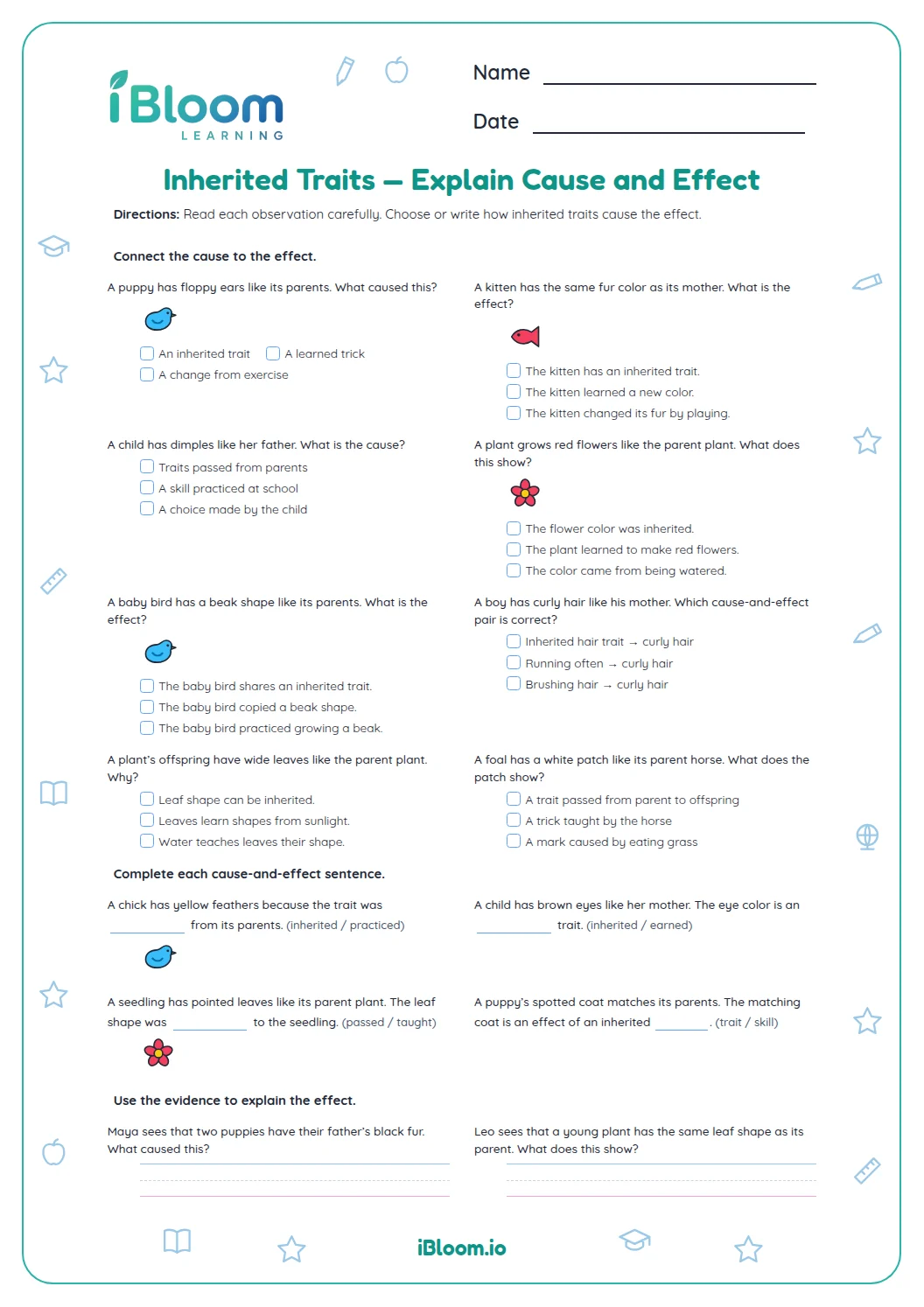
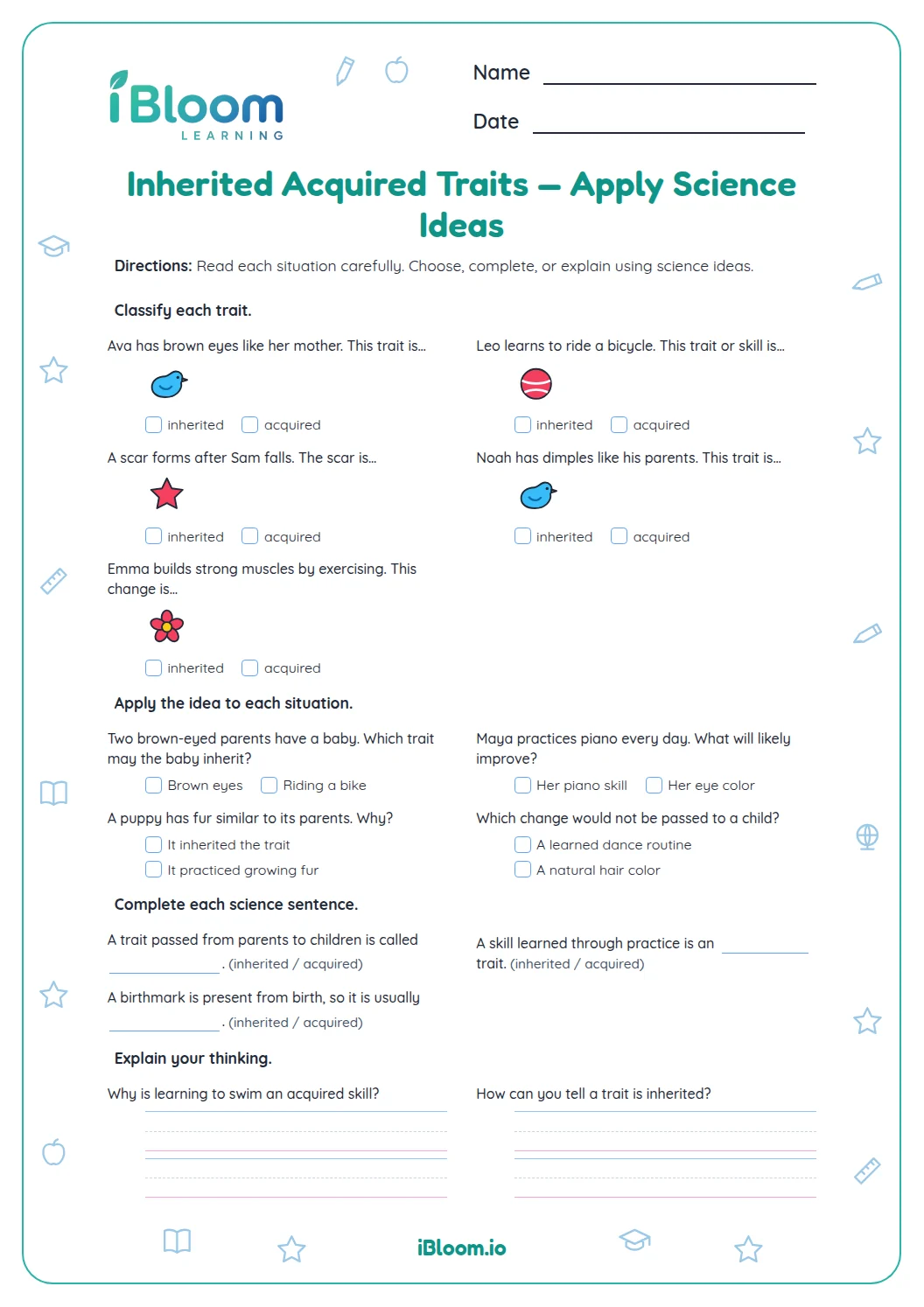
This Grade 3 science worksheet asks students to use observations of plants and animals to identify inherited traits and variation. Students classify examples, read a small trait table, and complete evidence-based statements about similarities and differences in a group. The questions align with NGSS 3-LS3-1, which asks students to analyze and interpret evidence that plants and animals inherit traits and that variation exists within groups. The printable includes a separate answer key.
Aligned to 3-LS3-1
What makes a trait inherited?
A trait is a feature of a living thing, such as a plant’s leaf shape or an animal’s coat color. A trait is inherited when it is passed from parent organisms to their young. Comparing related organisms gives evidence for shared traits.
What does variation look like?
Variation means individuals in a group differ in a feature. Rabbits of the same kind may have different fur colors, and plants may have different leaf shapes. Careful observations help distinguish a group pattern from a one-time detail.
- 1Plant A: oval leaves; Plant B: oval leaves; Plant C: pointed leaves.
- 2A and B both have oval leaves.
- 3Plant C differs, so the table shows variation in leaf shape.
How can observations support a claim?
Name the trait and the pattern you observe. For example, if several young snails have shell patterns also seen in their parent snails, the observations support the idea that shell pattern can be inherited. Avoid making a claim from one observation alone.
How to use this worksheet
- 1Read each plant or animal example closely.
- 2Decide whether it describes an inherited feature, a difference, or an environmental response.
- 3For the table questions, compare all three rows before making a claim.
- 4In written answers, name the trait and the evidence.
- 5Use more than one example when describing a group pattern.
- 6Check the answer key and revise explanations that need clearer evidence.
Common reasoning mistakes and fixes
The mistake
Calling every feature an inherited trait, including a bent stem after wind.
The fix
Ask whether the feature was passed from parent organisms or changed through an experience or condition.
The mistake
Assuming all individuals of one kind have identical traits.
The fix
Compare several individuals and look for both similarities and differences.
The mistake
Making a broad claim from one organism.
The fix
Use observations from multiple members of the group to support a pattern.
Next Generation Science Standards alignment
Students use plant and animal observations to reason about inheritance and variation.
Use evidence to identify inherited traits and variation in groups of organisms.
On this sheet: Questions compare traits in parent and young organisms and interpret differences within groups.
Show the official wordingHide the official wording
Analyze and interpret data to provide evidence that plants and animals have traits inherited from parents and that variation of these traits exists in a group of similar organisms.
What to practice next
Make more practice
Further reading
Questions parents and teachers ask
What are inherited traits in plants and animals?
Inherited traits are features passed from parent organisms to their young. Examples on this worksheet include leaf shape, shell pattern, and coat color. Students compare observations and look for similarities across generations. These observable examples help them connect a trait to evidence from related plants and animals.
What does variation mean in science?
Variation means that members of a group differ in one or more traits. For instance, a group of rabbits may include different fur colors. The worksheet asks students to use examples and a table to identify such differences.
Does the worksheet ask students to study genes?
The questions focus on visible traits and evidence from plants and animals, such as comparing the leaf shapes of young plants or the coats of young foxes. Students do not need to explain genetic mechanisms. They use observations to make and support a simple science claim.
How many questions are included?
There are 14 questions across classification, evidence reading, and fill-in reasoning. A small table compares leaf shapes in three plants, and later items ask students to connect observations with a science idea. This gives students practice interpreting data and explaining a pattern.
Is an answer key included?
Yes. The separate answer key provides short answers and sample responses for open-ended questions. Students can use it to check whether they named the relevant trait and backed up an idea with observations. A response may use different wording while keeping the same evidence-based idea.