



About this worksheet
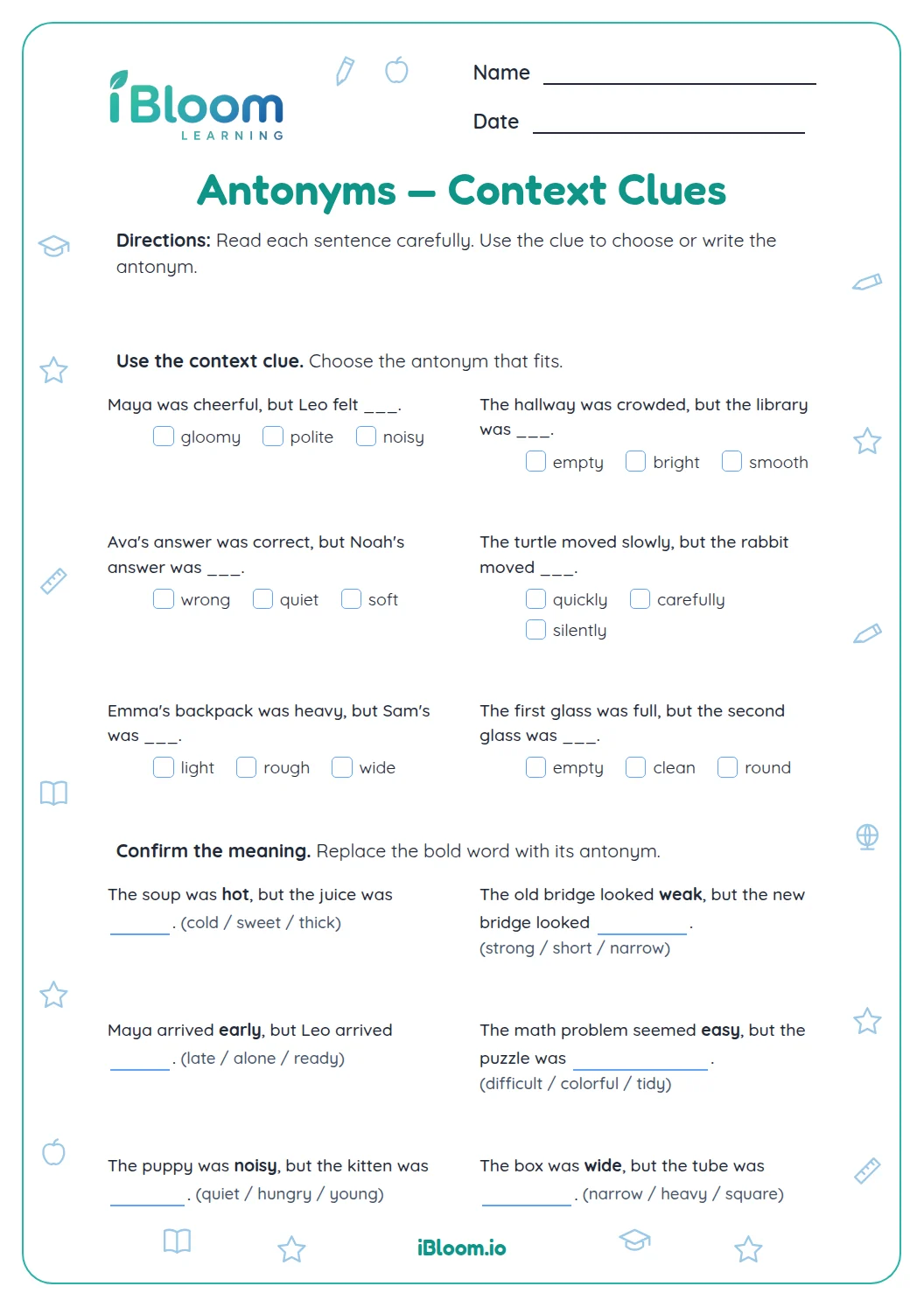
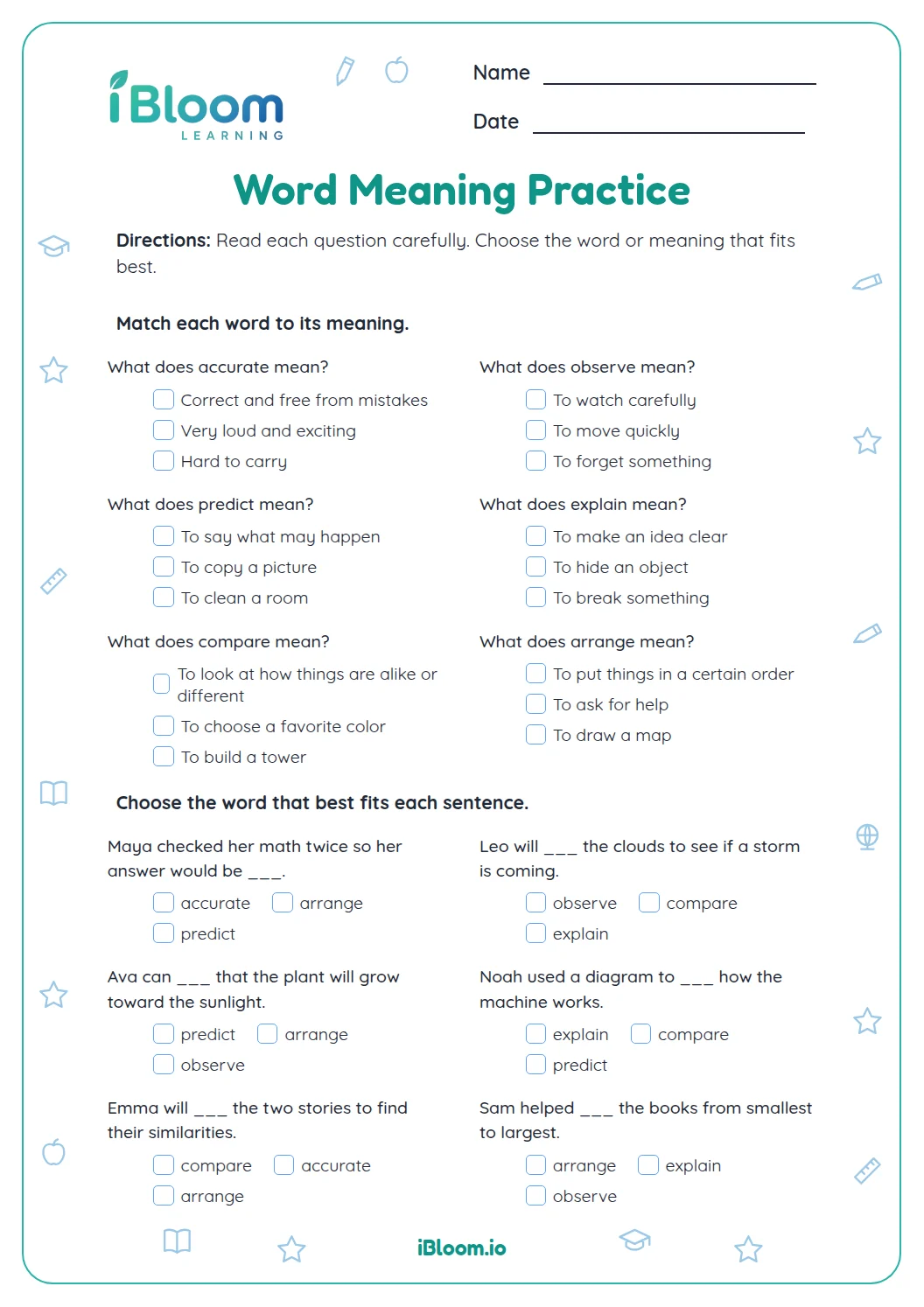
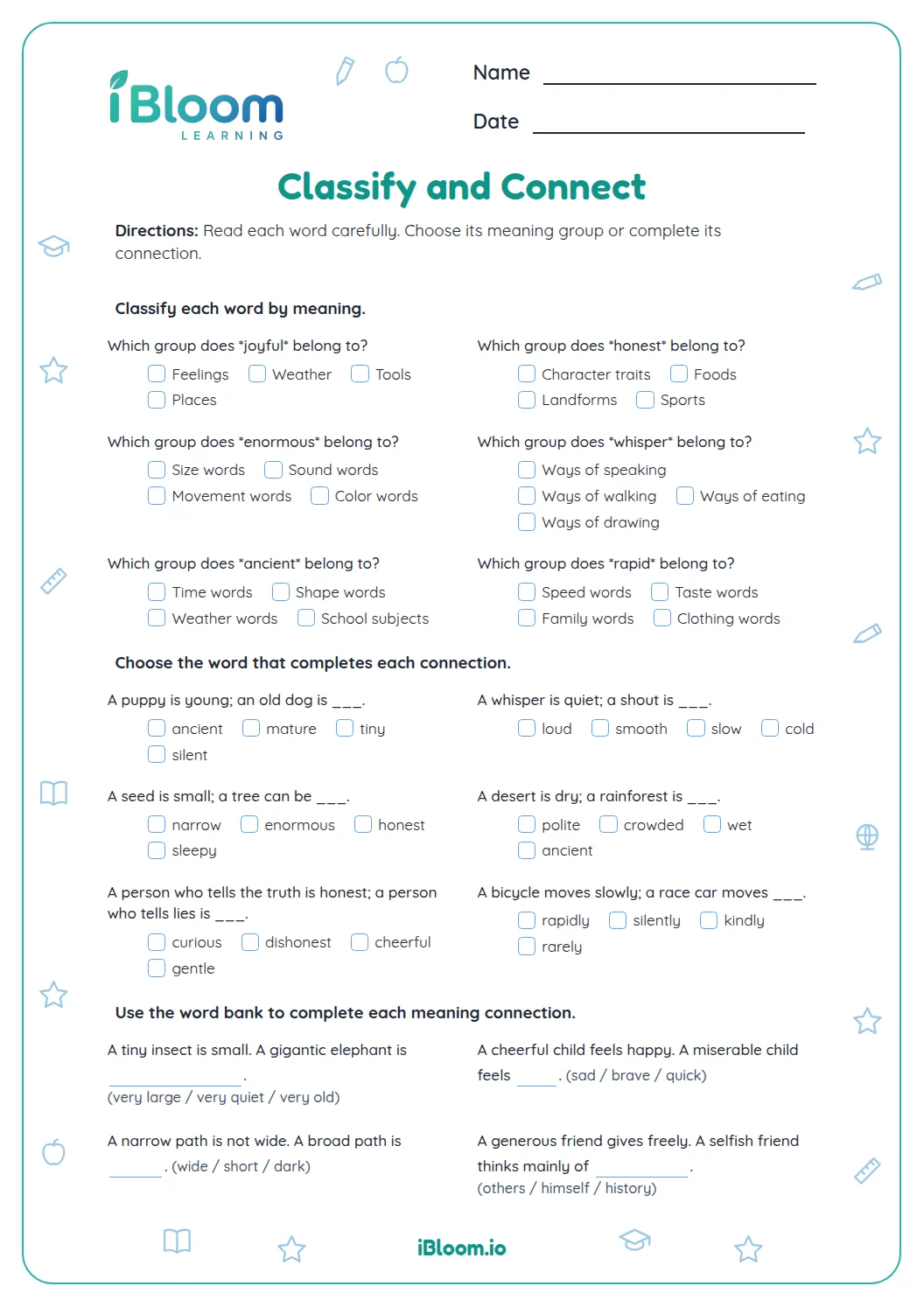
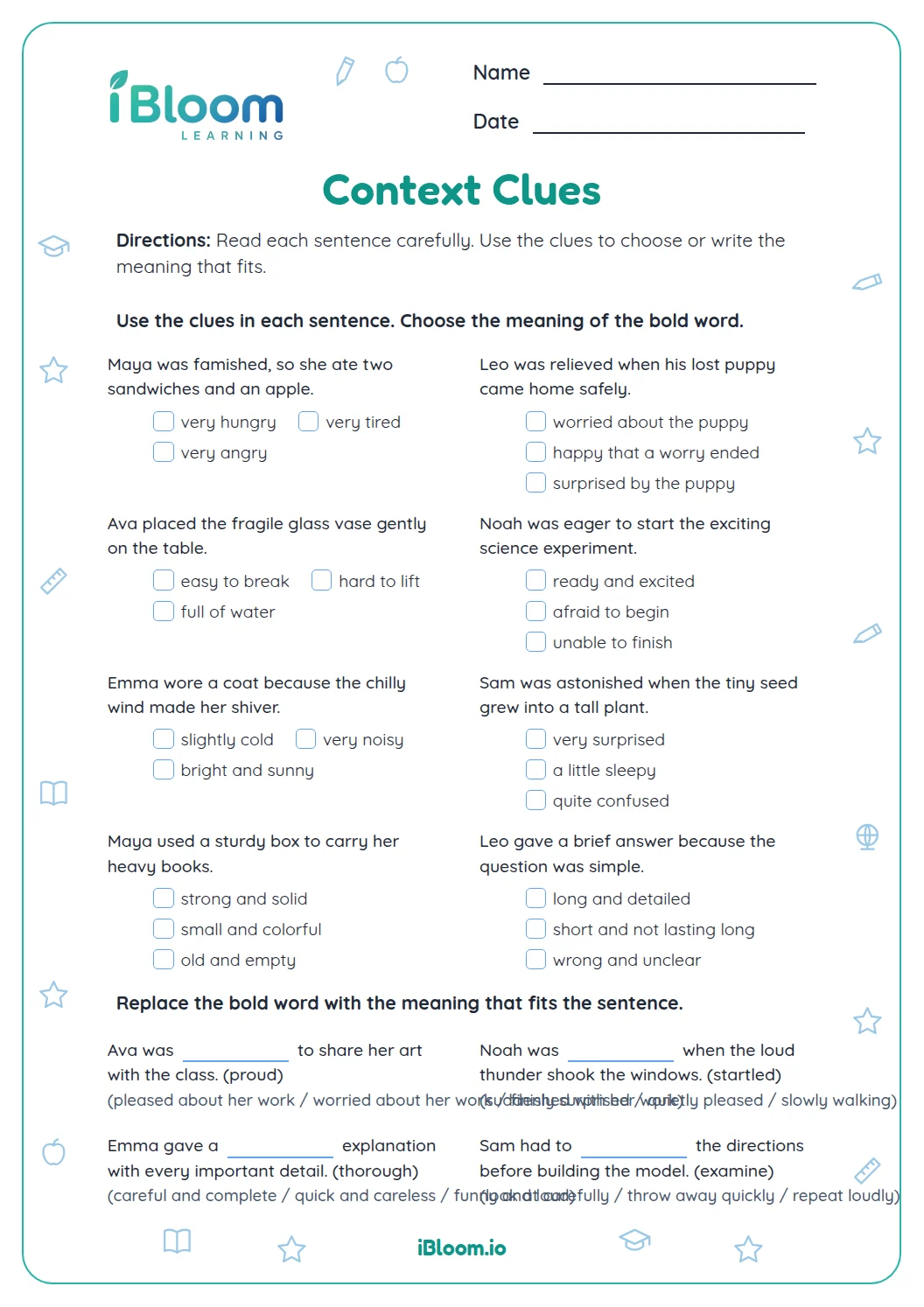
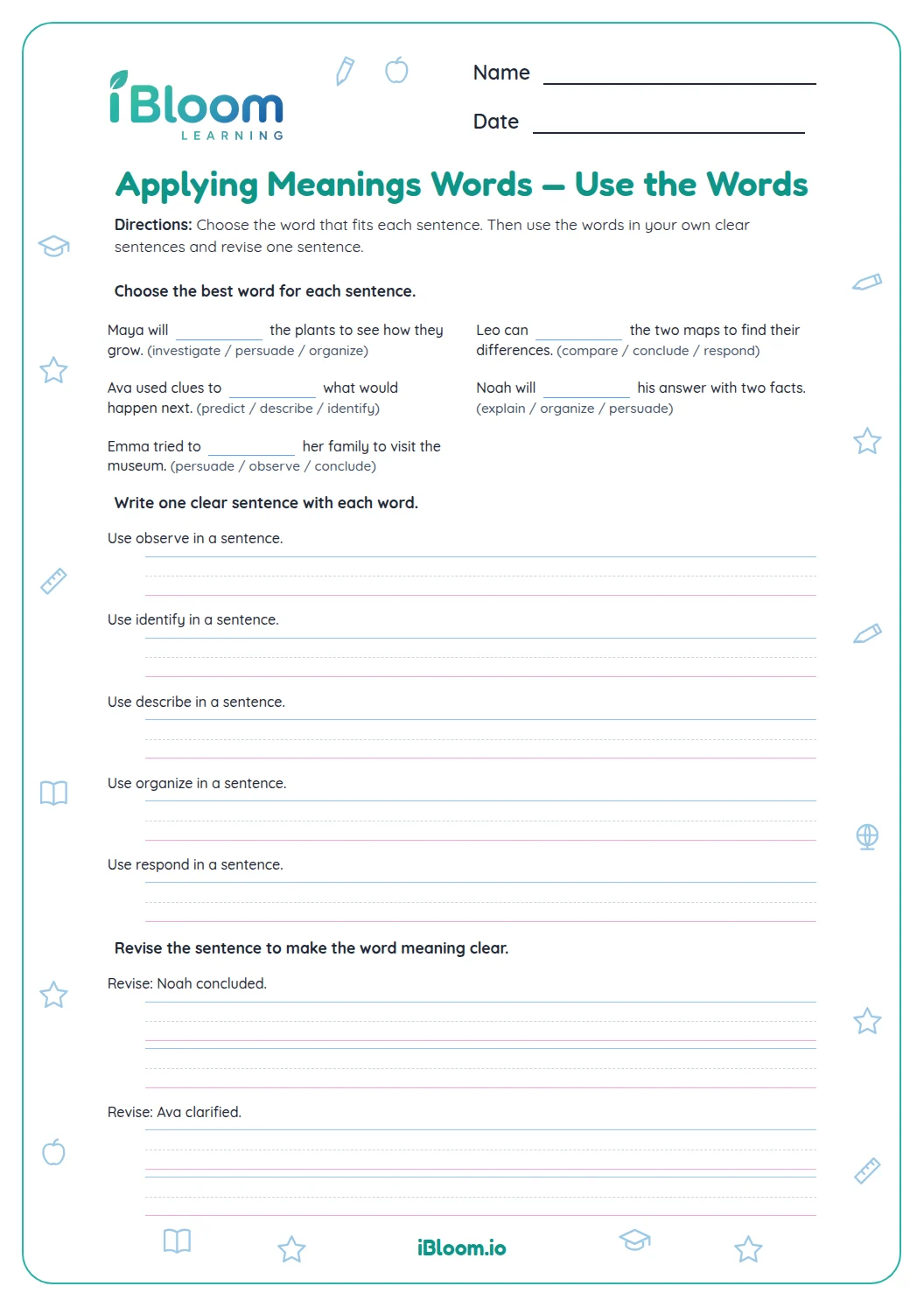
This Grade 4 worksheet asks learners to read each short context carefully, infer a bold word’s meaning, and connect a meaning to a supporting detail. Twelve items practice word meaning; the final two ask which clue supports an inference. The answer key gives a clear check for each choice.
Aligned to L.4.4a
What is a context clue?
A context clue is a nearby word, phrase, or sentence detail that helps a reader work out an unfamiliar word. Sometimes the text gives an example; other times, the surrounding actions or descriptions point to the meaning.
- 1The trail was arduous, so the hikers rested often on the steep, rocky path.
- 2Clue: hikers rested often; the path was steep and rocky.
- 3Those details suggest arduous means difficult.
How do you use the whole sentence?
Read beyond the target word. Look for an explanation, an example, a contrast, or a result. Then substitute a possible meaning and check whether the entire context still makes sense.
How can a reader explain a meaning?
Part A has twelve short contexts with a bold target word. Part B asks learners to choose the detail that supports a word meaning in its context.
How to use this worksheet
- 1Read the whole context, including the sentence after the target word.
- 2Use nearby descriptions, actions, or results as clues.
- 3Test a possible meaning in the sentence.
- 4For the final two items, choose the detail that supports the meaning.
- 5Check each choice with the answer key.
Common mistakes and quick fixes
The mistake
Guessing from the target word alone.
The fix
Use the nearby details and reread the sentence with a possible meaning.
The mistake
Choosing a detail that is true but unrelated to the meaning.
The fix
Check how the detail explains or supports the target word.
The mistake
Stopping after reading only the clause with the target word.
The fix
Read the rest of the context for a result, description, or example.
Common Core alignment
Learners use nearby descriptions, actions, and results as context for word meaning.
Use nearby sentence clues to determine the meaning of an unfamiliar word.
On this sheet: All 14 multiple-choice items use a context sentence to determine a word meaning or select a detail that supports it.
Show the official wordingHide the official wording
Use context (e.g., definitions, examples, or restatements in text) as a clue to the meaning of a word or phrase.
What to practice next
Make more practice
Further reading
Questions parents and teachers ask
What is a context clue?
A context clue is information near an unfamiliar word that helps a reader infer its meaning. It may be an example, description, contrast, or result. In “The puppy was famished … and ate its whole bowl,” the action of eating a full bowl points to famished meaning very hungry.
How should a child solve the multiple-choice questions?
Read the complete context, notice details around the bold target word, and test each choice in the sentence. For arduous, steep rocks and hikers resting point to difficult. A choice that does not fit the whole context can be ruled out.
How does the worksheet ask children to use clues?
The final two items ask learners to choose details that support an inference. Mina waits for her brother before entering the dark attic, a clue that she is reluctant. The stool holds a heavy box without wobbling, a clue that it is sturdy.
What kinds of clues appear on the page?
The contexts use descriptions, actions, and results. A fragile vase might break, a famished puppy eats eagerly, and soil that stays moist after rain needs no water. Learners use details like these to infer the bold word’s meaning and choose the answer that fits.
How can adults support a child who is stuck?
Ask the child to reread the sentence and point to details near the target word. Try substituting one possible meaning and reading the sentence again. If it fits the whole context, the child can use that detail to explain the choice rather than guessing from the word alone.