
About this worksheet
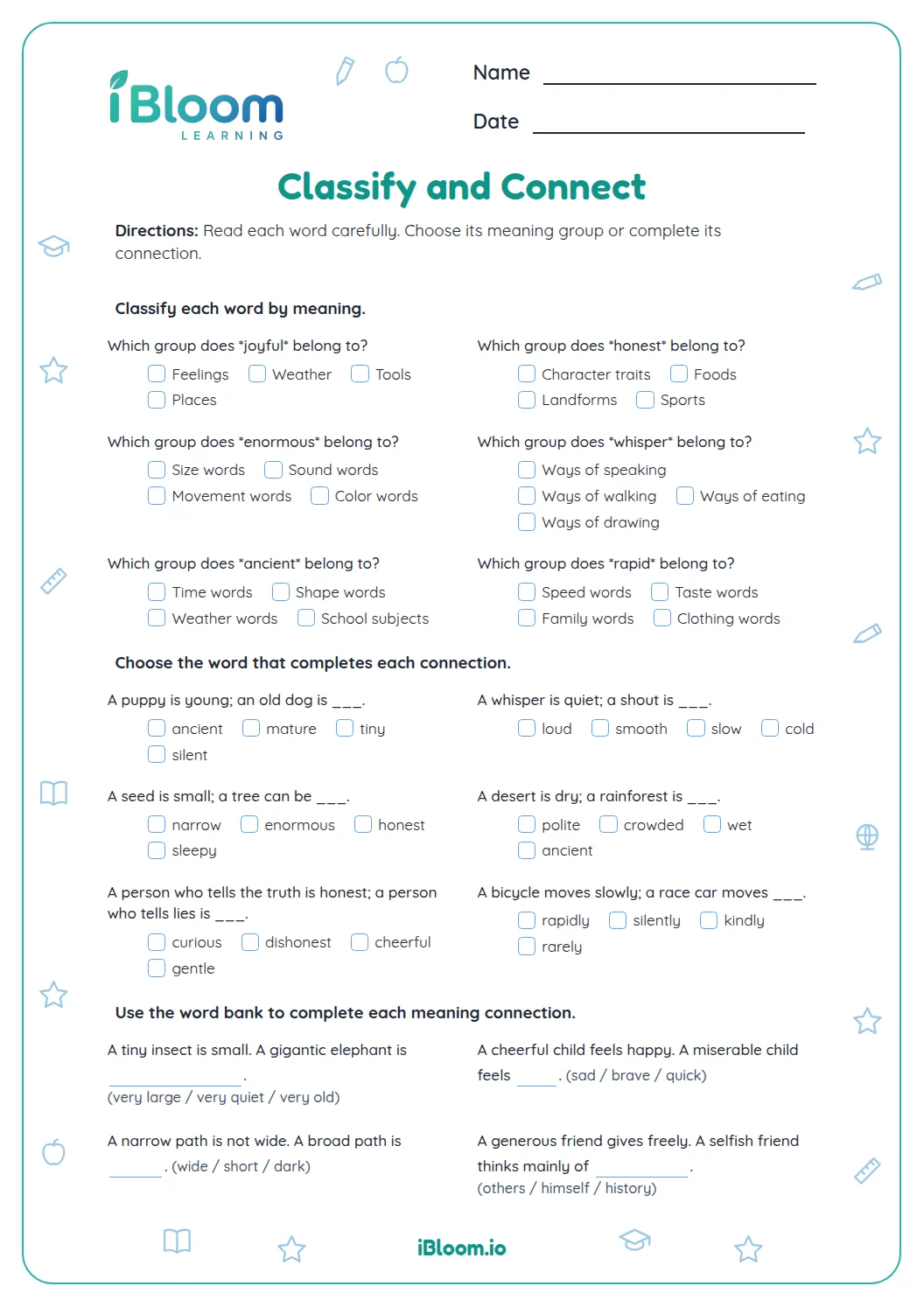
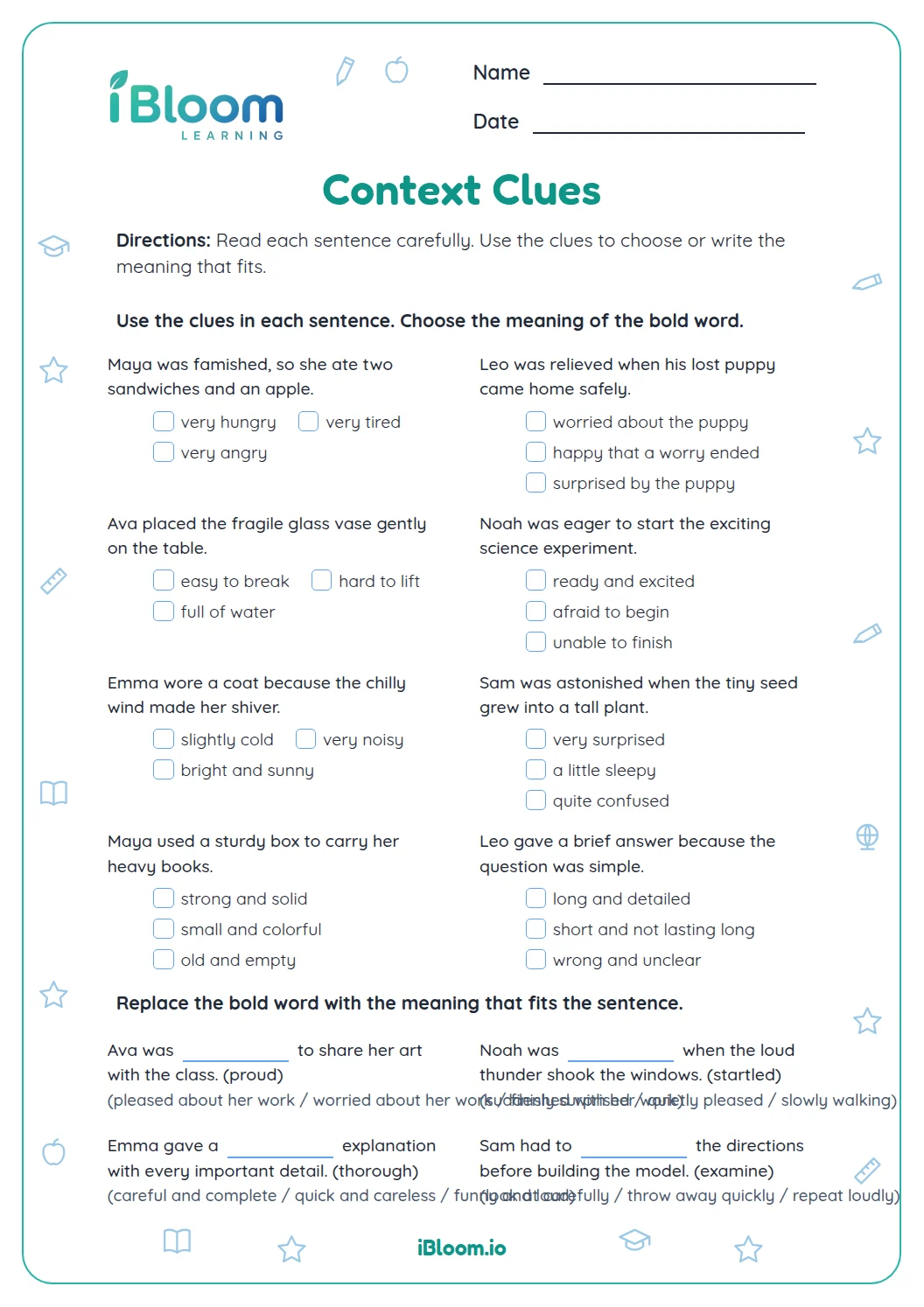
This Grade 4 vocabulary worksheet helps learners use details in a paragraph to work out word meaning. Part A has eight short paragraphs with multiple-choice meanings; Part B has eight more paragraphs with a missing-word meaning to complete. The examples use descriptions, examples, and restatements as clues. It aligns with Common Core L.4.4a and includes a separate answer key.
Aligned to L.4.4a
What counts as a context clue?
A context clue is information near a word that helps explain it. A paragraph may give a definition, show an example, or restate the idea in different words. Readers combine the clue with what they already know.
How can a reader test a possible meaning?
First, read the whole paragraph. Next, notice the details around the target word. Say a possible meaning in its place and see whether it matches those details.
- 1Gray clouds hide the sun; Maya needs a flashlight.
- 2The clues point to a lack of light.
- 3Try “not bright” in place of “dim.”
- 4Answer: not bright
What does each part ask learners to do?
Part A asks learners to choose among three meanings for eight words. Part B asks learners to write a short meaning for eight more words. Each prompt provides a paragraph with clues, so answers come from reading the context rather than recalling a word list.
How to use this worksheet
- 1Read the complete paragraph before answering.
- 2Find details that explain, demonstrate, or restate the target word.
- 3Try a possible meaning in place of the word.
- 4In Part A, compare that meaning with all three choices.
- 5In Part B, write a short phrase that fits the paragraph.
- 6Use the key to check the idea, not only the exact wording.
Common mistakes and quick fixes
The mistake
Choosing a familiar meaning without checking the paragraph.
The fix
Point to the sentence detail that supports the meaning.
The mistake
Using one clue but ignoring another.
The fix
Check that your meaning matches all the details, not just one.
The mistake
Writing a related word instead of a meaning.
The fix
Explain the idea in a short phrase, such as “not wide” for narrow.
Common Core alignment
This practice connects the worksheet activities to the following standard.
Use definitions, examples, and restatements in context to infer meaning.
On this sheet: Every question asks learners to use details in a paragraph to determine a word meaning.
Show the official wordingHide the official wording
Use context (e.g., definitions, examples, or restatements in text) as a clue to the meaning of a word or phrase.
What to practice next
Make more practice
Further reading
Questions parents and teachers ask
How do context clues help with word meaning?
Context clues are nearby details that hint at what an unfamiliar word means. A definition, example, or restatement can help. For instance, when a paragraph says a path was dim because clouds hid the sun and Maya needed a flashlight, dim means not bright.
What kinds of clues appear on this worksheet?
The 16 short paragraphs use restatements, examples, and descriptions of what happens. Eight questions ask learners to choose a meaning, and eight ask them to write a concise meaning in a blank. The separate answer key lists each intended meaning.
Should my child use a dictionary?
Try the paragraph clues first. The goal here is to infer the meaning used in each short paragraph; afterward, a dictionary can help confirm that meaning or compare it with another use of the word. For this practice, point to the clue before checking.
What should a good written answer include?
A good answer gives the meaning that fits the paragraph in a few clear words. For example, “tranquil” means peaceful in the paragraph where people speak quietly and soft music plays. The answer key uses brief meanings, but equivalent wording may also be correct.
How can I support a learner who guesses from the word alone?
Ask the learner to point to two details in the paragraph before choosing or writing a meaning. Then reread the paragraph with the proposed meaning in place of the target word and check whether the sentence still makes sense.
How long does this worksheet take?
Plan for about 20 minutes. Learners can complete the eight multiple-choice paragraphs first and then write meanings for the final eight. Discussing one or two clues aloud can make the strategy visible without giving away the remaining answers.