
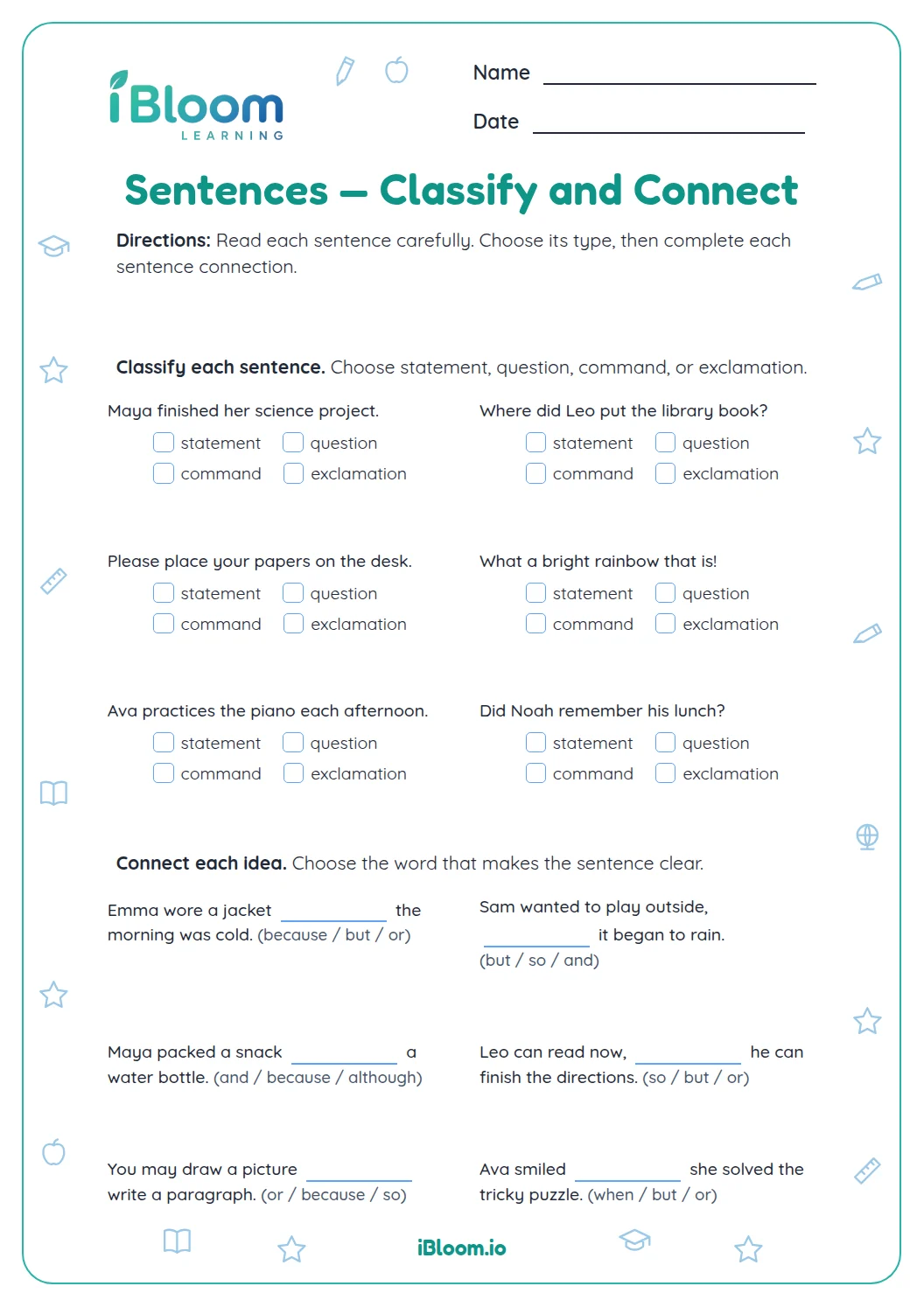
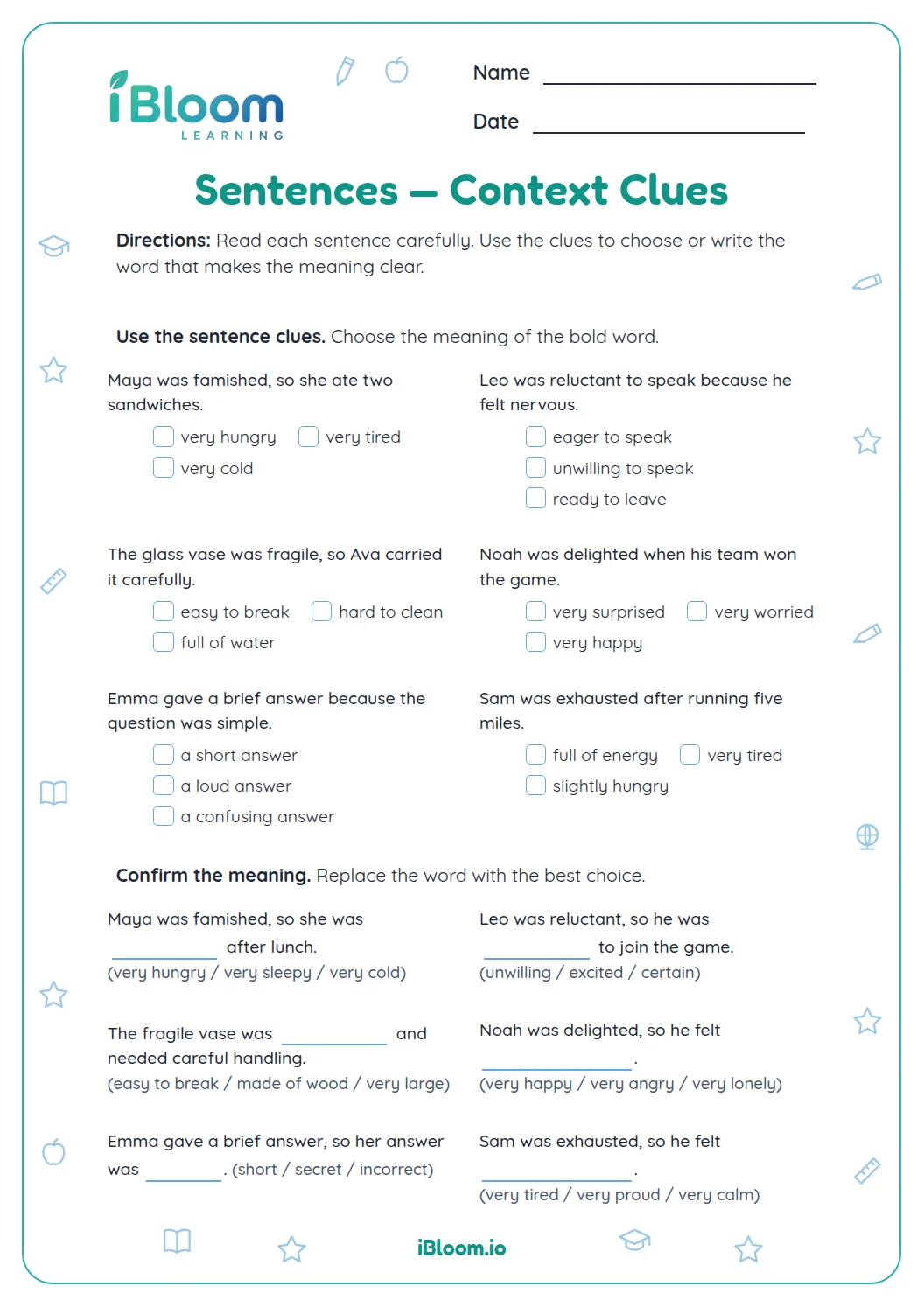

About this worksheet
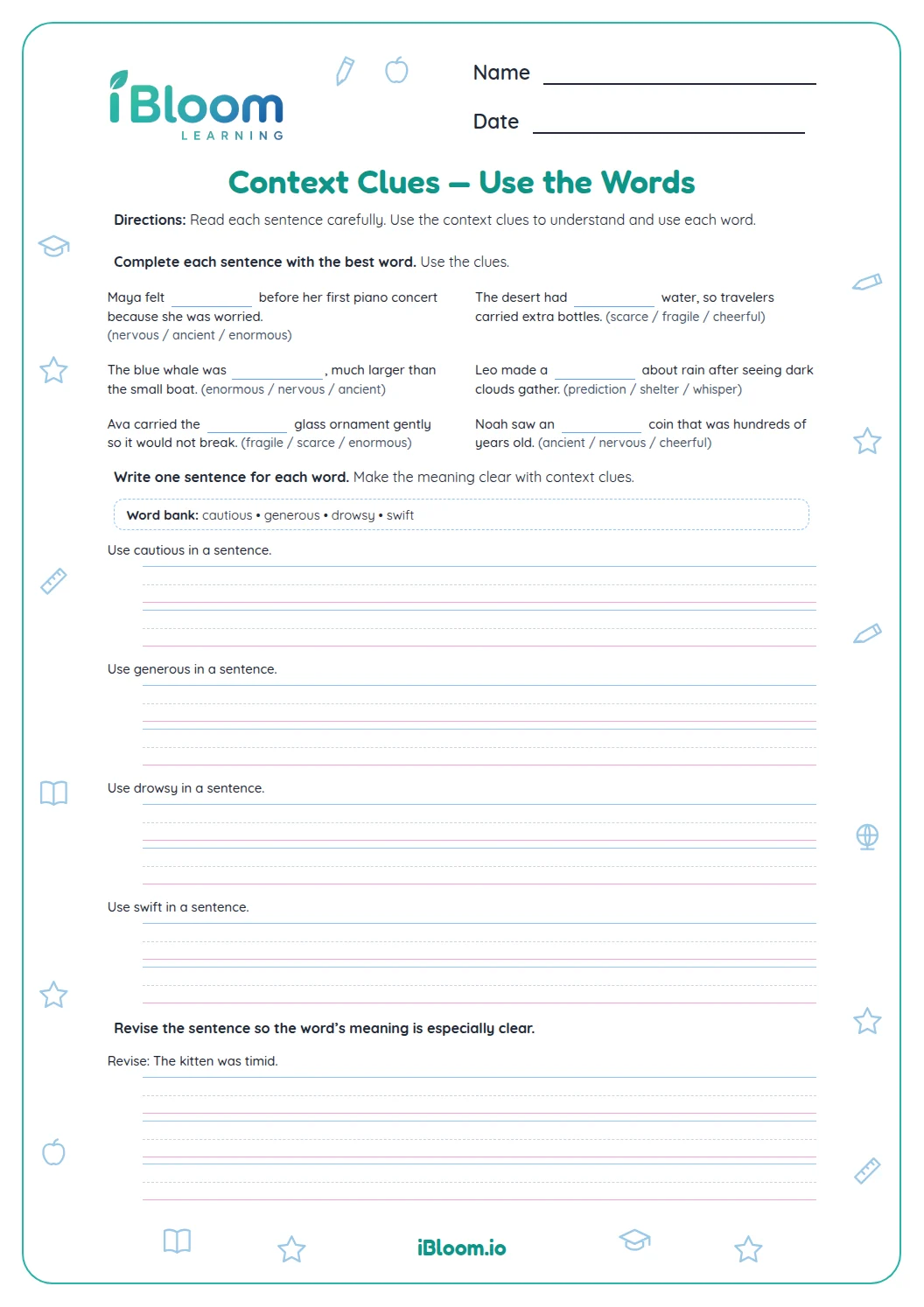
This Grade 4 printable practices using context to choose precise vocabulary. Children select a word that makes sense in each sentence, using details such as a bridge holding a heavy cart or a glass that breaks easily. The 14 multiple-choice questions are grouped into three parts and include a separate answer key.
How do sentence clues help?
Context clues are details that help a reader infer a word’s meaning. In “The sturdy bridge held the heavy cart,” the bridge’s ability to hold the weight points to sturdy.
Question 3 asks children to use that clue to select the word that fits.
- 1The sturdy bridge held the heavy cart.
- 2“Held the heavy cart” is the clue.
- 3Sturdy means strong and well built.
How can children show they know a word?
Read the complete sentence and check that the chosen word fits every clue. For example, fragile fits glass that is easy to break.
What is included in the practice?
All 14 questions are sentence completions with three word choices. Children practice sentence clues, precise word selection, and vocabulary meaning.
How can I use this worksheet?
- 1Read the whole sentence before choosing.
- 2Underline the detail that hints at the word’s meaning.
- 3Write the target word carefully.
- 4For your own sentence, add a clue that makes the meaning clear.
- 5Use the key as a model, then accept other accurate examples.
Common mistakes and quick fixes
The mistake
Guessing from only the first letter
The fix
Use the sentence detail that describes the word.
The mistake
Choosing a word that is close but does not fit
The fix
Read the sentence aloud with the chosen word.
The mistake
Writing a sentence that gives no clue to meaning
The fix
Add a detail or action that shows what the word means.
What to practice next
Make more practice
Further reading
Questions parents and teachers ask
How many questions are included?
The sheet has 14 multiple-choice questions in three parts. Each item gives a sentence with a blank and three word choices. Children use clues in the sentence to select the word that makes the most sense, then check the intended choices in the separate answer key.
How do context clues help?
Context clues are details around a word that point toward its meaning. In question 3, the bridge holds a heavy cart, which suggests it is sturdy. Have the child reread the full sentence, name the helpful detail, and then compare that clue with each word choice.
What does “use the words” mean on this sheet?
Children select vocabulary words that complete sentences in a sensible way. The practice uses words such as sturdy, narrow, relieved, and fragile, with sentence details that help show which meaning fits. The answer key lists the intended choice for every question.
Can children use a dictionary?
Try the sentence clues first and then check an unfamiliar word in a dictionary. Ask which detail supports the choice, such as an action, description, or result in the sentence. The key can help you review the intended meaning after the child has completed the item.
Is there a writing response?
All 14 prompts are multiple choice, so children select the best word rather than write their own sentences. The questions practice interpreting and using vocabulary in context. An adult can ask the child to point out the clue that supports each selected word.