


About this worksheet
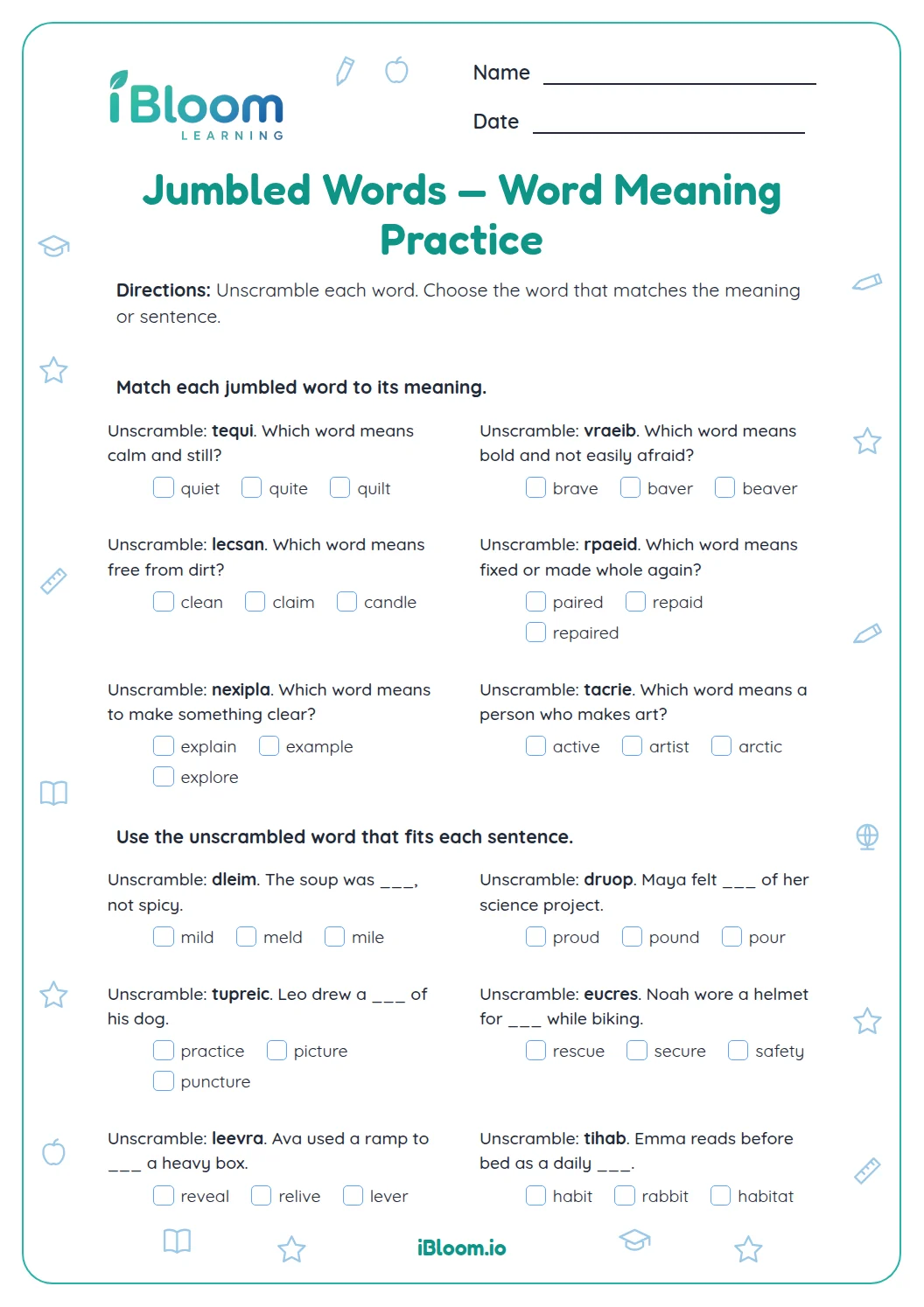
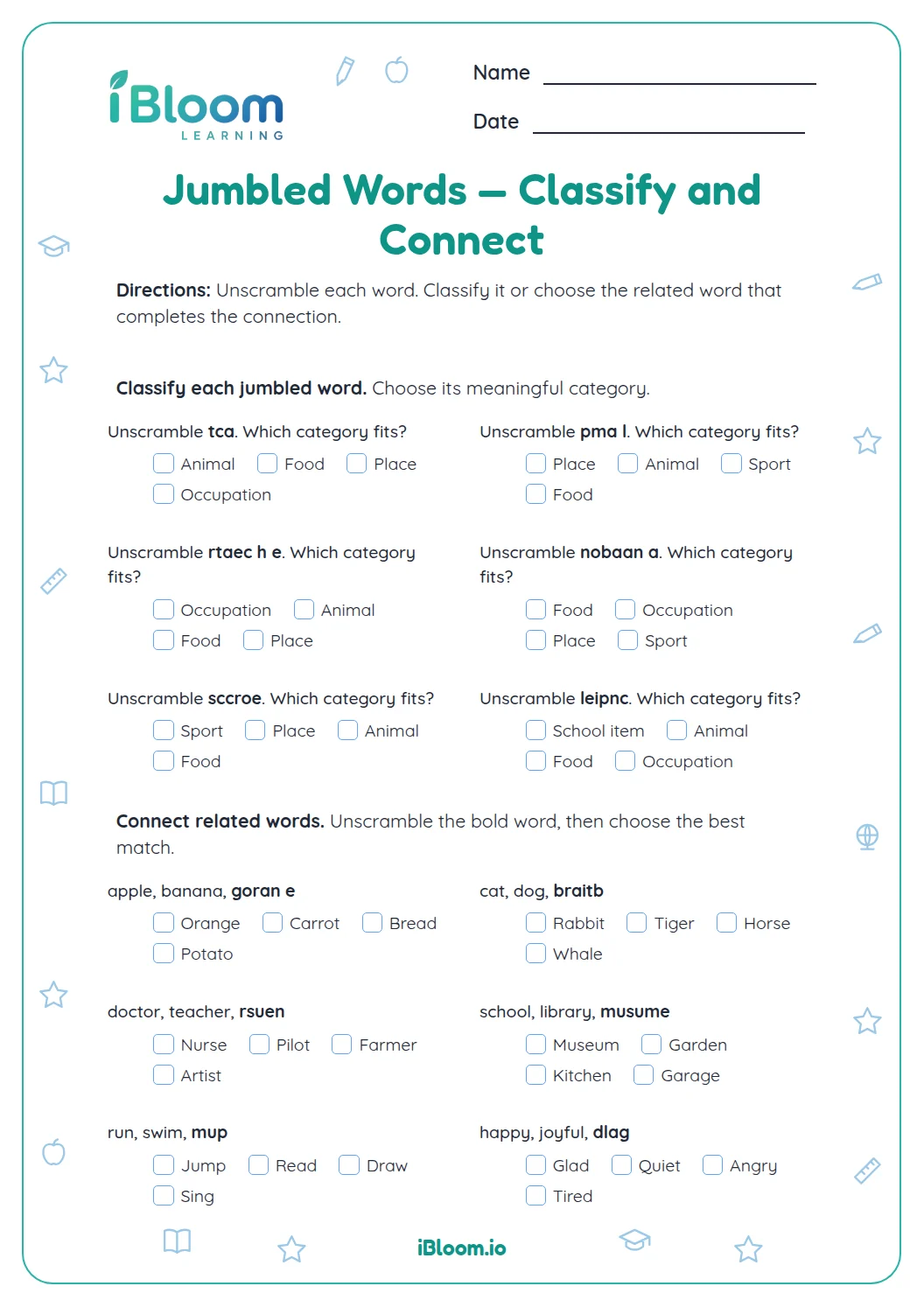
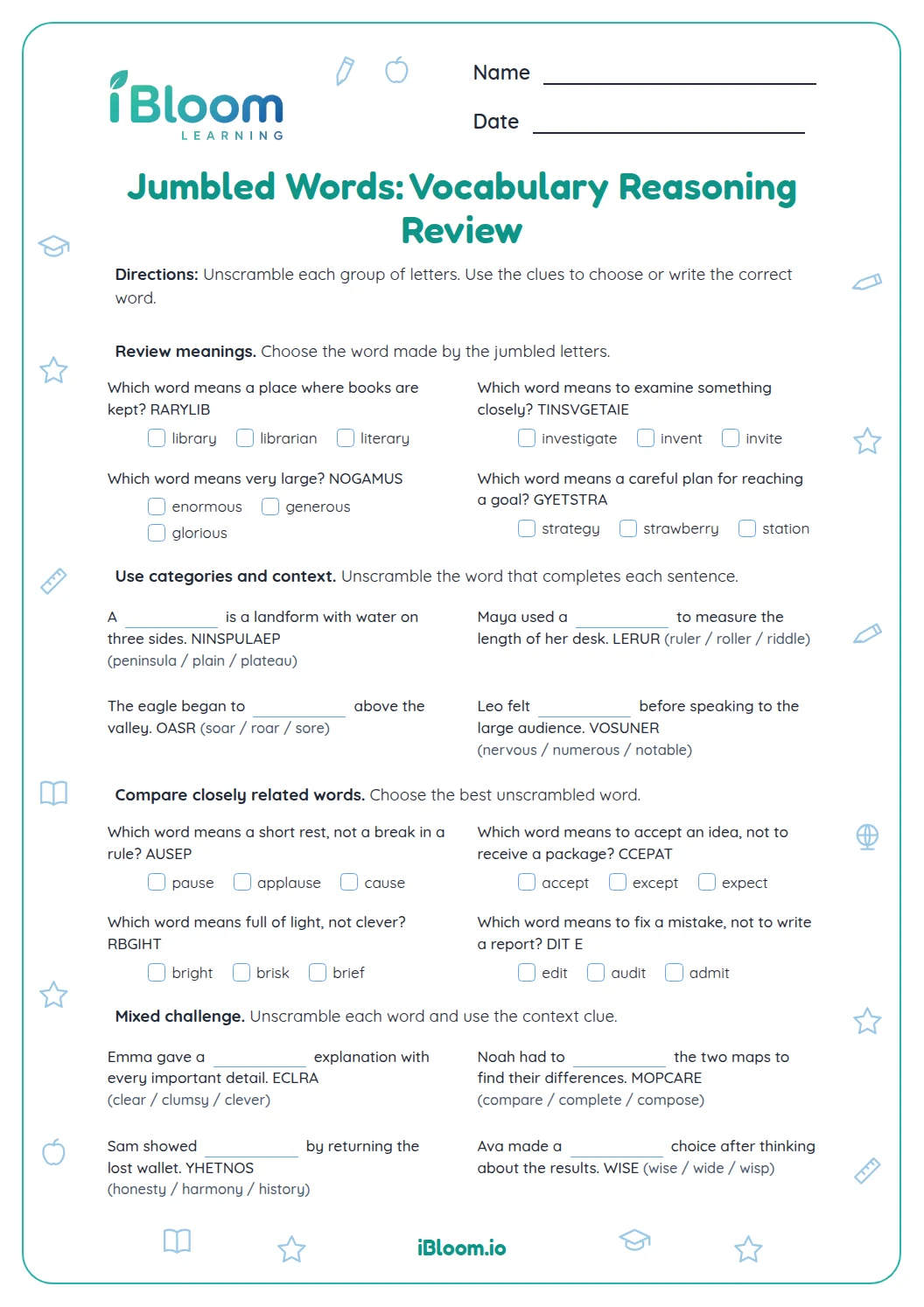
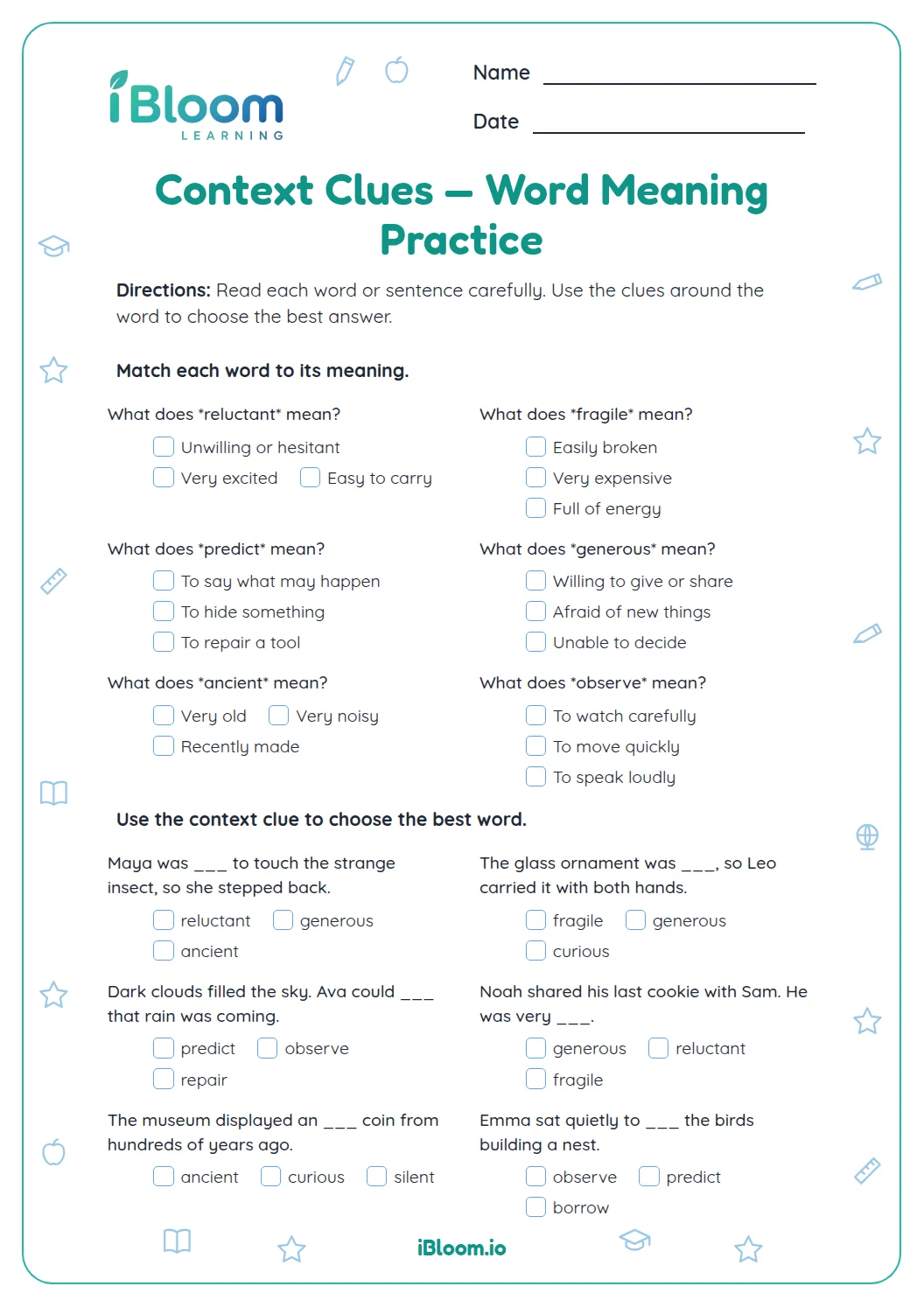
This Grade 5 printable turns jumbled letters into meaningful vocabulary practice. Students unscramble words in sentence context, write sentences that show the meanings of target words, and select words that fit a clue. A final item checks accurate use of “teams.” The worksheet practices CCSS L.5.4 and L.5.6, with a separate answer key that includes sample sentences for open responses.
Aligned to L.5.4 and L.5.6
How do sentence clues help solve a jumble?
Rearrange the letters into a word that fits the meaning and grammar of the sentence. The sentence “The road was ___ after the storm” points toward a describing word for the road.
- 1Jumbled letters: ykcor
- 2Clue: The road was ___ after the storm.
- 3Unscramble: rocky
- 4Check: “rocky” describes a road.
How can you check spelling and meaning together?
Read the completed sentence aloud and see whether the word fits. Questions 9 and 10 ask students to compare spellings or meanings that can look similar, then select the one that matches the clue.
How can a sentence show you understand a word?
Use a target word in a complete sentence that makes its meaning clear. Questions 9–11 ask for sentences with elephant, courage, and discovery; later items check a multiple-meaning word and accurate use of teams.
How to use the jumbled words
- 1Read the sentence before moving any letters.
- 2Rearrange the letters into a word that fits the clue and grammar.
- 3Reread the whole sentence to confirm the meaning.
- 4Check choices for both correct spelling and a fitting meaning.
- 5Write a complete sentence that gives enough context for the target word.
- 6Use the key to check spelling and compare your sentence with the sample.
Common mistakes and quick fixes
The mistake
Choosing a familiar word that does not fit the sentence clue.
The fix
Read the full sentence with the word inserted and check whether it makes sense.
The mistake
Leaving out or repeating a letter while unscrambling.
The fix
Mark off each letter as you use it, then compare the final spelling with the choices.
The mistake
Writing a sentence that repeats the target word without showing its meaning.
The fix
Add an action, place, or clue that makes the word’s meaning clear.
Common Core alignment
The tasks connect word meaning, spelling, sentence context, and accurate word use.
Use sentence context to confirm the meaning of an unfamiliar word.
On this sheet: Context sentences guide students as they unscramble and select words.
Show the official wordingHide the official wording
Determine or clarify the meaning of unknown and multiple-meaning words and phrases based on grade 5 reading and content, choosing flexibly from a range of strategies.
Use precise general and topic words accurately in sentences.
On this sheet: Students apply target vocabulary accurately in original sentences.
Show the official wordingHide the official wording
Acquire and use accurately grade-appropriate general academic and domain-specific words and phrases, including those that signal contrast, addition, and other logical relationships (e.g., however, although, nevertheless, similarly, moreover, in addition).
What to practice next
Make more practice
Further reading
Questions parents and teachers ask
Which words do students unscramble?
The first eight questions use bear, catch, rocky, rainbow, courage, discovery, ruler, and teams. Each word fits the sentence around it. The final items ask students to use several of those words in clear contexts. A quick reread of the passage or prompt helps connect the answer to its evidence.
Why are there answer choices after some jumbles?
Choices help students compare close spellings and meanings after they have considered the letter clues. For instance, the sentence about a road after a storm points to “rocky,” while the other choices do not fit as naturally. The answer key accepts other clear responses that show the same idea.
What should a good sentence response include?
A good response uses the target word correctly in a complete sentence and provides enough context for a reader to understand it. The answer key offers one sample for each prompt; another clear, accurate sentence may also work. This gives students a chance to reread and explain their thinking.
How does the “bat” question work?
“Bat” can name an animal or sports equipment. Students revise the short sentence by adding details that make one meaning clear. The sample sentence places the bat in a cave and describes it flying. Each task keeps the practice connected to the named skill.
How many questions are on the worksheet?
There are 14 questions: eight contextual unscrambles, three word-choice checks, two original sentence prompts, one clarity revision, and one sentence-use choice. The separate key includes the correct answers and sample writing. Invite the learner to explain which word or detail led to the choice.
Which standards does this worksheet practice?
It practices CCSS L.5.4 through using sentence context to clarify word meaning and L.5.6 through accurate vocabulary use. The curriculum section provides the official wording and source link. This gives students a chance to reread and explain their thinking. The question provides a concrete way to practice the target skill.