




About this worksheet
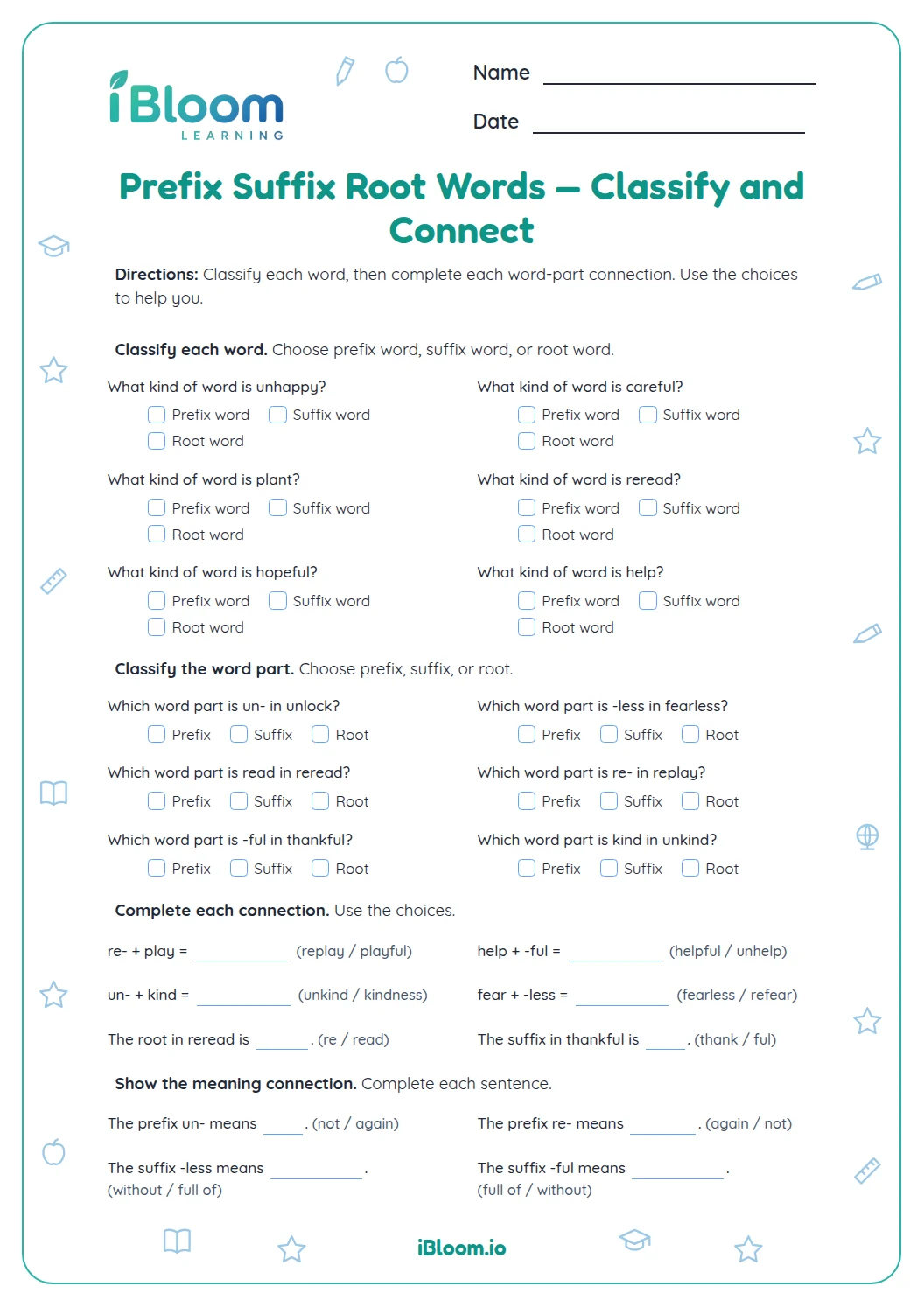
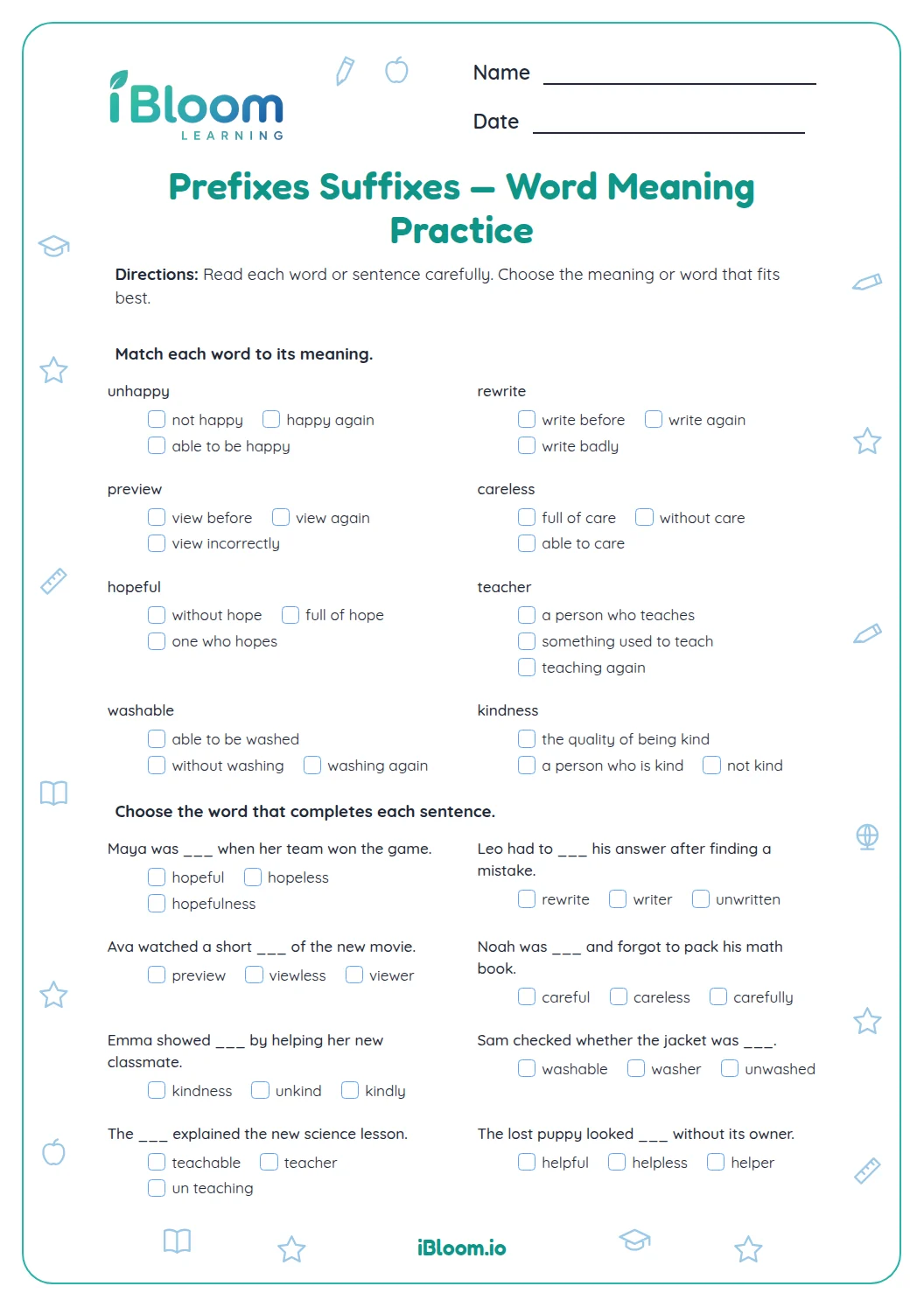
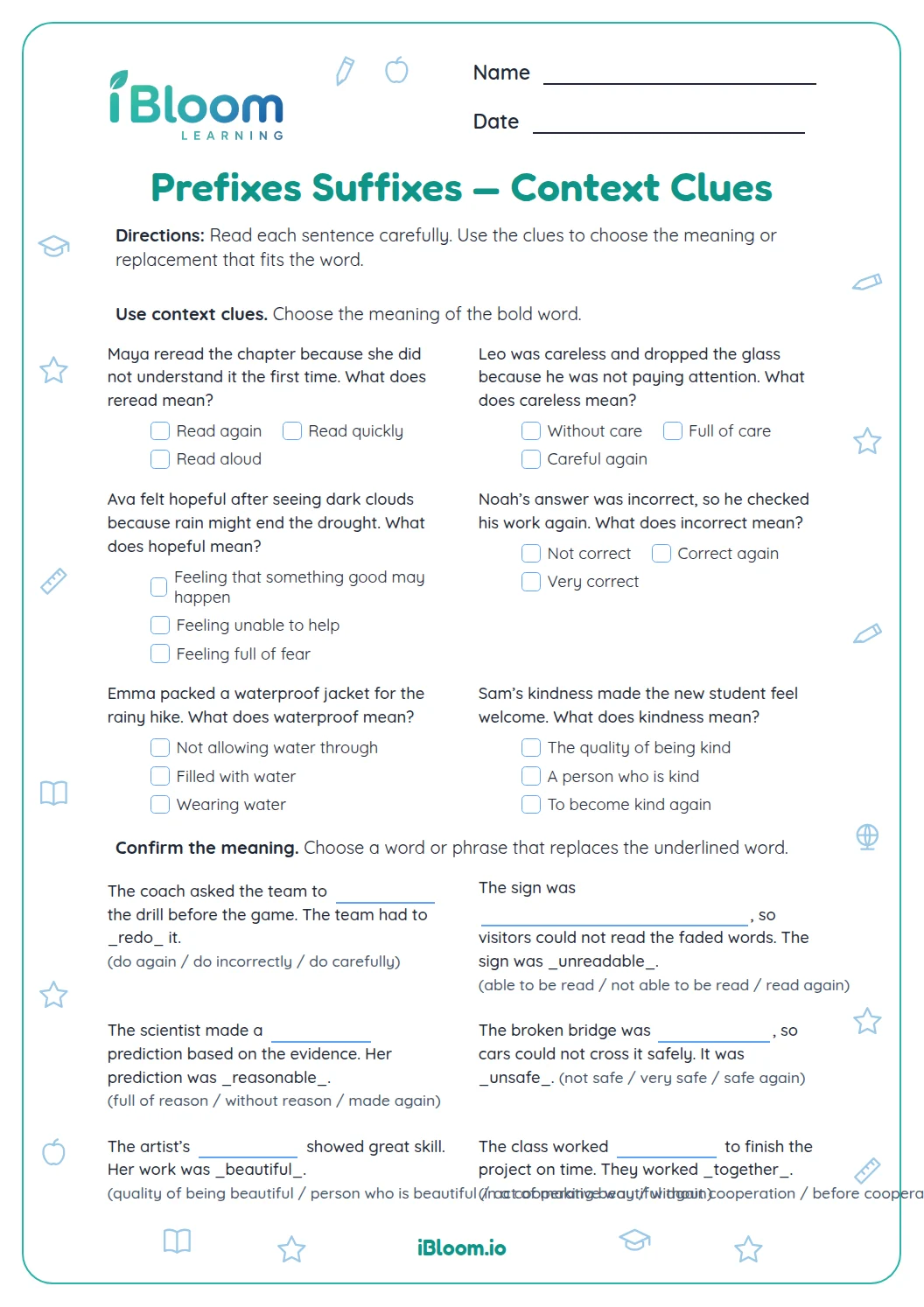
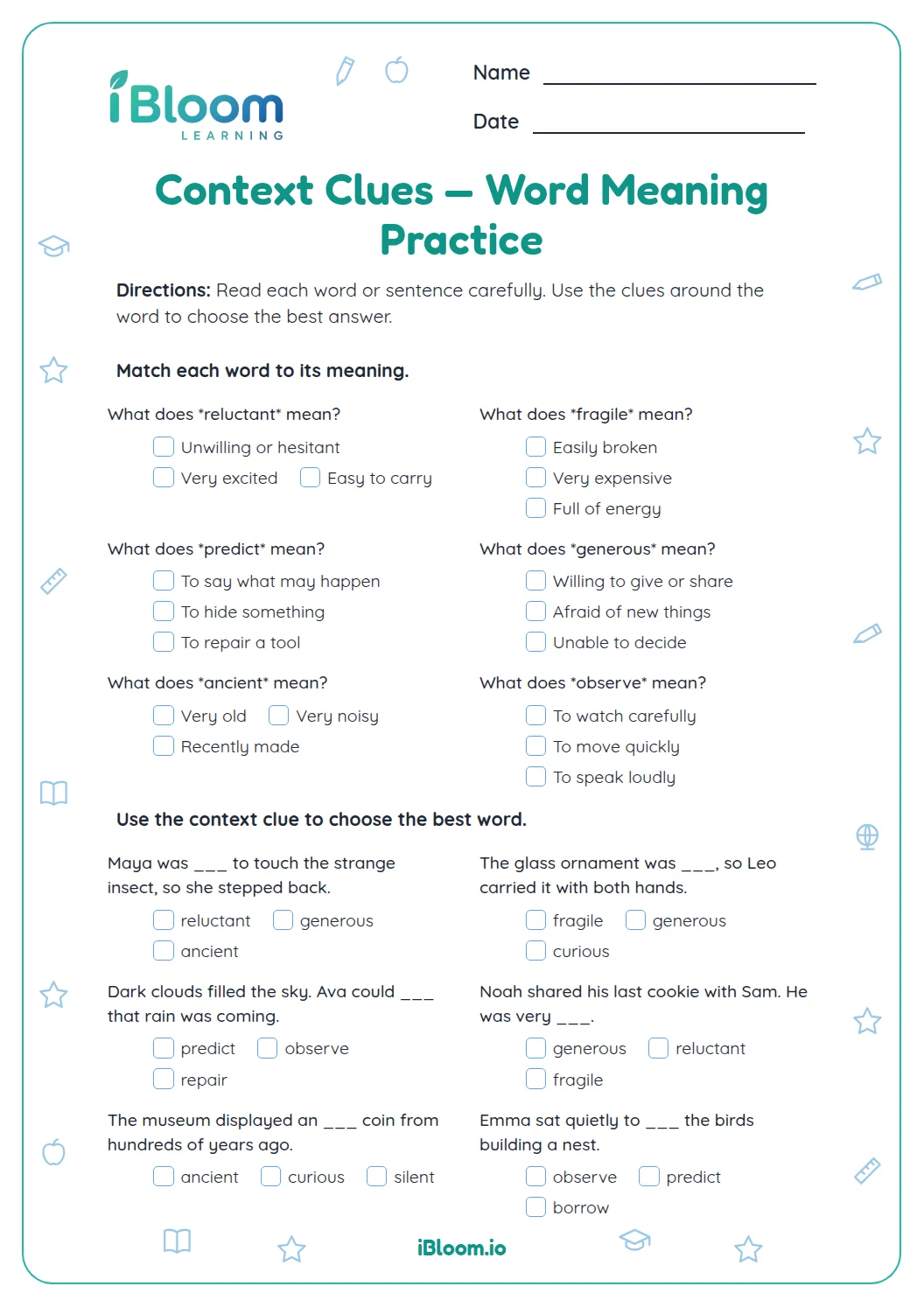
This Grade 5 vocabulary worksheet asks students to use common prefixes, suffixes, and roots as clues to word meaning. Six multiple-choice questions cover familiar word parts; eight fill-ins apply meanings in context. The separate key gives each response. The questions practice using affixes and roots as one strategy for clarifying unfamiliar words.
Aligned to L.5.4
What are prefixes, suffixes, and roots?
A prefix appears before a base or root, a suffix appears after it, and a root carries a core meaning. In “preview,” pre- means before and view means look, so the full word suggests looking beforehand.
How can students use a word part as a clue?
A word part is a clue, not the whole definition. Students can combine the part’s meaning with the rest of the word and then check whether the result makes sense in the sentence or task.
- 1Word: rewrite
- 2Prefix: re- means again.
- 3Root: write means make words.
- 4Meaning: write again.
What does this review include?
The multiple-choice items cover prefixes such as pre-, re-, mis-, and sub-, suffixes such as -less, -able, and -ist, and roots such as port and bio. Five prompts ask students to supply a word or action, and the final response explains one clue.
How to use this worksheet
- 1Read the entire word before focusing on one part.
- 2Identify whether the clue is at the beginning, end, or in the root.
- 3Recall the part’s meaning and combine it with the rest of the word.
- 4Try the meaning in the item to see if it makes sense.
- 5Use the answer key to review the word part behind any missed choice.
Common mistakes and quick fixes
The mistake
Treating a prefix as the full definition.
The fix
Combine the prefix clue with the base or root.
The mistake
Mixing up -less and -ful.
The fix
Use the contrast: -less means without; -ful means full of.
The mistake
Ignoring the root when a word has a prefix or suffix.
The fix
Check each recognizable part, then put the clues together.
Common Core alignment
Students use affixes and roots to clarify the meaning of words in context.
Use word-part clues as one strategy for figuring out a word’s meaning.
On this sheet: Every question asks students to use affixes or roots to reason about word meaning.
Show the official wordingHide the official wording
Determine or clarify the meaning of unknown and multiple-meaning words and phrases based on grade 5 reading and content, choosing flexibly from a range of strategies.
What to practice next
Make more practice
Further reading
Questions parents and teachers ask
What is a prefix?
A prefix is a word part added to the beginning of a base or root. In “rewrite,” re- means again, so rewrite means to write again. Combine the prefix meaning with the rest of the word, then check that the whole meaning makes sense.
How is a suffix different from a root?
A suffix is added to the end of a word part and can change its meaning or use; a root carries a core meaning. In careless, -less means without, while port carries the meaning carry in portable. Ask the student to point to a specific detail, explain how it supports the answer, and check the response against the separate key.
How many questions are included?
There are 14 questions: six multiple-choice items and eight fill-ins. Students reason about prefixes such as pre- and mis-, suffixes such as -less, and roots such as port and spect. Ask the student to point to a specific detail, explain how it supports the answer, and check the response against the separate key.
Does this worksheet include Greek and Latin roots?
Yes. Students use roots including port, bio, and spect as meaning clues. They connect each root to a word in context, such as port in portable or spect in inspect. Ask the student to point to a specific detail, explain how it supports the answer, and check the response against the separate key.
What if a word has more than one word part?
Read the word parts in order and combine their clues. In rebuild, re- means again and build is the base, so rebuild means to build again. Ask the student to point to a specific detail, explain how it supports the answer, and check the response against the separate key.
How long should students spend?
About 20 minutes is a useful estimate for choosing answers and completing the fill-ins. Students can reread each whole word to check that the word-part clue fits its meaning. Ask the student to point to a specific detail, explain how it supports the answer, and check the response against the separate key.