




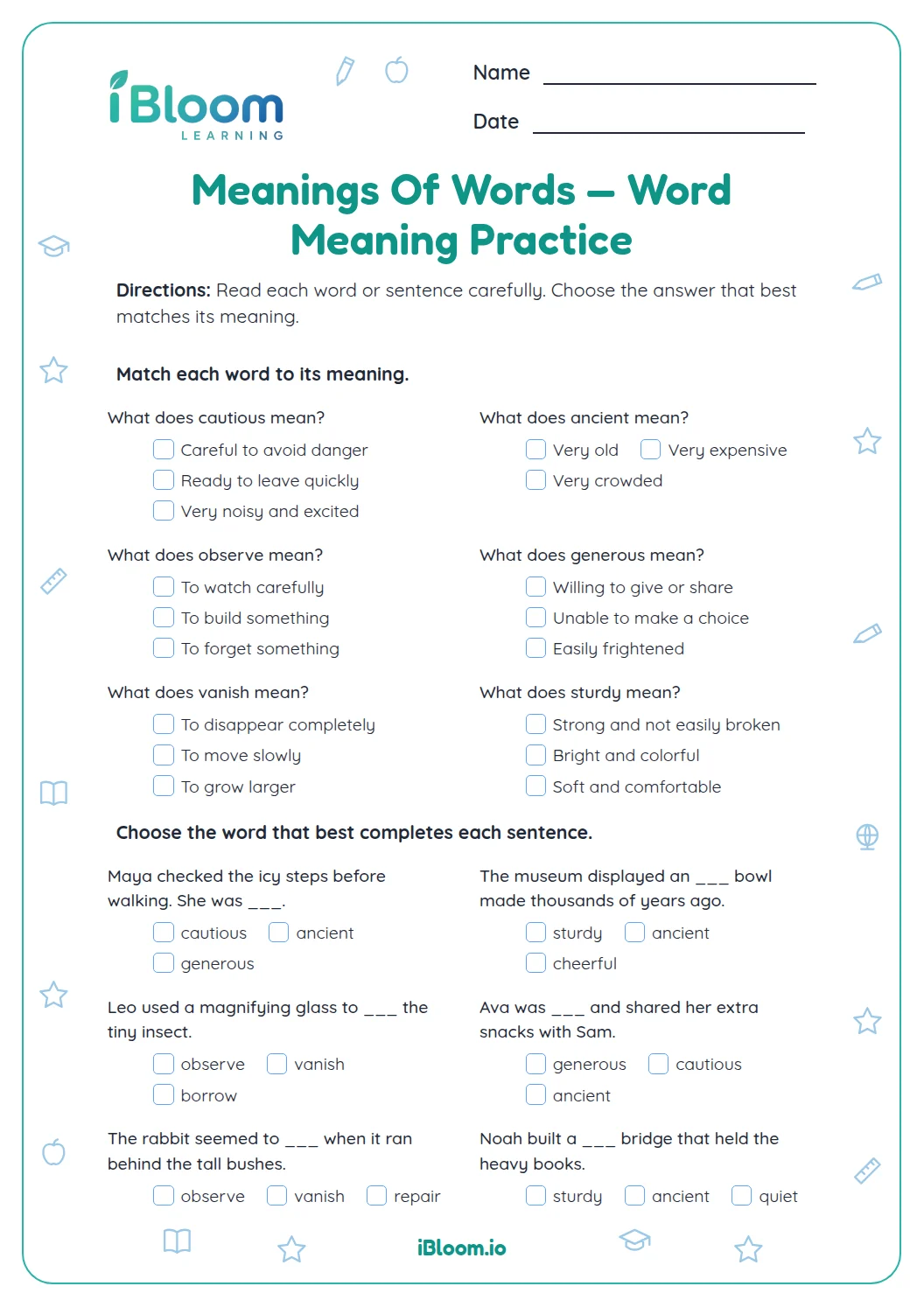
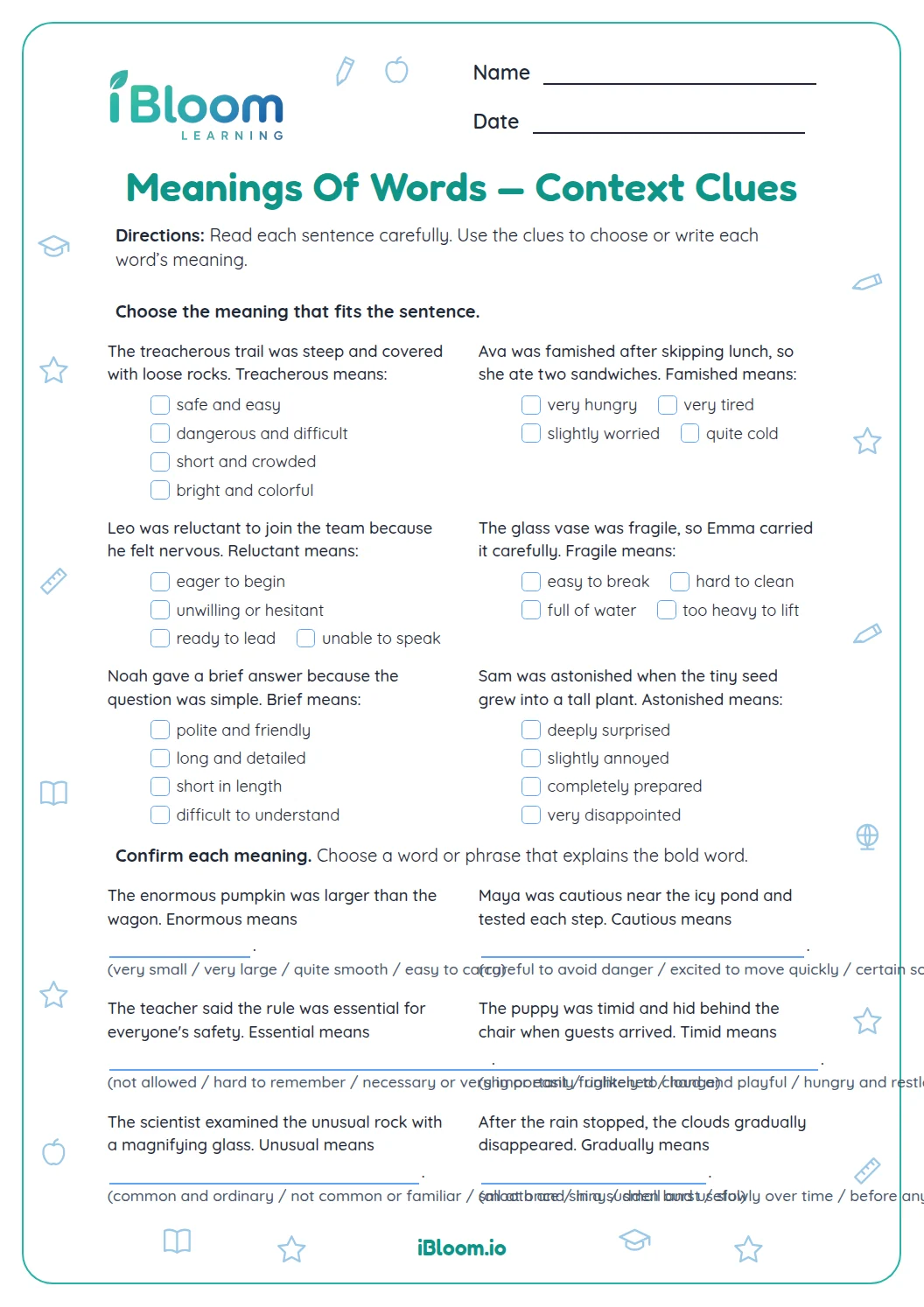
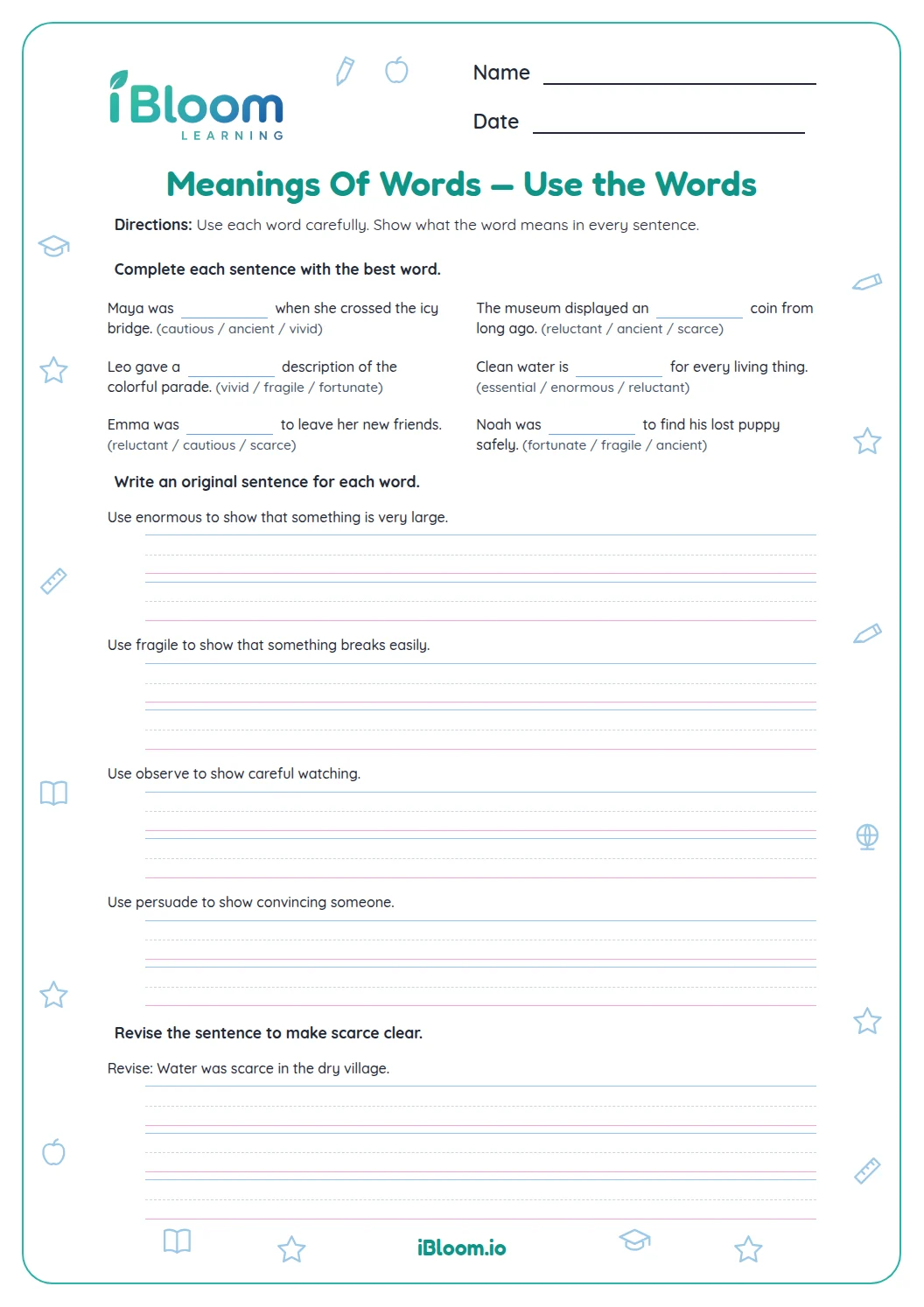

About this worksheet
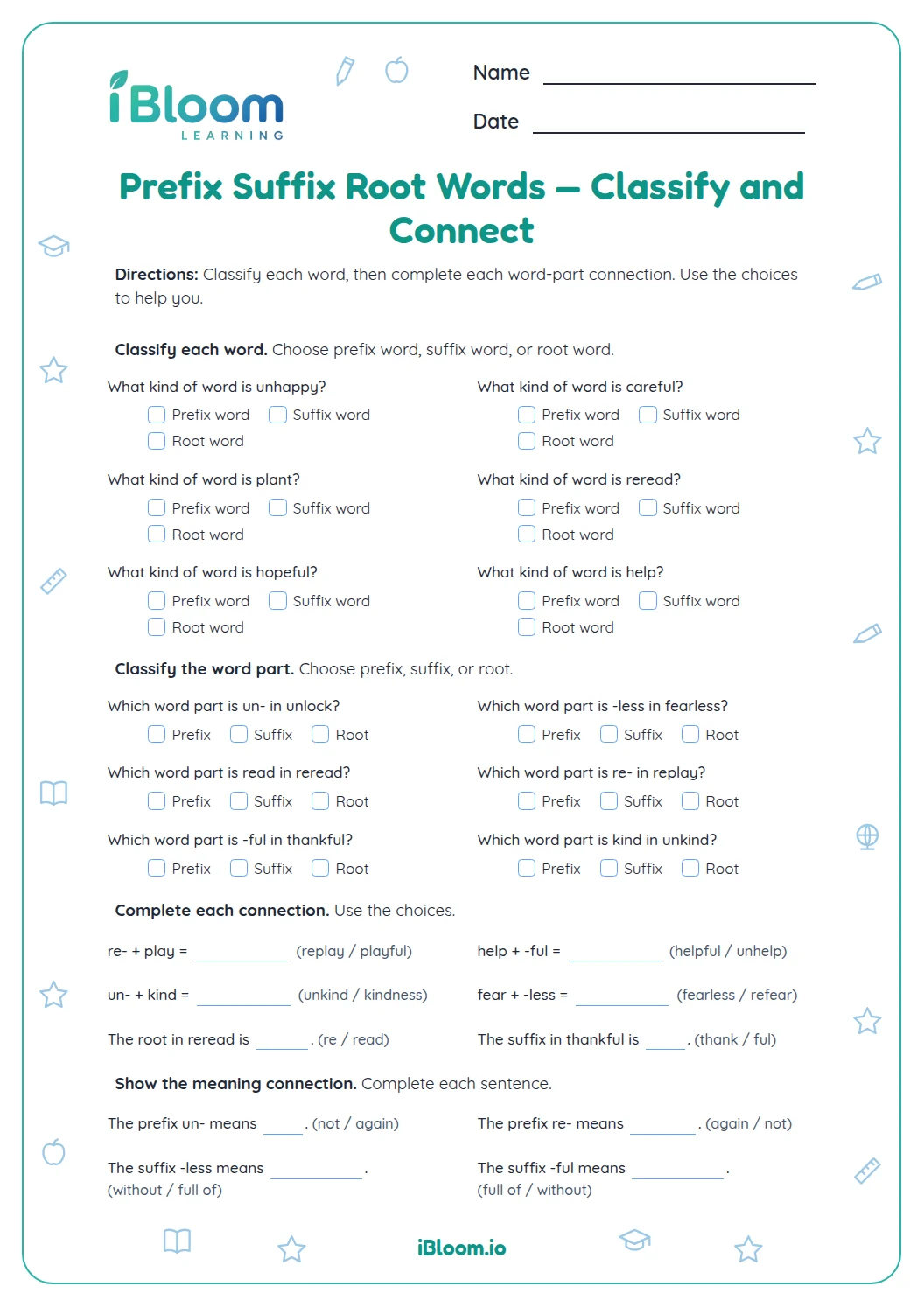
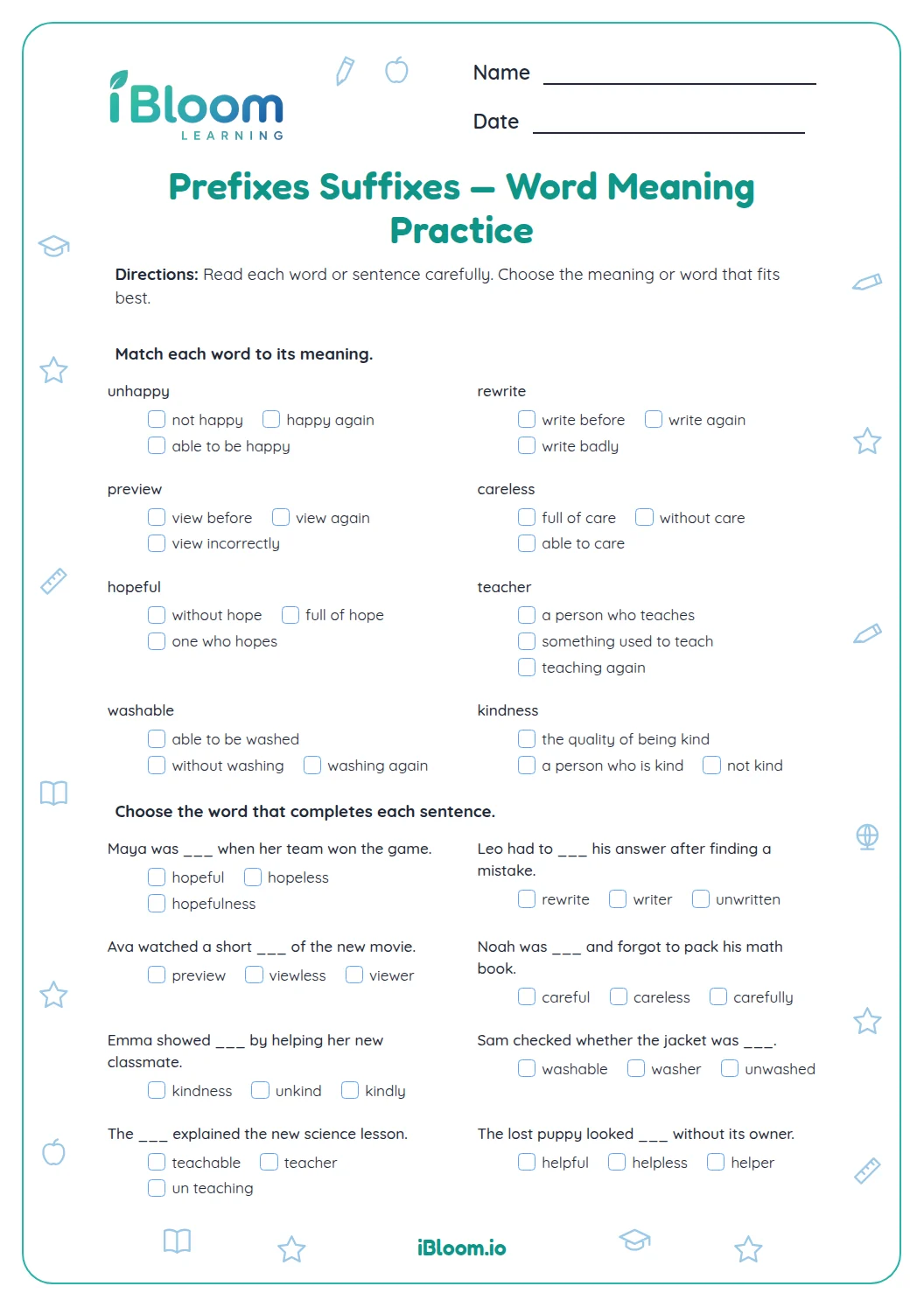
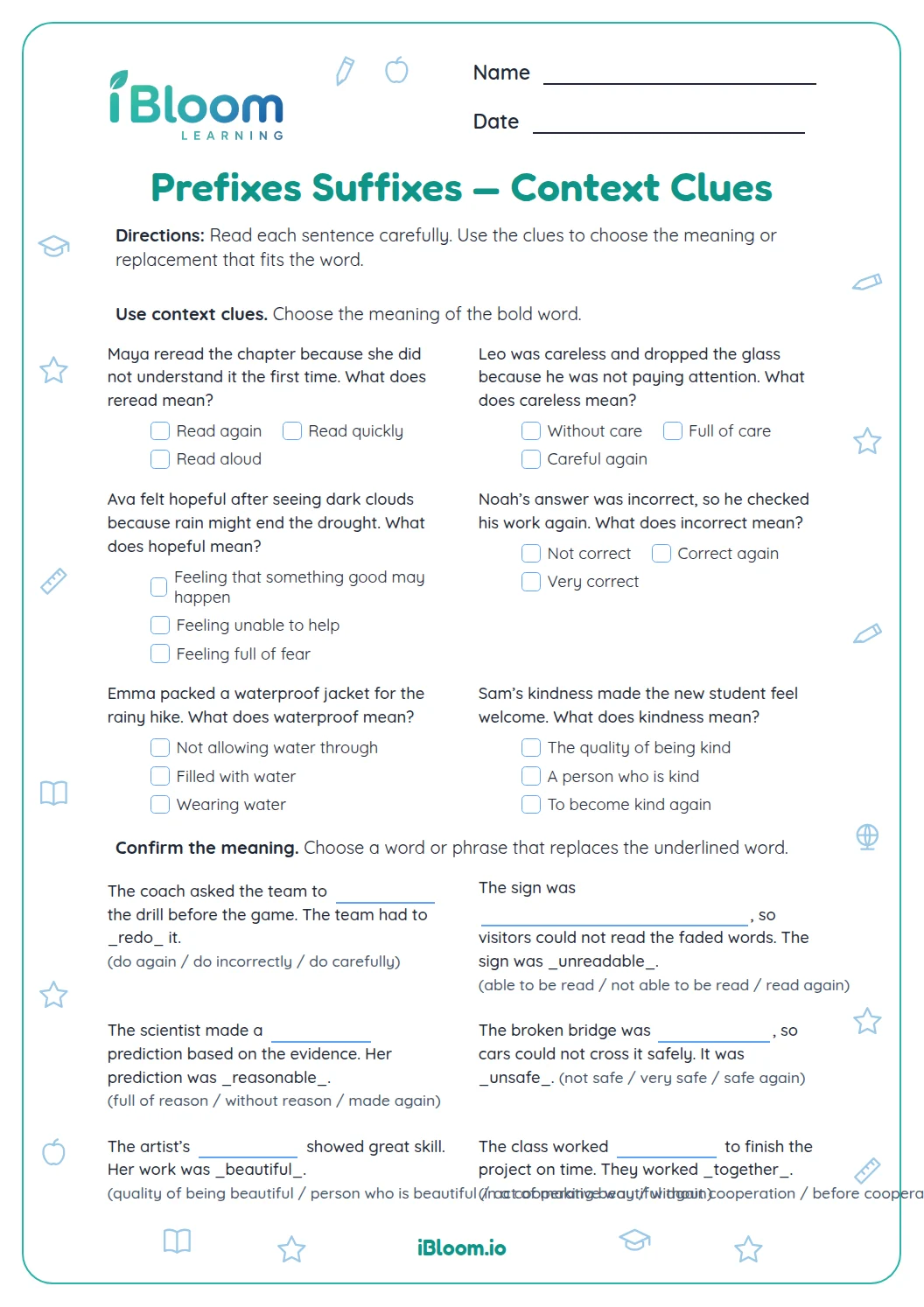
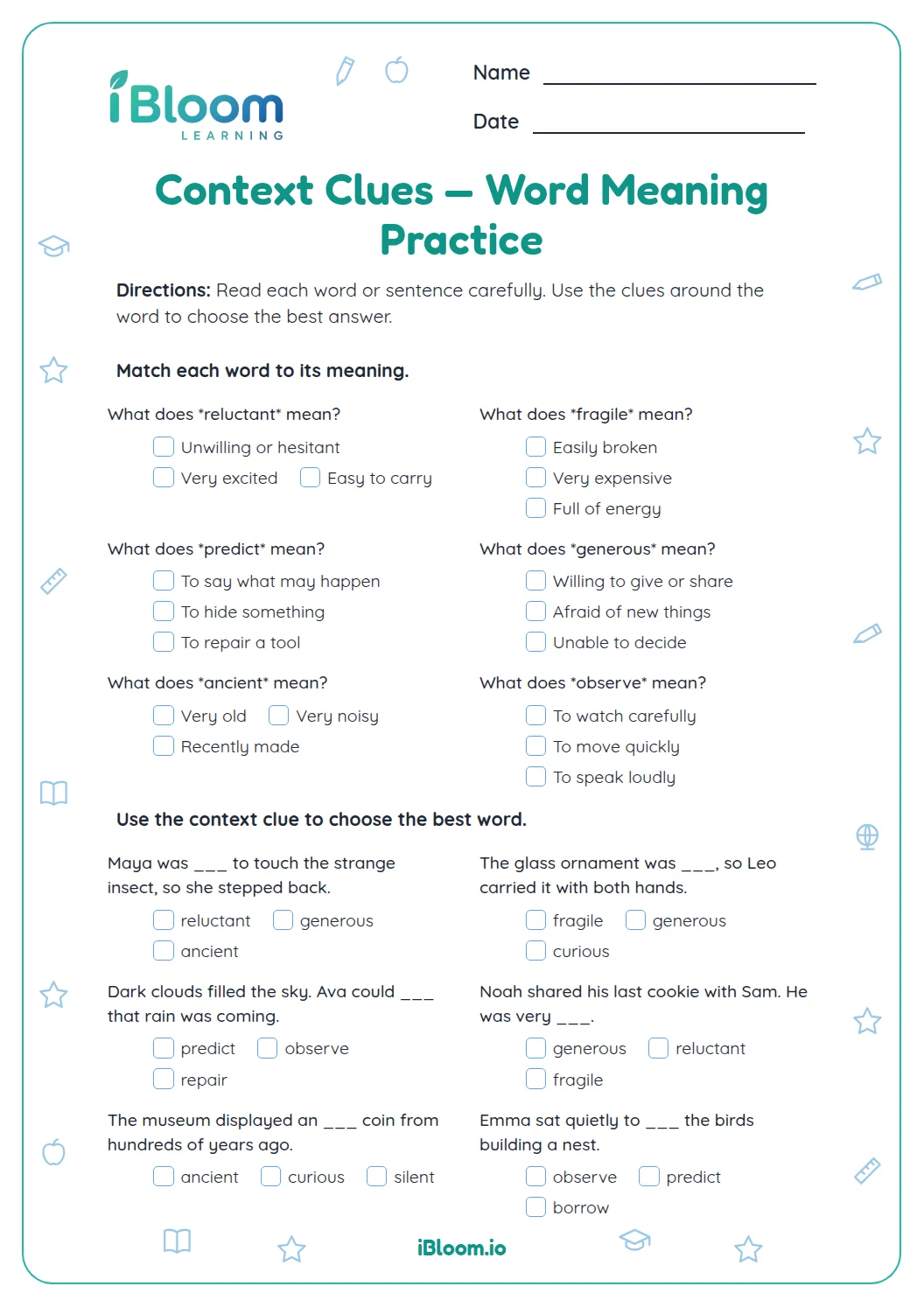
This free printable Grade 5 worksheet gives students 14 chances to work out word meanings using familiar prefixes, suffixes, roots, and sentence details. Part A explores word parts in words such as biography, washable, and portable. Part B uses sentence context to interpret words such as inspect, predict, and fragile. The sheet practices CCSS L.5.4a and L.5.4b, with a separate answer key.
Aligned to L.5.4a and L.5.4b
How do word parts help explain a new word?
A prefix appears at the beginning of a word, a suffix at the end, and a root carries a central meaning. In preview, pre- means “before”; in portable, port means “carry.” Word parts offer clues, and the whole word helps you connect them.
Part A asks what common affixes and roots contribute to words.
- 1A preview happens ahead of a show. Pre- means:
- 2Ahead of a show points to something that comes before it.
- 3Answer: before
How can a sentence confirm a word’s meaning?
A sentence may explain a word with an example, a contrast, or a cause and effect. In “Dad wrapped the fragile glass ornament carefully,” the careful wrapping is a clue that fragile means easily broken.
Part B gives students a sentence clue to test against each meaning choice.
- 1Lena inspected the shell with a magnifier. What does inspected mean?
- 2A magnifier helps someone look closely.
- 3Answer: looked at closely
What will students practice on the worksheet?
Part A has seven questions about prefixes, suffixes, and roots. Part B has seven sentence-context questions. For each, students choose the meaning that fits the word part or the full sentence.
How to use this worksheet
- 1Read the complete sentence before choosing an answer.
- 2In Part A, find the prefix, suffix, or root named in the question.
- 3Connect that word part to the meaning of the full word.
- 4In Part B, look for examples, contrasts, or results around the target word.
- 5Try each choice in the sentence and see which one makes sense.
- 6Use the answer key to review the clue that supports each answer.
Common mistakes and quick fixes
The mistake
Treating a prefix or suffix as the whole word meaning.
The fix
Combine the affix with the base or root, then check how the full word is used.
The mistake
Guessing from a familiar root without reading the sentence.
The fix
Use the root as a clue, then reread the sentence to check the meaning.
The mistake
Choosing a meaning that could fit the word but not its sentence.
The fix
Test the choice in the sentence and look for details that support it.
Common Core alignment
The sheet practices Grade 5 word-meaning strategies with affixes, roots, and sentence context.
Use sentence clues to determine a word’s meaning.
On this sheet: Part B uses sentence details to select the meaning that fits each word.
Show the official wordingHide the official wording
Use context (e.g., cause/effect relationships and comparisons in text) as a clue to the meaning of a word or phrase.
Use common affixes and roots as clues to word meaning.
On this sheet: Part A asks students to use common prefixes, suffixes, and roots to infer word meaning.
Show the official wordingHide the official wording
Use common, grade-appropriate Greek and Latin affixes and roots as clues to the meaning of a word (e.g., telegraph, photograph, autograph).
What to practice next
Make more practice
Further reading
Questions parents and teachers ask
What does this Grade 5 worksheet cover?
It covers common prefixes, suffixes, roots, and context clues. The 14 multiple-choice questions are split into two parts: seven word-part questions and seven sentence-context questions. Students choose a meaning, then can use the separate answer key to check each response.
How should students use a root to figure out a word?
Students can recall the root’s common meaning and connect it to the rest of the word. In question 7, port means “carry,” so a portable radio is easy to take along. A root gives a clue; students should also check whether the meaning fits the full word.
What is the difference between an affix and a root?
A root carries a central part of a word’s meaning. An affix attaches to a root or base: a prefix comes before it, and a suffix comes after it. For example, pre- is a prefix meaning before, while -able in washable suggests something can be washed.
How do context clues help with words such as fragile?
Context clues are details around a word that point toward its meaning. In question 13, Dad wraps a glass ornament carefully, which suggests fragile means easily broken. Students can reread the whole sentence and use those details before selecting a choice.
Can students complete this worksheet independently?
Students who can read the sentences and choices may work through the questions independently. An adult can prompt them to name the word part or sentence detail that supports a choice without giving the meaning. The separate answer key makes it easy to review any uncertain response.
Is an answer key included, and how long does the sheet take?
Yes. The answer key is on two separate pages, so students can finish before checking their choices. Plan about 20 minutes for all 14 questions, with extra time if you pause to discuss how a root, affix, or sentence detail points to a meaning.