




About this worksheet
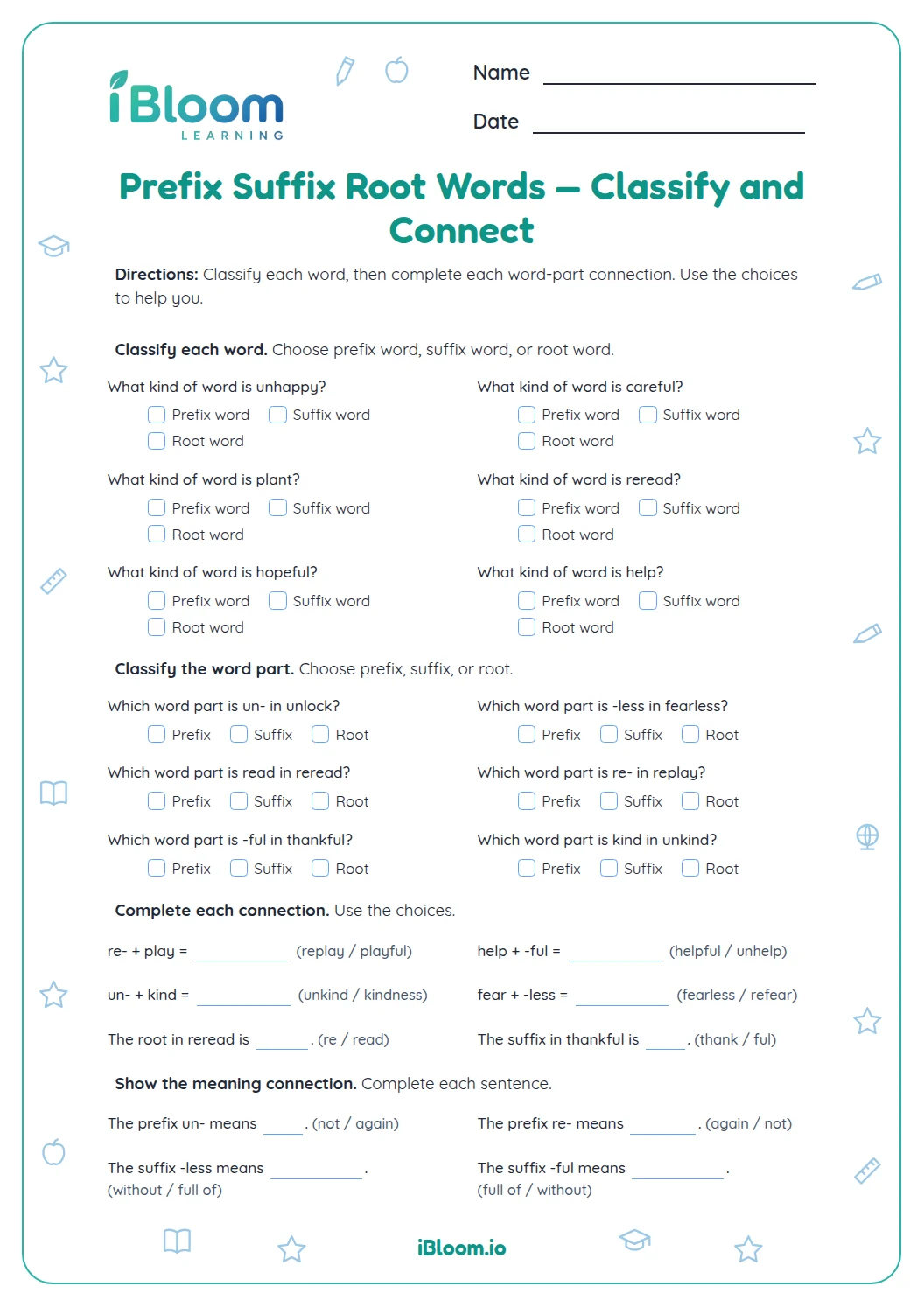
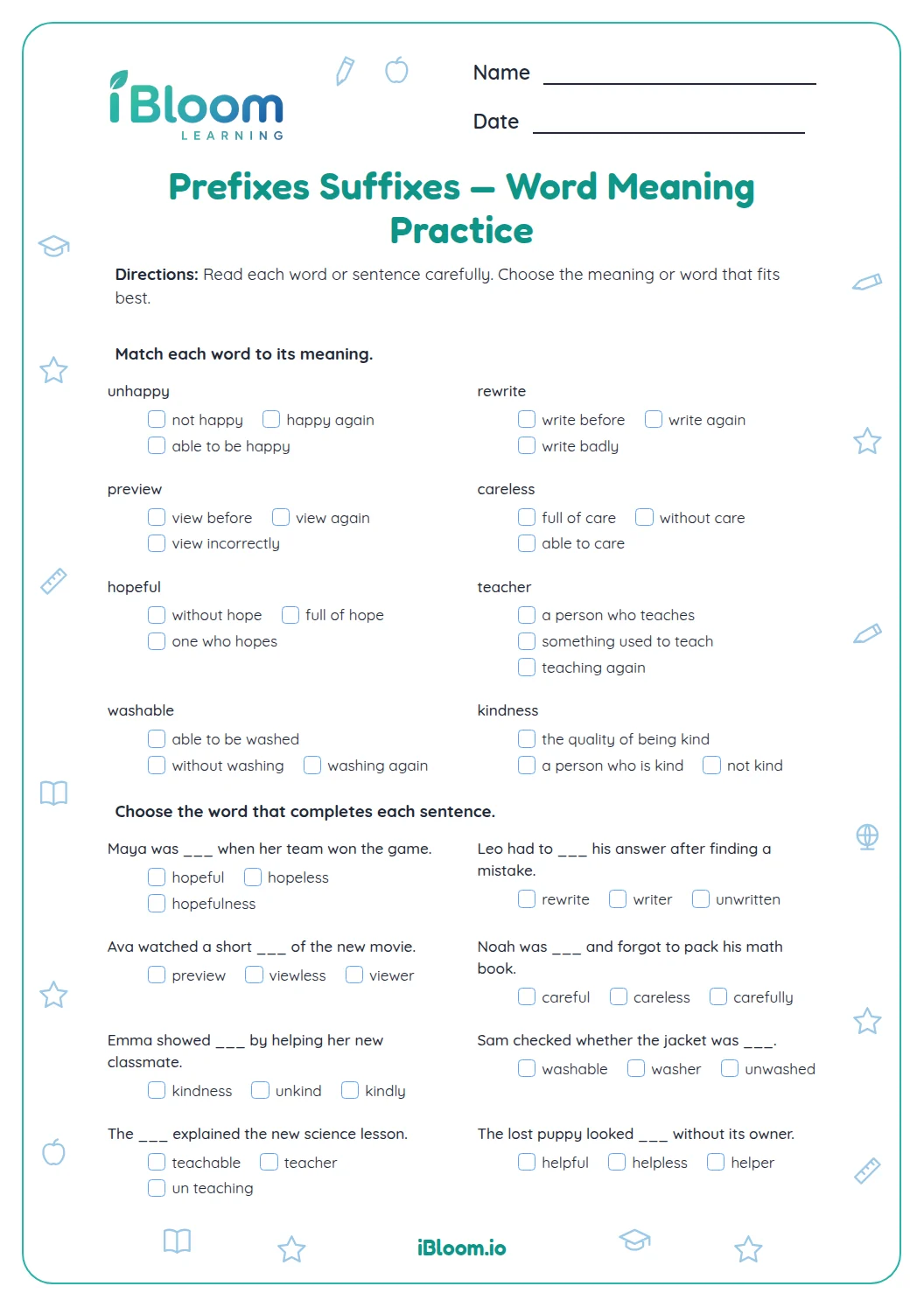
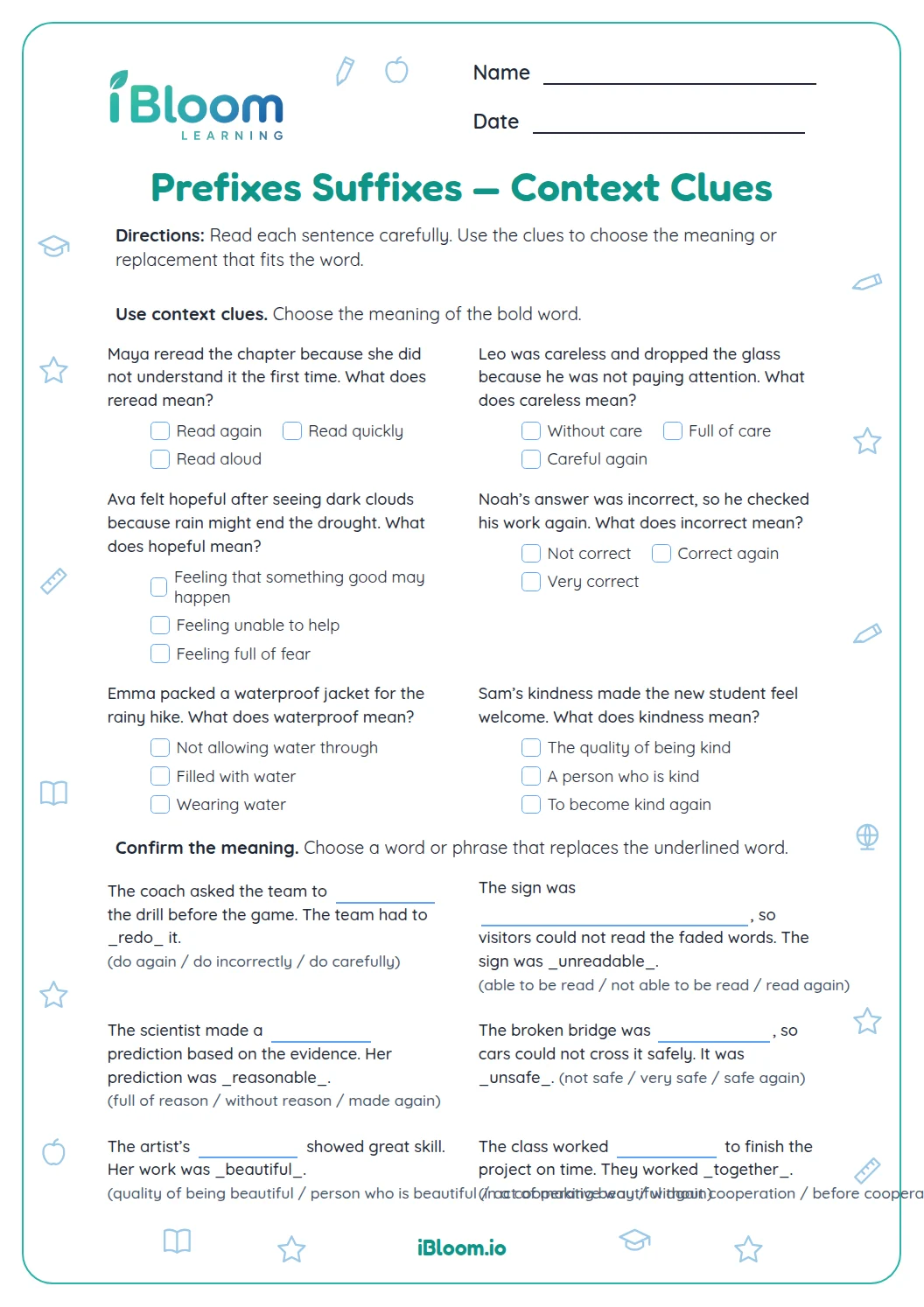
This Grade 5 vocabulary worksheet focuses on how word parts change meaning. Children identify familiar prefixes such as un- and re-, suffixes such as -less and -ful, and the base word that carries the core meaning. Sentence clues make the practice more than a matching drill: learners use the part and the context together. It includes 14 questions and an answer key.
Aligned to 5.L.4
How can a word part change a word?
A prefix comes before a base word and changes its meaning. In rewrite, re- means “again,” so rewrite means write again. A suffix comes after a base word: -less means “without” in careless.
Question 2 asks about rewrite. Remove re- to find write, then use “again” to explain the full word.
- 1re- means again.
- 2rewrite means write again.
How do sentence clues help?
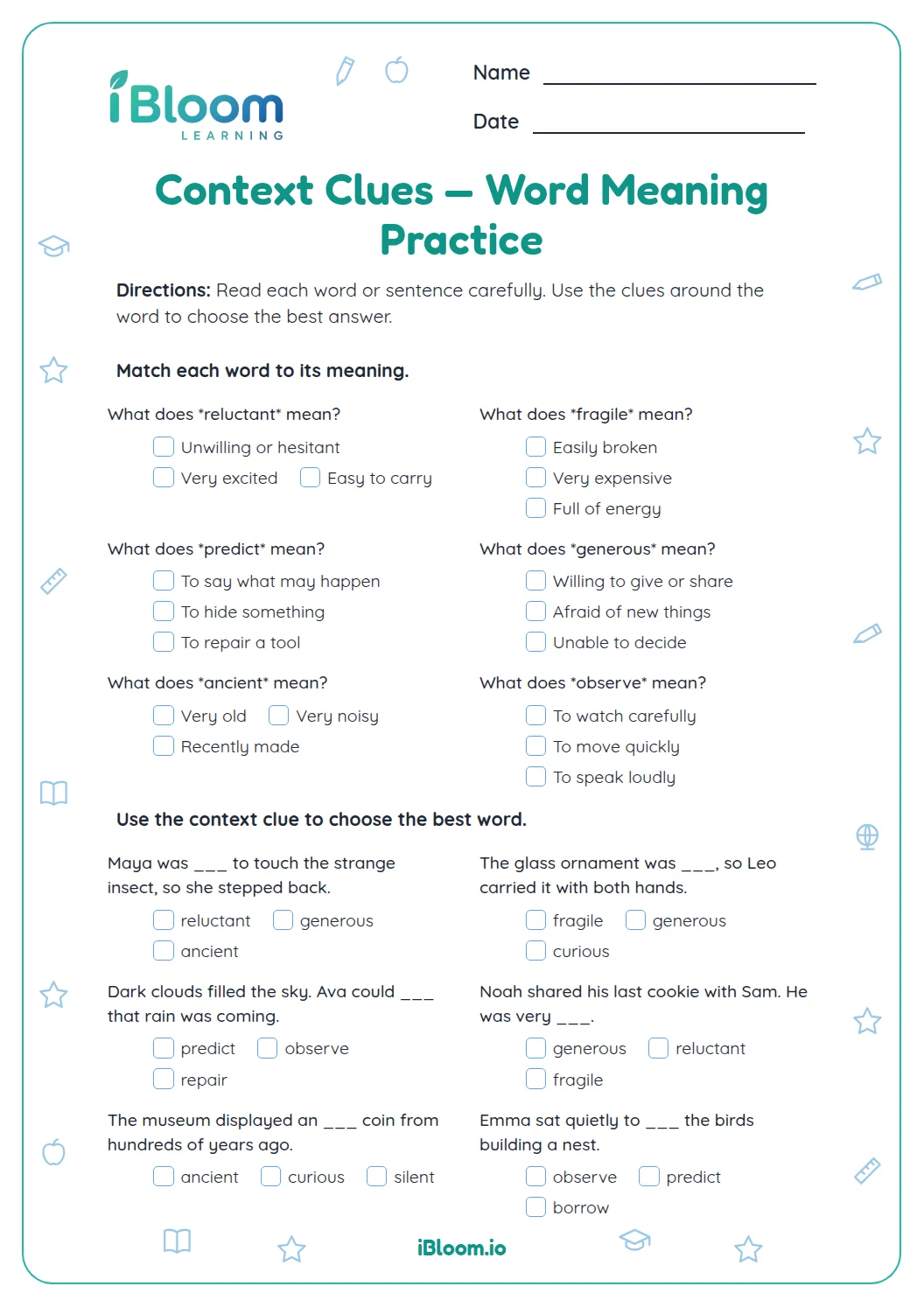
A word part gives a useful clue, while the sentence helps confirm it. In “Mina reread the directions after missing a step,” reread means she read them again. The sentence shows why she did it.
What does the practice include?
The questions move from recognizing parts to interpreting them in sentences, choosing a word from a definition, and building a word from a base.
How to use this worksheet
- 1Find the prefix or suffix and say what it contributes.
- 2Read the base word to identify its core meaning.
- 3Combine the part and the base into a full meaning.
- 4Use the whole sentence to check that meaning.
- 5For a build-a-word question, write the whole word.
Common mix-ups and fixes
The mistake
Treating re- as “before.”
The fix
In these examples re- means “again,” as in reread.
The mistake
Reading -less as “full of.”
The fix
The suffix -less means “without,” so painless means without pain.
The mistake
Ignoring the root after spotting an affix.
The fix
Keep the base meaning: rewrite combines write with again.
Curriculum alignment
This worksheet practices the reading and language skills named below.
Use word-part clues to clarify unfamiliar word meanings.
On this sheet: Use word-part analysis as a strategy to clarify word meaning.
Show the official wordingHide the official wording
Determine or clarify the meaning of unknown and multiple-meaning words and phrases based on grade 5 reading and content, choosing flexibly from a range of strategies.
What to practice next
Make more practice
Further reading
Questions parents and teachers ask
What is a prefix?
A prefix is a word part added to the beginning of a base word. Here re- means again in rewrite and reread, while un- means not in unhappy. Each prefix changes the base word’s meaning. A prefix appears at the start of a word, while its base word carries the central idea. Combine the two meanings to understand the complete word.
What is a suffix?
A suffix is a word part added to the end of a base word. The sheet uses -less, meaning without, and -ful, meaning full of. Children combine each suffix meaning with its base word. A suffix appears at the end of a base word. Saying the base and suffix meanings separately can help children combine them accurately.
How does context help with word parts?
Context gives clues about whether a possible meaning fits the sentence. In the reread item, Mina missed a step and then reread directions, confirming she read them again. Rereading gives Mina another chance to understand the directions. That sentence clue supports the meaning “read again.”
What is the base word in helpful?
The base word is help. The suffix -ful adds the idea “full of” or “providing,” so helpful describes someone or something that gives help. To find the base, remove the suffix and check that the remaining word still carries the central meaning. The word part changes the form and meaning without hiding the base.
How many items are included?
There are 14 questions: six word-part meanings, four context questions, two word choices, and two word-building or root questions. A separate answer key supports checking. The key includes a concise response for each item, including the two prompts that ask children to build or identify a word part.