






About this worksheet
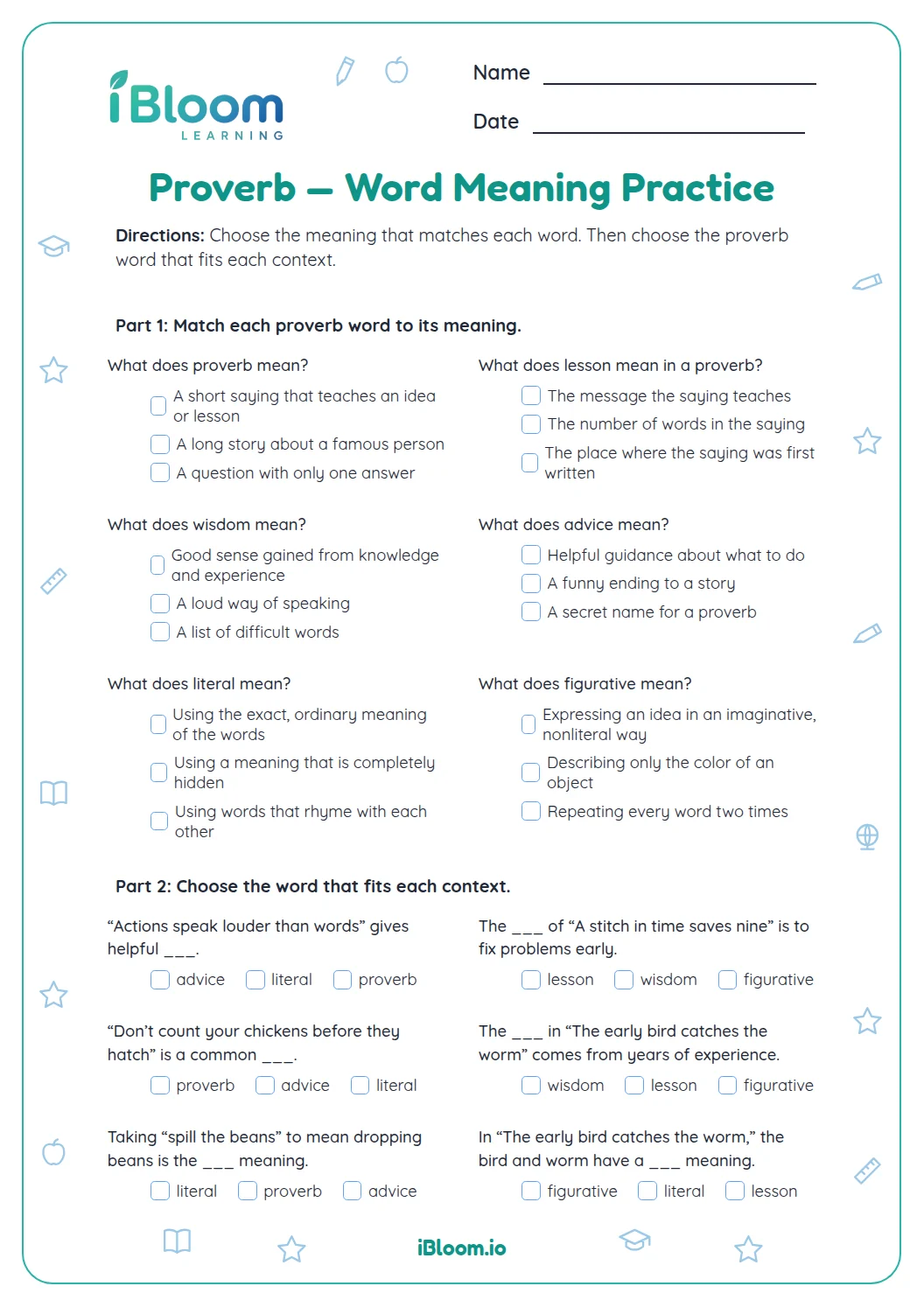
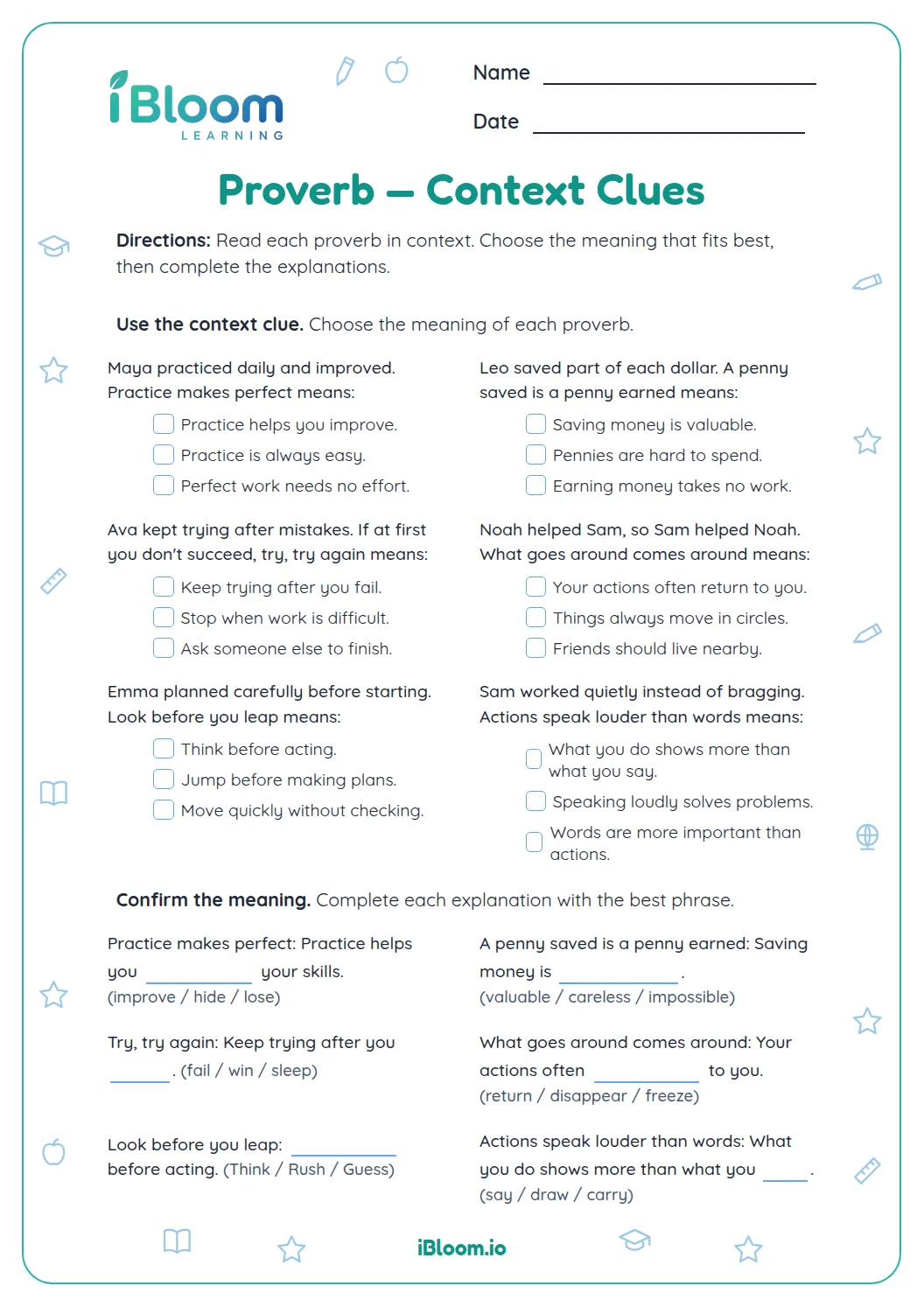
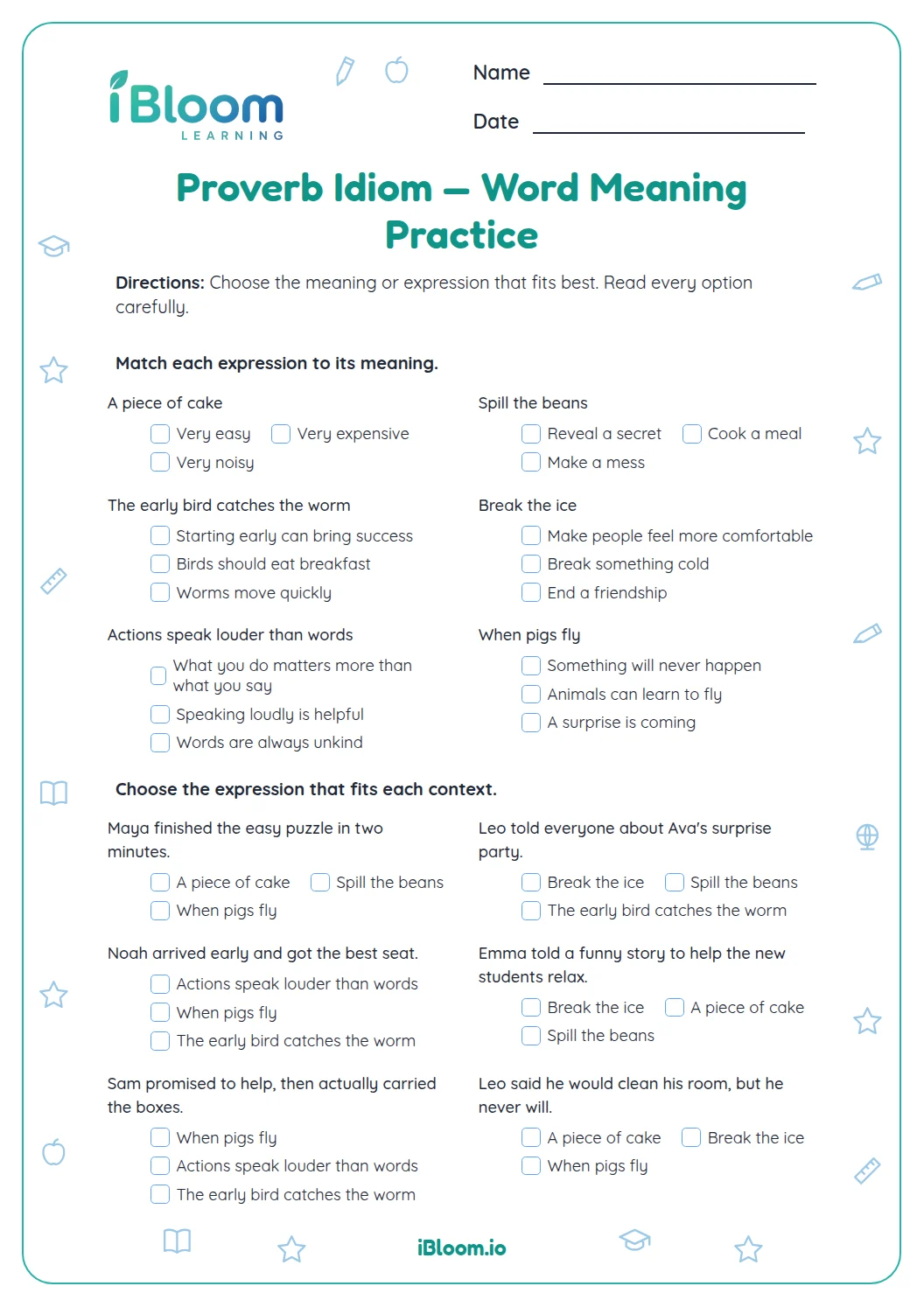
This free Grade 5 vocabulary worksheet asks students to reason about nine familiar proverbs. Part A has four meaning questions. Part B asks which action fits two more sayings. Part C moves into writing: students explain a broken promise, compare related advice and create a school example of shared work. The ten questions practice Common Core L.5.5.b by connecting figurative advice to concrete situations. A separate answer key gives six selected answers and four sample responses, so adults can check meaning while allowing students to use their own words.
Aligned to L.5.5.b
What makes a proverb more than a literal statement?
A proverb is a familiar saying that offers advice or expresses a general observation. “Many hands make light work” uses hands to represent helpers; light means less difficult. The advice concerns shared effort.
The sayings use images of leaping, hands, chickens and stitches. Ask students to translate each into plain language before choosing an answer. The written comparisons then ask how two useful pieces of advice differ.
What does a strong explanation include?
A strong explanation names the advice and links it to an action in the question. In question 7, the important contrast is between Ben promising help and leaving. An answer about speaking quietly misses that contrast.
- 1Proverb: Actions speak louder than words.
- 2Detail: Ben promises to help but leaves.
- 3Sample: Ben’s promise means little because he leaves instead of helping.
How do students compare related proverbs?
Question 8 pairs “Practice makes perfect” with “Slow and steady wins the race.” Both encourage effort, but the first emphasizes repeating a skill and the second emphasizes patient progress.
Question 10 compares “Many hands make light work” with “Two heads are better than one.” Both value cooperation. The first focuses on sharing a task; the second focuses on thinking together. A clear comparison explains both sides.
How to use this worksheet
- 1Read each saying aloud and ask for its advice in everyday language.
- 2Complete Part A, checking the meaning of light in question 2.
- 3In Part B, connect the chosen action to the proverb’s advice.
- 4For questions 8 and 10, explain the distinct advice in both sayings.
- 5Check the original example and final explanation against the sample key.
Mistakes to notice and fix
The mistake
Explaining “Many hands make light work” as a statement about lamps.
The fix
Use the helpers in the saying to infer that light means easier here.
The mistake
Saying the chicken proverb means that planning is always wrong.
The fix
Distinguish preparing for a possible win from assuming the win is certain.
The mistake
Repeating “Actions speak louder than words” without mentioning Ben.
The fix
Add the specific contrast: he promises help but leaves instead.
Common Core alignment
Explain familiar proverbs and connect their advice to specific situations.
On this sheet: Students select meanings, judge examples and explain the advice in proverbs.
Show the official wordingHide the official wording
Recognize and explain the meaning of common idioms, adages, and proverbs.
What to practice next
Make more practice
Further reading
Questions parents and teachers ask
What do the written questions ask students to do?
The four written questions ask students to explain a broken promise, compare practice with patient progress, create a school example of shared work and compare shared work with shared thinking. Each prompt prints its proverbs, so students can concentrate on explaining the advice and making a precise connection.
Does my child need to memorize the sayings first?
No; each question prints the proverb it uses. Students can focus on meaning and application while the wording stays visible. If a saying is unfamiliar, talk through its literal image first, then ask what advice that image might offer someone facing the situation in the question.
How should I check the four written answers?
Check whether each answer explains the advice and connects it to the prompt. The key gives sample sentences, so different wording can be correct. In question 7, for instance, an answer should connect Ben’s failure to help with the difference between a promise and an action.
How are the two proverbs in question 10 different?
“Many hands make light work” emphasizes sharing a task, while “Two heads are better than one” emphasizes thinking together. Both value cooperation, but a complete answer explains that difference. Students might contrast classmates dividing cleanup jobs with two classmates discussing possible solutions to a difficult problem.
What is a good school example for question 9?
A group sharing classroom cleanup is a good example. Several classmates might stack chairs together, reducing the work each person must do. Students can choose another school task, but their sentence should explain how helpers share the effort instead of simply mentioning a group of people.