





About this worksheet
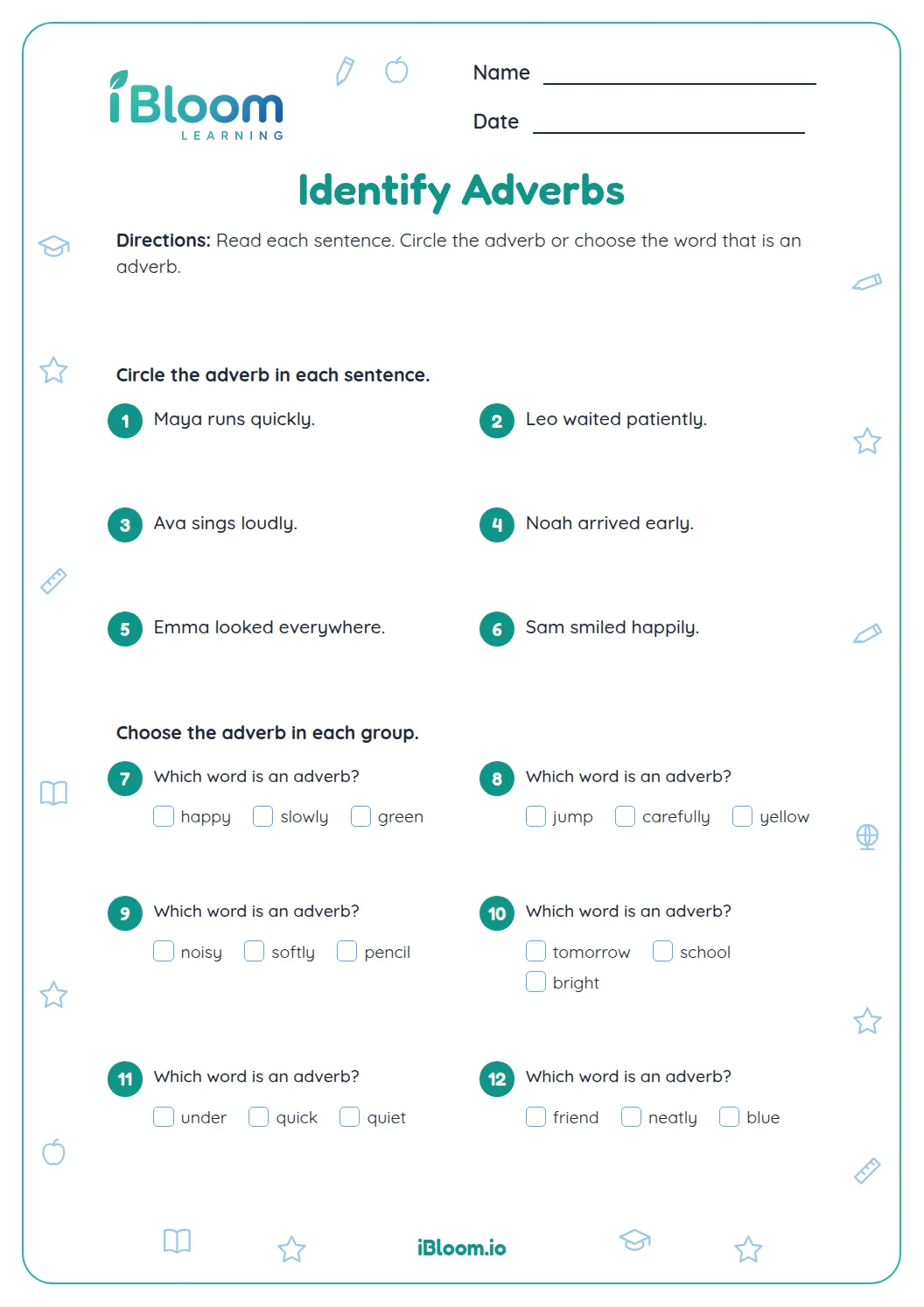
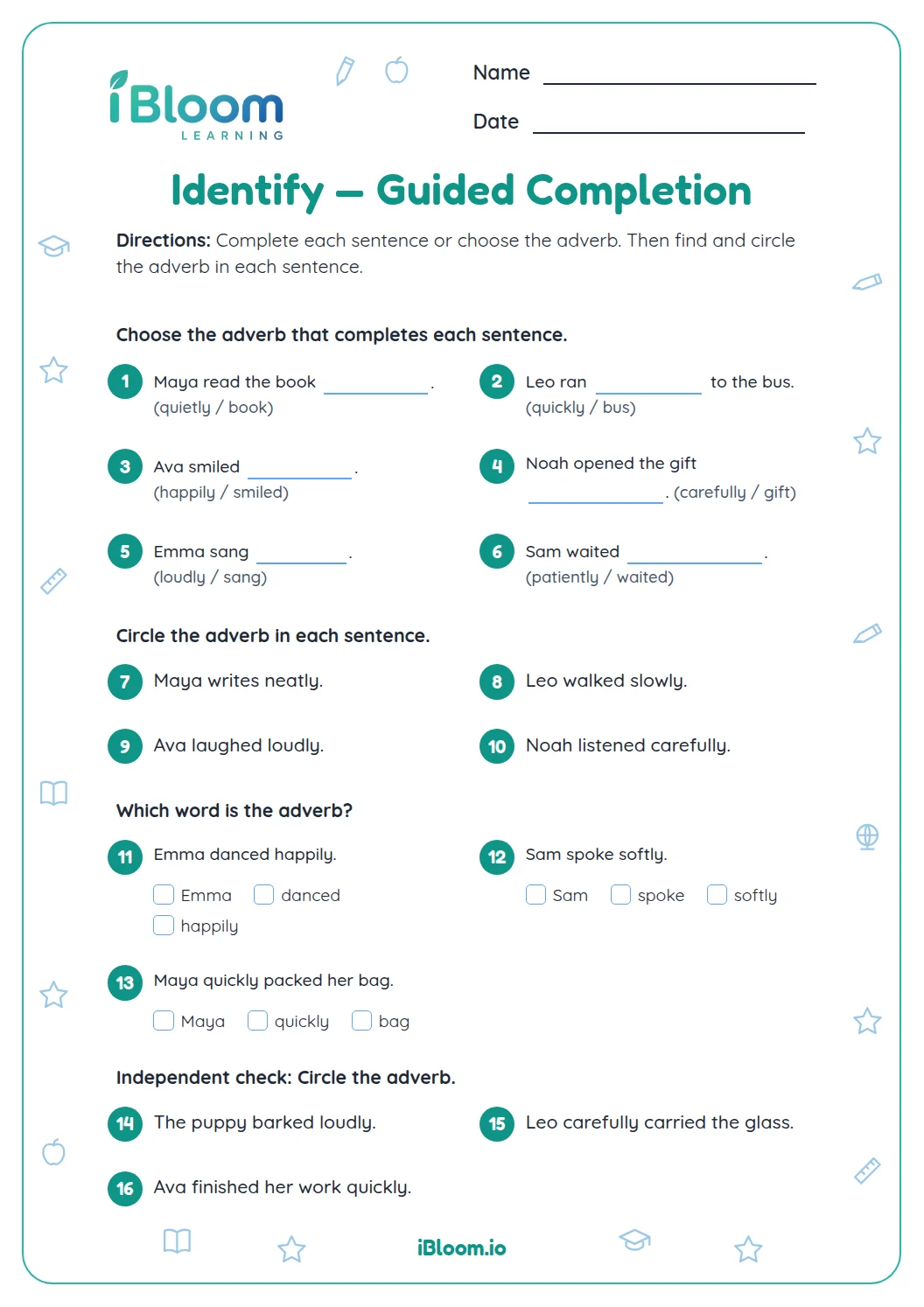
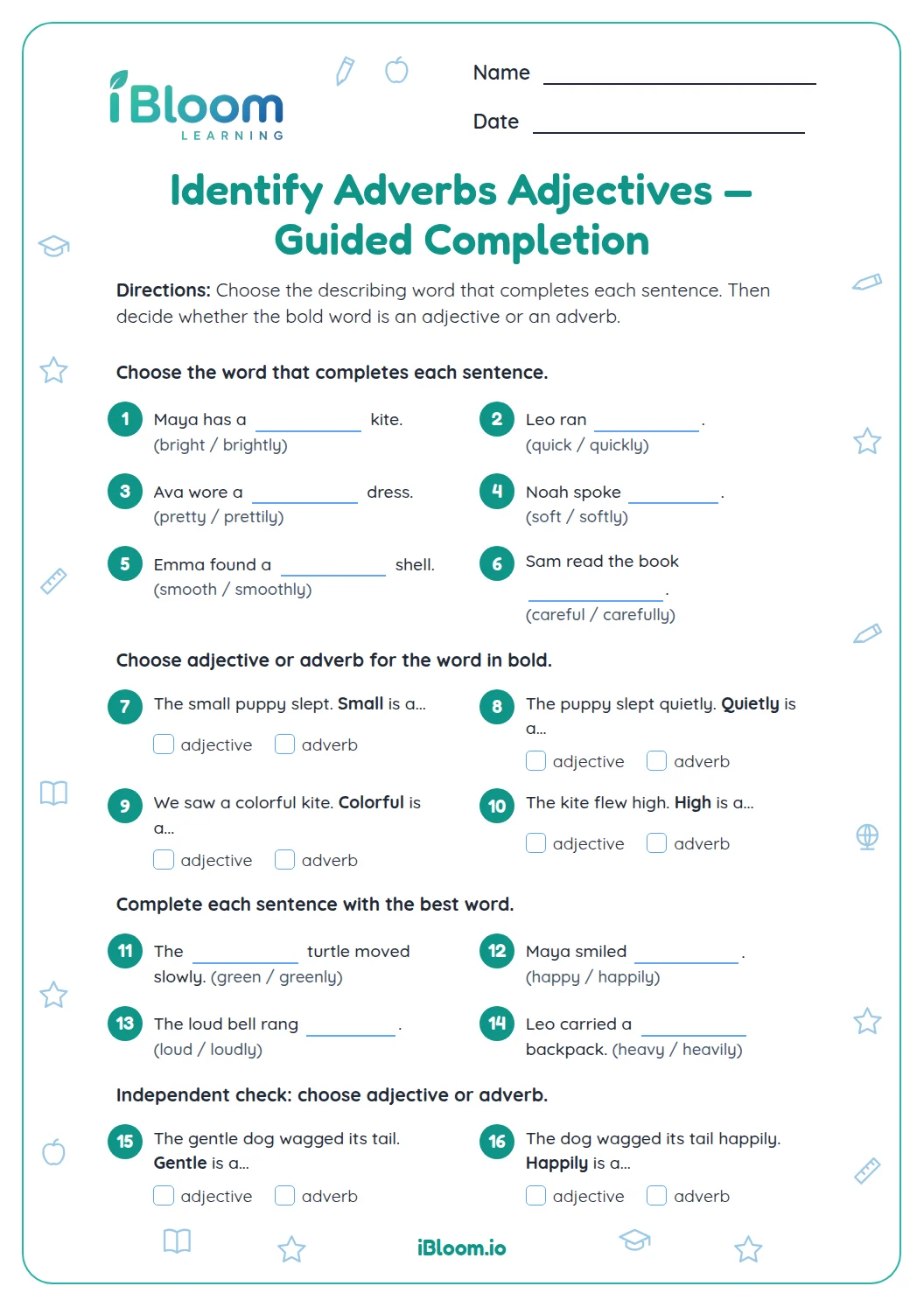
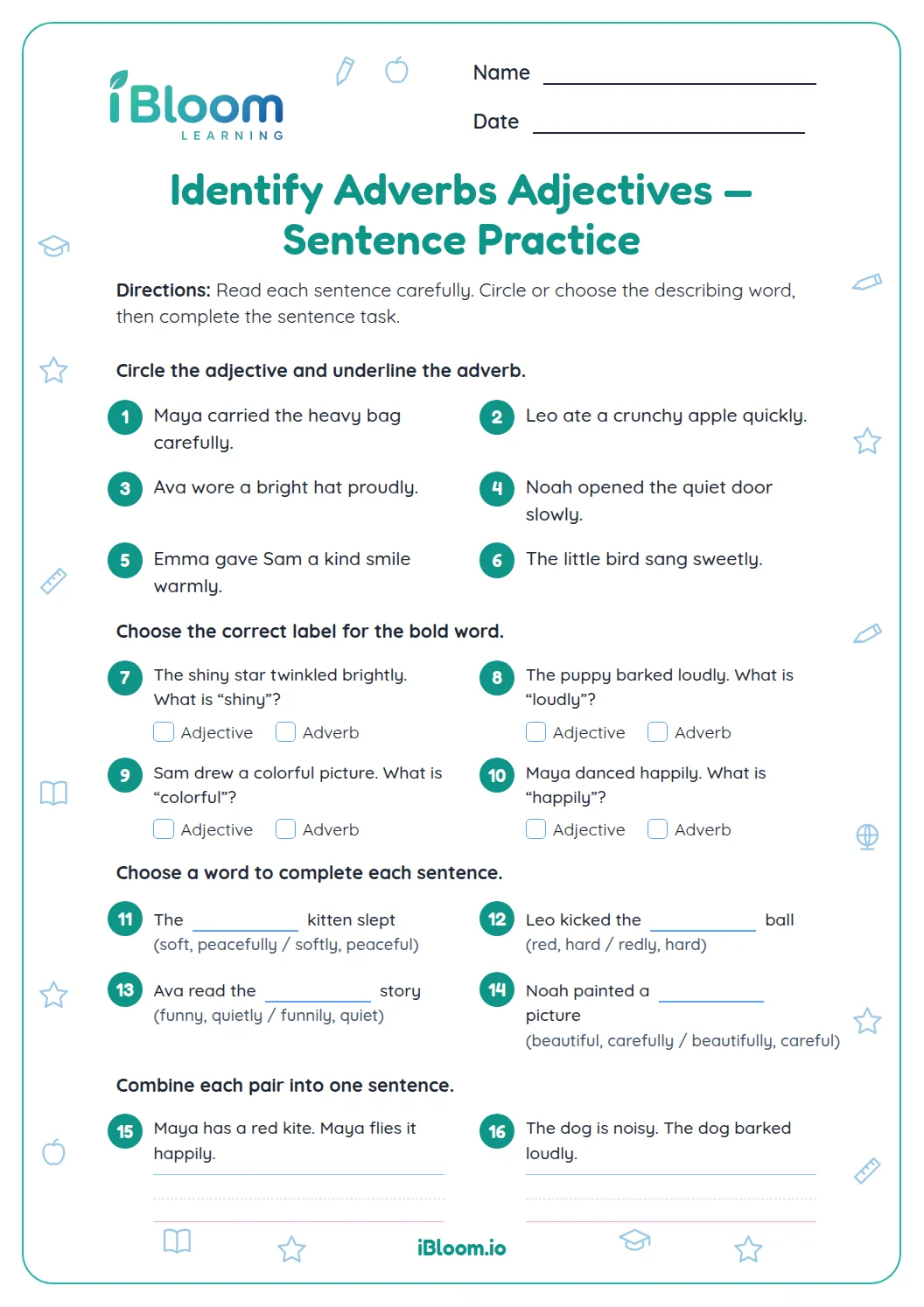
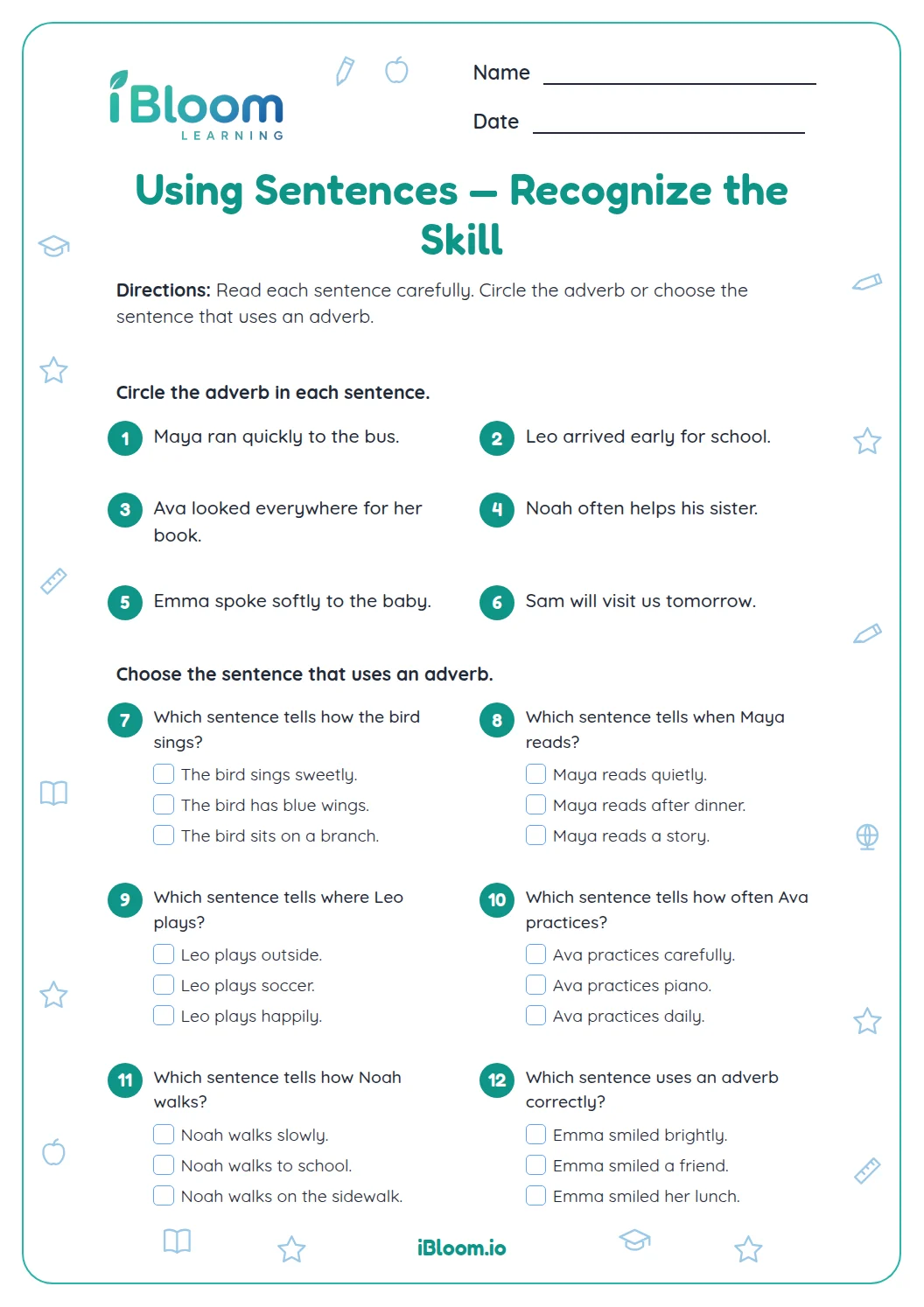
This Grade 2 grammar worksheet gives students three ways to practice adverbs: choose a word that completes a sentence, find an adverb in a sentence, and write original examples. The questions include adverbs that tell how, when, and where an action happens. A separate answer key lists the choices and sample sentences for the open responses.
What does an adverb tell us?
Part A gives students seven sentences with a clear clue and three choices.
In question 1, “The rabbit hopped ___ over the log,” quickly describes how it hopped.
- 1The rabbit hopped ___ over the log.
- 2Answer: quickly
How can a reader spot an adverb?
Part B asks students to find how, when, or where words in four sentences. In “The bird sang sweetly today,” sweetly describes how the bird sang.
How can students use adverbs in their own sentences?
Part C has three written prompts. Students use a named adverb or choose one that adds information, then make clear which action it describes.
How to practice adverbs
- 1Read each whole sentence before choosing.
- 2Ask whether the missing word tells how, when, or where.
- 3In a sentence, locate the action and find the word that adds information.
- 4For writing items, use the requested adverb in a complete sentence.
- 5Check the answer key and make sure your word describes an action.
Adverb checks
The mistake
Choosing a describing word for a person or thing instead of an adverb.
The fix
Ask whether the word tells about an action: how, when, or where it happens.
The mistake
Missing an adverb such as outside or always because it does not end in -ly.
The fix
Look for meaning, not just the ending; adverbs can take several forms.
The mistake
Writing an adverb without a complete sentence.
The fix
Add a subject and action, then check that the adverb adds information about that action.
What to practice next
Make more practice
Questions parents and teachers ask
What kinds of adverbs appear on the worksheet?
The questions include words that tell how, when, and where an action happens. Examples include quickly, tomorrow, outside, and always. Students choose these words, identify them in sentences, and use adverbs in their own writing. These include adverbs without the -ly ending.
How many questions are on the page?
There are 14 questions in three parts. Seven are sentence-completion choices, four ask students to find an adverb in a sentence, and three invite students to write a sentence using an adverb. Students also check which action each adverb describes.
Do all adverbs end in -ly?
No. Some adverbs, such as quickly and carefully, end in -ly, while others such as soon, outside, and always do not. The worksheet includes both kinds so students focus on what the word tells about an action. The action and meaning reveal the adverb’s job.
What does the answer key show for writing questions?
The key gives sample sentences for the three open-ended prompts. Students may write different sentences and still be correct if the sentence is complete and the requested adverb tells how, when, or where. A different example is fine when it follows the prompt.
Can students use their own adverbs?
Yes. For the named-word prompts, use the requested adverb in a complete sentence. For the final prompt, choose an adverb that clearly tells where an action happens. The answer key offers a possible model. The final prompt focuses on place, which students can spot by asking where.