


About this worksheet
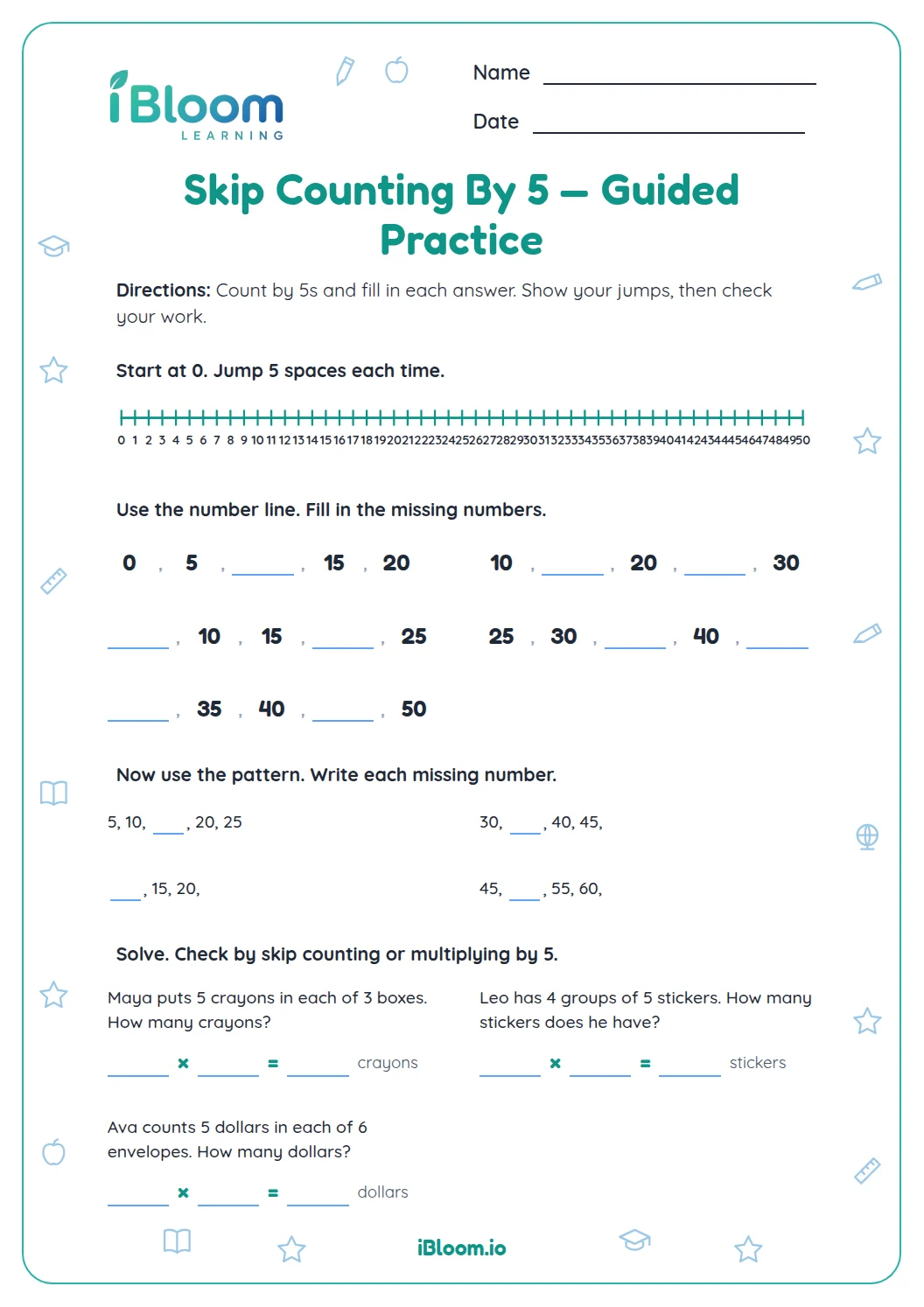
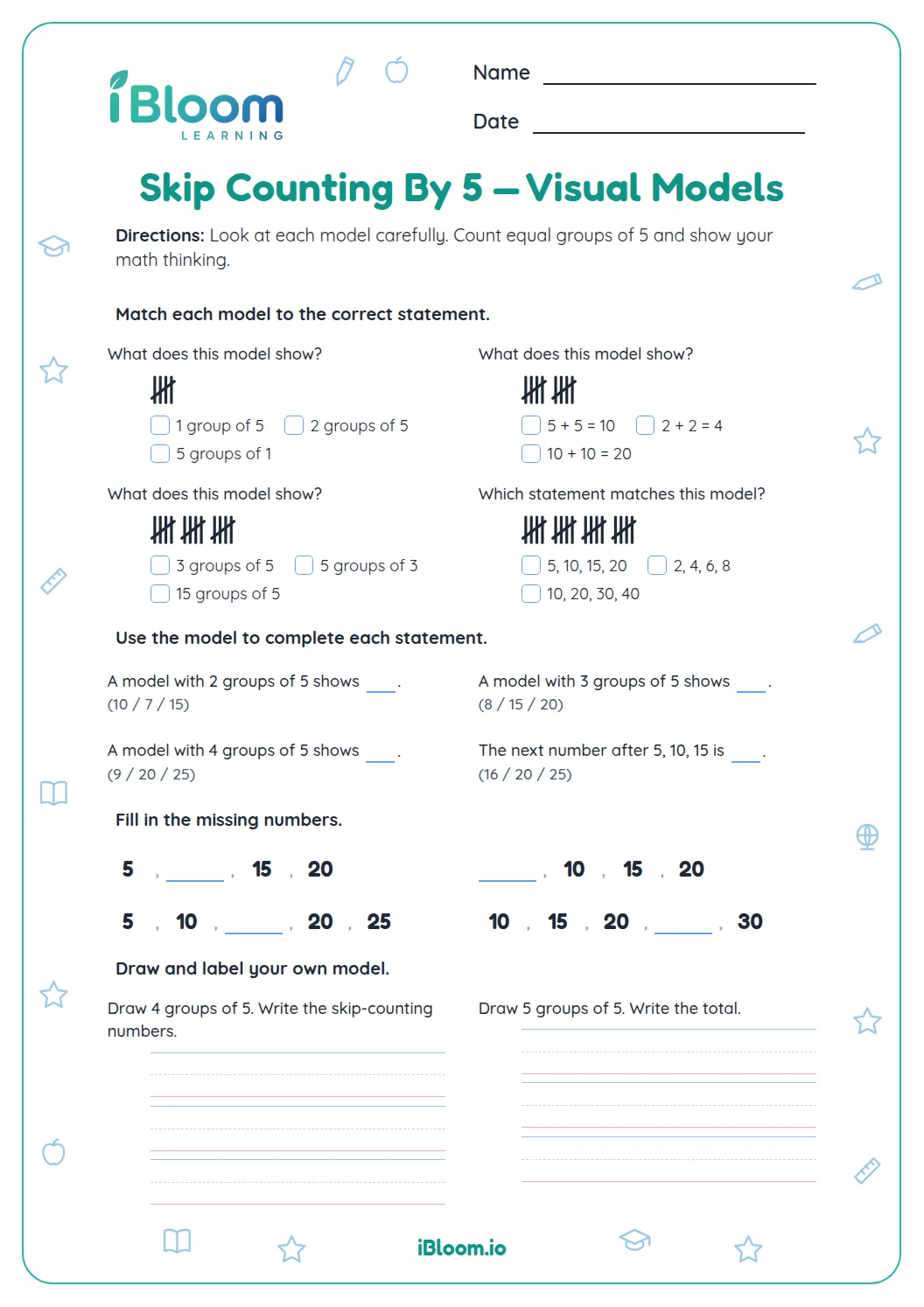
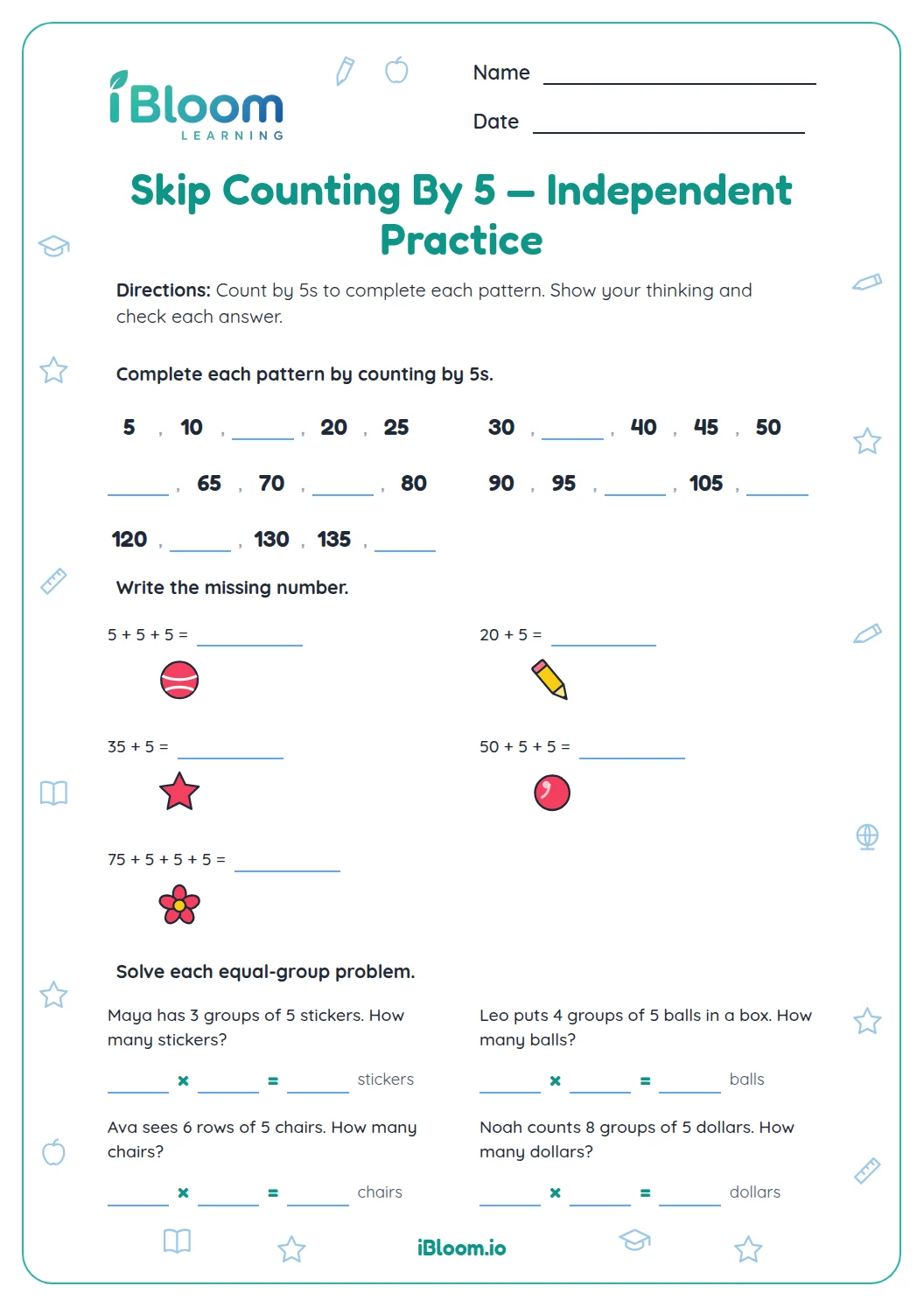
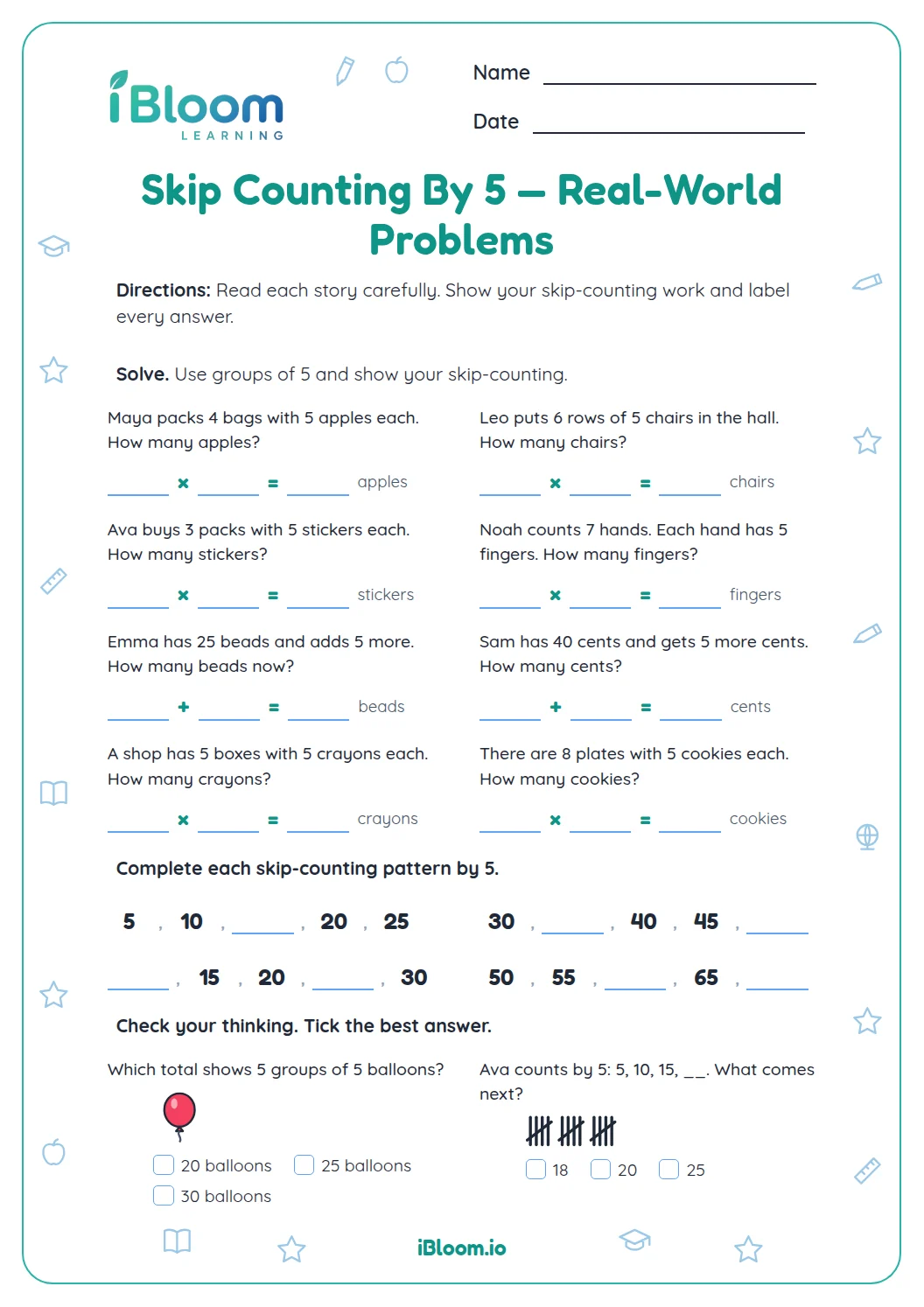
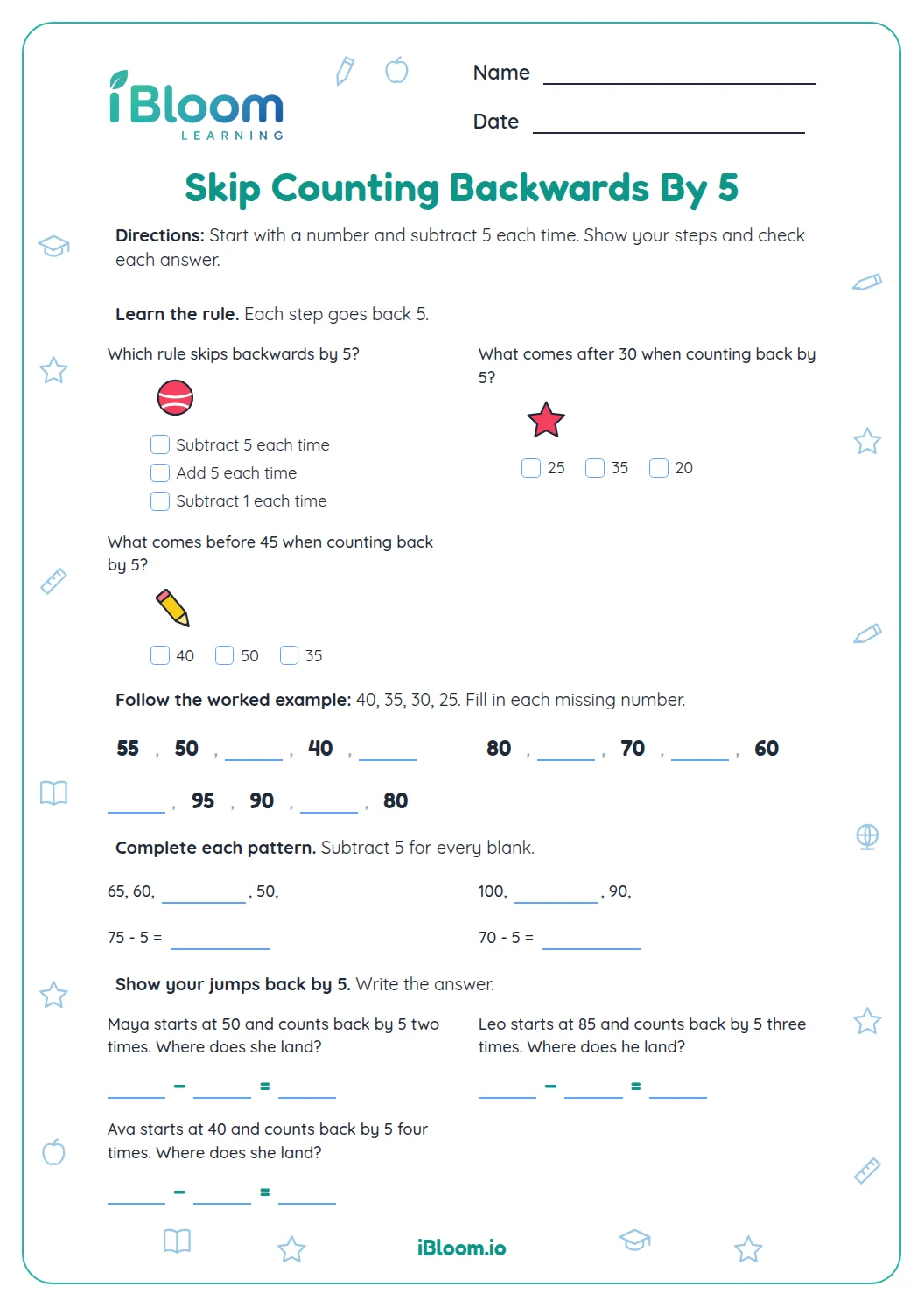
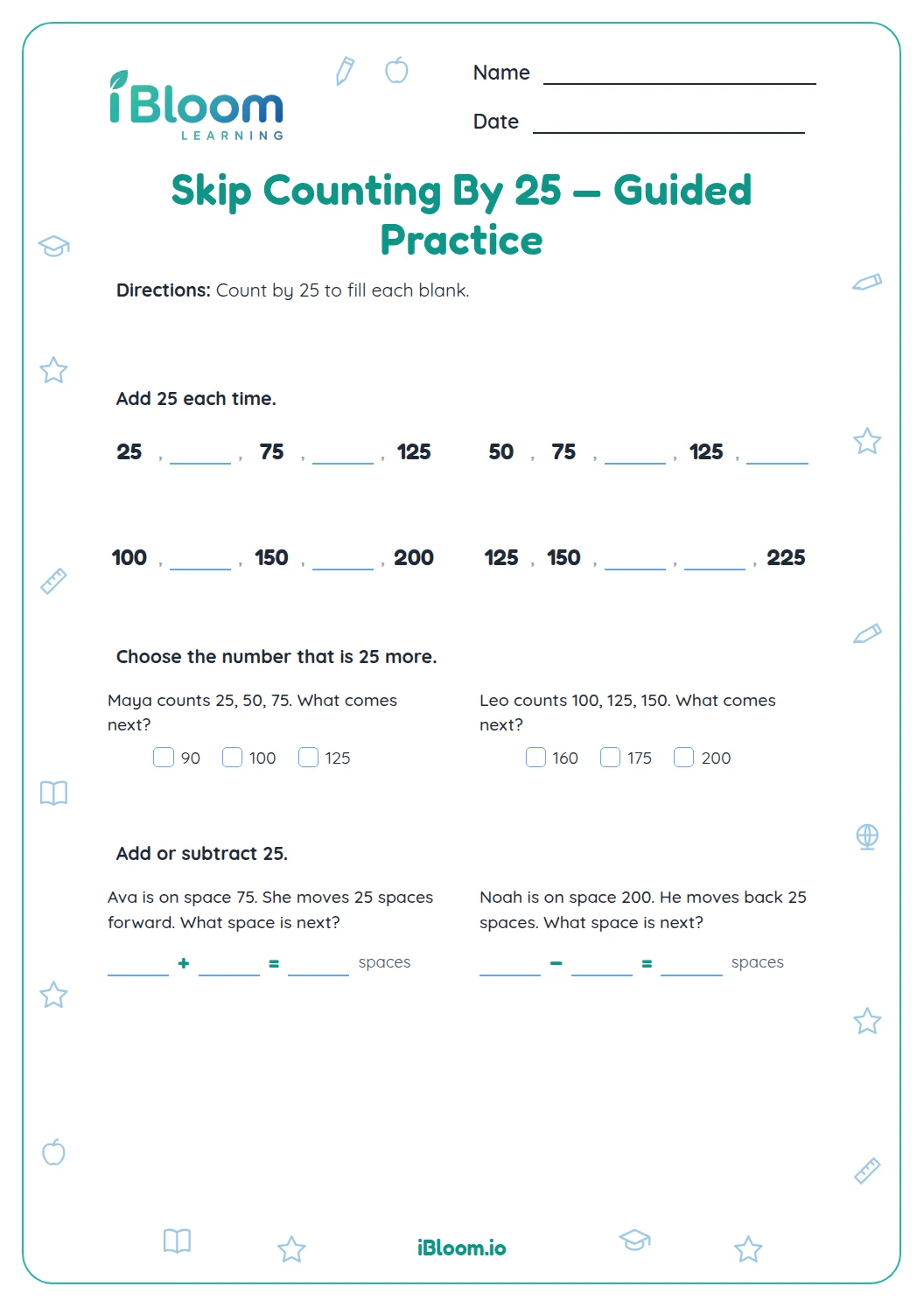
This free Grade 2 worksheet builds skip-counting-by-5 reasoning with sequences that begin at different numbers. Children fill missing terms, choose a list that keeps equal jumps, and explain how many jumps connect two values. The sixteen questions practice CCSS 2.NBT.A.2 by counting within 1,000 in groups of five. A separate answer key supports quick checking at home or in class.
Aligned to 2.NBT.A.2
How does each number change?
In every sequence, compare neighboring numbers. If the next number is 5 more, the pattern is counting by fives.
Question 1 is 10, 15, ___, 25, 30. Count 20 after 15; then check that 25 is 5 more than 20.
- 110, 15, ___, 25, 30
- 215 + 5 = 20
- 320 + 5 = 25
- 4The missing number is 20.
How can a child check a skip-count pattern?
Check more than one jump. In Part B, one wrong term can make a list look almost right; compare each pair and confirm every step is exactly 5. Starting points can be any number, so attend to the jump, not just whether a number ends in 0 or 5.
How do jumps help solve the challenge questions?
A jump count turns repeated addition into a shorter plan. From 40, four jumps are 45, 50, 55, 60. For a count moving backward from 45, step back twice to 40 and 35.
How to use this worksheet
- 1Say the first two terms aloud and name the change.
- 2Complete Part A by adding 5 one step at a time.
- 3In Part B, check every transition before selecting a list.
- 4Use a number line or count aloud for the jump questions.
- 5Ask your child to explain one answer using the words “5 more.”
- 6Check the answer key and revisit any sequence with an uneven jump.
Common mistakes and quick fixes
The mistake
Adding 1 because the terms are listed one after another.
The fix
Say “five more” before writing each new term.
The mistake
Checking only the final term in a list.
The fix
Compare every neighboring pair; each jump must be 5.
The mistake
Confusing the number of jumps with the landing number.
The fix
List each landing once; from 30, five jumps land on 55.
Common Core alignment
This worksheet practices the math skills named below through its sequence problems and explanations.
Count within 1,000 by fives and use that pattern to find missing terms.
On this sheet: Every sequence advances by five, including missing terms and jump counts.
Show the official wordingHide the official wording
Count within 1000; skip-count by 5s, 10s, and 100s.
What to practice next
Make more practice
Further reading
Questions parents and teachers ask
What is the rule for skip counting by 5?
Add 5 to the number each time. On this sheet, a child can check the rule by comparing each pair in a sequence, such as 35, 40, 45. The final section also asks children to count jumps, which gives them a way to explain how a pattern reaches its endpoint.
Why do some sequences start with numbers other than 5?
A skip-count pattern can begin at different numbers as long as each step changes by five. Starting at 70 gives 70, 75, 80, 85. The worksheet varies starting points so children focus on the size of each jump rather than memorizing one list.
How can I explain the missing number in question 1?
The terms are 10, 15, blank, 25, 30. Add five to 15 to get 20, then check that 25 is five more than 20. The two-sided check helps catch a guessed number that fits only one neighboring term.
What does “number of jumps” mean?
A jump is one move of five from one term to the next. From 30 to 55, the landings are 35, 40, 45, 50 and 55, so there are five jumps. Counting the moves rather than the listed numbers gives the requested total.
Does this worksheet include an answer key?
Yes. The separate key lists all sixteen answers, including the sequence completions and short explanations. For explanation questions, accept wording that correctly identifies the repeated increase of five and the number of jumps; the child does not need to copy the sample wording exactly.