

About this worksheet
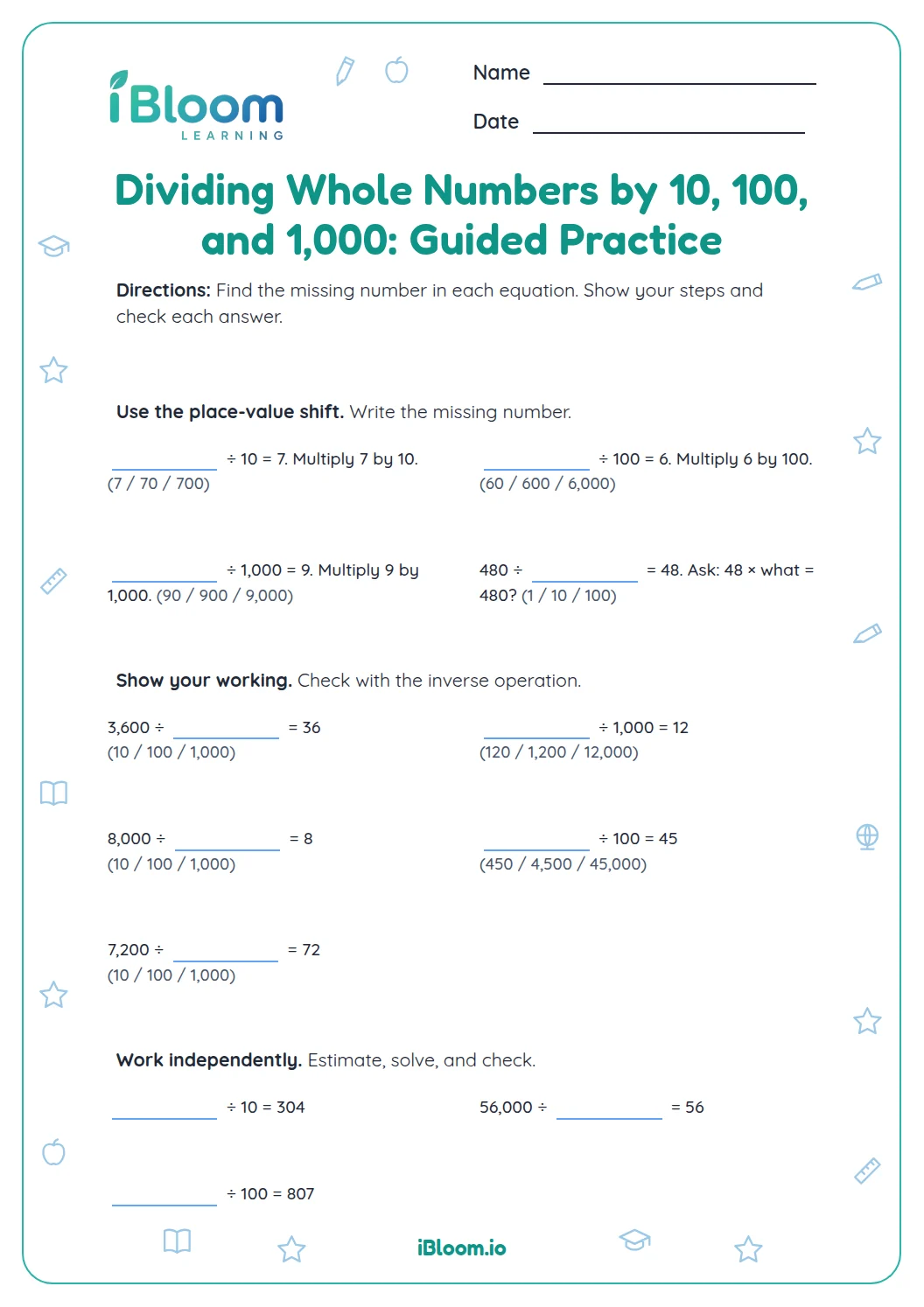
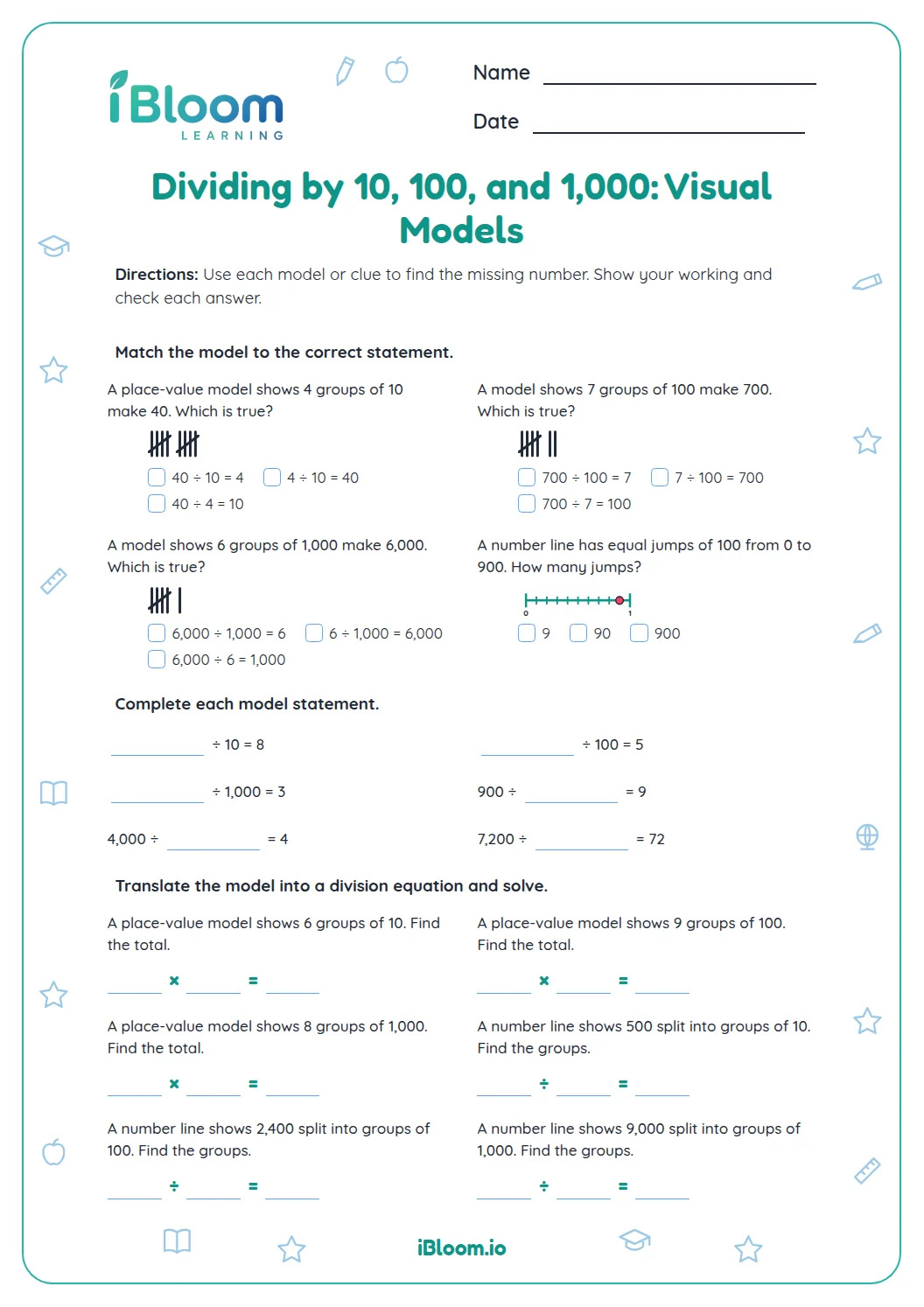
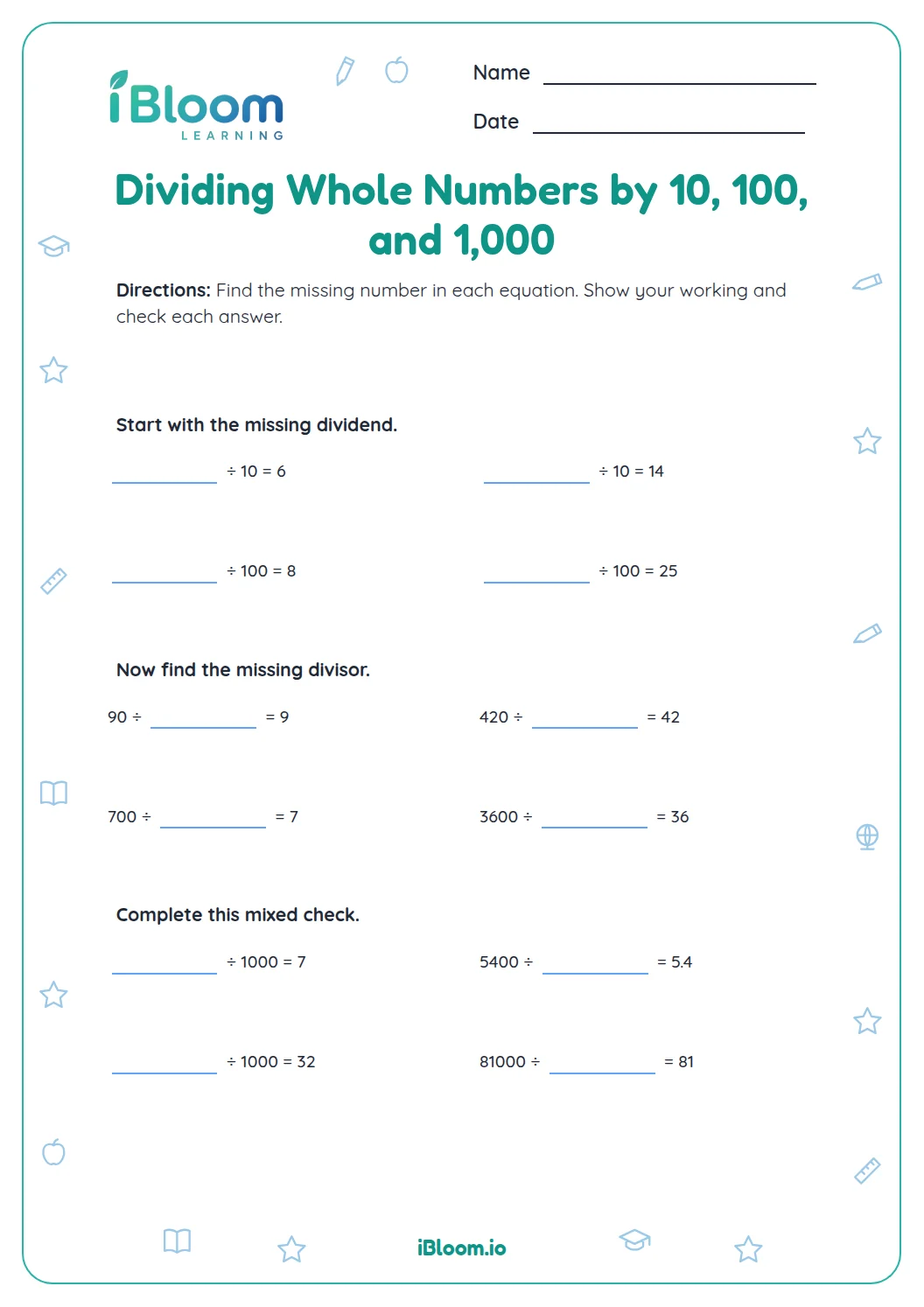
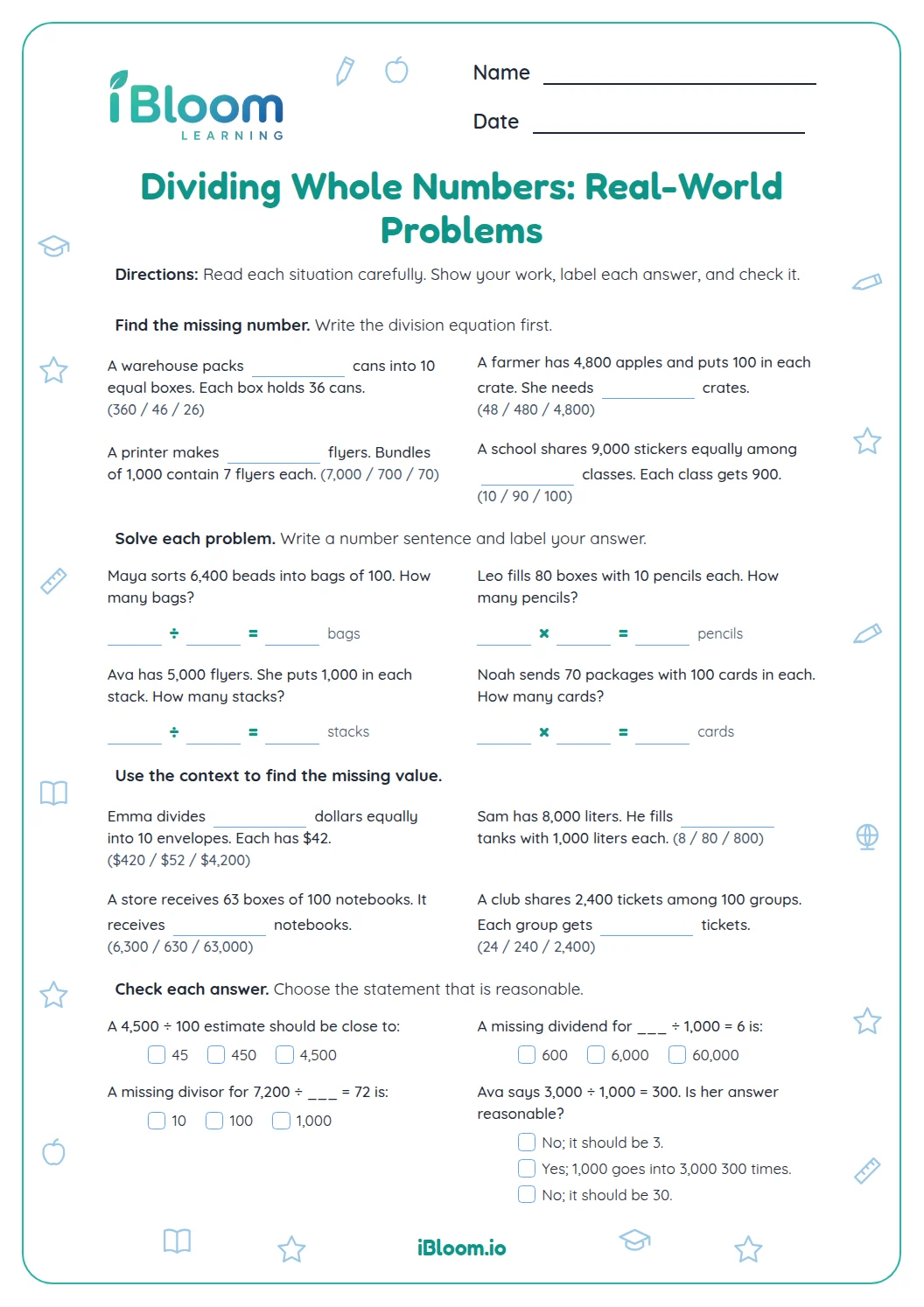
This free printable Grade 6 worksheet gives students 16 problems dividing whole numbers by 10, 100, or 1,000. Students first find quotients, then use multiplication to recover a missing dividend or test a missing divisor, and finally check a claim and apply the pattern to a short situation. Question 1, 4,800 ÷ 10, has quotient 480. The practice supports the place-value pattern in CCSS 5.NBT.A.2 and comes with a separate answer key.
Aligned to 5.NBT.A.2
What happens when a whole number is divided by 10?
Dividing by 10 makes the quotient one tenth of the dividend. In 4,800 ÷ 10, each place shifts one position to the right in the written digits, so the quotient is 480. Dividing by 100 or 1,000 follows the same place-value pattern.
- 14,800 ÷ 10 = 480
- 2Check: 480 × 10 = 4,800
- 3The product returns to the original dividend.
How can multiplication reveal a missing number?
Division and multiplication undo each other. To solve ___ ÷ 10 = 528, calculate 528 × 10, giving 5,280. For 72,000 ÷ ___ = 72, find which divisor makes 72 × divisor equal 72,000.
How can students check the place-value pattern?
Multiply the quotient by the divisor and compare the product with the dividend. This also helps catch a misplaced digit, such as the error in question 14, where 48,000 ÷ 100 is claimed to be 4,800.
How to use this worksheet
- 1Name the divisor: 10, 100, or 1,000.
- 2Use the place-value pattern to find the quotient.
- 3For a missing dividend, multiply the quotient by the divisor.
- 4For a missing divisor, test the quotient times the possible divisor.
- 5Substitute the answer back into the original equation.
- 6Use the key to review the result after completing each part.
Common mistakes and quick fixes
The mistake
Moving the digits the wrong direction when dividing.
The fix
Estimate the quotient: division by 10, 100, or 1,000 makes a positive whole number smaller.
The mistake
Choosing a divisor without checking the quotient.
The fix
Multiply the proposed divisor by the quotient and compare with the dividend.
The mistake
Changing too many place values.
The fix
Compare the size of the divisor and estimate whether the quotient should be tens, hundreds, or thousands.
Common Core alignment
This worksheet gives students practice with the standard below.
Divide whole numbers by 10, 100, and 1,000 and use inverse operations to find missing values.
On this sheet: Students divide whole numbers by powers of 10 and reason about the place-value pattern and inverse multiplication.
Show the official wordingHide the official wording
Explain patterns in the number of zeros of the product when multiplying a number by powers of 10, and explain patterns in the placement of the decimal point when a decimal is multiplied or divided by a power of 10.
What to practice next
Make more practice
Further reading
Questions parents and teachers ask
How can I check division by 10, 100, or 1,000?
Multiply the quotient by the divisor. For question 1, 480 × 10 returns 4,800, so the quotient is correct. This inverse check also works when the original equation has a missing dividend or divisor. Compare the product with the dividend in the original problem.
How do you find the missing dividend in question 9?
The equation is ___ ÷ 10 = 528. Multiply 528 by 10 to reverse the division, so the missing dividend is 5,280. Substituting it gives 5,280 ÷ 10 = 528. Multiplication reverses division and restores the dividend. Write the multiplication equation before filling the blank.
How do you find a missing divisor?
Use the known quotient and ask what divisor multiplied by that quotient gives the dividend. In question 11, 72 × 1,000 = 72,000, so the missing divisor is 1,000. This check confirms the quotient and divisor together. Write a multiplication equation to verify the divisor.
What is the error in question 14?
The claim says 48,000 ÷ 100 = 4,800, but dividing by 100 gives 480. Check by multiplying: 480 × 100 = 48,000. The claimed quotient is ten times too large. Students can use the inverse operation to confirm the correction.
What does the answer key include?
The separate two-page answer key lists the quotient for each direct division, the missing dividend or divisor, and the reasoning answers. Students can use multiplication to verify each result against the equation on the worksheet. The key supports checking each part after students have completed it.