




About this worksheet
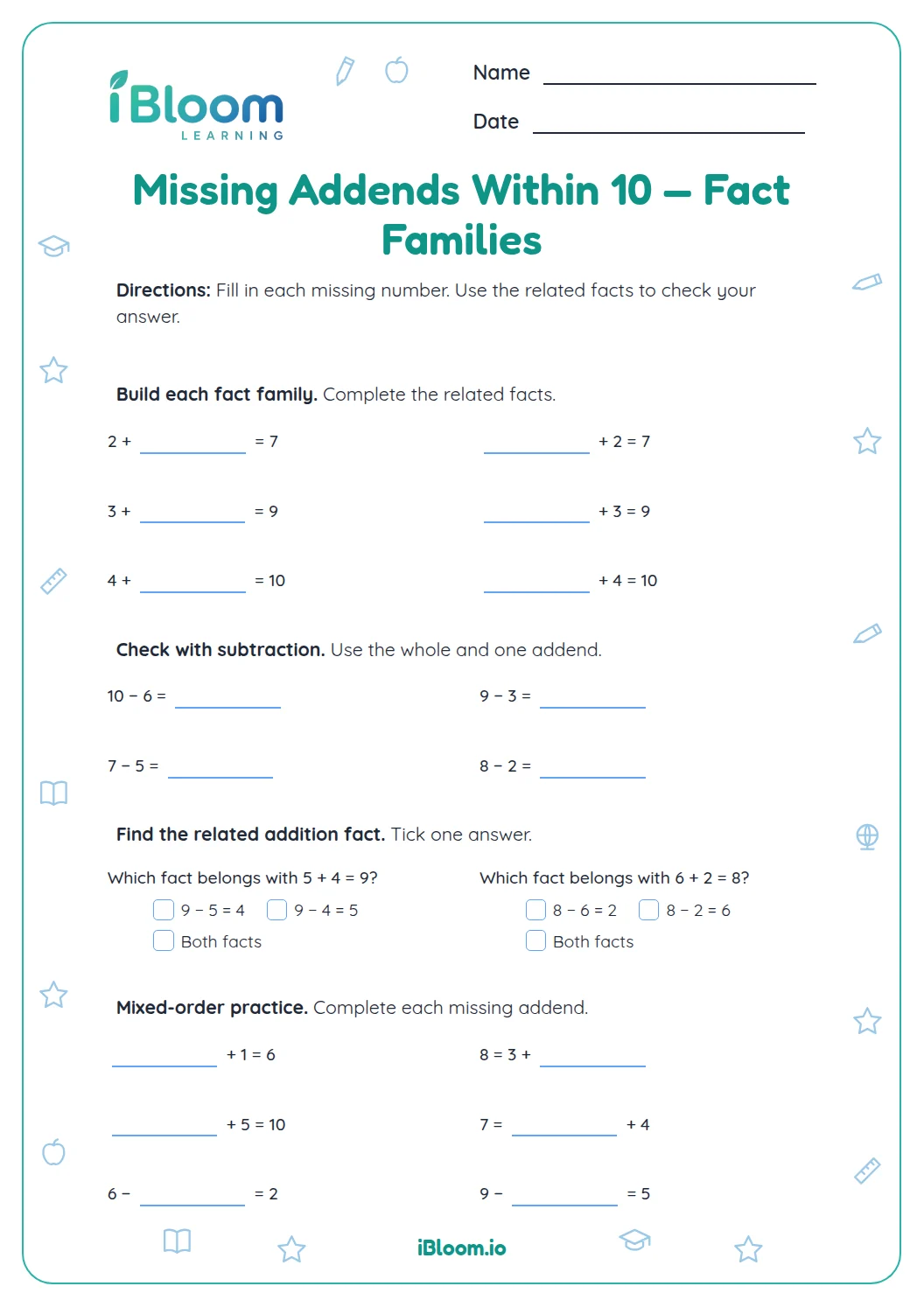
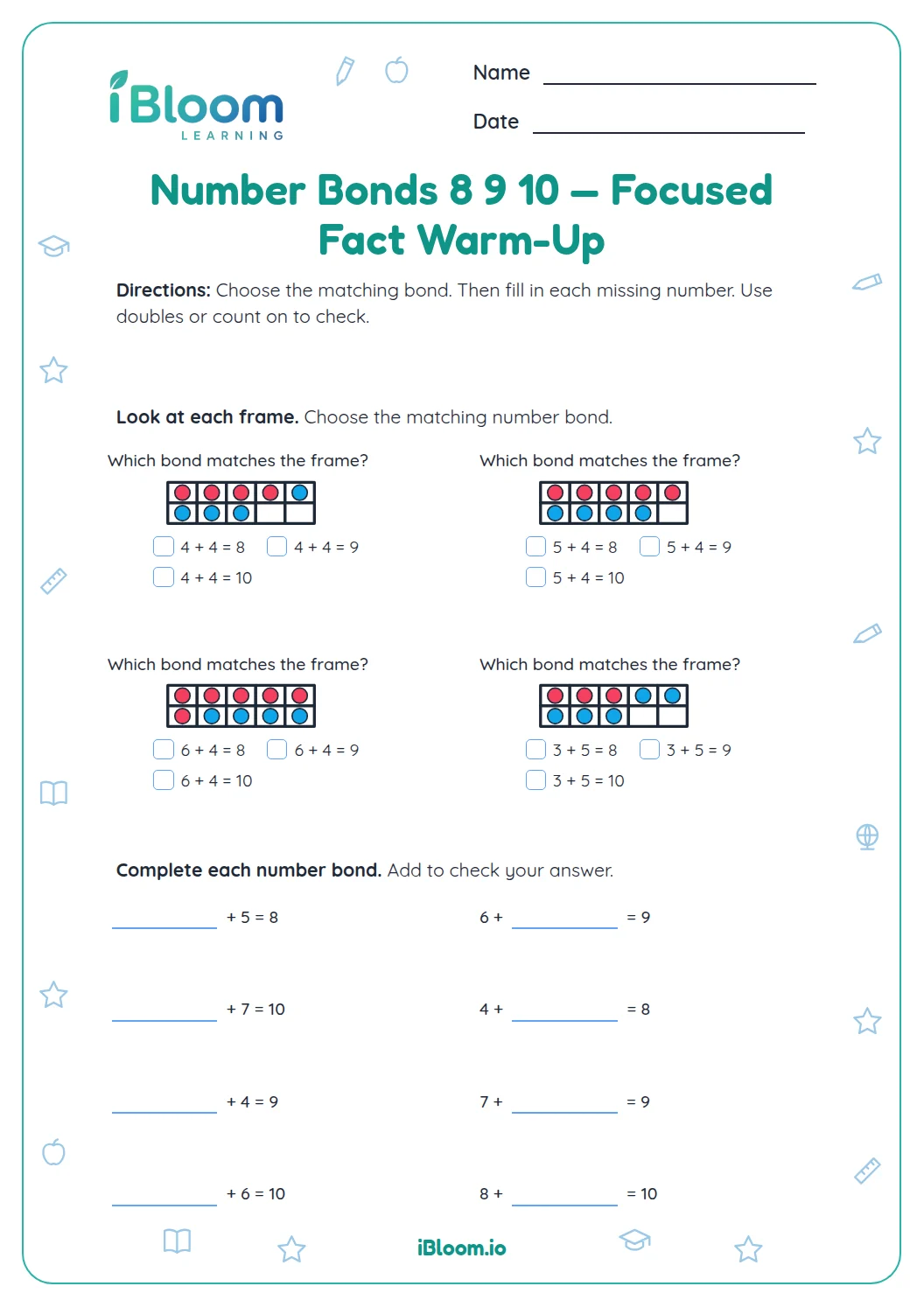
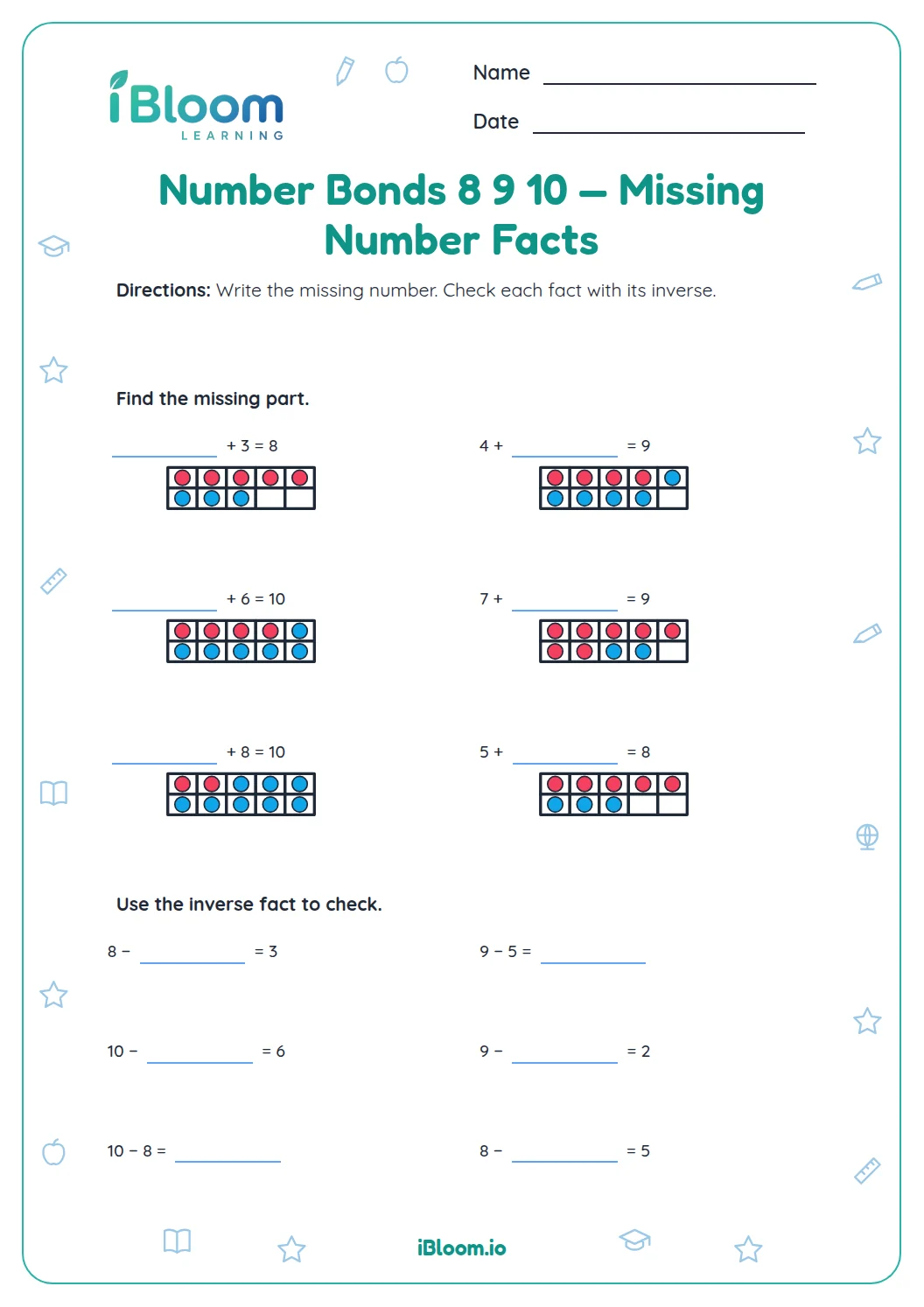
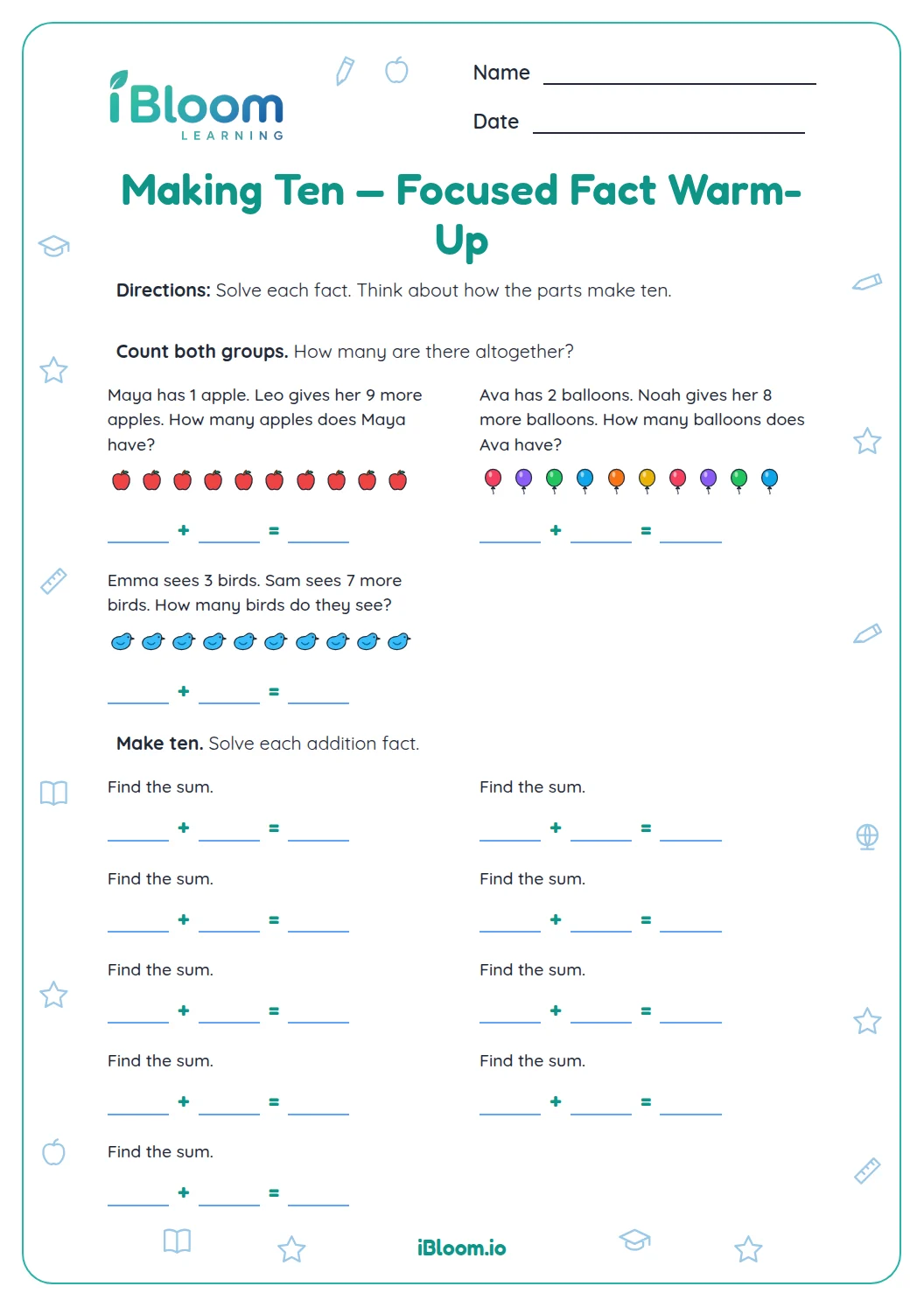
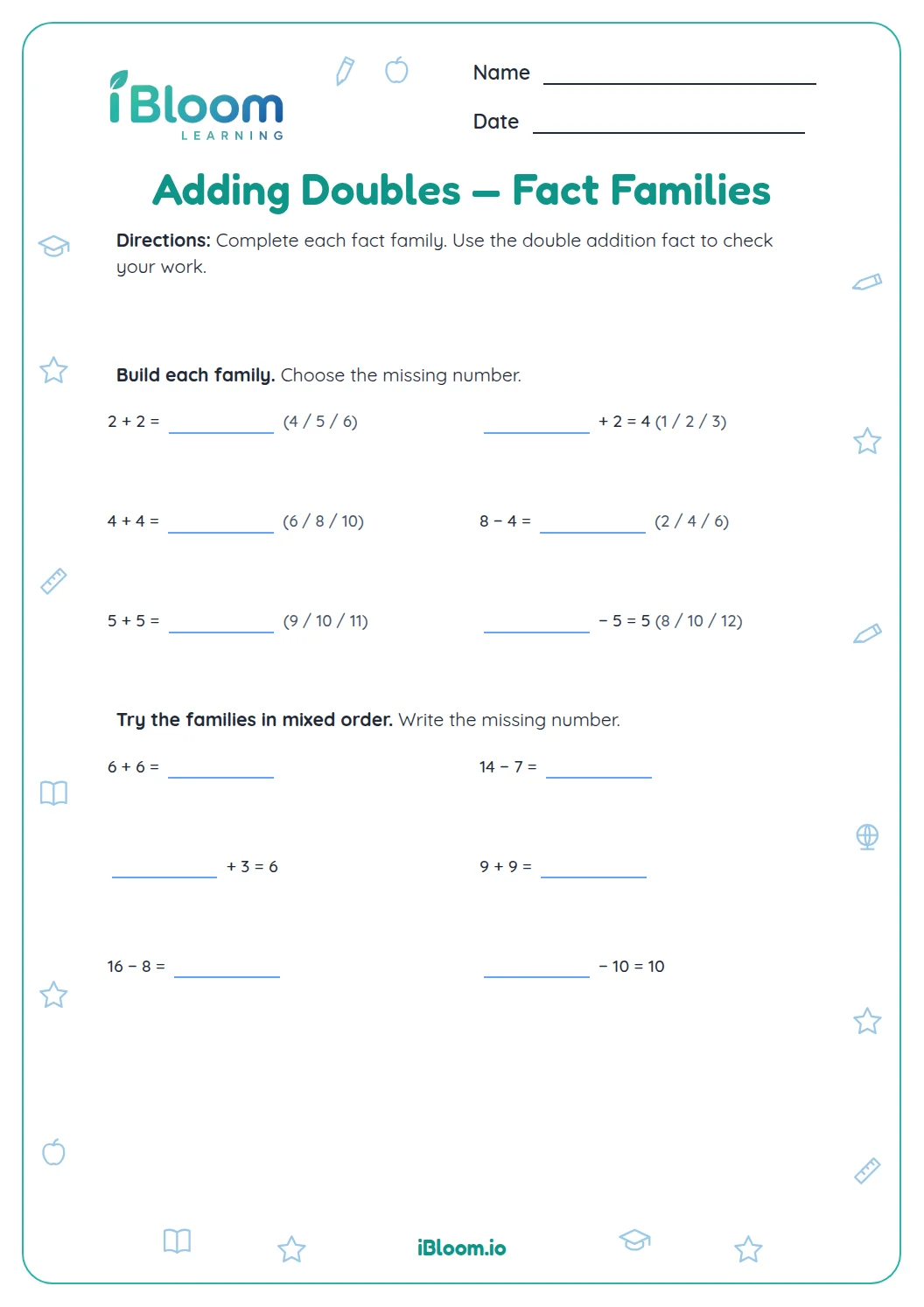
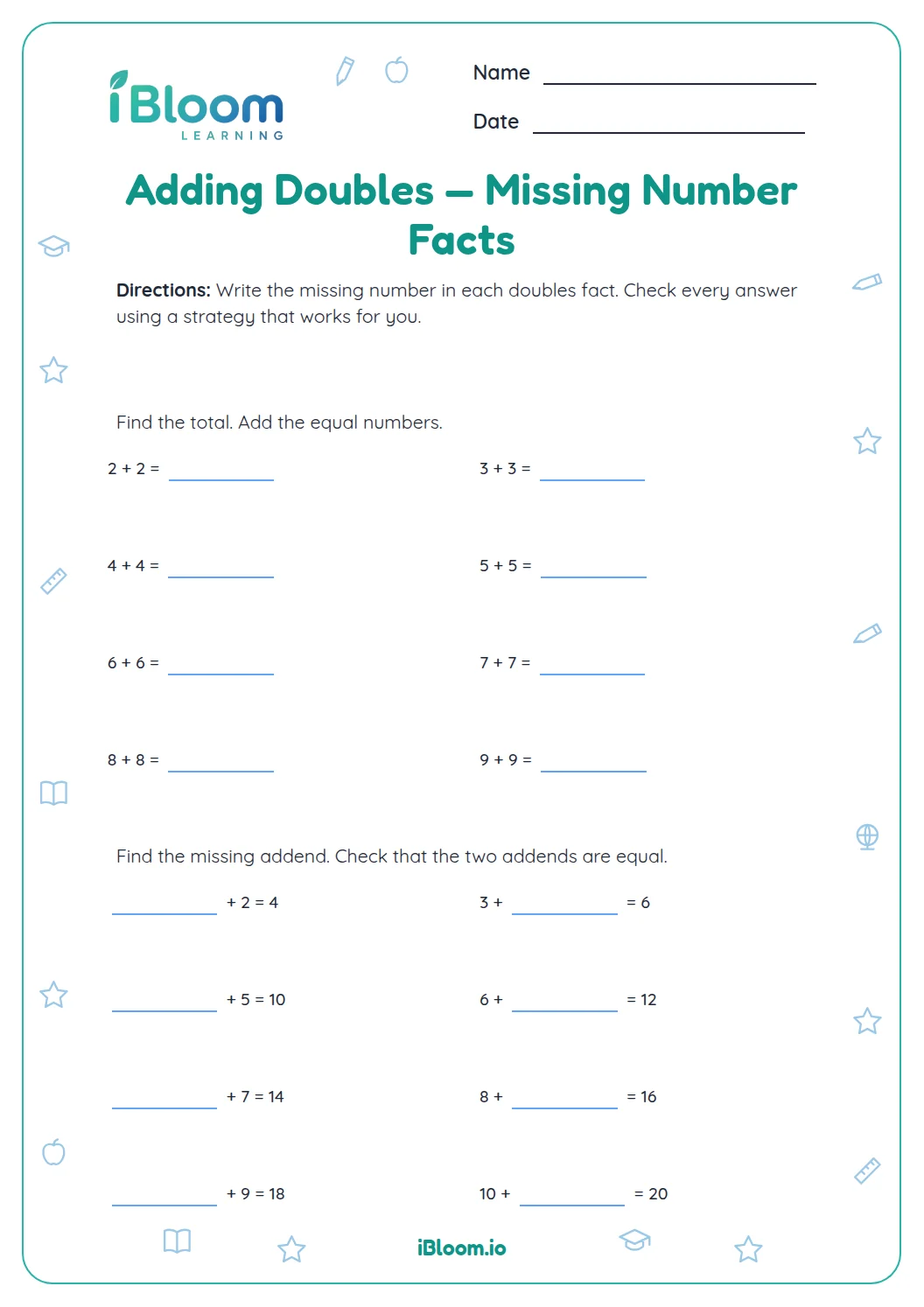
This free printable addition worksheet gives Grades 1–2 learners 14 missing-number questions with totals through 10. Children find an unknown addend when the blank comes first or second, use number bonds for 8, 9, and 10, and solve four short stories. It practices addition fact fluency and related strategies from CCSS 2.OA.B.2. The practice moves from equations to models and word problems, followed by an answer key for checking each response.
Aligned to 2.OA.B.2
How do you find an unknown addend?
Think about the total and the addend you already know. In question 1, 3 + ___ = 10. The missing number must be 7 because 3 + 7 = 10. You can check by reversing the fact: 10 − 3 = 7.
- 13 + ___ = 10
- 210 − 3 = 7
- 3Check: 3 + 7 = 10
How does a number bond show the missing part?
The whole is the total, and the two parts add to it. For a whole of 8 with one part 3, the blank part is 5. Question 13 shows this relationship in a number bond drawing.
How do the story problems connect to addition?
A story may give the total and one part, or two parts and ask for the total. Decide which number is missing before calculating. For eight birds with five flying away, subtract 5 from 8 to find that 3 stay.
- Part A: solve equations with a blank in either addend position.
- Part B: complete number bonds with wholes of 8, 9, and 10.
- Part C: find the missing amount in short stories.
How to use this worksheet
- 1Read the whole number sentence and locate the total.
- 2Name the addend you already know.
- 3Use a known fact or subtract the known part from the whole.
- 4For a bond, use the whole and the part that is already filled.
- 5Check by adding the two parts back together.
Common mistakes and quick fixes
The mistake
Adding the known addend to the total.
The fix
The total already includes both addends, so subtract the known part to find what is missing.
The mistake
Forgetting that the blank can be first or second.
The fix
Addition can be reversed: 4 + 6 and 6 + 4 have the same total.
The mistake
Giving the number that left in a story instead of the number that stayed.
The fix
Retell the final question in your own words, then check the answer against the story.
Common Core alignment
The worksheet builds addition fact fluency using unknown addends and related strategies.
Use addition and related subtraction facts within 20 to find missing addends.
On this sheet: All missing addends are within 10, and the problems invite using known addition facts or their related subtraction facts.
Show the official wordingHide the official wording
Fluently add and subtract within 20 using mental strategies. By end of Grade 2, know from memory all sums of two one-digit numbers.
What to practice next
Make more practice
Further reading
Questions parents and teachers ask
What is a missing addend?
An addend is a number being added. In 3 + ___ = 10, the missing addend is 7 because 3 + 7 makes 10. Children can also think 10 − 3 = 7 to find the number that completes the addition fact.
How do number bonds help find the answer?
A number bond shows a whole and the parts that make it. If the whole is 8 and one part is 3, the missing part is 5 because 3 + 5 = 8. This worksheet mostly shows the relationship in equations, so learners can find the unknown part and check by adding.
Can I solve a missing addend by subtracting?
Yes. For 8 + ___ = 10, subtract 8 from 10 to find 2. Addition and subtraction are related, so a child can choose a clear strategy. Check by adding: 8 + 2 = 10. For example, 10 − 8 = 2, and 8 + 2 returns to 10.
What facts appear on the worksheet?
The worksheet uses one-digit addends and sums from 8 to 10, with the missing number placed in either addend position. It also includes two number-bond equations and four short stories. Learners can find an unknown part by counting on or subtracting from the whole, then check by adding.
What does the answer key include?
A separate key lists the missing number for every equation, bond question, and story. For the stories, it gives the number that completes the situation; for equations, add the known and missing parts to check the sum. The answer key has two pages, matching the two-page worksheet.
How many questions are included?
There are 14 questions in three parts: six missing-addend equations, four additional missing-part equations, and four short stories. The two-page worksheet has a separate two-page answer key. Learners can complete a part at a time and use addition or subtraction to check each missing number.