








About this worksheet
This free printable worksheet gives Grade 1 and Grade 2 students a short drill on addition facts with sums up to 10. Round 1 opens with four picture sums where children count two groups, then six facts to solve at a steady pace. Round 2 is twelve facts that can be timed or not. Because the timer is optional, the same page works for a quick fluency check or a calm practice session. It practices CCSS 1.OA.C.6 and 2.OA.B.2, adding within 10 accurately and then quickly. A separate answer key shows every sum.
Aligned to 1.OA.C.6 and 2.OA.B.2
What is on this sums to 10 drill?
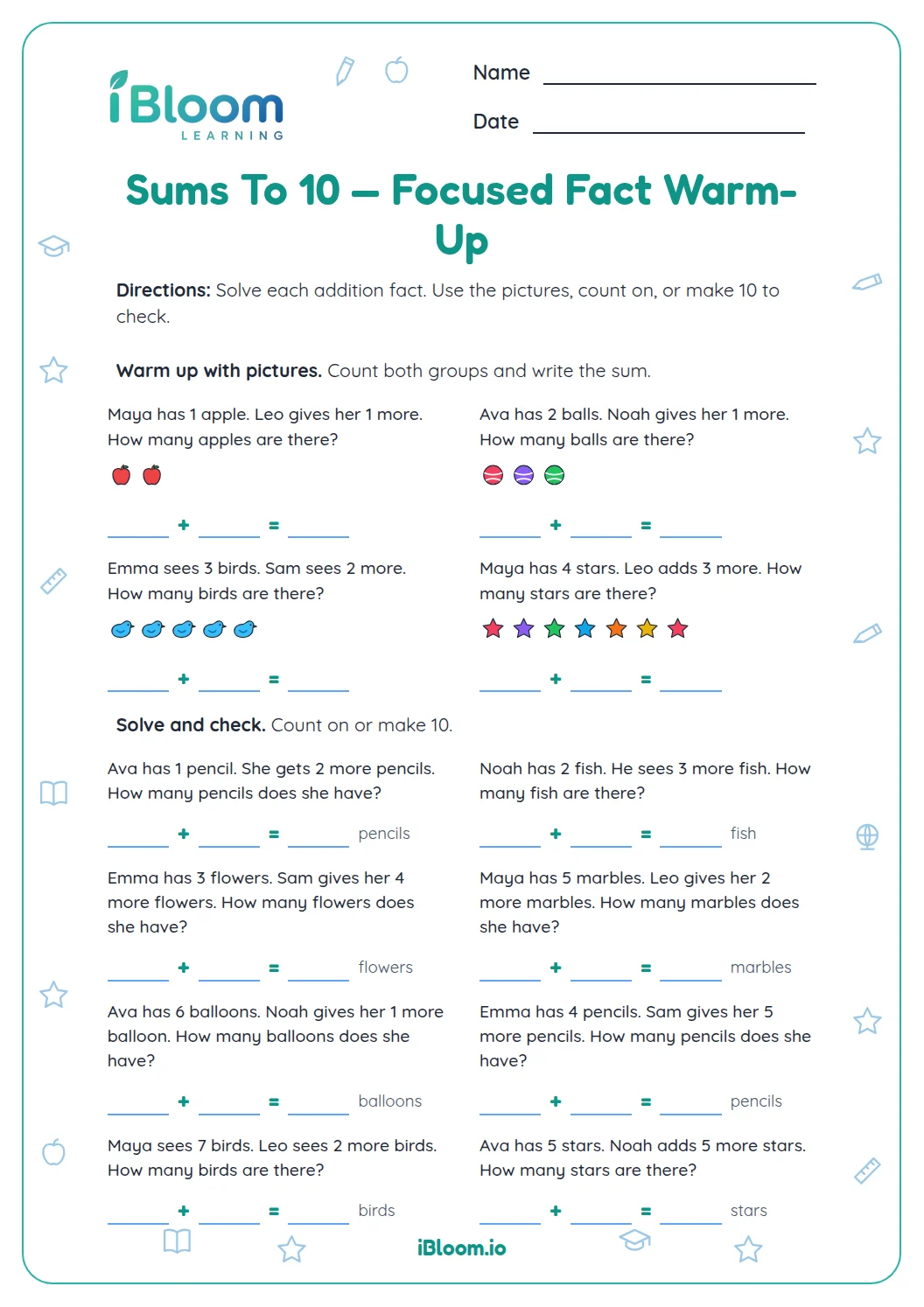
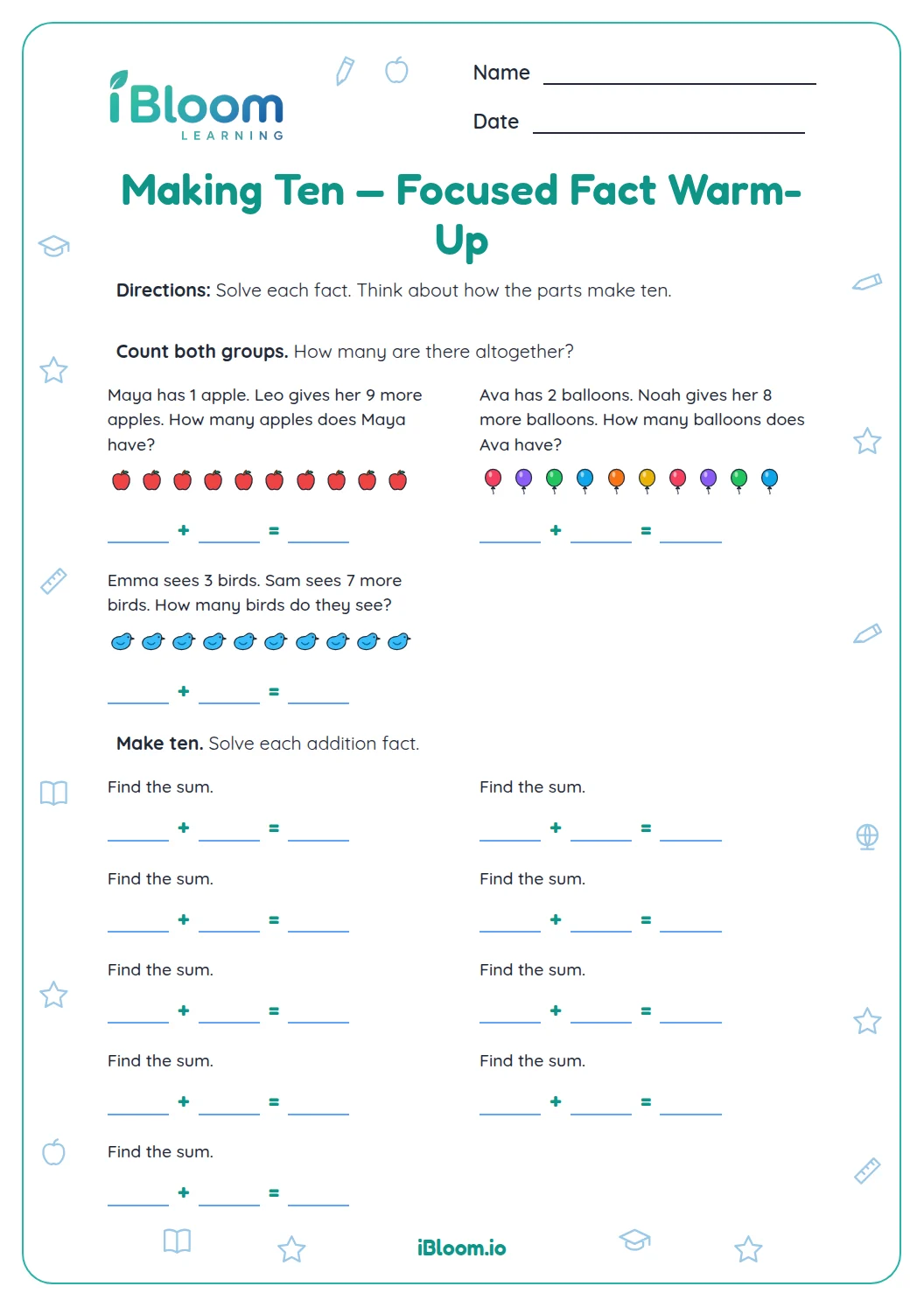
The two pages have three parts, and every sum stays at 10 or below. Parts A and B make up Round 1, with no timer. Part A starts with pictures: two kinds of pictures sit together, such as 3 apples and 2 pears, and children write the sum of the two groups. Part B follows with six plain facts, such as 7 + 2 and 5 + 5.
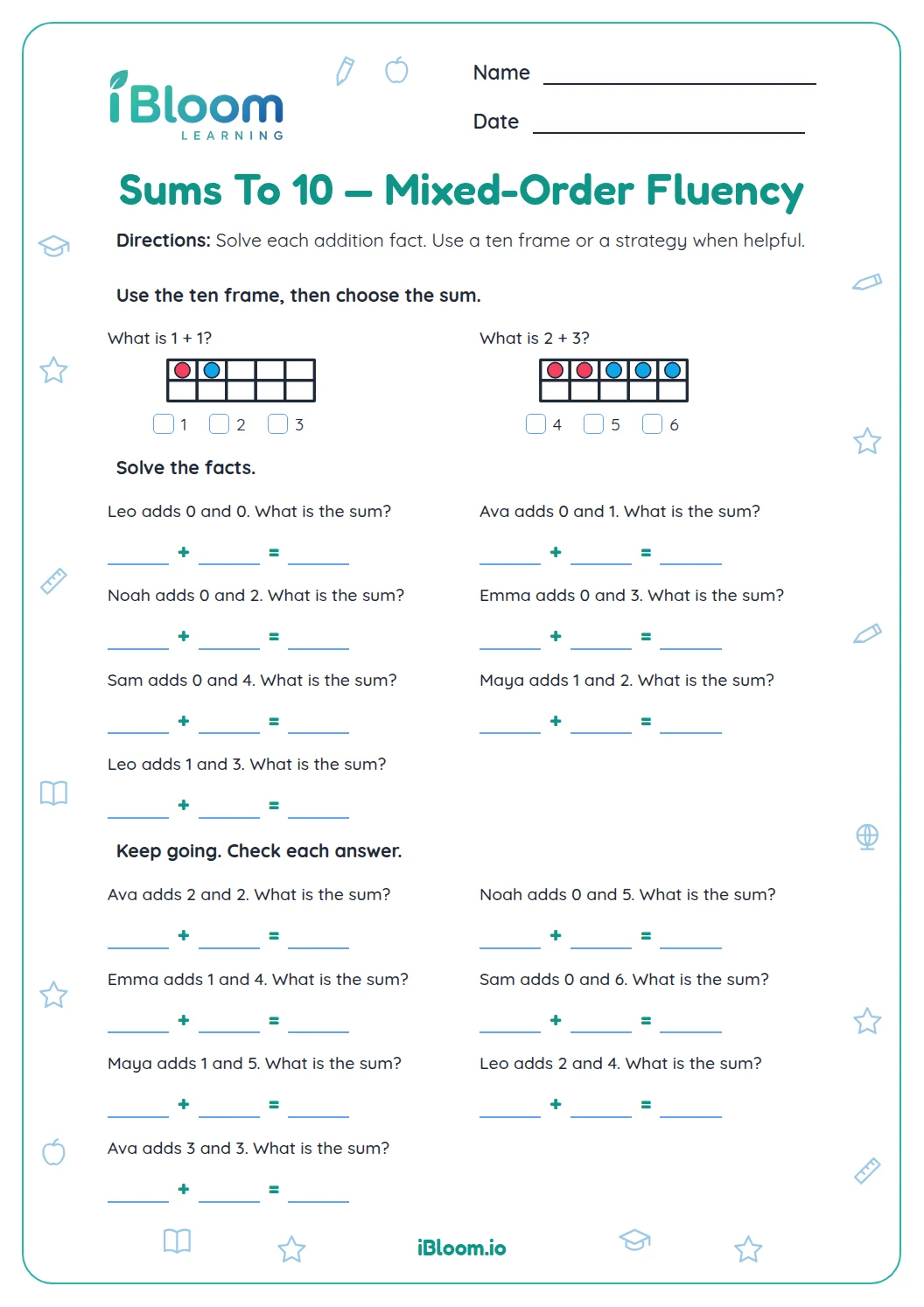
Part C is Round 2: twelve facts, from 2 + 7 to 3 + 5. It mixes facts children can lean on, like 9 + 1, 7 + 3 and the doubles 4 + 4 and 3 + 3, with ones that may need a moment's thought, like 6 + 3 and 5 + 4. The timer is up to you. Children can also do the round at their own pace and use the key to check.
- Part A (Round 1): four picture sums, 3 + 2, 4 + 5, 6 + 4 and 5 + 3, questions 1 to 4
- Part B (Round 1): six careful facts with no timer, questions 5 to 10
- Part C (Round 2): twelve facts to solve, optionally against a timer, questions 11 to 22
- Every sum is 10 or less, and one fact (0 + 8) uses zero
How do I use the optional timer without adding stress?
Let your child finish Parts A and B first, with no clock, and check them. Only then offer Round 2. Say what the timer is for: it shows how much faster they get, not whether they are good at math. Set a generous goal at first, such as three minutes, and write the actual time at the top of the page.
On another day, try Round 2 again with a fresh copy of the page, and compare the two times. Comparing your child with their own earlier time, rather than with a score out of 12 or with other children, keeps the focus on progress. If a fact still takes a long count, circle it and practice that one with objects.
- 1Question 1: 3 + 2 = ___ with 3 apples and 2 pears
- 2Count the apples: 3. Count the pears: 2.
- 3Start at 3 and count on 2 more: 4, 5. → 5
What strategies help with sums to 10?
Counting on is the first step: start at the bigger number and count up the smaller one. For 4 + 5, children can start at 5 and count 6, 7, 8, 9. Doubles such as 4 + 4 and 3 + 3 are easy to remember, and near-doubles use them: 5 + 4 is one more than 4 + 4.
Making ten is a strong anchor. Facts like 9 + 1, 7 + 3, 6 + 4 and 5 + 5 all equal 10, and children who know them can work out nearby facts. For example, 6 + 3 is one less than 6 + 4. Round 2 includes 9 + 1 and 7 + 3 for exactly this reason.
Why does fluency with sums to 10 matter?
Facts within 10 are the base for adding within 20 and for the make-a-ten method children use later with larger numbers. A child who still counts every sum on fingers spends attention on counting, not on the new idea in a word problem or a two-digit sum.
Fluency does not mean speed alone. It means a child can give a sum by recalling or reasoning it quickly and correctly. This page practices the correct part first, in Parts A and B, and the quick part second.
How to use this worksheet at home or in class
- 1Read the Part A directions aloud and do question 1 together, counting the apples and then the pears.
- 2Let your child finish questions 2 to 10 without a clock, and check them with the answer key.
- 3Say whether you will time Round 2 and pick a goal your child can reach, such as three minutes.
- 4Start the timer if you are using it, and let your child do questions 11 to 22 in any order.
- 5Check the answers and circle any fact that took a long time or a count on fingers.
- 6Practice the circled facts with small objects, then try Round 2 again a few days later and compare the times.
Common mistakes and quick fixes
The mistake
Giving the size of just one group in a picture sum, such as writing 3 for 3 + 2.
The fix
Point out that the sum counts both kinds of pictures. Say 3 for the apples, then touch each pear and count on: 4, 5.
The mistake
Writing 0 for 0 + 8, as if zero wipes out the other number.
The fix
Use real objects: 0 apples and 8 apples makes 8 apples. Adding zero leaves the number as it was.
The mistake
Rushing the timed round and writing 10 for 5 + 4 or 8 for 6 + 3, a slip that is off by one.
The fix
Slow the pace for a moment and say the fact aloud, 5 and 4. If the answer is not clear, count on from the larger number, and keep the timer for when accuracy is steady.
Common Core alignment
Most US states use the Common Core standards or a close state version. These two standards name the fact fluency this sheet builds.
Add within 20, with fluency for addition within 10.
On this sheet: All 21 questions are addition facts within 10, from counting two groups in Round 1 to recalling facts in Round 2.
Show the official wordingHide the official wording
Add and subtract within 20, demonstrating fluency for addition and subtraction within 10. Use strategies such as counting on; making ten (e.g., 8 + 6 = 8 + 2 + 4 = 10 + 4 = 14); decomposing a number leading to a ten (e.g., 13 - 4 = 13 - 3 - 1 = 10 - 1 = 9); using the relationship between addition and subtraction (e.g., knowing that 8 + 4 = 12, one knows 12 - 8 = 4); and creating equivalent but easier or known sums (e.g., adding 6 + 7 by creating the known equivalent 6 + 6 + 1 = 12 + 1 = 13).
Add quickly and know the sums of one-digit numbers.
On this sheet: The twelve Round 2 facts build the recall that Grade 2 aims for, starting with sums to 10.
Show the official wordingHide the official wording
Fluently add and subtract within 20 using mental strategies. By end of Grade 2, know from memory all sums of two one-digit numbers.
What to practice next
Make more practice
Further reading
Questions parents and teachers ask
Do I have to use a timer on this worksheet?
No. The page is written so that the timer is optional, and the whole worksheet works without one. If you do use a timer, use it only for Round 2, after your child has done the first two parts carefully. A timer is most useful once your child usually gets the facts right at a relaxed pace.
How long should Round 2 take?
There is no set time. Start with a goal your child can reach comfortably, such as three minutes for the twelve facts, and write the actual time at the top of the page. On later tries, aim for a time that drops a little. If a few facts slow your child down, that shows which facts to practice next.
Why do the first four questions have pictures?
The pictures give children something to count before they have to recall a fact. In 3 + 2 the apples and pears look different, so it is clear where one group ends and the next begins, and the fish and frogs in 5 + 3 work the same way. Then children do the same kind of sum with numbers only.
What if my child still counts on fingers?
Counting on fingers is a normal step, not a failure. Let your child count on from the larger number so there is less to count, and then work toward facts they know by heart. Doubles and sums of 10 are good first facts to learn, because they help with the facts near them.
Which facts on this page make 10?
Four questions have a sum of 10: 6 + 4 in Part A, 5 + 5 in Part B, and 9 + 1 and 7 + 3 in Round 2. Pairs that make 10 are useful because children can build on them: once they know 6 + 4 = 10, then 6 + 3 is one less, which is 9.
Can I use this sheet for more than one try?
Yes. Print it two or three times, or use one copy and record answers on paper. Do Round 2 on separate days and compare how long it took each time. The answers stay the same, so children see their own progress, and you can focus on the few facts that are still slow.