






About this worksheet
This free Grade 2 printable pairs an original informational passage about moon gardens with 16 comprehension questions. Children recall events, notice details, and decide why the author included them. The final questions ask for evidence in a short written response. The page practices CCSS RI.2.6 by having readers identify a text’s main purpose and use details to explain it; a separate answer key includes sample responses.
Aligned to RI.2.6
How do readers find an author’s purpose?
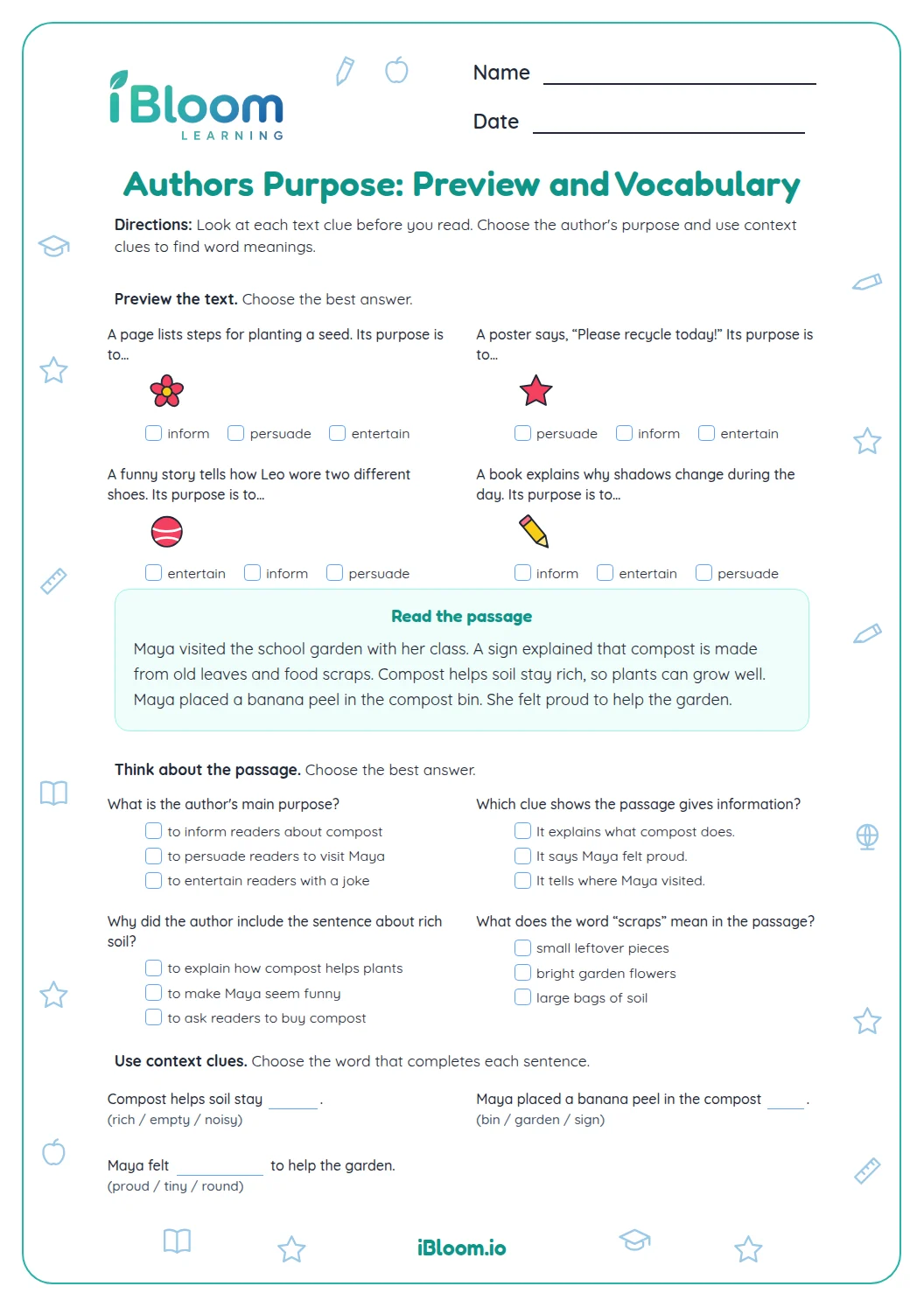
Ask what the text mostly helps the reader do: learn, enjoy a passage, or take an action. Then look for details that support that choice. This passage explains how pale plants and solar lights help people enjoy a garden after sunset, so its main purpose is to inform.
Question 10 points to a clue: the passage explains that solar lights collect energy from sunlight during the day. That fact helps readers understand how the garden can be seen after sunset.
- 1Clue: Solar lights collect energy from sunlight during the day.
- 2The passage explains how those lights work.
- 3This fact helps explain moon gardens, so “to explain moon gardens” is the best purpose.
What will children practice on the page?
The passage explains why pale flowers are easier to see at dusk, how solar lights work, and how a map can protect new plants. Questions first check understanding, then ask how the author’s choices guide the reader. The last two prompts call for a detail and an explanation.
- Part B: recall facts and details from the passage
- Part C: choose the best purpose and supporting clue
- Part D: explain an answer with passage evidence
How should families use the answer key?
Use the key to check short answers and to compare written responses with the sample. A child’s wording may differ and still be correct if it names a relevant passage detail and explains how that detail supports the purpose.
How to work through the passage
- 1Read the title and predict what kind of passage may follow.
- 2Read once for the events, then reread a paragraph when a question asks for a detail.
- 3Answer the first set using names, actions, and reasons from the passage.
- 4For purpose questions, ask what the whole passage mostly does.
- 5In the written responses, include a specific clue and explain it.
- 6Check with the key and discuss any answer that needs a clearer detail.
Common mix-ups and quick fixes
The mistake
Choosing “inform” because a passage includes one fact.
The fix
Ask whether the whole passage mainly explains facts, tells events, or encourages an action.
The mistake
Picking a purpose from one sentence alone.
The fix
Look across the whole passage, then use a detail as evidence.
The mistake
Repeating a fact without explaining how it supports the purpose.
The fix
Name a specific detail and connect it to what the author explains.
Common Core alignment
This worksheet practices reading closely and explaining an author’s purpose.
Use text details to identify why an author wrote a text.
On this sheet: Questions identify the informational passage’s main purpose and use details as clues.
Show the official wordingHide the official wording
Identify the main purpose of a text, including what the author wants to answer, explain, or describe.
What to practice next
Make more practice
Further reading
Questions parents and teachers ask
What does author’s purpose mean?
Author’s purpose is the main reason a text was written, such as to inform, entertain, or persuade. Children use the whole text and its details to decide which purpose fits best. This moon-garden passage mainly explains how pale plants and solar lights help visitors.
What is the passage about?
The passage explains how a moon garden can be seen after sunset. It describes pale flowers, solar lights that store sunlight, and a map that guides visitors. Children use these details to answer comprehension questions and identify the author’s purpose.
How many questions are included?
There are 16 questions across detail recall, purpose choices, and written explanations. The passage, questions, and answer key are arranged across four printed pages. The key provides sample responses for questions where more than one wording can work.
Does the answer need to match the sample exactly?
No. A written response can use different words if it names an accurate detail from the passage and explains what the detail shows. The answer key gives a model to help adults check for both parts: relevant evidence and a clear connection to purpose.
What is a good way to explain an answer?
Point to one specific fact, then say what it helps explain. For example, the passage says solar lights store energy from sunlight. Connecting that fact to how a moon garden is seen after dark makes the author’s purpose clear.
Is there a separate answer key?
Yes. The printable includes a separate answer key page with concise answers and sample written responses. The passage and questions fill the practice pages; the key makes four printed pages total for checking or discussion at home or in class.