



About this worksheet
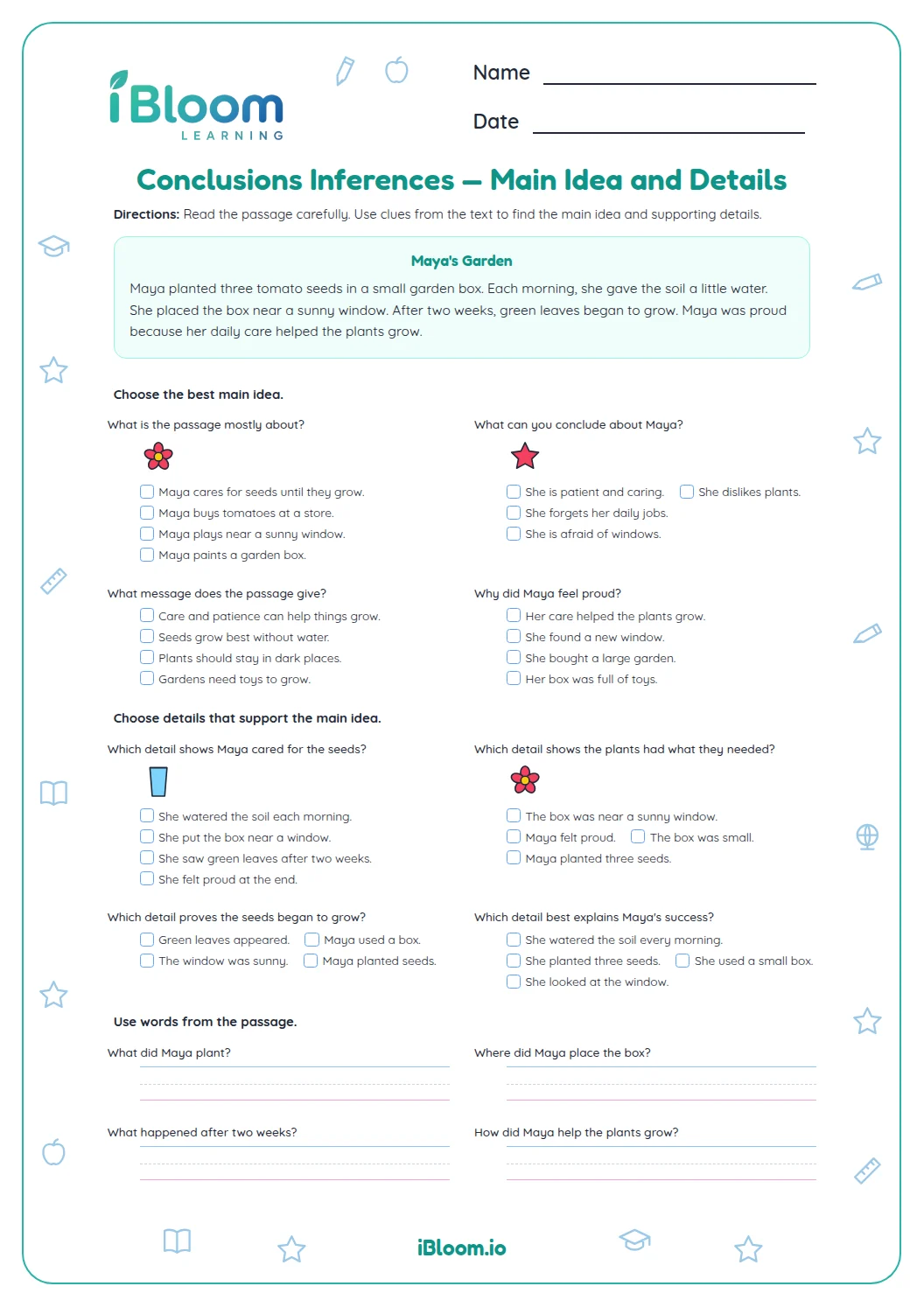
This free Grade 2 reading worksheet pairs an original garden-club story with fourteen questions about feelings, helpful actions and personal connections. Mia hesitates to plant a seed, tries one small step with Sam’s help, and then welcomes another child. Children use details from her actions to infer how she feels and connect a small first step in their own lives to Mia’s experience. The questions practice Common Core RL.2.1 and RL.2.3. Twelve choices and two written connections give a mix of support and independent thinking; a separate key includes sample personal connections.
Aligned to RL.2.1 and RL.2.3
How does a personal connection help with an inference?
Part B has twelve multiple-choice questions about Mia’s feelings, choices and actions. Students use story details to support inferences and select a memory that connects to her first try.
Keep the two sources clear. “I held back at my first swimming lesson” belongs to the reader’s life. “Mia stepped back” belongs to the story. A strong answer explains how those experiences are alike.
Which story clue supports the first inference?
Question 1 asks how Mia probably feels at first. Nervous is the best choice because she grips her seed cup and steps back. Question 2 asks the reader to select that supporting clue.
- 1Inference: Mia feels nervous at first.
- 2Evidence: Mia gripped her cup and stepped back.
- 3Connection: I have held back when I did not know what to do.
- 4The connection helps explain the feeling; the clue comes from Mia’s actions.
What do children do in each part?
Part A is the story, “One Small Part.” Part B has eight multiple-choice questions about Mia’s feelings, the actions that support those ideas, Sam’s help and a relevant personal connection.
Part C has two written connections. Children name a first try and compare it with Mia’s experience, then explain how a small step could help them. They use a story detail in their explanation and may choose a real memory or an imagined everyday situation.
How to use this sheet
- 1Read “One Small Part” once to follow what happens at garden club.
- 2Reread Mia’s first and last actions and talk about what they suggest.
- 3Answer Part B, then point to words that support the answers about Mia.
- 4For question 8, explain why trying a new game connects with Mia’s first garden-club visit.
- 5Use Part C to describe a real or imagined first try and connect it to Mia’s small step.
- 6Check text-based answers with the key and discuss personal answers for a clear connection.
Mistakes to notice and how to help
The mistake
Giving a favorite gardening fact instead of a personal connection.
The fix
Name a particular first try and explain how it resembles Mia’s first seed planting.
The mistake
Treating a personal memory as proof of what Mia did.
The fix
Return to the passage for proof. Use the memory to explain the feeling, not to add events to Mia’s story.
The mistake
Saying Mia feels the same way from beginning to end.
The fix
Compare stepping back at the start with reaching for another seed and welcoming a child at the end.
Common Core alignment
Answer questions about Mia using details from the garden-club story.
On this sheet: Children identify helpful actions and cite details that support their inferences about Mia.
Show the official wordingHide the official wording
Ask and answer such questions as who, what, where, when, why, and how to demonstrate understanding of key details in a text.
Describe how Mia responds to planting for the first time and receiving help.
On this sheet: Questions follow Mia’s actions before and after Sam helps her plant her first seed.
Show the official wordingHide the official wording
Describe how characters in a story respond to major events and challenges.
What to practice next
Make more practice
Further reading
Questions parents and teachers ask
What if my child has never been to a garden club?
A garden-club memory is not needed. Any first try can make a useful connection, such as joining a game, learning a dance or starting a new art project. Children can also imagine an everyday first try and explain how a small step might help.
How are inference and evidence different here?
An inference is an idea about Mia that the reader works out, such as feeling nervous at first. Evidence is a detail from the story that supports that idea. Mia gripping her cup and stepping back gives the reader a reason to make that inference.
Are the personal-response answers all different?
They can be, because children bring different experiences to the story. The key marks these answers as samples. A successful response names a relevant experience or imagined situation and explains the connection, while any claim about Mia remains consistent with a detail in the passage.
Can I read the story aloud to my child?
Yes, you can read it aloud while your child follows the printed words. Pause after the first paragraph to consider Mia’s actions, then finish before answering. During the questions, let your child return to the relevant sentence so the discussion stays connected to the text.
What does the ending tell us about Mia?
The answer key shows the choices for all twelve multiple-choice questions and sample responses for both personal connections. A child’s own example can differ from the sample if it connects clearly to Mia’s experience and uses a relevant story detail.