


About this worksheet
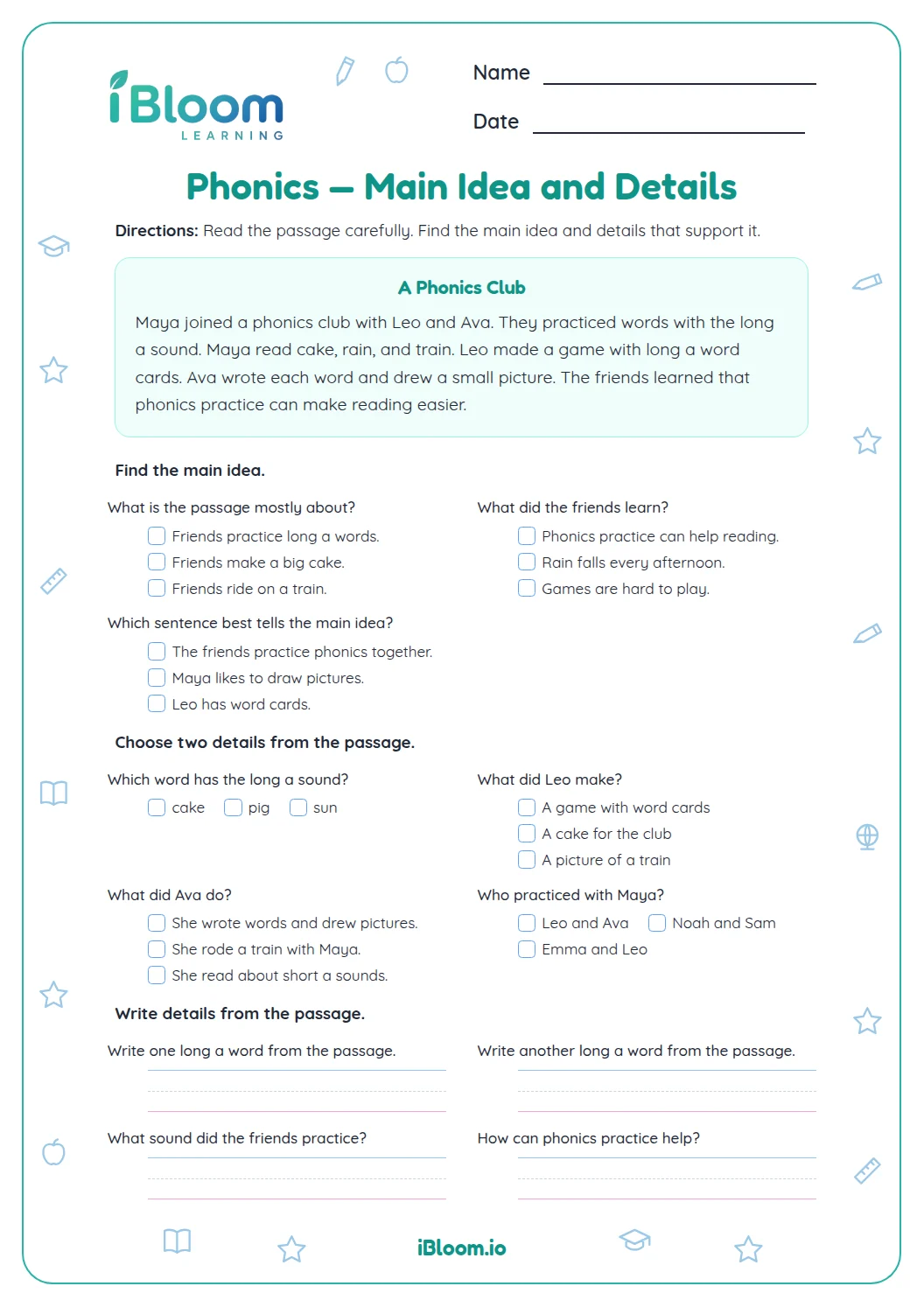
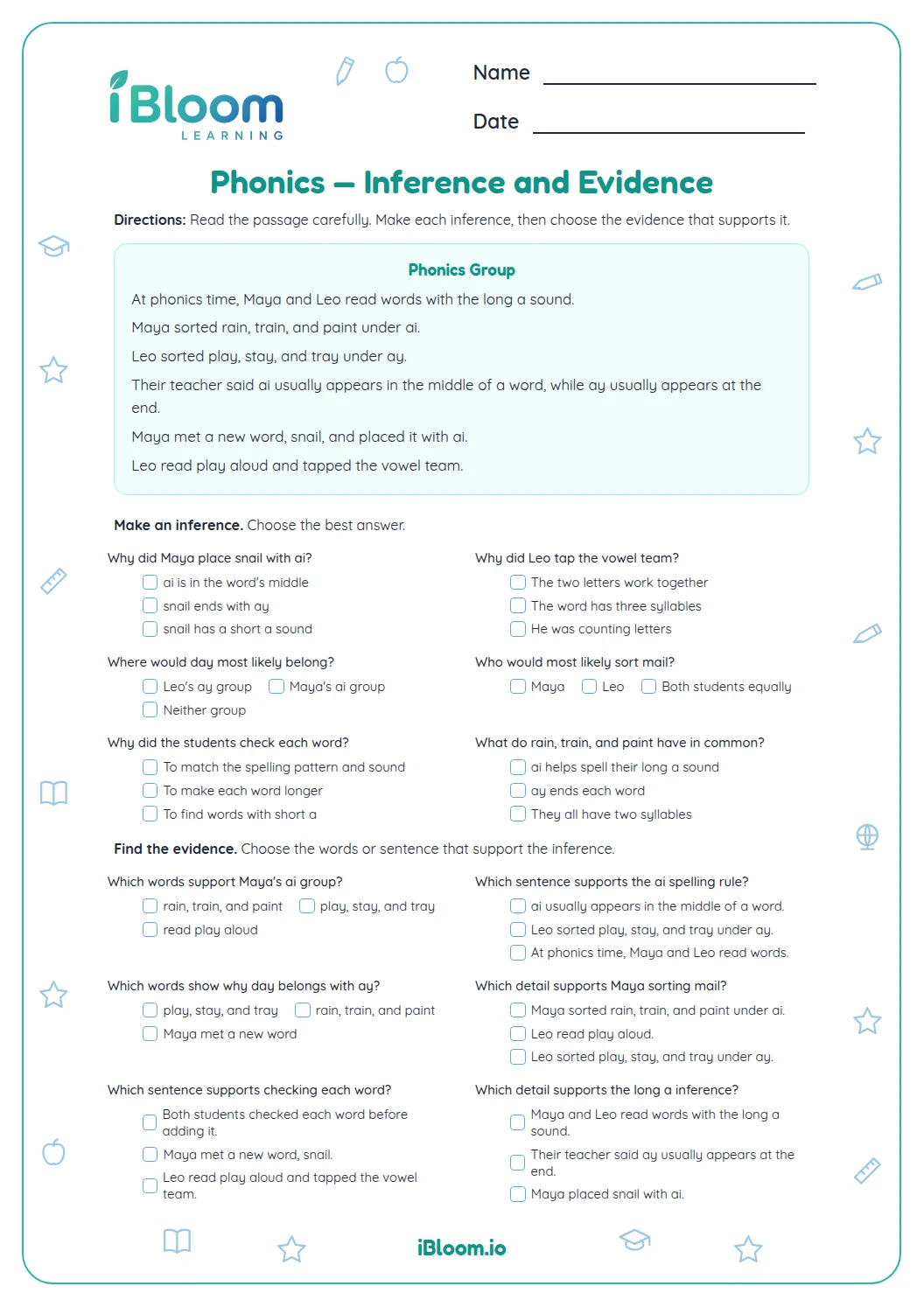
This Grade 1 phonics worksheet pairs a short original story with sound and comprehension questions. Students identify words with long a, long e, short i, and long o spellings, then answer questions using details from Fox and the Rain. The 15 questions include written responses and a separate answer key.
Aligned to RF.1.3.c
What is in Fox and the Rain?
The passage follows Fox during a rainy day and a meeting with a wet bird. Part B asks students to recognize vowel spellings in words from the passage. Parts C and D ask for story details and written responses.
- Original short story about Fox and a bird
- Five questions about vowel sounds and spellings
- Four short story-detail answers
- Six written responses
How can a student find a vowel pattern?
Look at the letters that spell the vowel sound, then check the word in the passage. Rain has long a spelled ai; green has long e spelled ee.
- 1Which word has the long a sound spelled ai?
- 2Answer: rain
- 3The letters ai spell the long a sound.
How should students use story details?
For a detail question, return to the passage and find the sentence that answers it. For a written response, turn that detail into a complete sentence. The final questions ask students to explain Fox’s choice and describe a kind action.
How can we check a written response?
Compare the response with the key’s sample and the passage. The wording can differ, but the answer should stay true to the story and respond to every part of the question.
How to use this worksheet
- 1Read the story once to understand what happens.
- 2For Part B, check the spelling pattern in each answer choice.
- 3Return to the story for each Part C detail.
- 4Write complete sentences for the Part D prompts.
- 5Use the key samples to check that responses match the passage.
Common mistakes and quick fixes
The mistake
Choosing a word with the right sound but a different spelling pattern.
The fix
Check both the vowel sound and the letters named in the question.
The mistake
Answering a story question from memory and missing a detail.
The fix
Look back at the sentence that tells what happened.
The mistake
Writing a response that adds an event not in the passage.
The fix
Keep the response consistent with Fox and the bird’s actions in the story.
Common Core alignment
This story asks students to recognize common vowel-team spellings for long vowel sounds.
Recognize common vowel-team spellings for long vowel sounds in story words.
On this sheet: Students identify ai, ee, and oa vowel teams in words from the passage.
Show the official wordingHide the official wording
Know final -e and common vowel team conventions for representing long vowel sounds.
What to practice next
Make more practice
Further reading
Questions parents and teachers ask
What vowel spellings does the worksheet practice?
The word choices practice long a spelled ai, long e spelled ee, short i, and long o spelled oa. Students find examples in the story, then answer questions about its characters and events. Ask the learner to point to the clue that supports the answer.
How many questions are on the worksheet?
There are 15 questions in four parts. Students choose words by sound and spelling, answer short questions about the passage, and write responses using story details. The separate answer key includes sample responses. Ask the learner to point to the clue that supports the answer.
What happens in Fox and the Rain?
Fox sees a wet bird during a rainy day and brings it a dry leaf. The bird rests, the rain ends, and Fox walks with the bird to a pine tree. The questions refer to those events. Ask the learner to point to the clue that supports the answer.
Can my child use different words from the answer key?
Yes. The key gives sample responses for open-ended questions. A different answer is appropriate when it uses a relevant passage detail, forms a complete response when asked, and does not change what happens in the story. Ask the learner to point to the clue that supports the answer.
How can I support the written responses?
Have your child reread the relevant part of the story and say the answer aloud first. Then write it as a complete sentence. Check that the response answers the whole question and matches the passage. Ask the learner to point to the clue that supports the answer.