

About this worksheet
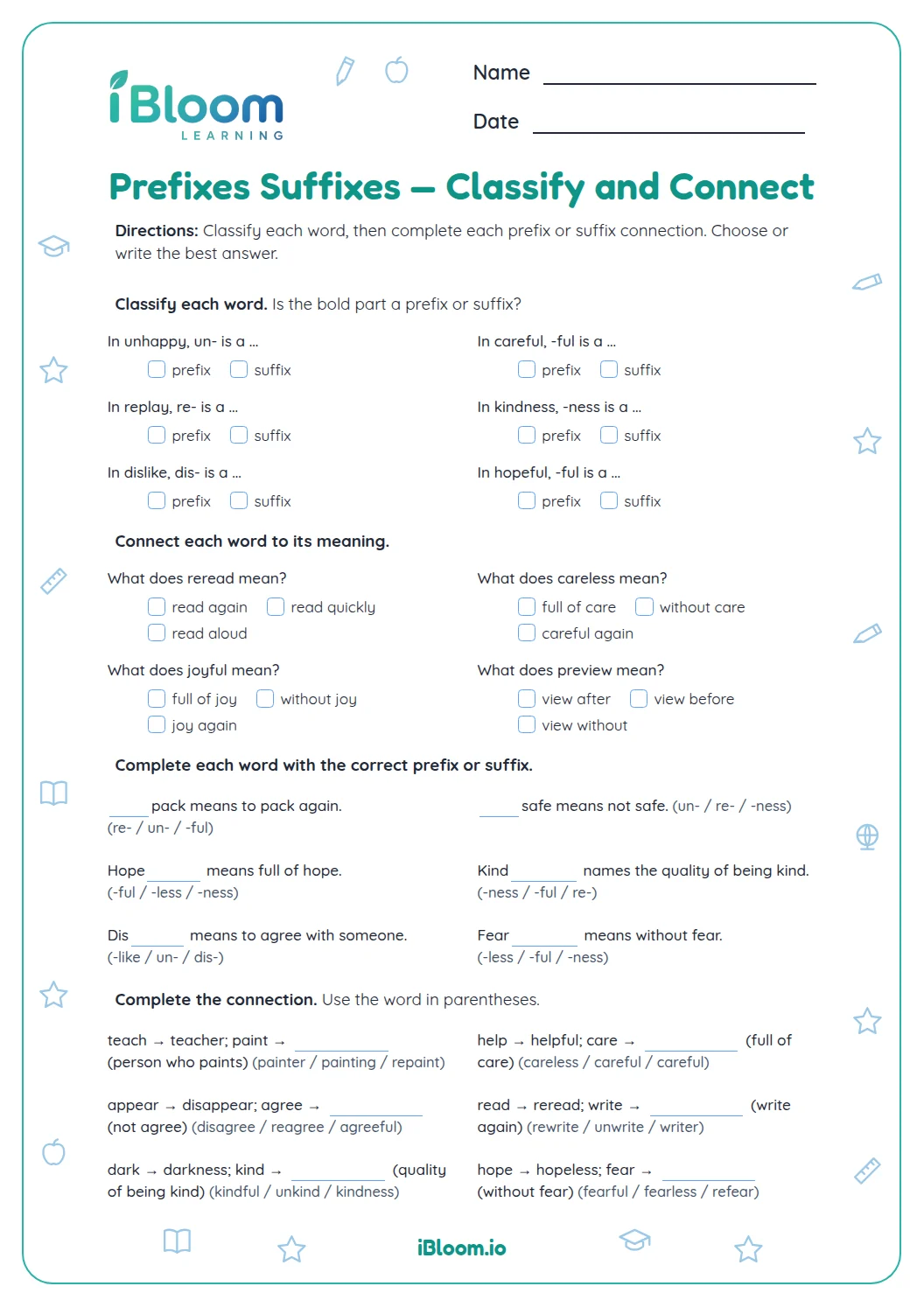
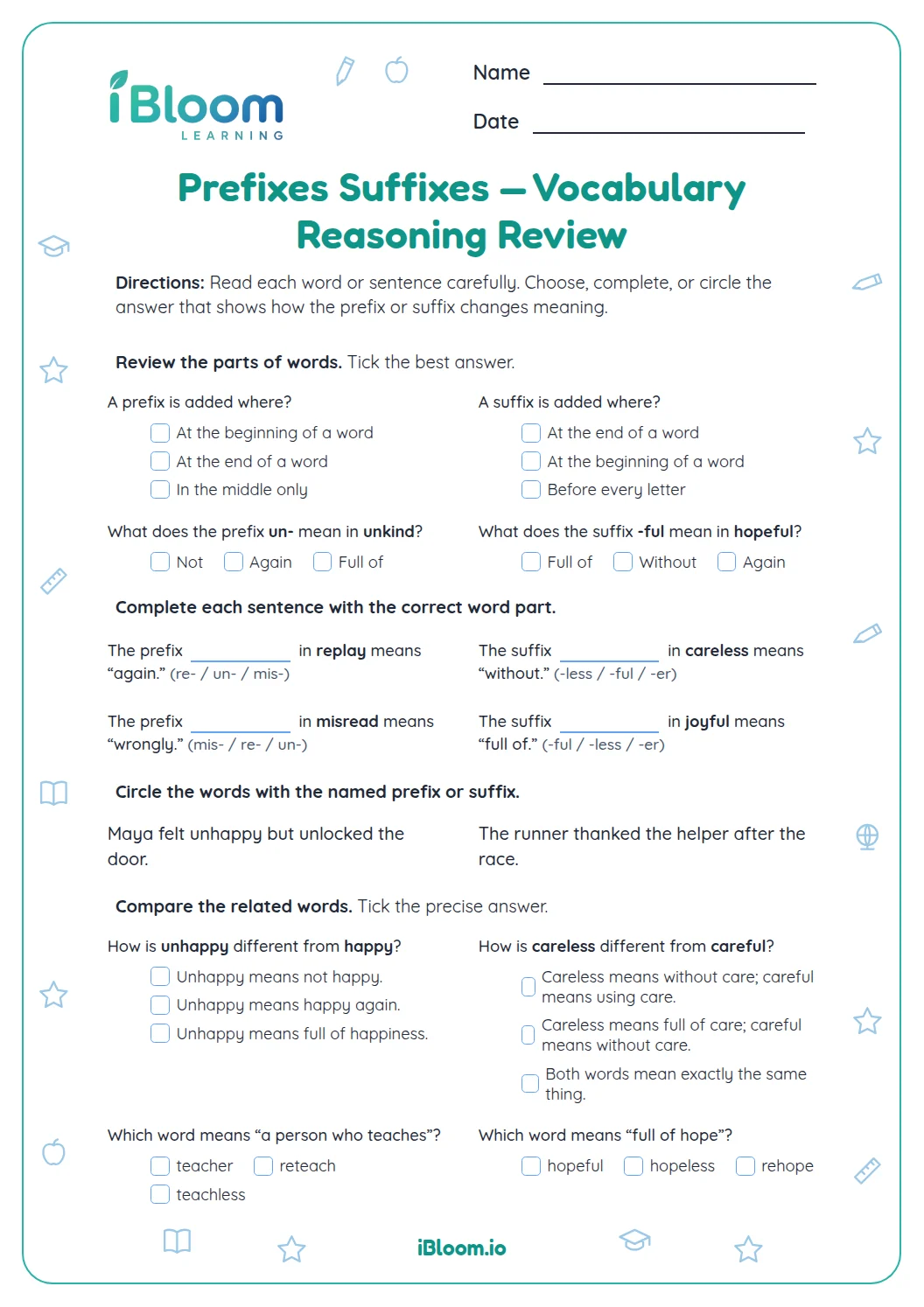
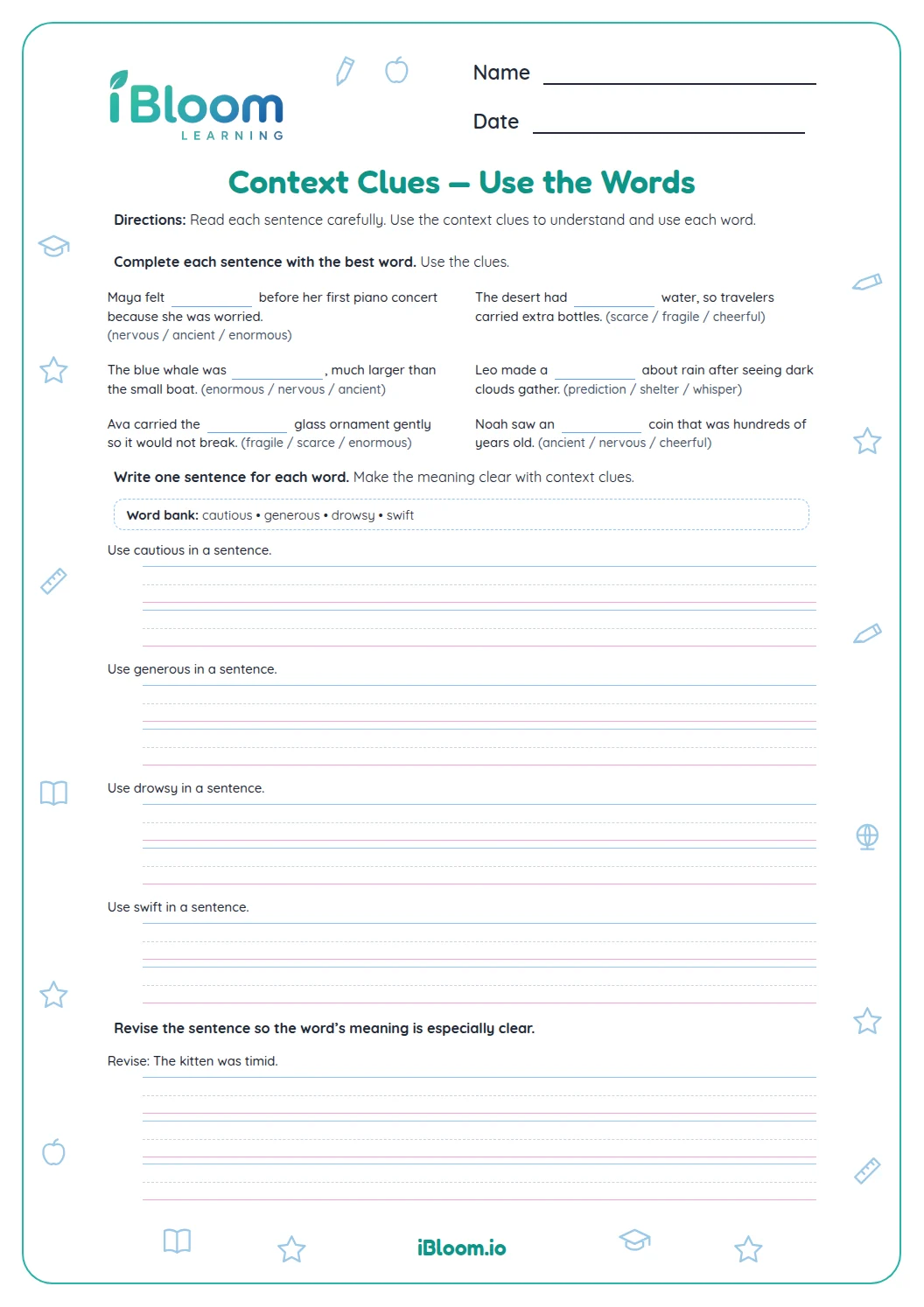
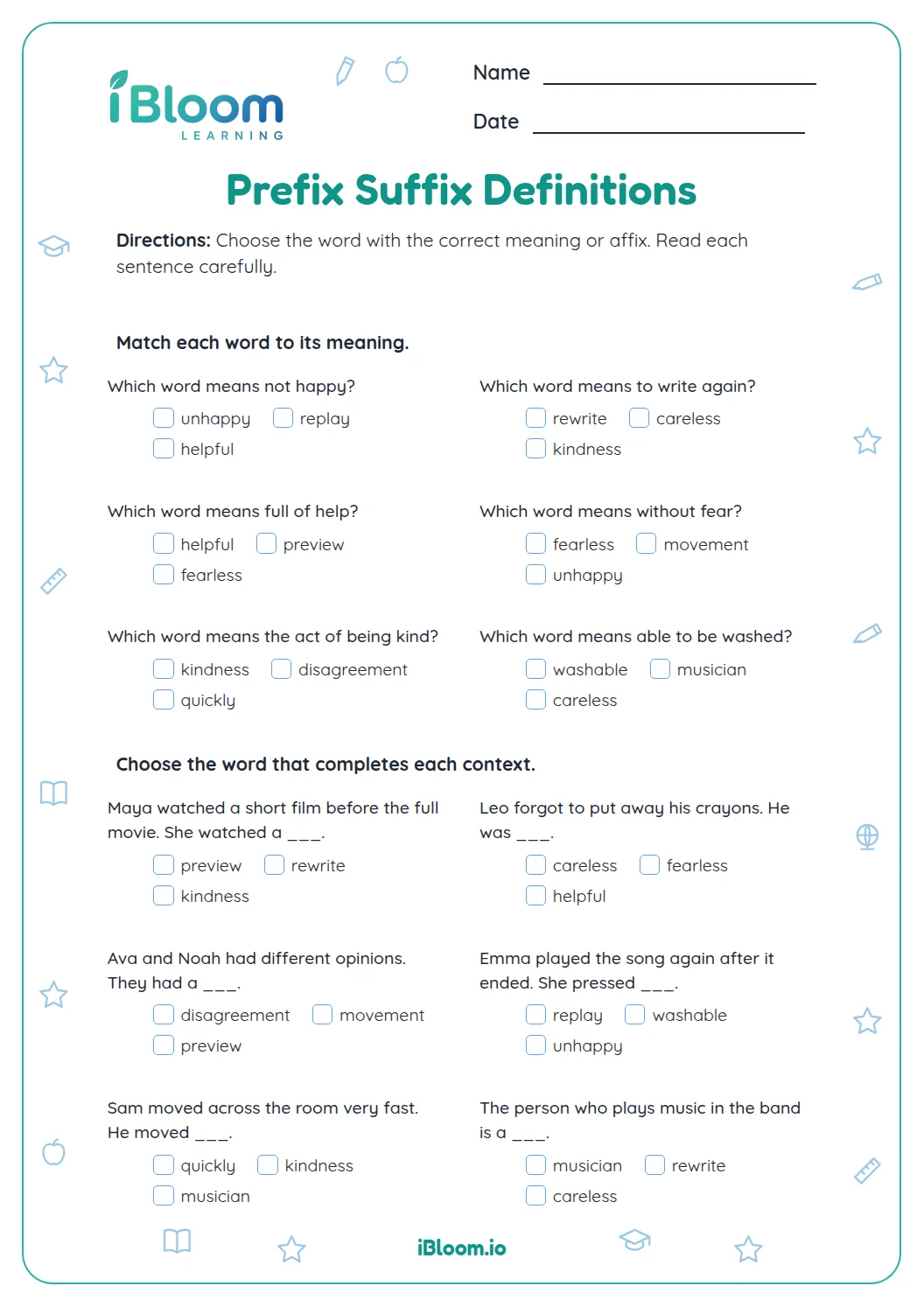
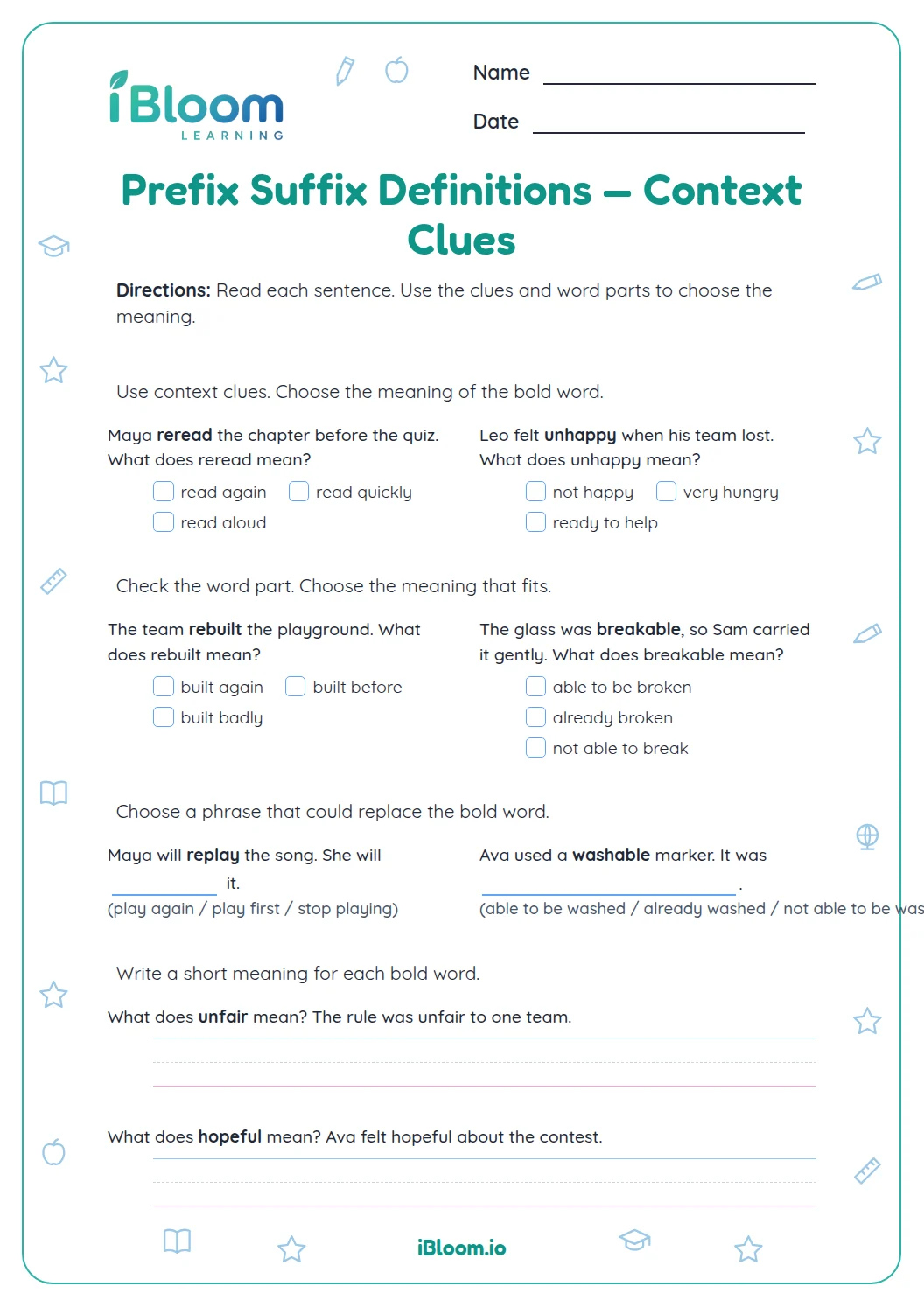
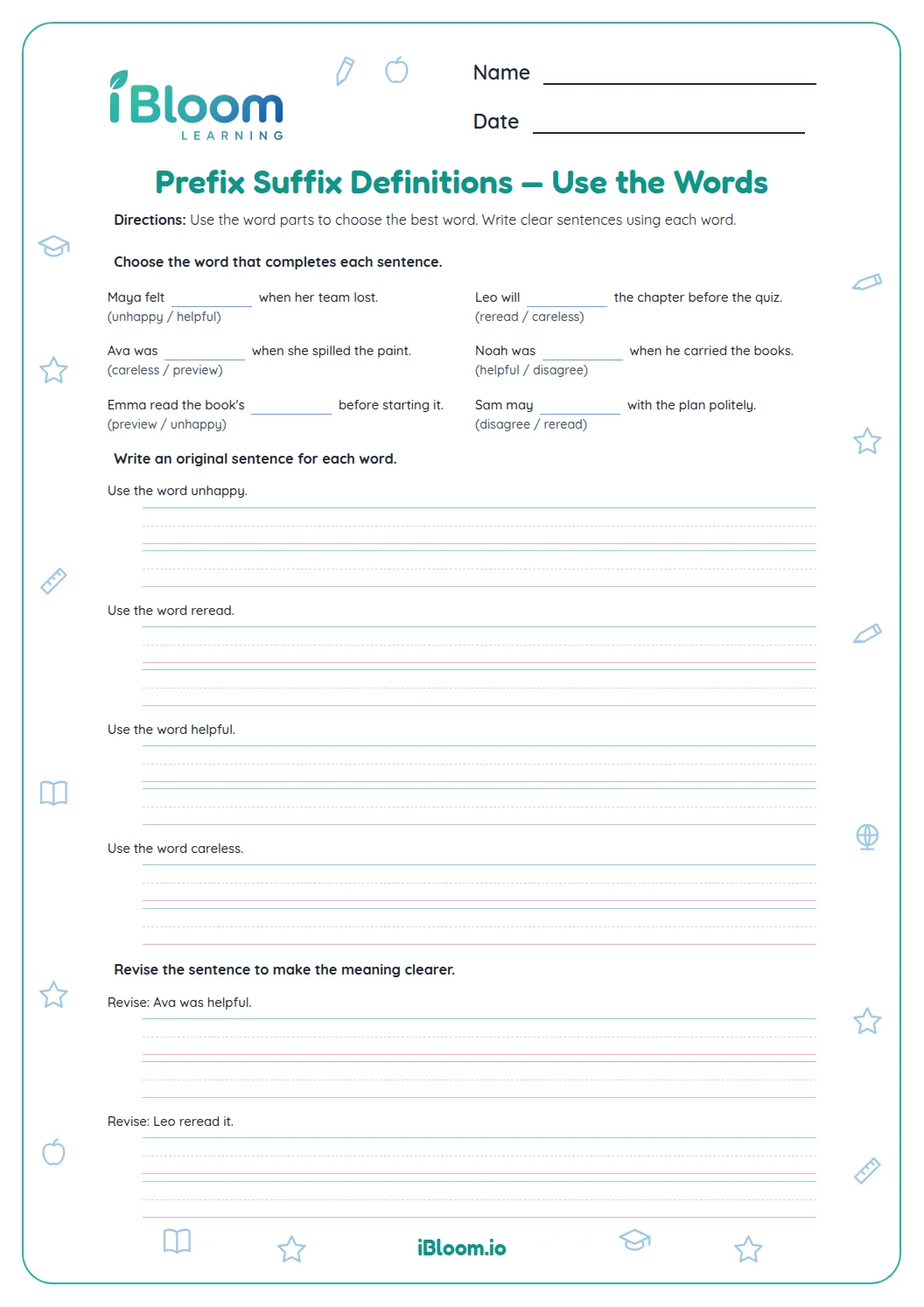
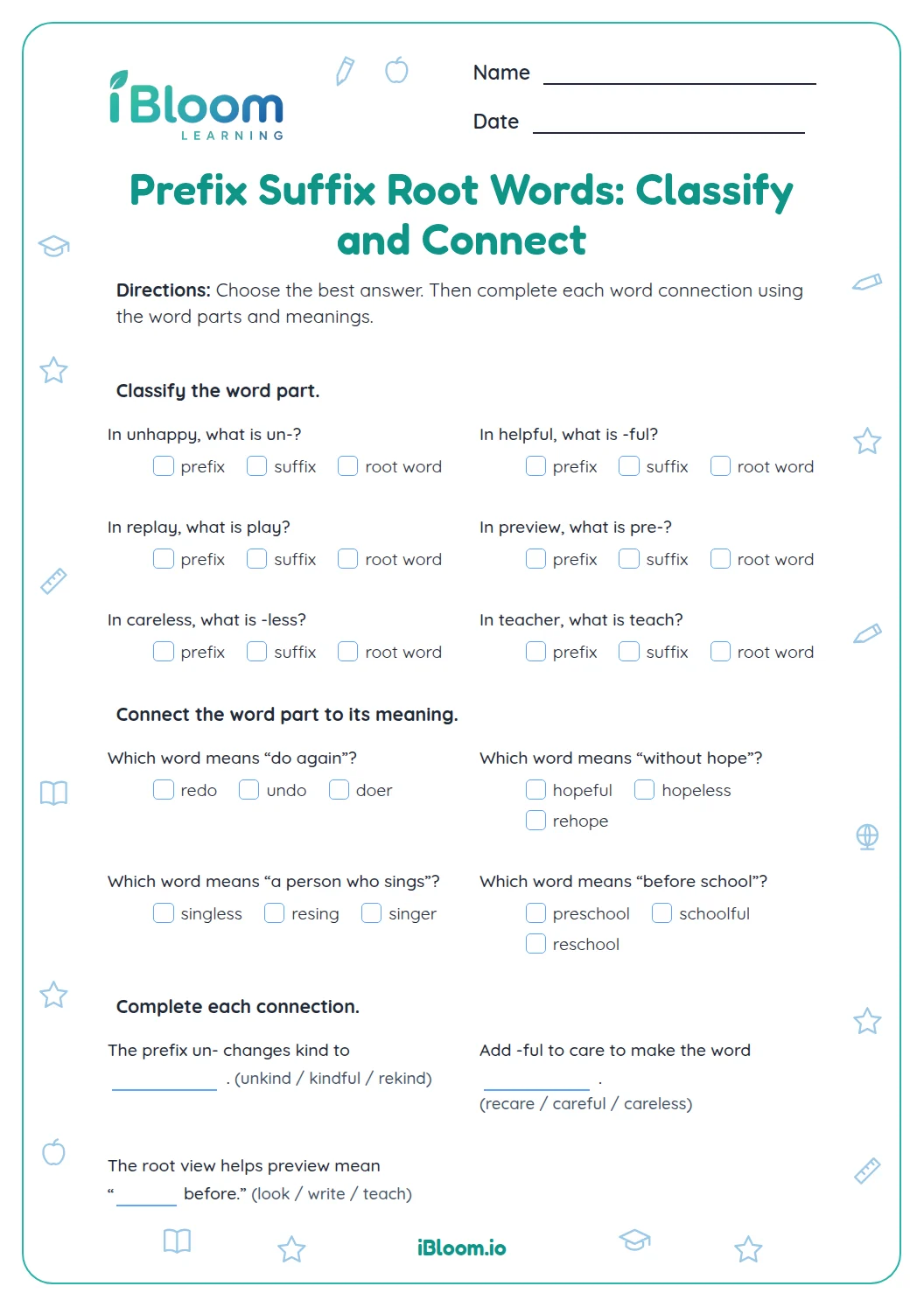
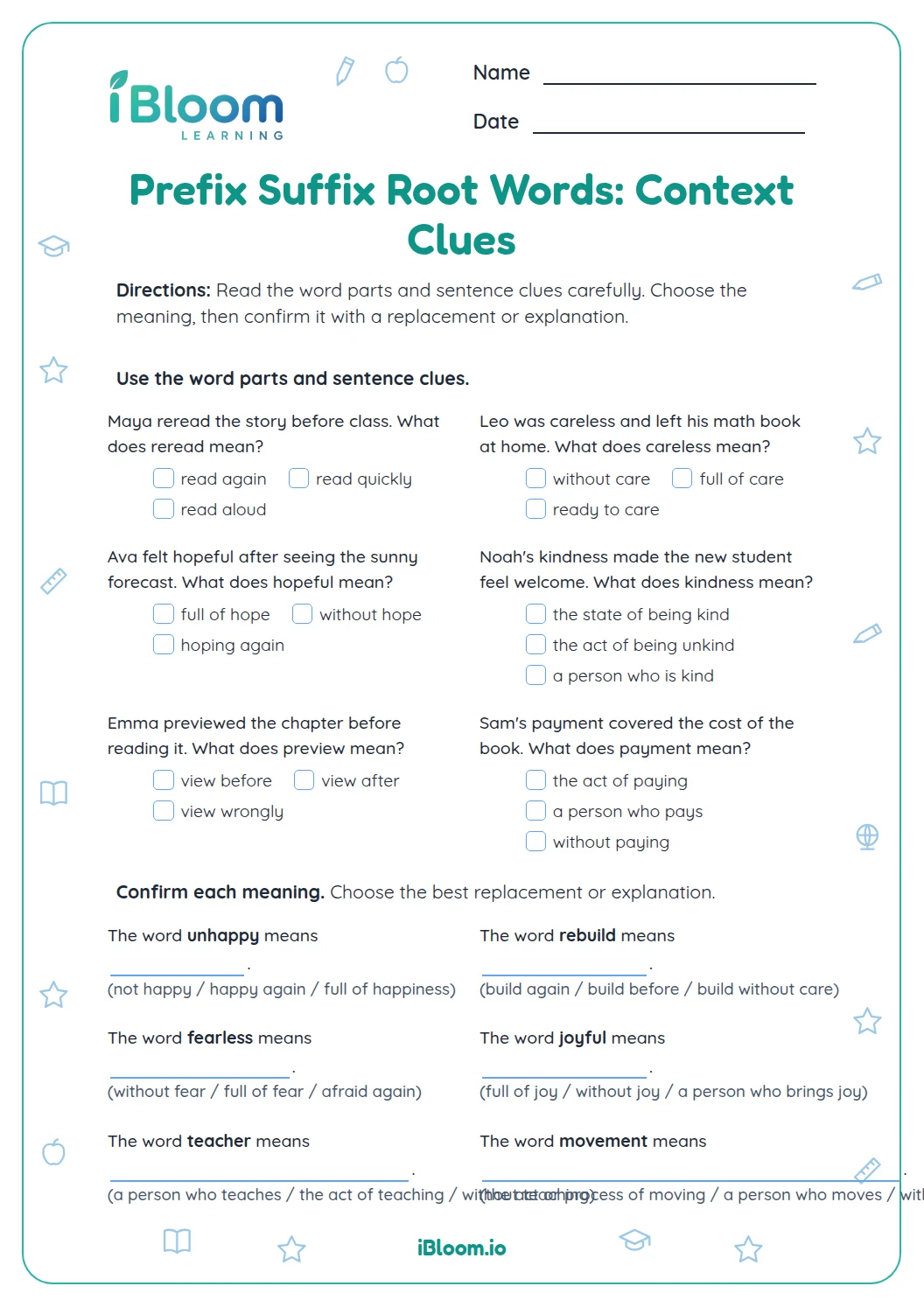
This free printable Grade 4 worksheet combines word-part analysis with sentence context. Learners use common prefixes and suffixes to interpret words, then use nearby details to infer meanings such as cautiously and fragile. It contains 16 questions across three parts, with a separate answer key.
Aligned to L.4.4.a and L.4.4.b
How do word parts and sentence details help?
A prefix comes before a base word, and a suffix comes after it. Sentence details help confirm whether the word-part meaning fits. For example, “She reread the directions” signals that she read them again.
How can a reader check a meaning?
For “Nora was famished after the long hike and ate two sandwiches,” the detail about eating after a hike supports “very hungry.” Check both the word and its context before choosing.
- 1In “Nora was famished after the long hike and ate two sandwiches,” the detail about eating supports “very hungry.”
- 2In “We saw a short preview of the film before it began,” pre- means before, so preview is something seen before the film.
What does this page practice?
Part A uses affixes in sentences, Part B uses sentence clues for words such as cautiously and fragile, and Part C checks common affix meanings. The answer key lists all 16 answers.
How to use this worksheet
- 1Read the full sentence before choosing a meaning.
- 2Underline the prefix or suffix and think about its meaning.
- 3Use nearby details to check that the meaning fits.
- 4Complete the three parts, then check the key and explain one answer.
Common mistakes and quick fixes
The mistake
Treating re- as a suffix.
The fix
Check where the word part appears: re- begins reread.
The mistake
Guessing a context meaning from one word alone.
The fix
Use the full sentence, including the action or result.
The mistake
Choosing an affix meaning that does not fit the base word.
The fix
Put the proposed meaning back into the sentence and reread it.
Common Core alignment
This worksheet practices the listed skill through its questions.
Use context clues to determine the meaning of an unfamiliar word.
On this sheet: Use sentence details to infer the meanings of unfamiliar words.
Show the official wordingHide the official wording
Use context (e.g., definitions, examples, or restatements in text) as a clue to the meaning of a word or phrase.
Use common Greek and Latin affixes and roots as clues to word meaning.
On this sheet: Use common prefixes and suffixes to determine the meanings of words.
Show the official wordingHide the official wording
Use common, grade-appropriate Greek and Latin affixes and roots as clues to the meaning of a word (e.g., telegraph, photograph, autograph).
What to practice next
Make more practice
Further reading
Questions parents and teachers ask
How does a prefix differ from a suffix?
A prefix is added to the beginning of a base word, while a suffix is added to the end. In this worksheet, pre- in preview means before, and -less in careless means without. Learners use those word parts alongside sentence clues to check each meaning.
How can context clues help with a new word?
Read the whole sentence and look for an action, example, or result that points to the word’s meaning. In the famished question, Nora eats two sandwiches after a long hike, which supports very hungry. The word part can offer another clue.
What kinds of questions are included?
There are 16 questions in three parts: eight word-part meaning choices, four context-clue questions, and four affix checks. Words include preview, rewrite, cautiously, visible, famished, fragile, fearless, and enjoyment. A separate answer key gives answers for each question and can support discussion of the clues.
Should learners use the answer key while working?
It works best as a checking tool after learners complete a section. Ask them to explain which word part or sentence detail supports an answer. This makes it easier to notice whether a choice came from the prefix or suffix, the context, or both.
What if a word has both a word-part clue and a sentence clue?
Use both clues and see whether they agree. First think about the prefix or suffix, then reread the sentence with that meaning in mind. If the proposed meaning does not make sense in the sentence, reconsider the word part or use a different context clue.