

About this worksheet
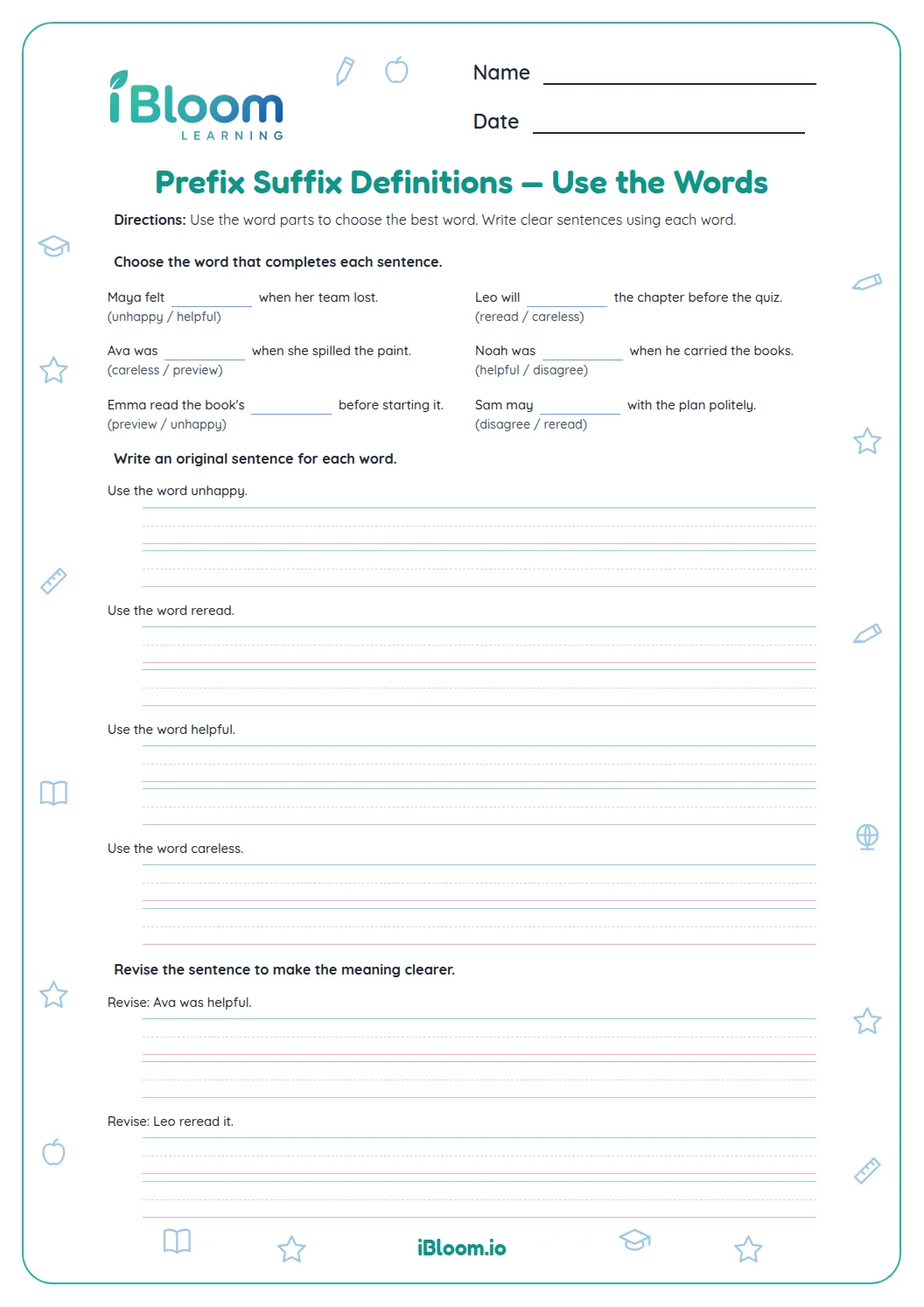
A prefix comes before a base word, while a suffix comes after it. Both can change a word’s meaning or use. This practice asks students to interpret familiar word parts in complete words and short contexts.
Aligned to L.4.4b
How do prefixes and suffixes change words?
A prefix comes before a base word; a suffix comes after it. The word part adds a clue to meaning or use. For example, re- in reread means to read again.
What kinds of word parts appear?
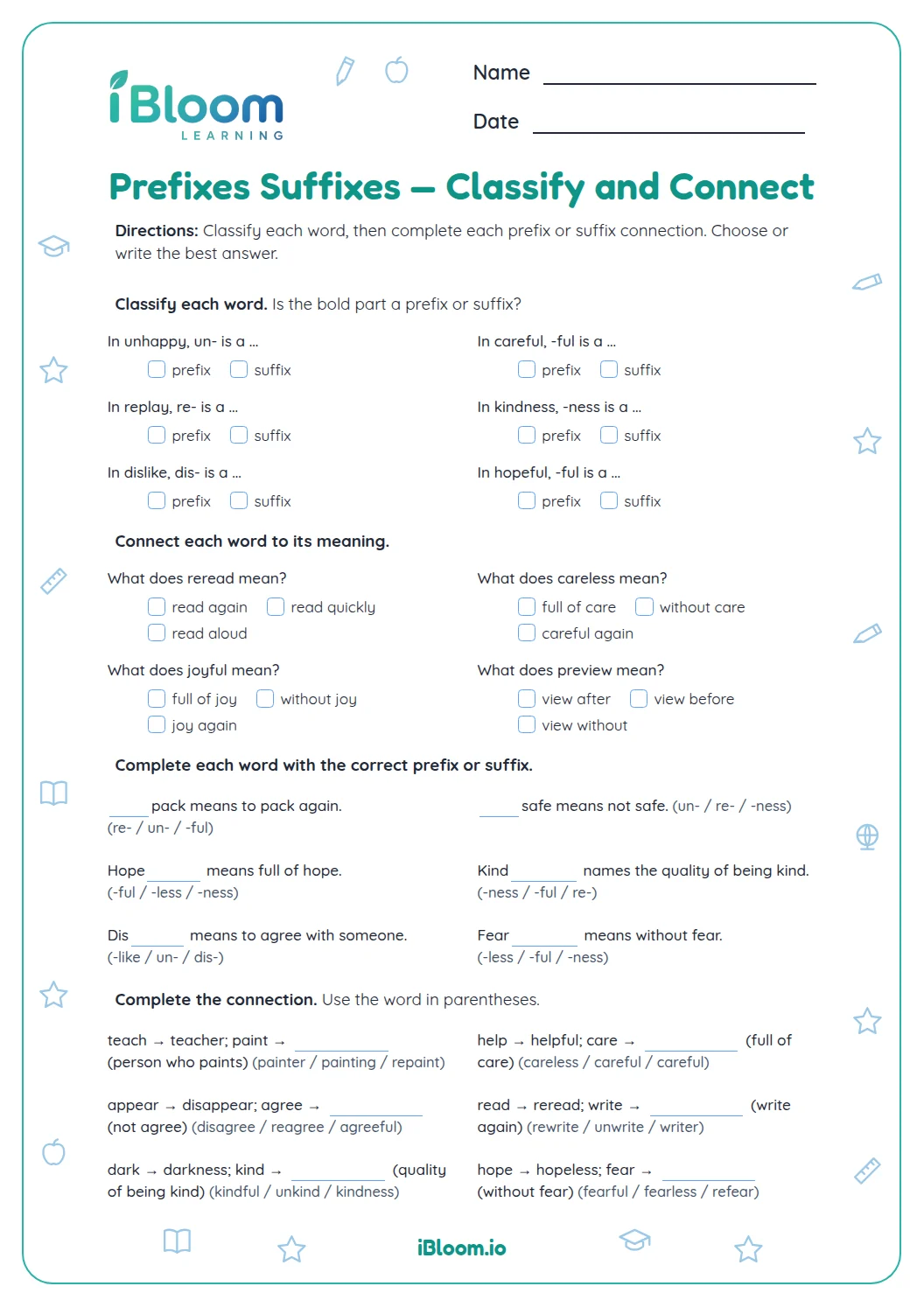
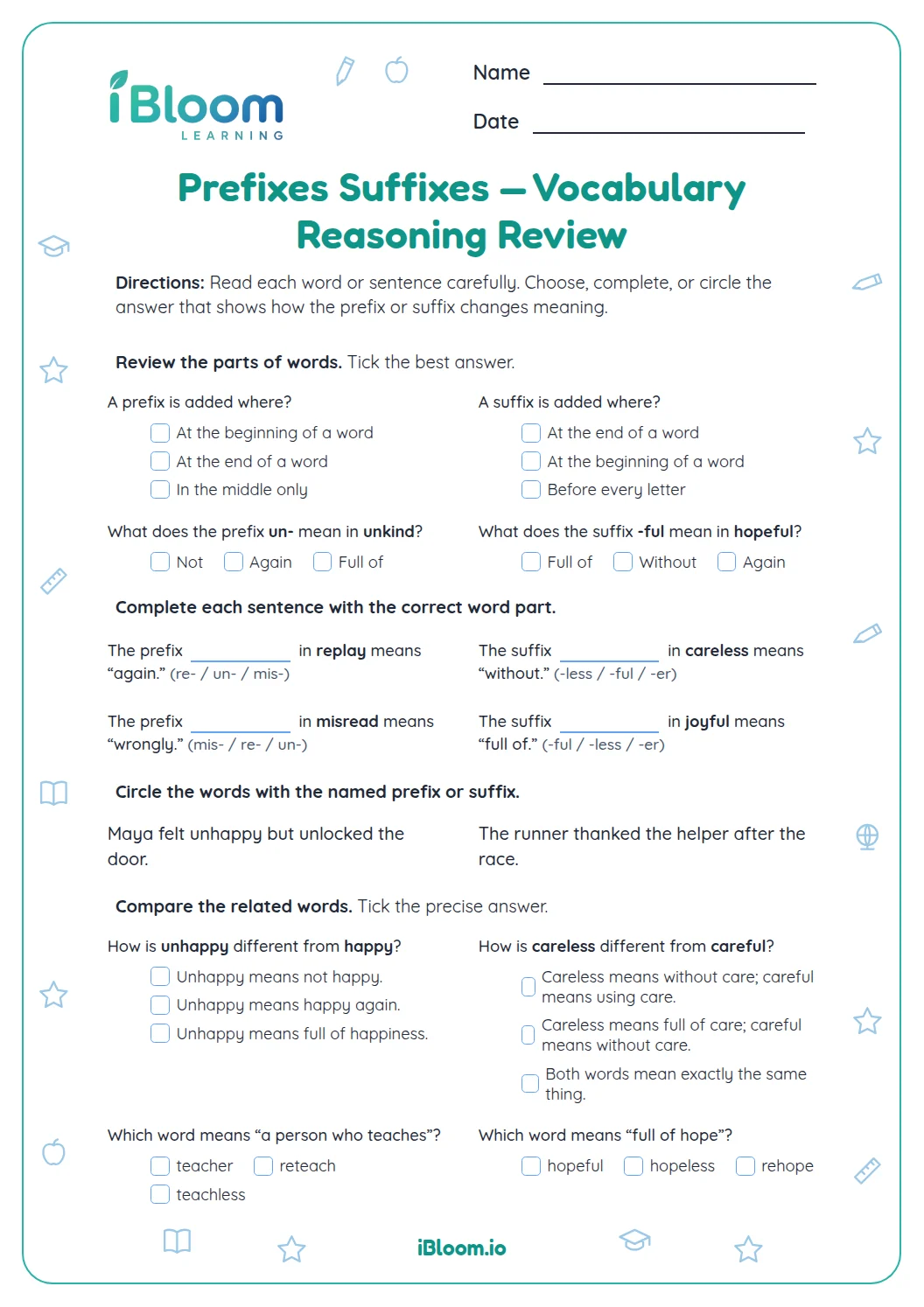
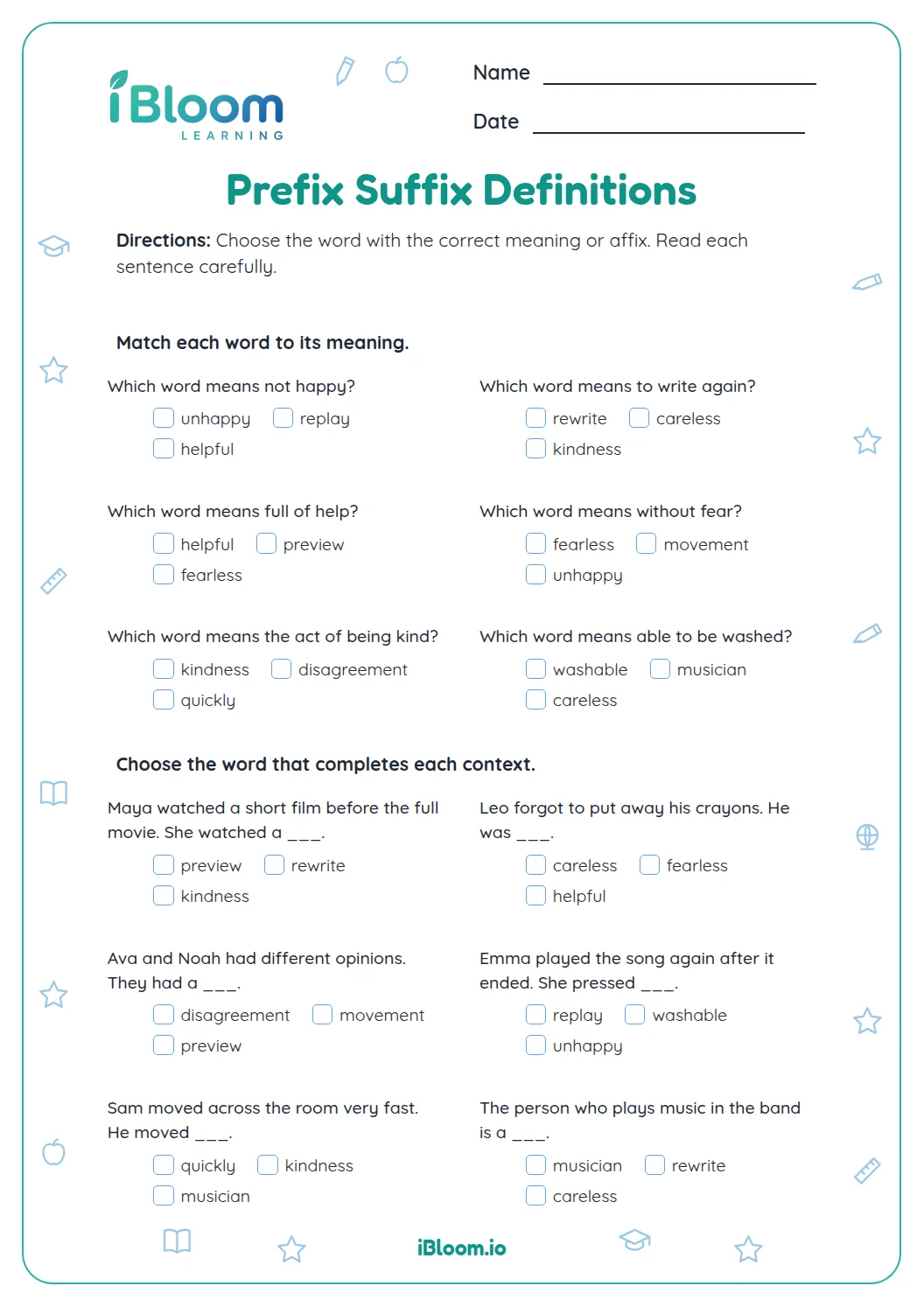
Questions cover un-, re-, mis-, -ful, -less, and -able, along with related words such as teacher and kindness. Some ask for an affix meaning; others ask for the whole word.
- 1Word: reread
- 2Base word: read
- 3Prefix: re- means again
- 4Meaning: read again
How can context confirm a word meaning?
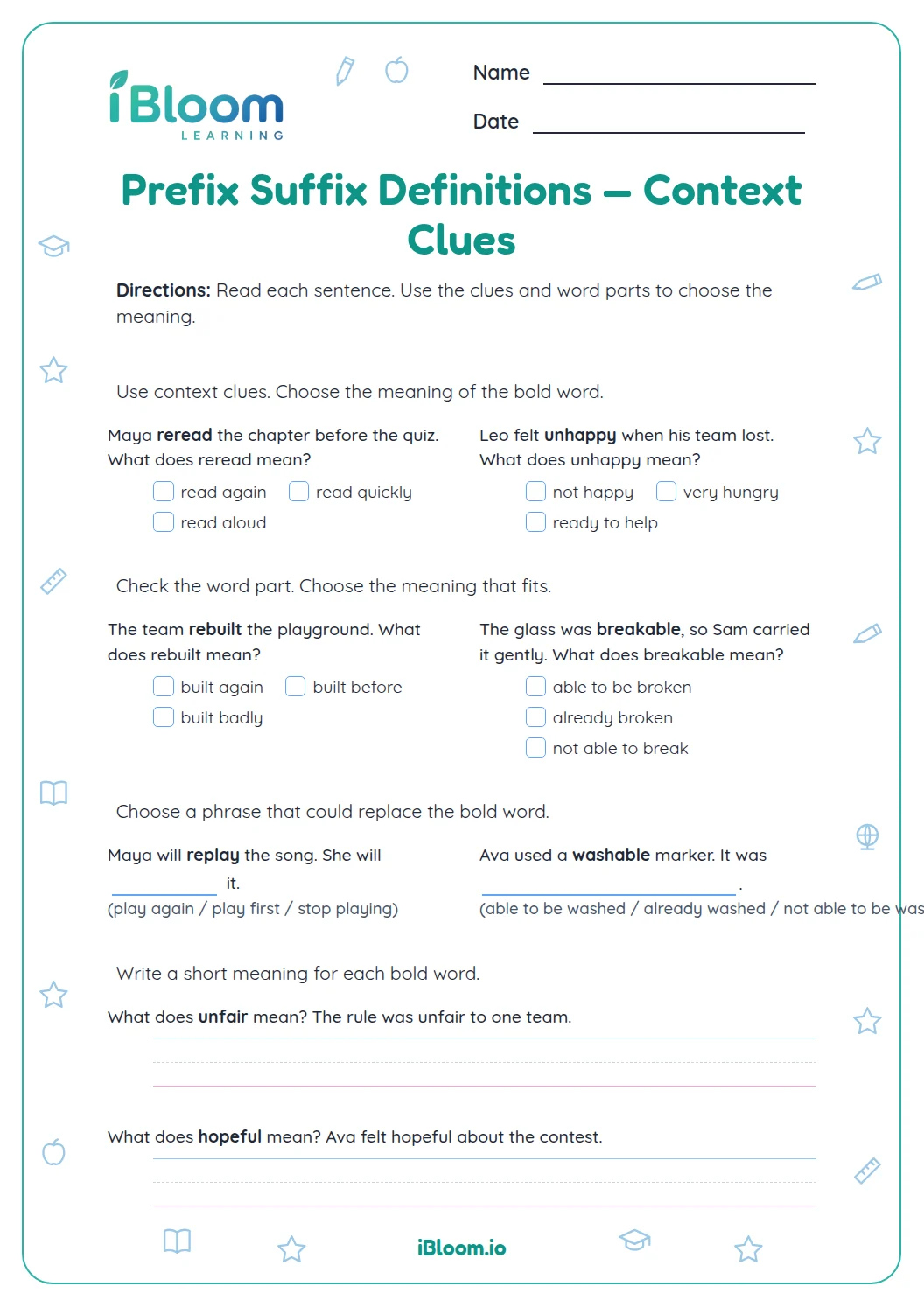
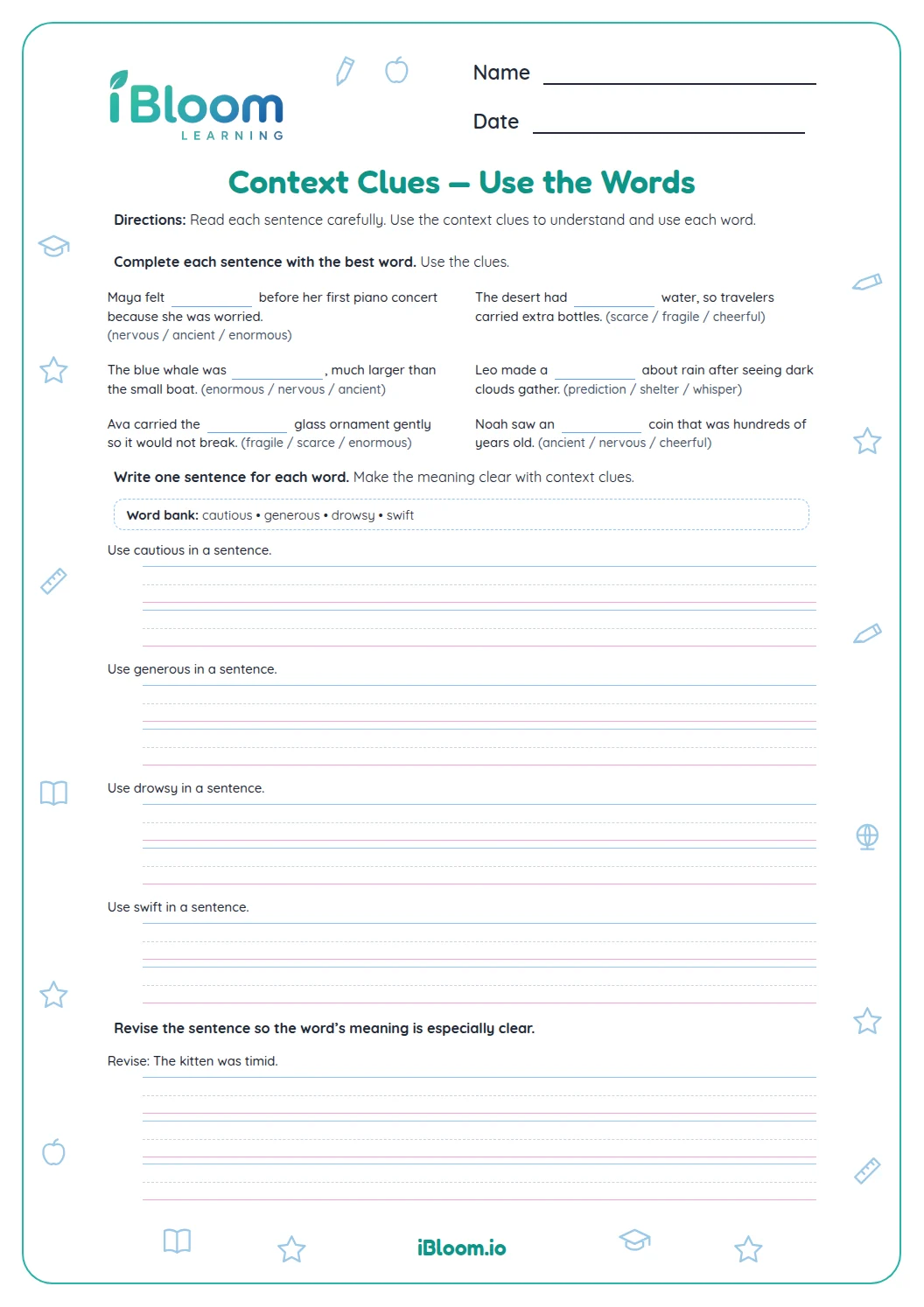
Combine the base word and affix, then see whether the meaning fits the sentence. The second part uses complete sentence clues to help check an interpretation.
How to use this worksheet
- 1Read the whole word before separating its parts.
- 2Identify the familiar prefix or suffix.
- 3Combine the affix clue with the base word meaning.
- 4For a sentence item, reread the sentence to confirm that the meaning fits.
Common mistakes and quick fixes
The mistake
Treating a prefix as part of the base word.
The fix
Look at the beginning for a familiar word part such as un- or re-.
The mistake
Guessing only from the base word.
The fix
Use the affix too; it may reverse, repeat, or describe the base word.
The mistake
Giving only the base-word meaning and ignoring the affix.
The fix
Explain how the prefix or suffix changes or adds to the base meaning.
Common Core alignment
This page targets the named skill at its stated grade level.
Use common affixes and roots as clues to a word’s meaning.
On this sheet: Students use common affixes such as un-, re-, mis-, -ful, -less, and -able to infer word meanings.
Show the official wordingHide the official wording
Use common, grade-appropriate Greek and Latin affixes and roots as clues to the meaning of a word (e.g., telegraph, photograph, autograph).
What to practice next
Make more practice
Further reading
Questions parents and teachers ask
What is a prefix?
A prefix is a word part added to the beginning of a base word. For example, re- comes before read in reread and gives the word the meaning “read again.” The base word read keeps its meaning while re- changes the action.
What is a suffix?
A suffix is a word part added to the end of a base word. In hopeful, the suffix -ful adds the idea of being full of hope. Notice that -ful turns hope into a describing word. The suffix changes how the word works in a sentence.
How do prefixes and suffixes help with meaning?
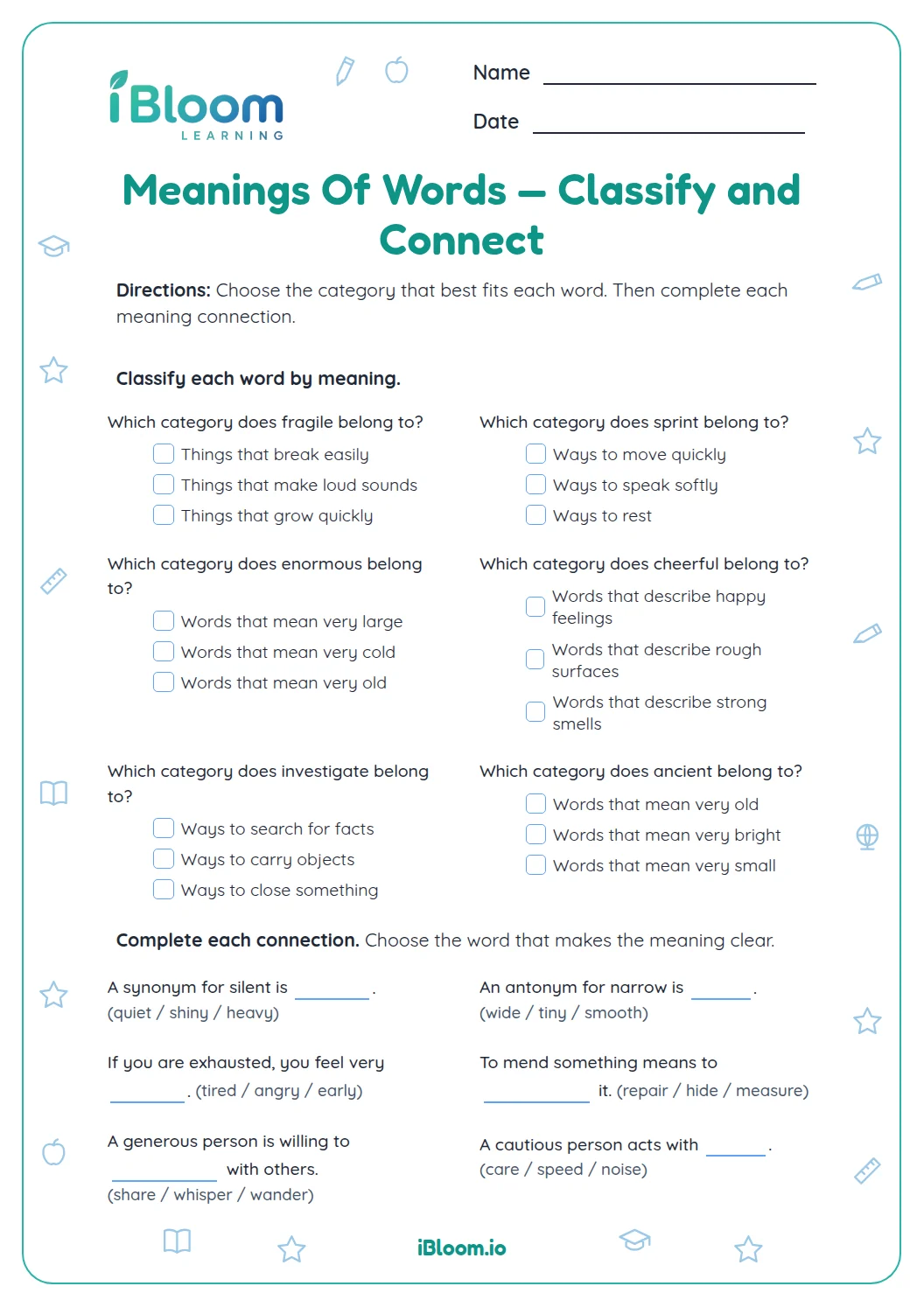
A familiar word part gives a clue to the whole word. Students can combine the affix meaning with the base word, then check whether that meaning fits the sentence. Context confirms that the word-part guess makes sense in use. A dictionary can help with unfamiliar base words.
Which word parts appear on this worksheet?
The questions practice un-, re-, and mis- at the beginning of words, along with -ful, -less, -able, and other endings. Students use the word parts to reason about meaning. Each affix contributes a clue to the whole word’s meaning. Then test the meaning in a sentence.
What kinds of affixes are practiced?
The questions include un-, re-, and mis- as prefixes and -ful, -less, and -able as suffixes. Students use those parts in words such as unfair, reread, careless, and removable. The answer key gives concise meanings for each item.