


About this worksheet
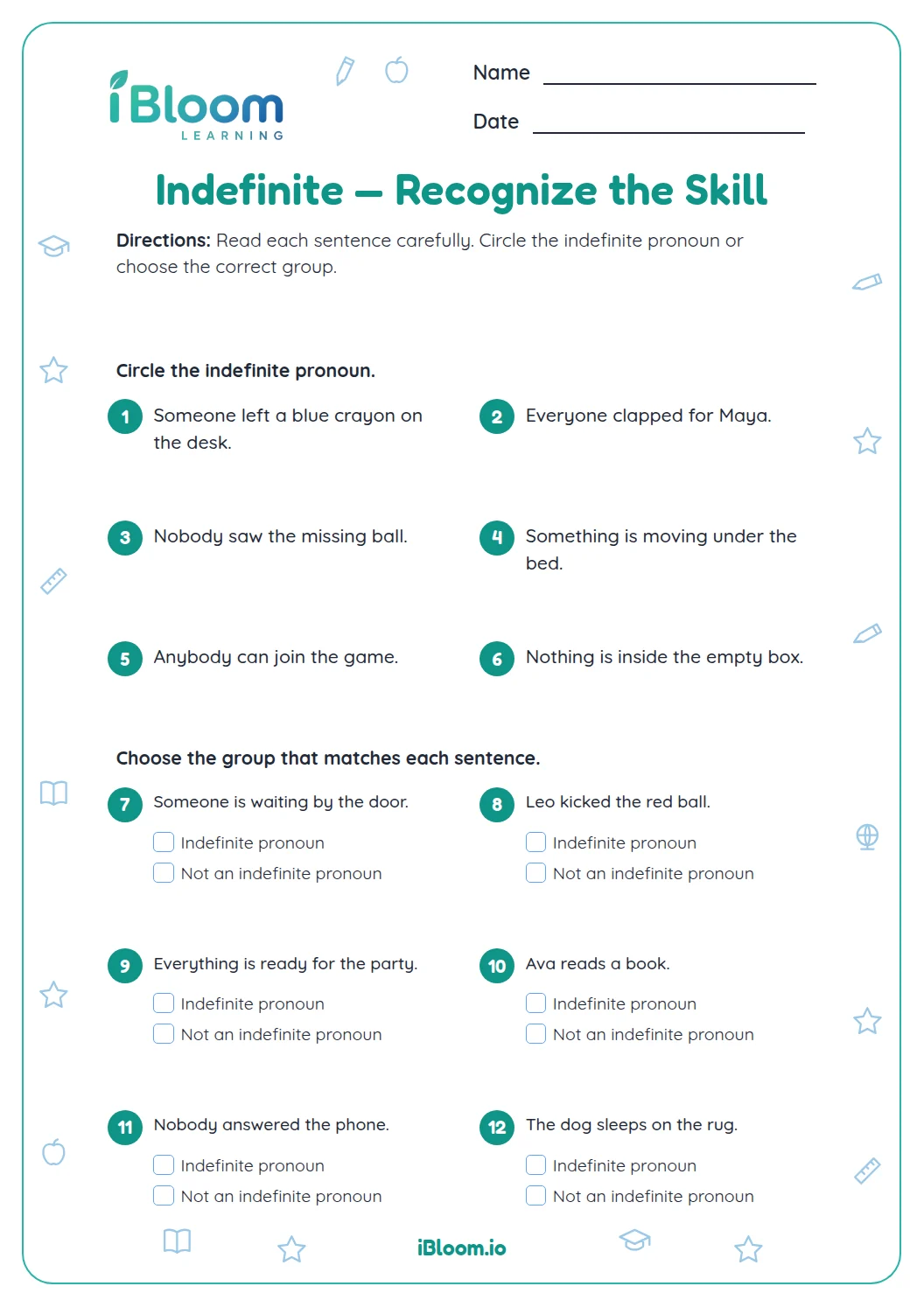
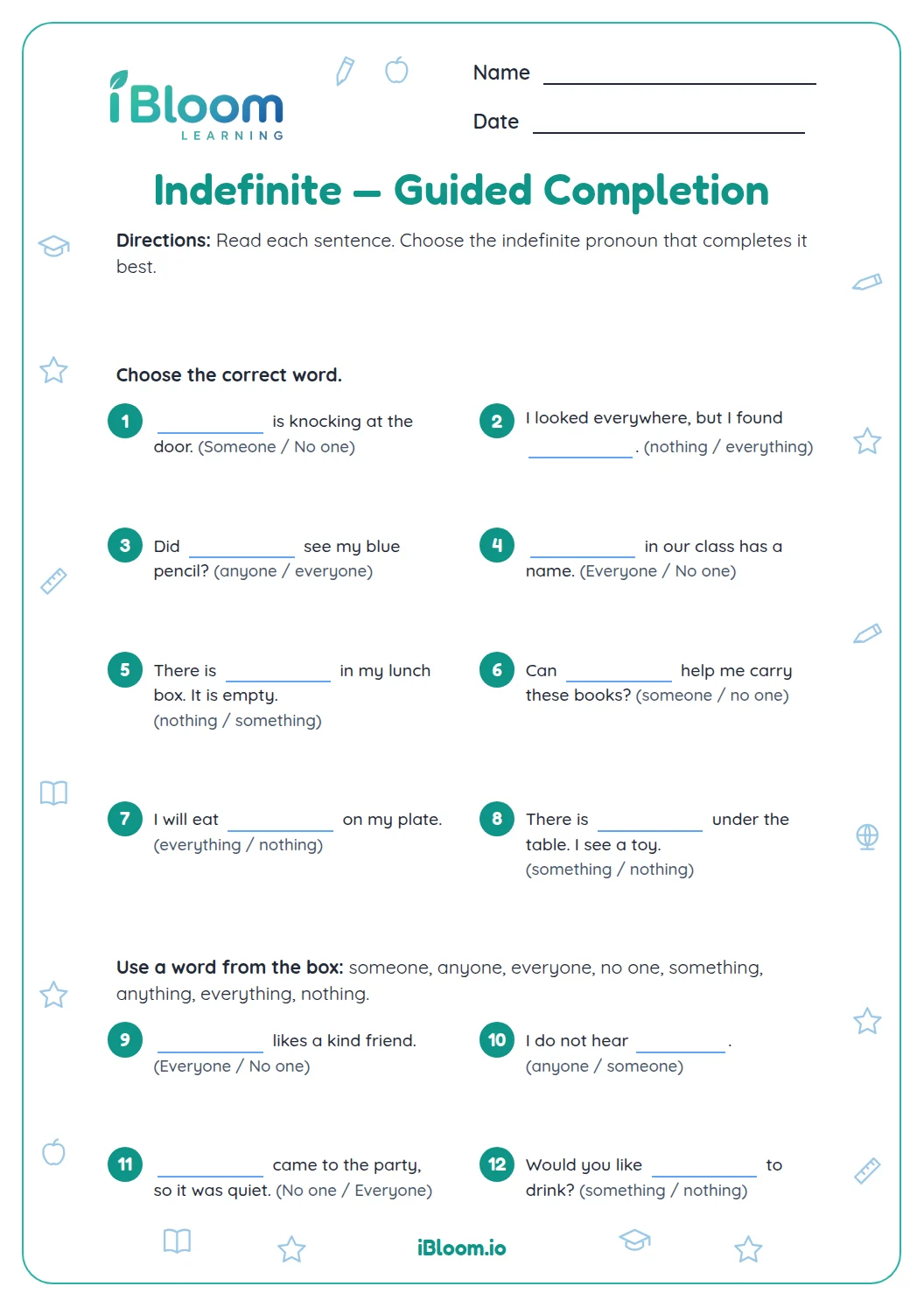
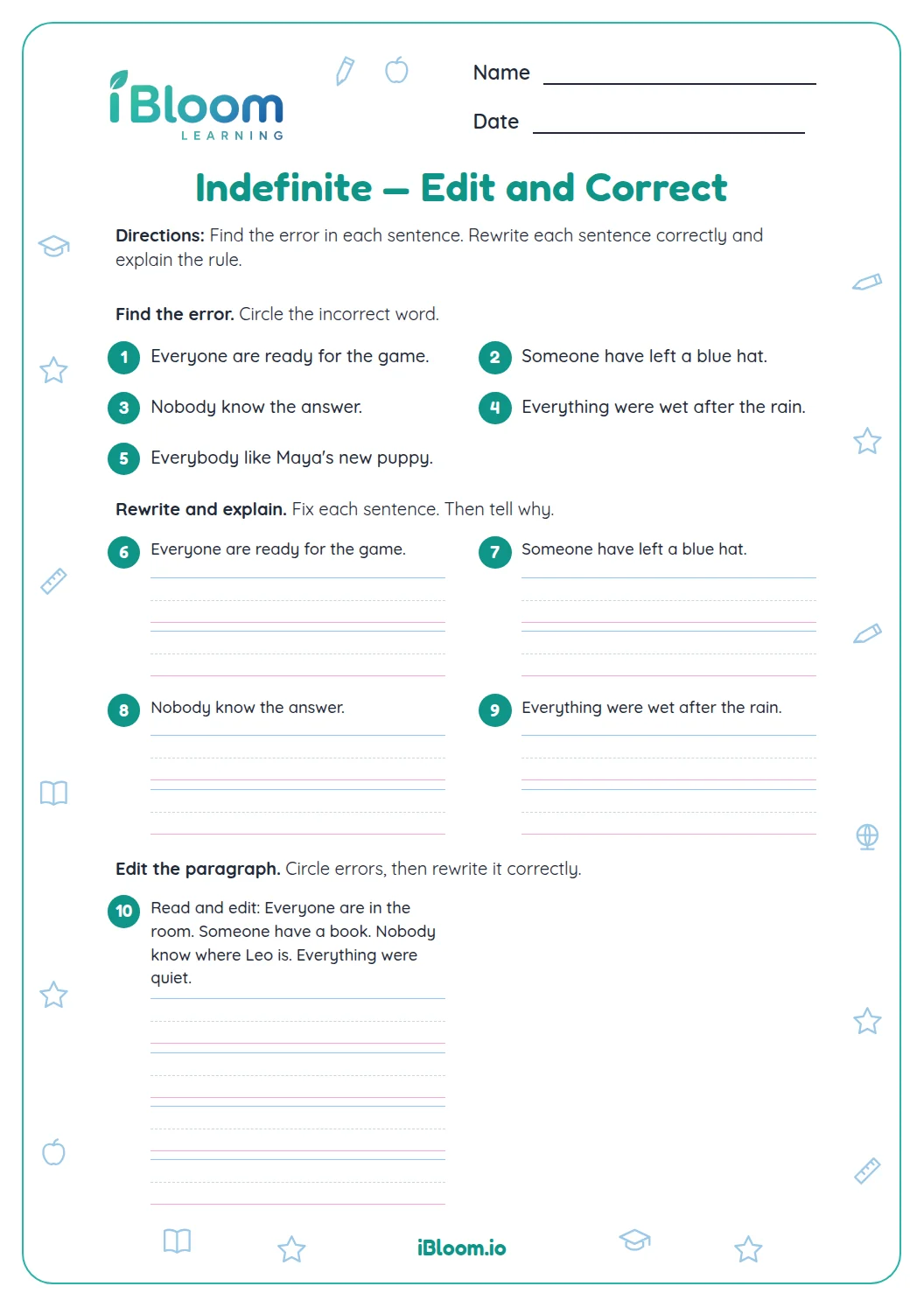
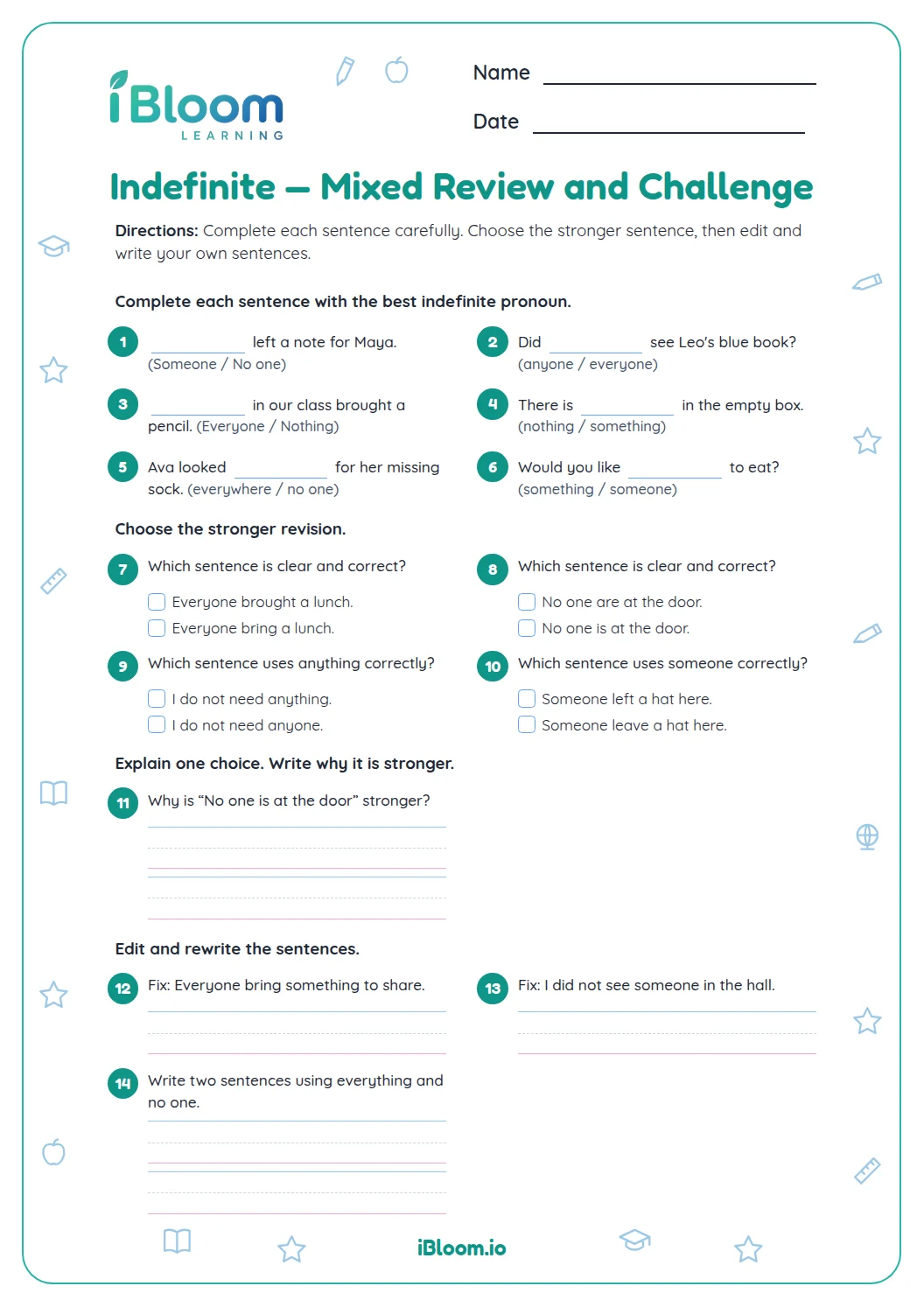
This free printable Grade 1 worksheet gives learners three ways to use indefinite pronouns. In Part A, they choose a pronoun that fits a sentence; Part B asks them to supply a pronoun in four sentence frames; Part C asks for original sentences using everyone and someone. The worksheet has 14 questions across two pages, plus a two-page answer key with sample writing responses.
Aligned to L.1.1.d
What will learners do with indefinite pronouns?
The sheet starts with eight choices such as someone, nothing, and everyone. Four fill-in prompts then ask learners to supply an indefinite pronoun, followed by two sentence-writing prompts.
- Part A: choose a fitting pronoun
- Part B: complete four sentences
- Part C: write with everyone and someone
How can a learner choose an indefinite pronoun?
Read the whole sentence and use its meaning to decide whether it calls for a person, a thing, or no one. Then read the pronoun in the sentence to check that it makes sense.
- 1___ found my red crayon. → Someone
- 2Someone is a person, so it fits the sentence.
What makes a complete sentence with a pronoun?
A sentence should tell a complete thought and begin with a capital letter. For example, “Everyone clapped for the singers.” Everyone stands for the people who clapped; the answer key gives sample sentences, and other clear, correct sentences can work.
How can adults help with sentence writing?
Before writing, ask the learner to say the sentence aloud. Check that the pronoun stands for a person or thing and that the sentence tells a complete thought. Then check its capital letter and ending punctuation.
How to use this worksheet
- 1Read the instruction line and look over the first part together.
- 2Complete the first question as a model, naming the clue or step used.
- 3Finish the rest of that part independently.
- 4Move to the next part and use the same strategy on the new format.
- 5Check answers with the key and revisit any missed item.
Indefinite-pronoun mix-ups and quick fixes
The mistake
Choosing a pronoun for a person when the sentence is about an object.
The fix
Ask whether the blank stands for a person, a thing, or no one.
The mistake
Using a pronoun that changes the sentence meaning, such as everyone instead of no one.
The fix
Read the complete sentence with the pronoun and check its meaning.
The mistake
Writing a fragment after the prompt asks for a sentence.
The fix
Say a complete thought aloud, then write it with a capital and ending mark.
Common Core alignment
This worksheet practices choosing and using indefinite pronouns in complete sentences.
Use indefinite pronouns such as someone, nothing, and everyone in sentences.
On this sheet: Learners select, supply, and write sentences using indefinite pronouns.
Show the official wordingHide the official wording
Use personal, possessive, and indefinite pronouns (e.g., I, me, my; they, them, their, anyone, everything).
What to practice next
Make more practice
Further reading
Questions parents and teachers ask
How many questions are on this indefinite-pronoun worksheet?
There are 14 questions in three parts: eight multiple-choice items, four sentence completions, and two original-sentence prompts. The answer key gives correct choices and sample responses for the writing items, so adults can check both recognition and sentence use. The two-page worksheet and separate key make it easy to print practice and check responses afterward.
What is an indefinite pronoun?
The practice includes words for people and things, such as someone, everyone, something, and nothing. Children use the meaning of each sentence to choose an indefinite pronoun that fits the person or thing described. The two-page worksheet and separate key make it easy to print practice and check responses afterward.
Are there different correct answers for the writing prompts?
The answer key gives a sample response, but another complete sentence using the requested pronoun can also be correct. Check that it expresses a full thought and ends with punctuation. The two-page worksheet and separate key make it easy to print practice and check responses afterward.
What is one example from Part A?
The first prompt says one person found a crayon, so someone fits the clue. Read the completed sentence aloud to check that the pronoun matches the information in the prompt. The two-page worksheet and separate key make it easy to print practice and check responses afterward.
How can I help my child complete a sentence?
For a blank, check whether the sentence describes a person, a thing, or an empty set. In Part C, say the sentence aloud first, then check its capital letter and ending mark. The two-page worksheet and separate key make it easy to print practice and check responses afterward.