


About this worksheet
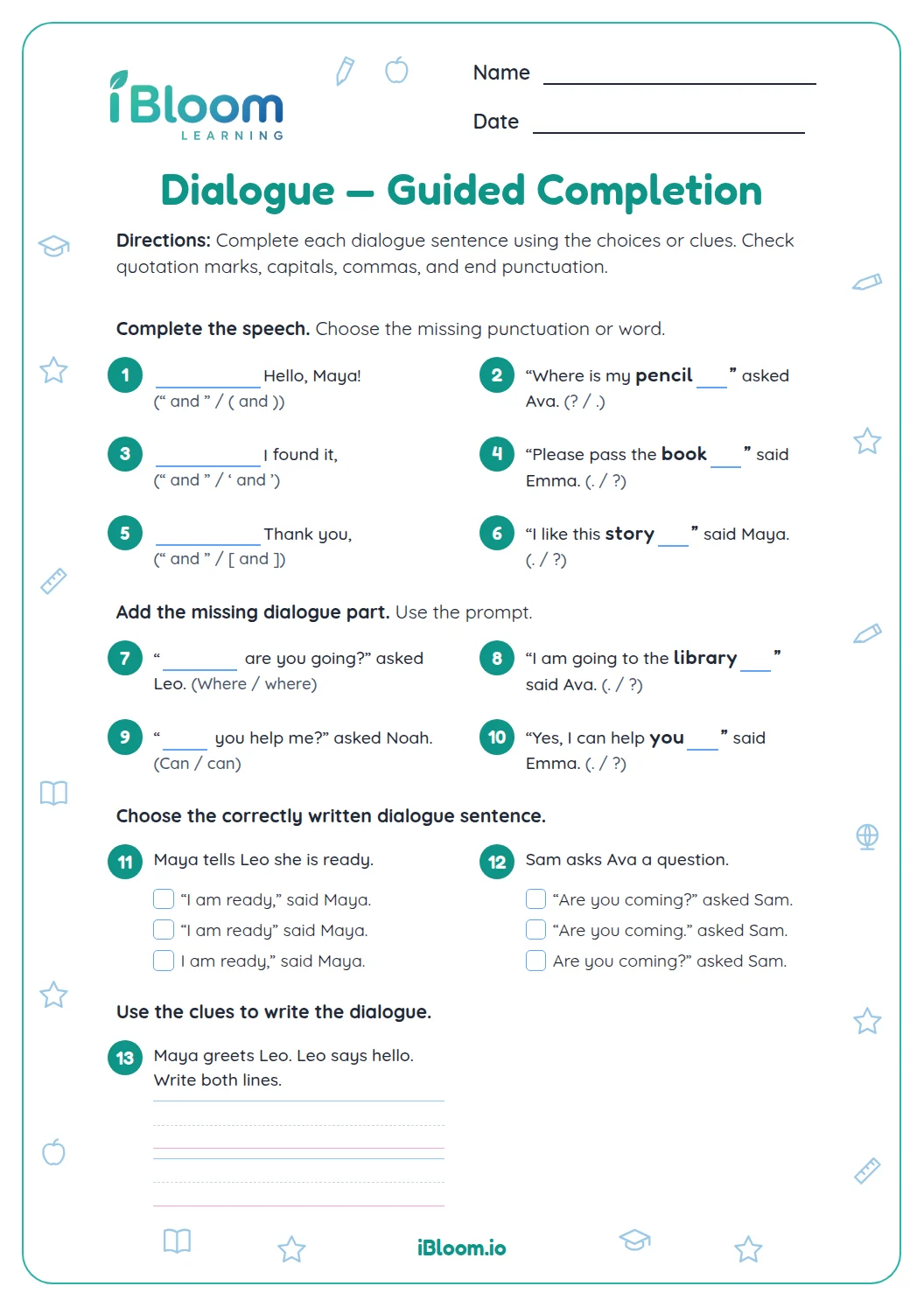
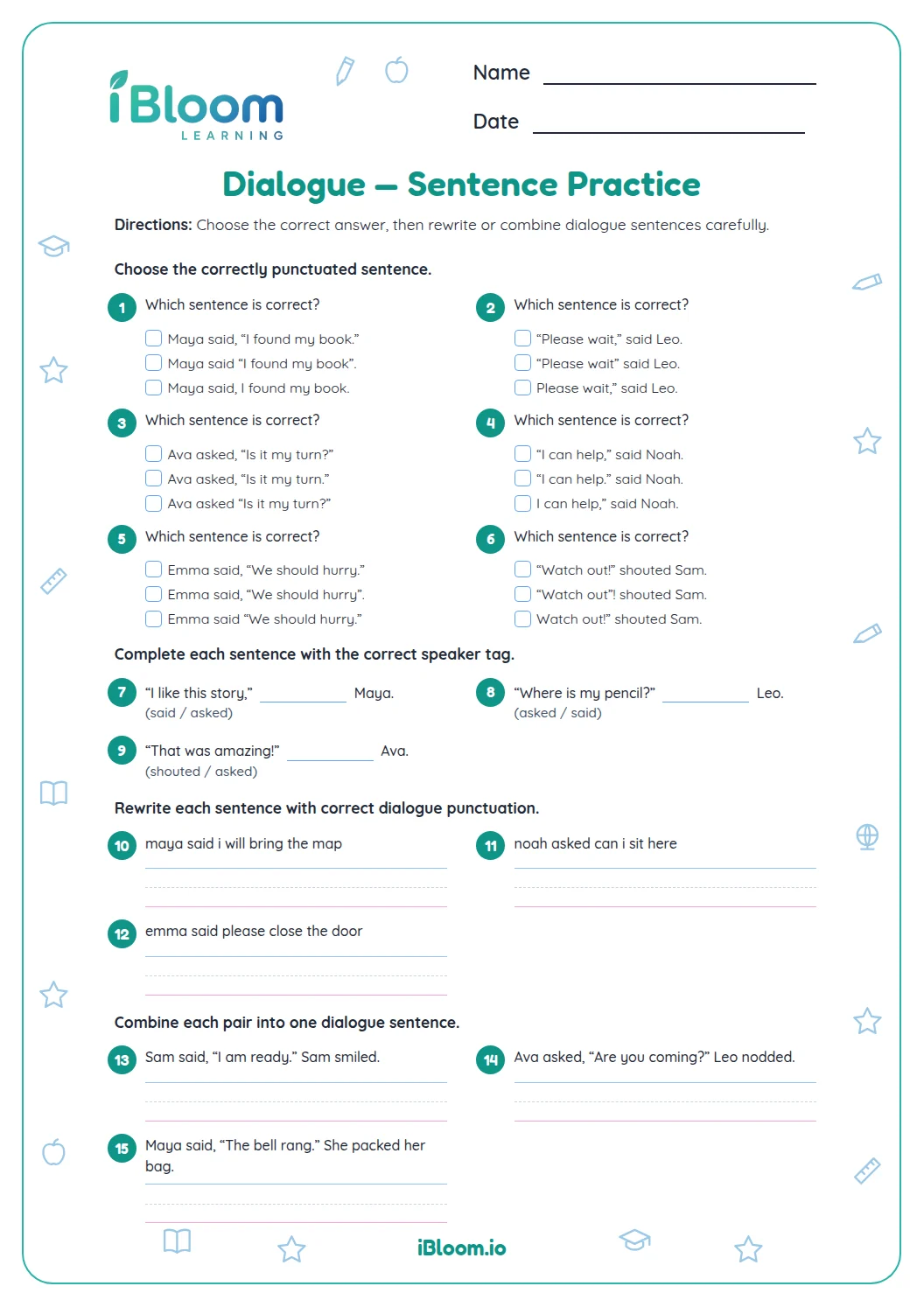
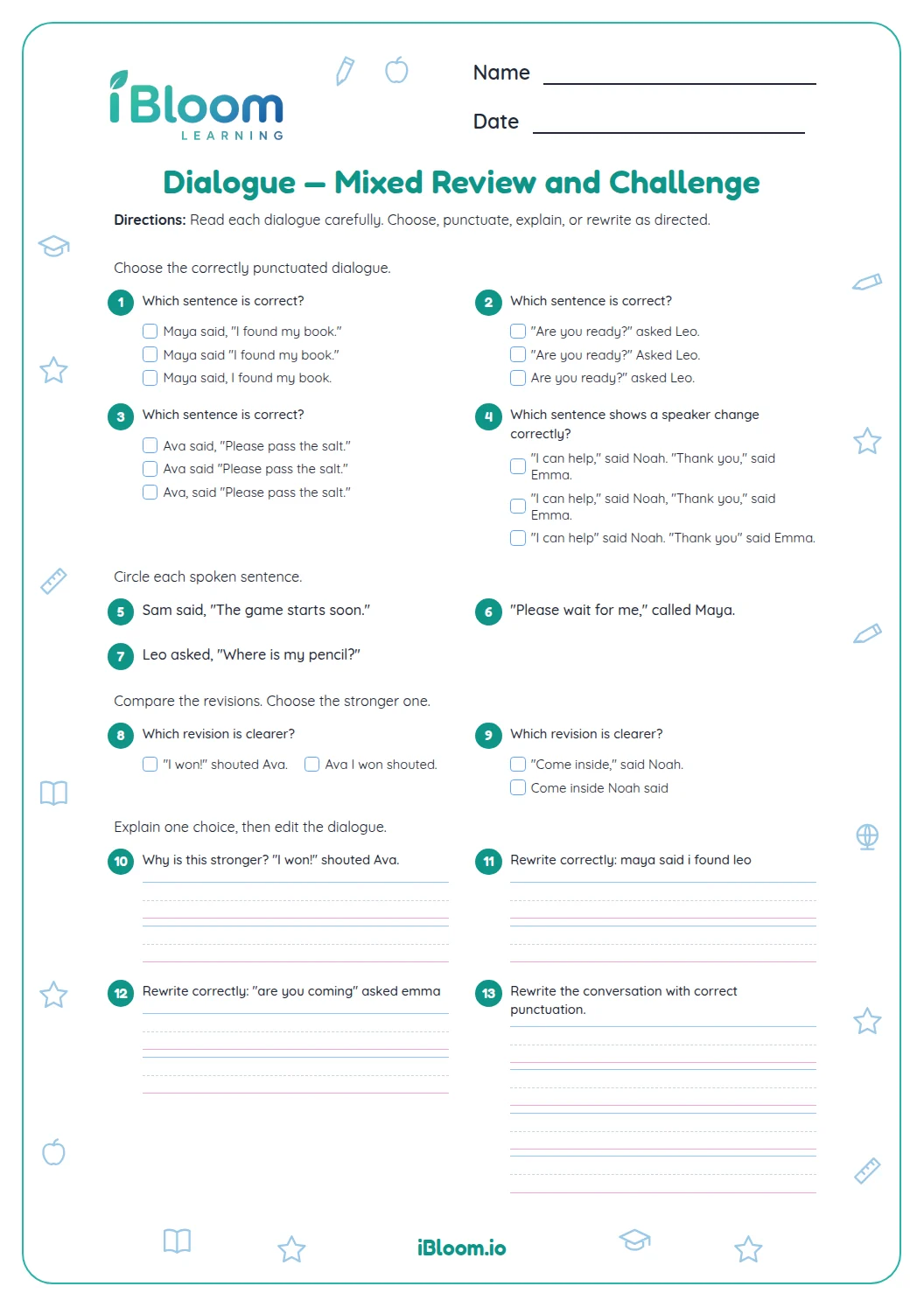
This Grade 3 printable practices dialogue punctuation through short examples and original writing. Learners choose correctly punctuated lines, add a missing mark to quoted speech, and write dialogue with speaker tags. The answer key gives fixed answers and sample responses for open writing. It practices Common Core standard L.3.2c: commas and quotation marks in dialogue.
Aligned to L.3.2c
How do quotation marks show spoken words?
The first four questions ask learners to choose a correctly punctuated line. In “I found it,” Jay said, the quotation marks enclose the spoken words, and the comma sits before the closing mark.
Where does the comma go with a speaker tag?
When a speaker tag follows a statement, place the comma inside the closing quotation mark: “Please pass the map,” asked Noor. The next group asks learners to supply the missing punctuation.
How can learners apply the punctuation?
The final two prompts ask learners to write dialogue. Look for quotation marks around the exact words spoken, an appropriate end mark, and a tag that identifies the speaker.
How to use this worksheet
- 1Find the words spoken by the character.
- 2Put quotation marks at the beginning and end of those words.
- 3Use a comma before a speaker tag after a statement.
- 4Put a question mark or exclamation point inside the quotation marks when the spoken words need one.
- 5Reread the sentence and check both quotation marks.
Common mistakes and quick fixes
The mistake
Putting the comma after the closing quotation mark.
The fix
Place it before the closing quotation mark.
The mistake
Leaving the speaker’s words outside the quotation marks.
The fix
Put quotation marks around only the words the character says.
The mistake
Using a period for a spoken question.
The fix
Use a question mark inside the quotation marks.
This page practices a skill named in the Common Core State Standards.
Use commas and quotation marks to punctuate dialogue in sentences and original lines.
On this sheet:
Show the official wordingHide the official wording
Use commas and quotation marks in dialogue.
What to practice next
Make more practice
Further reading
Questions parents and teachers ask
What does this dialogue punctuation worksheet practice?
This printable has four multiple-choice items, nine missing-mark sentences, and two dialogue-writing prompts for Grade 3 learners. It moves from spotting the skill to using it in context, with an answer key for checking fixed answers and comparing open responses. Use the prompts to talk through the choices and the evidence behind them.
How should we use the answer key?
Have the learner finish a part before checking its key page. For a written response, compare the child’s idea with the sample and the story or sentence; the wording does not need to match exactly. Invite the learner to revise one answer after checking.
Can I use this printable at home or in class?
Yes. Print the worksheet pages for independent practice, a small group, or a short lesson. The key pages are for the adult or teacher. A pencil is enough for the activities, and the writing prompts can be completed at the learner’s own pace.
How long will the worksheet take?
Plan for about 20 minutes, allowing extra time for the open-response items. The page is divided into short parts, so a learner can pause after a section and return to the remaining questions later. Time will vary with reading and writing speed.
What if a written answer differs from the key?
Check whether the response meets the prompt and uses the relevant sentence or story detail. The key gives a sample for answers that can vary, so equivalent wording may be correct. For a fixed answer, revisit the item together and look for the clue that settles it.