Free printable practice
Adaptations Practice Activities
Grade 1 science worksheets that help children identify how animal body parts and behaviors help animals live in their habitats.
Free printable worksheet PDFs
Preview every available page, then download the free worksheet PDF for home, homeschool, tutoring, or classroom practice.
Preview the exact activity before downloading it.
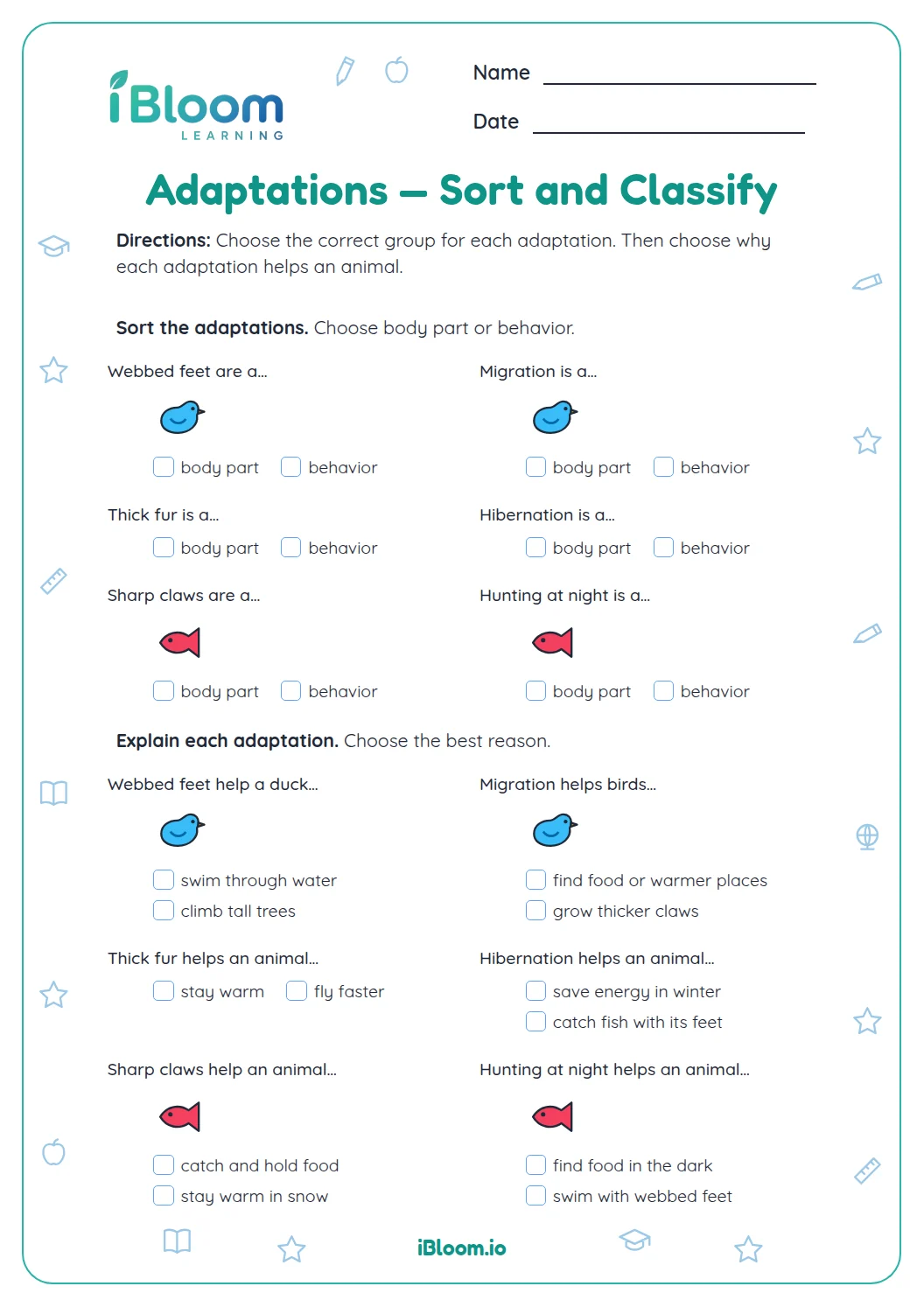 Adaptations — Sort and ClassifyGrade 1 science worksheets that help children identify how animal body parts and behaviors help animals live in their habitats. This sort and classify worksheet provides a distinct, age-appropriate way to practise the same lesson.Grade 1Free PDF preview
 Adaptations — Label and ModelGrade 1 science worksheets that help children identify how animal body parts and behaviors help animals live in their habitats. This label and model worksheet provides a distinct, age-appropriate way to practise the same lesson.Grade 1Free PDF preview
 Adaptations — Explain Cause and EffectGrade 1 science worksheets that help children identify how animal body parts and behaviors help animals live in their habitats. This explain cause and effect worksheet provides a distinct, age-appropriate way to practise the same lesson.Grade 1Free PDF preview
 Adaptations — Apply Science IdeasGrade 1 science worksheets that help children identify how animal body parts and behaviors help animals live in their habitats. This apply science ideas worksheet provides a distinct, age-appropriate way to practise the same lesson.Grade 1Free PDF preview
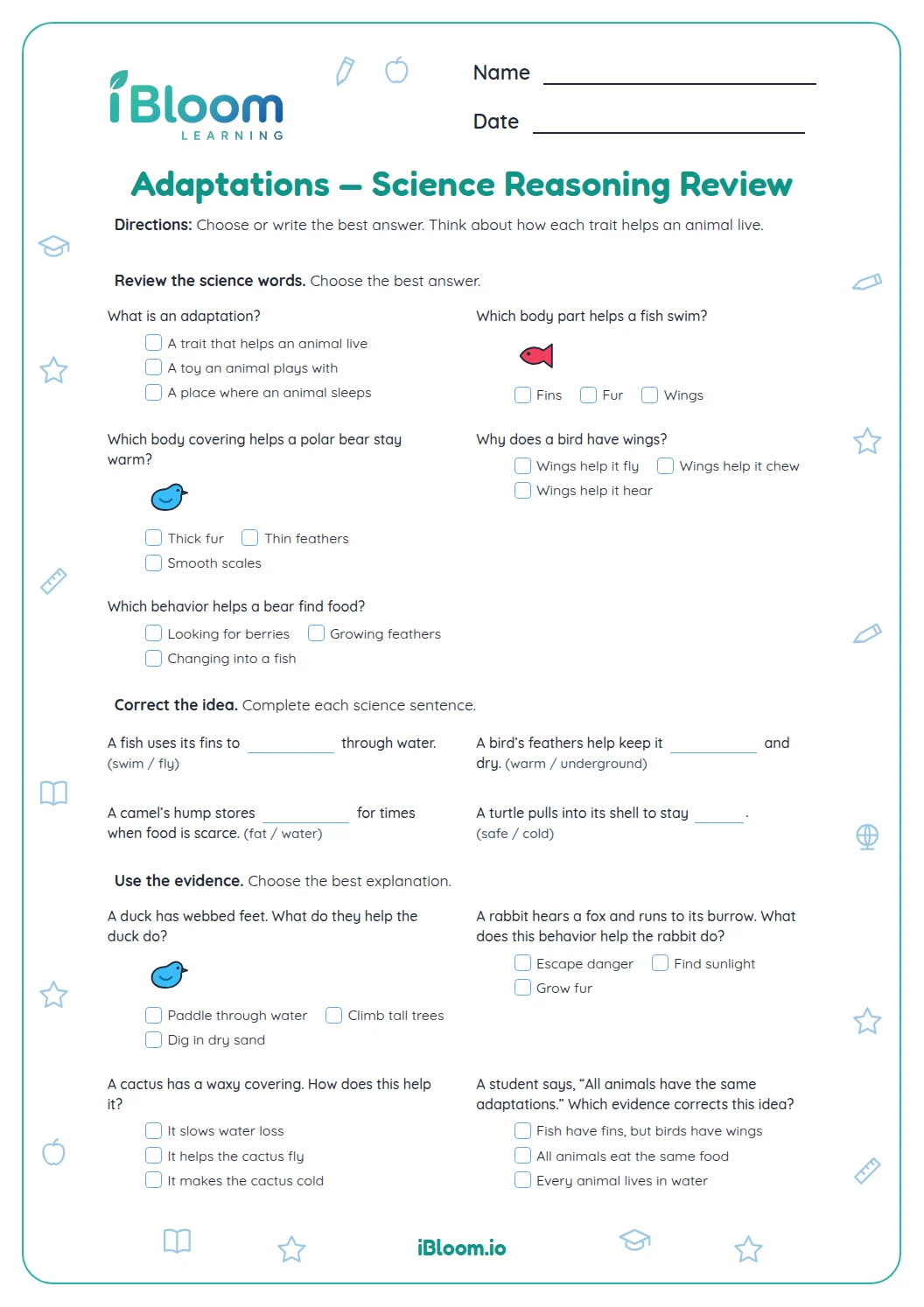 Adaptations — Science Reasoning ReviewGrade 1 science worksheets that help children identify how animal body parts and behaviors help animals live in their habitats. This science reasoning review worksheet provides a distinct, age-appropriate way to practise the same lesson.Grade 1Free PDF preview
Practice that builds confidence
What children learn about adaptations
These Grade 1 adaptations worksheets help children notice how animals survive in different places. Students practise connecting simple animal features, such as beaks, fur, claws, shells, or webbed feet, to what the animal needs to eat, move, stay safe, or keep warm.
The printable activities use clear pictures, matching tasks, sorting, short answer prompts, and observation-based questions. Children build science vocabulary while explaining why a body part or behavior is useful in a habitat.
An adaptation is a body part or behavior that helps an animal live. At this level, children do not need long definitions; they need to observe and explain. A duck’s webbed feet help it swim, a turtle’s shell helps protect it, and thick fur can help an animal stay warm. The focus is on the connection between the feature and the animal’s need.

From noticing to explaining
The worksheets move from simple identification to reasoning. Children may circle an animal part, match animals to helpful features, sort animals by habitat, or complete a sentence such as “The bird uses its beak to ___.” This progression helps students go beyond naming animals and begin using cause-and-effect language: because, so, helps, protects, moves, and finds food.
Parent routine for home practice
Choose one worksheet and first look at the pictures together. Ask, “What do you notice?” before naming the adaptation. Then use a two-part sentence: “The camel has long eyelashes. They help keep sand out of its eyes.” After the page, invite your child to pick a stuffed animal, toy animal, or picture in a book and explain one feature that helps it live.

Classroom uses for teachers
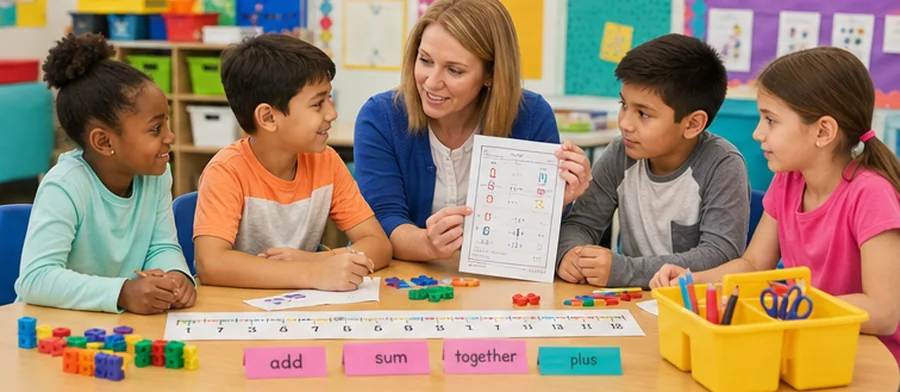
Teachers can use these printables during an animals unit, science centers, small-group reading connections, or as a quick follow-up after a read-aloud about habitats. They also work well for oral language practice: students can turn to a partner and explain how a body covering, mouth part, foot shape, or protective feature helps the animal.
Common errors to watch for
Some children think every feature is only for one purpose, or they may describe what an animal “likes” instead of what helps it survive. Guide them back to evidence in the picture: “How does that help it get food, move, stay safe, or stay warm?” Also watch for confusion between habitat and adaptation; a pond is a habitat, while webbed feet are an adaptation.
Free printable PDF download
Use this grade 1 animal adaptations worksheet page to preview the activity, print it, or download it as a PDF for quick practice. It works well for homework, homeschool lessons, tutoring, morning work, revision, and classroom centers.
Answers and answer key support
After the child completes the worksheet independently, parents and teachers can use the answer support or answer key information to check the work, review mistakes, and choose the next practice step.
Why iBloom worksheets help
The activities use Grade 1-friendly visuals and short prompts so children can reason without being overwhelmed by heavy text. A helpful child strategy is: look closely, name the feature, tell its job. That simple routine supports careful observation and clear science explanations.
Helpful answers
Frequently asked questions
What is an animal adaptation for Grade 1 students?
For Grade 1, an adaptation can be explained as a body part or behavior that helps an animal live, such as a shell for protection or webbed feet for swimming.
Do these worksheets teach physical and behavioral adaptations?
Yes. The main focus is on easy-to-see physical features, but children may also discuss simple behaviors, such as hiding, moving in groups, or looking for food.
How can I help my child explain an adaptation instead of just naming it?
Use a sentence frame: “The animal has ___, and it helps the animal ___.” This encourages your child to connect the feature to a purpose.
Are habitats included in these adaptation activities?
Habitats are used as context. Children learn that an adaptation makes sense when they think about where the animal lives and what it needs there.
What vocabulary should Grade 1 children practise with this topic?
Useful words include adaptation, habitat, protect, survive, body part, behavior, beak, claws, fur, shell, and webbed feet.
Is this grade 1 animal adaptations worksheet free?
Yes. You can preview it for free and use the printable worksheet for home or classroom practice.
Can I download this grade 1 animal adaptations worksheet as a PDF?
Yes. Use the worksheet download option to save a printable PDF, or print the worksheet directly from the page.
Does this grade 1 animal adaptations worksheet include answers or an answer key?
When the activity has fixed answers, iBloom includes answer support so parents and teachers can check the completed worksheet.