Free printable practice
Classification Practice Activities
Printable Grade 1 science activities that help children sort and classify animals by observable features such as coverings, body parts, movement, and habitat.
Free printable worksheet PDFs
Preview every available page, then download the free worksheet PDF for home, homeschool, tutoring, or classroom practice.
Preview the exact activity before downloading it.
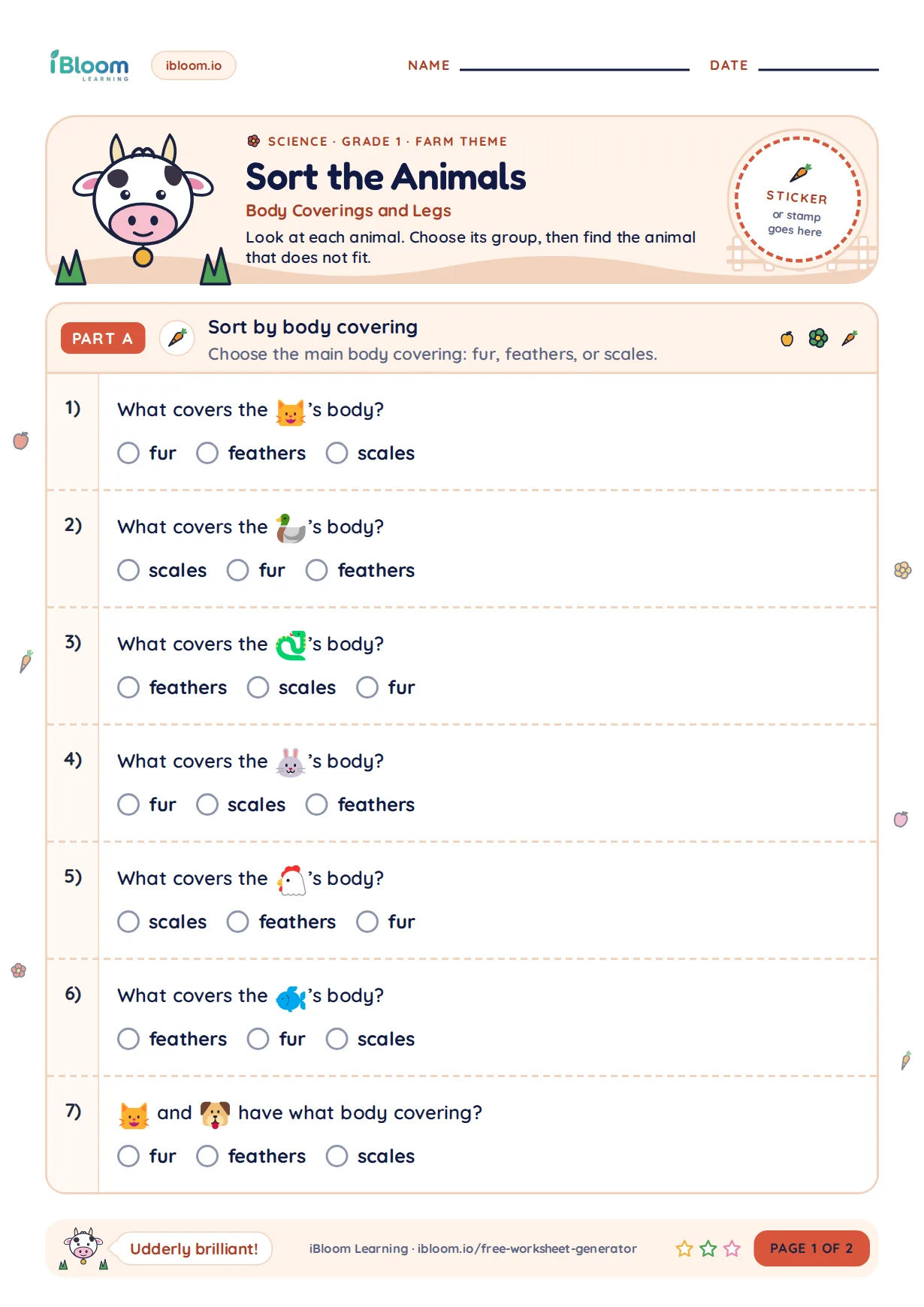 Classification — Sort and ClassifyPrintable Grade 1 science activities that help children sort and classify animals by observable features such as coverings, body parts, movement, and habitat. This sort and classify worksheet provides a distinct, age-appropriate way to practise the same lesson.Grade 1Free PDF preview4 pages
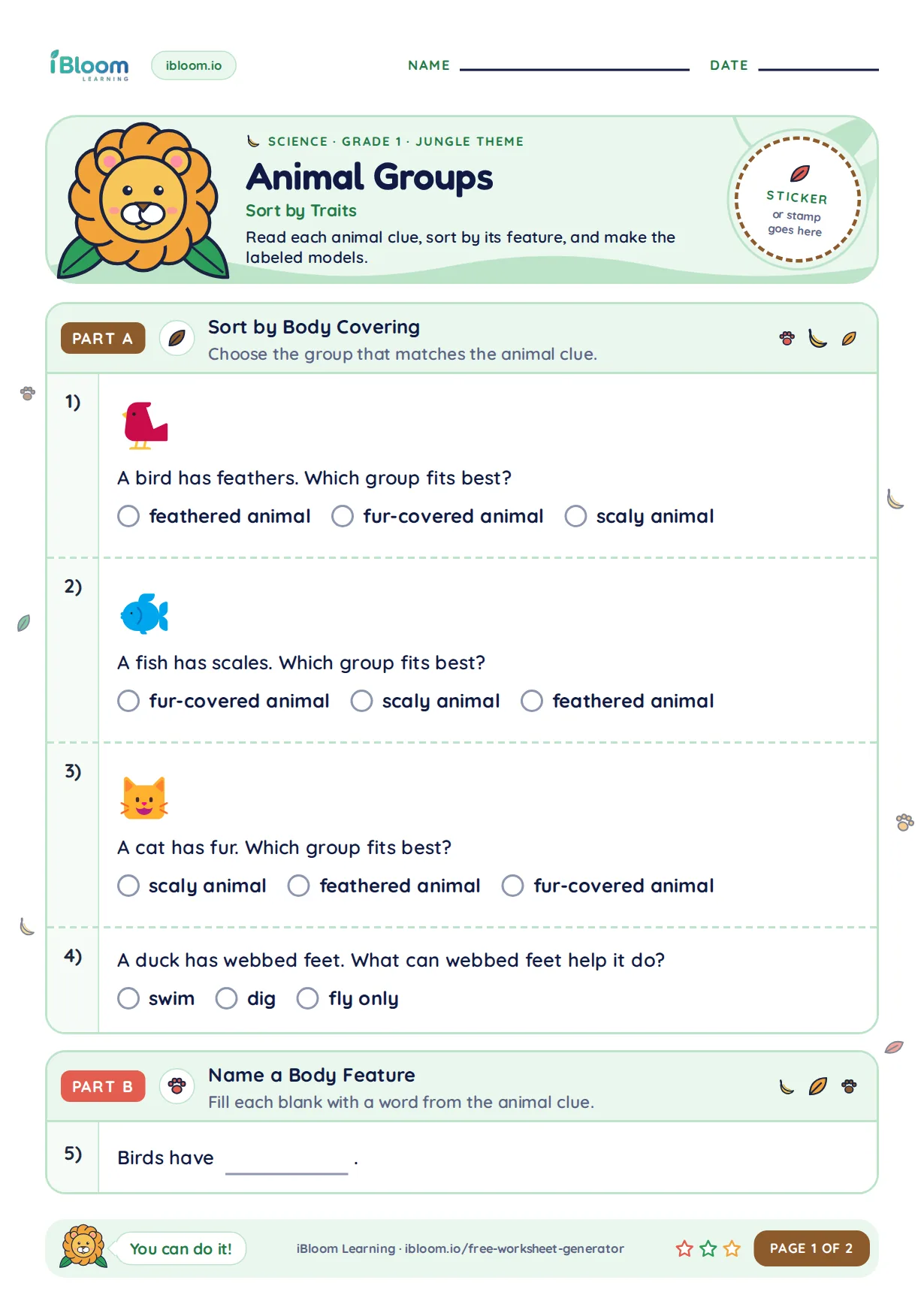 Classification — Label and ModelPrintable Grade 1 science activities that help children sort and classify animals by observable features such as coverings, body parts, movement, and habitat. This label and model worksheet provides a distinct, age-appropriate way to practise the same lesson.Grade 1Free PDF preview
 Classification — Explain Cause and EffectPrintable Grade 1 science activities that help children sort and classify animals by observable features such as coverings, body parts, movement, and habitat. This explain cause and effect worksheet provides a distinct, age-appropriate way to practise the same lesson.Grade 1Free PDF preview4 pages
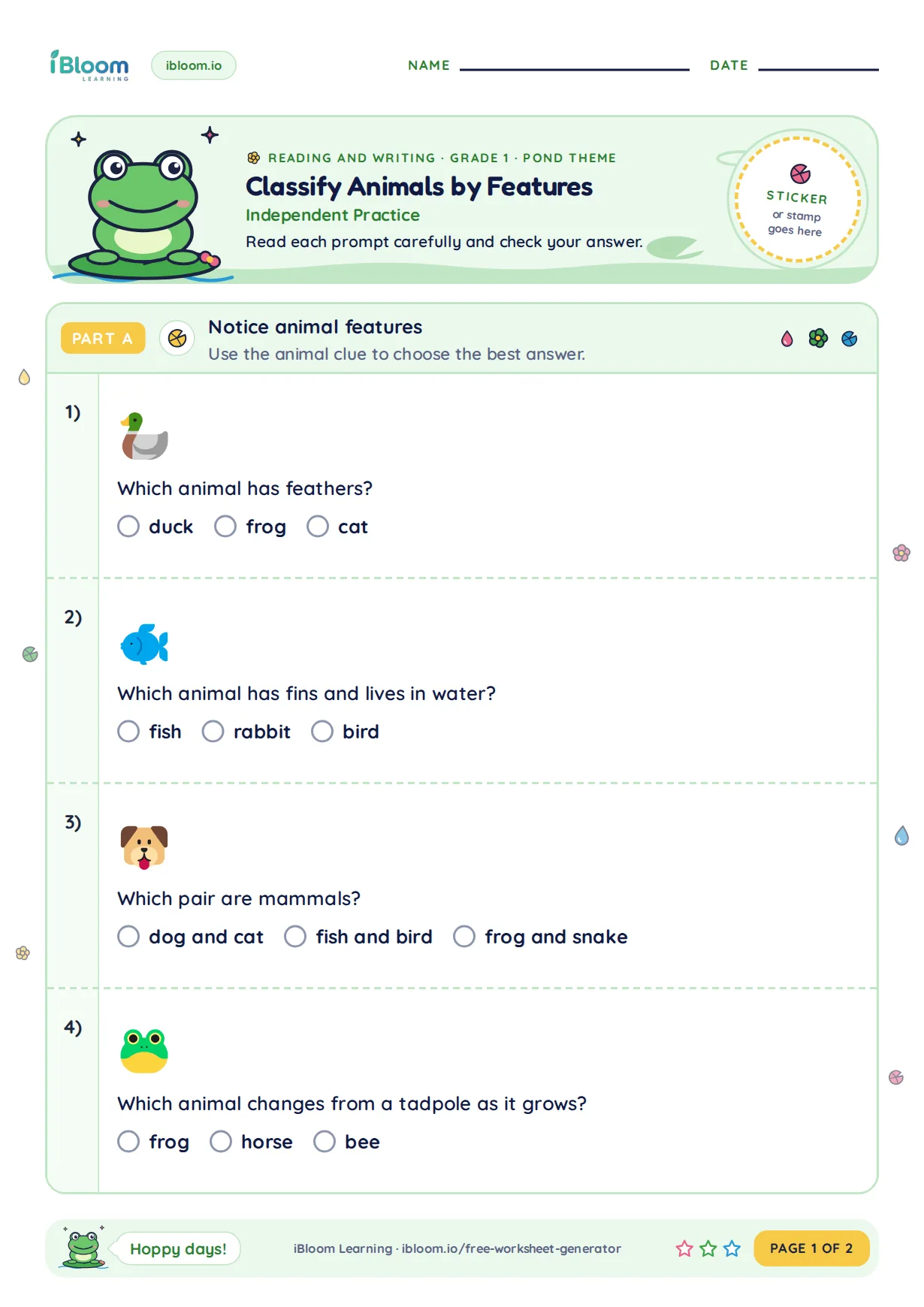 Classification — Apply Science IdeasPrintable Grade 1 science activities that help children sort and classify animals by observable features such as coverings, body parts, movement, and habitat. This apply science ideas worksheet provides a distinct, age-appropriate way to practise the same lesson.Grade 1Free PDF preview
 Classification — Science Reasoning ReviewPrintable Grade 1 science activities that help children sort and classify animals by observable features such as coverings, body parts, movement, and habitat. This science reasoning review worksheet provides a distinct, age-appropriate way to practise the same lesson.Grade 1Free PDF preview
Practice that builds confidence
What animal classification means in Grade 1
These Grade 1 science worksheets help children practise animal classification in a clear, hands-on way. Students look closely at animals, notice observable features, and group them using clues such as fur, feathers, scales, wings, legs, fins, or where the animal lives.
The printable activities include sorting tasks, picture-based questions, matching, cut-and-paste style classification, and simple prompts that ask children to explain why animals belong together. They support the Science > Grade 1 > Animals > Classification skill step by step.
Classification is the skill of putting animals into groups based on shared features. At this level, children are not expected to memorize long scientific lists. They learn to observe carefully and say, for example, “These animals have feathers,” “These animals live in water,” or “These animals have six legs.” The goal is to build early science thinking: look, compare, sort, and explain.

How the worksheets build the skill
The activities move from simple visual sorting to more thoughtful grouping. Children may identify animals with fur, feathers, scales, shells, wings, fins, or many legs. They may compare pets, farm animals, wild animals, water animals, flying animals, and crawling animals. Some questions ask for one correct group, while others allow children to choose a rule and justify it, which is an important part of classification.
A simple parent routine
At home, begin with a quick picture walk. Ask, “What do you notice about this animal?” Then choose two animals and ask, “How are they alike? How are they different?” After the worksheet, invite your child to sort toy animals, stickers, or picture cards into two or three groups. Encourage full sentences such as “I put the duck here because it has feathers.”

Classroom uses for teachers
Teachers can use these pages during a Grade 1 animals unit, science centers, small-group observation practice, or as a follow-up after reading an animal nonfiction book. The worksheets also work well for partner talk: one child sorts, and the other explains whether the rule makes sense. For early finishers, ask students to create a new group rule on the back of the page.

Common errors to watch for
Children often group animals by personal preference, size, or color instead of a science feature. A shark and a dolphin may both be placed together because they live in water, but children may also think they are the same kind of animal. Guide them back to observable evidence: body covering, body parts, movement, and habitat.
Free printable PDF download
Use this grade 1 animal classification worksheet page to preview the activity, print it, or download it as a PDF for quick practice. It works well for homework, homeschool lessons, tutoring, morning work, revision, and classroom centers.
Answers and answer key support
After the child completes the worksheet independently, parents and teachers can use the answer support or answer key information to check the work, review mistakes, and choose the next practice step.
Why iBloom worksheets help
These iBloom worksheets keep the focus on clear animal pictures, age-appropriate vocabulary, and explain-your-thinking prompts. A child-friendly strategy is: “Look closely, name one feature, then choose the group.” This gives Grade 1 learners a repeatable way to classify animals with confidence.
Helpful answers
Frequently asked questions
What classification skills do these Grade 1 animal worksheets practise?
They help children sort animals by observable traits such as body covering, body parts, movement, and habitat, then explain why animals belong in a group.
Do children need to know animal group names before using these worksheets?
No. The worksheets focus first on noticing features like feathers, fur, scales, fins, wings, or legs. Scientific group names can be introduced gradually.
How can I help my child if they sort animals by color or size?
Ask guiding questions such as “What body covering does it have?” or “How does it move?” This redirects attention from appearance alone to science-based features.
Can these worksheets be used in science centers?
Yes. They are suitable for Grade 1 science centers, partner sorting tasks, small-group review, or independent practice during an animals unit.
What is a good follow-up activity after the worksheet?
Have children sort toy animals, picture cards, or magazine cutouts and state the rule for each group, such as “These animals have wings” or “These animals live in water.”
Is this grade 1 animal classification worksheet free?
Yes. You can preview it for free and use the printable worksheet for home or classroom practice.
Can I download this grade 1 animal classification worksheet as a PDF?
Yes. Use the worksheet download option to save a printable PDF, or print the worksheet directly from the page.
Does this grade 1 animal classification worksheet include answers or an answer key?
When the activity has fixed answers, iBloom includes answer support so parents and teachers can check the completed worksheet.