Free printable practice
Movement Practice Activities
Grade 1 science worksheets that help children describe how animals move using clear action words and real animal examples.
Free printable worksheet PDFs
Preview every available page, then download the free worksheet PDF for home, homeschool, tutoring, or classroom practice.
Preview the exact activity before downloading it.
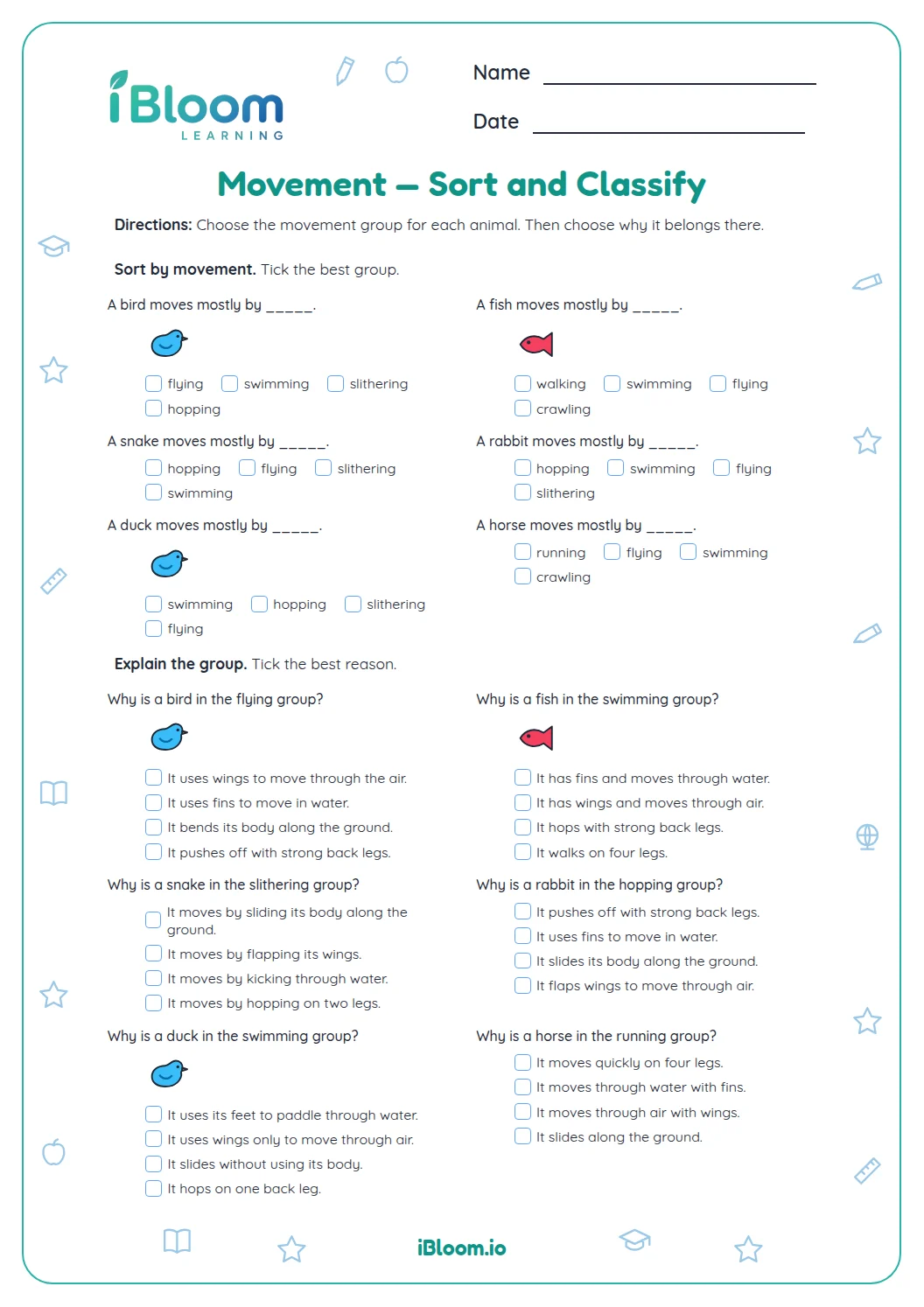 Movement — Sort and ClassifyGrade 1 science worksheets that help children describe how animals move using clear action words and real animal examples. This sort and classify worksheet provides a distinct, age-appropriate way to practise the same lesson.Grade 1Free PDF preview
 Movement — Label and ModelGrade 1 science worksheets that help children describe how animals move using clear action words and real animal examples. This label and model worksheet provides a distinct, age-appropriate way to practise the same lesson.Grade 1Free PDF preview
 Movement — Explain Cause and EffectGrade 1 science worksheets that help children describe how animals move using clear action words and real animal examples. This explain cause and effect worksheet provides a distinct, age-appropriate way to practise the same lesson.Grade 1Free PDF preview
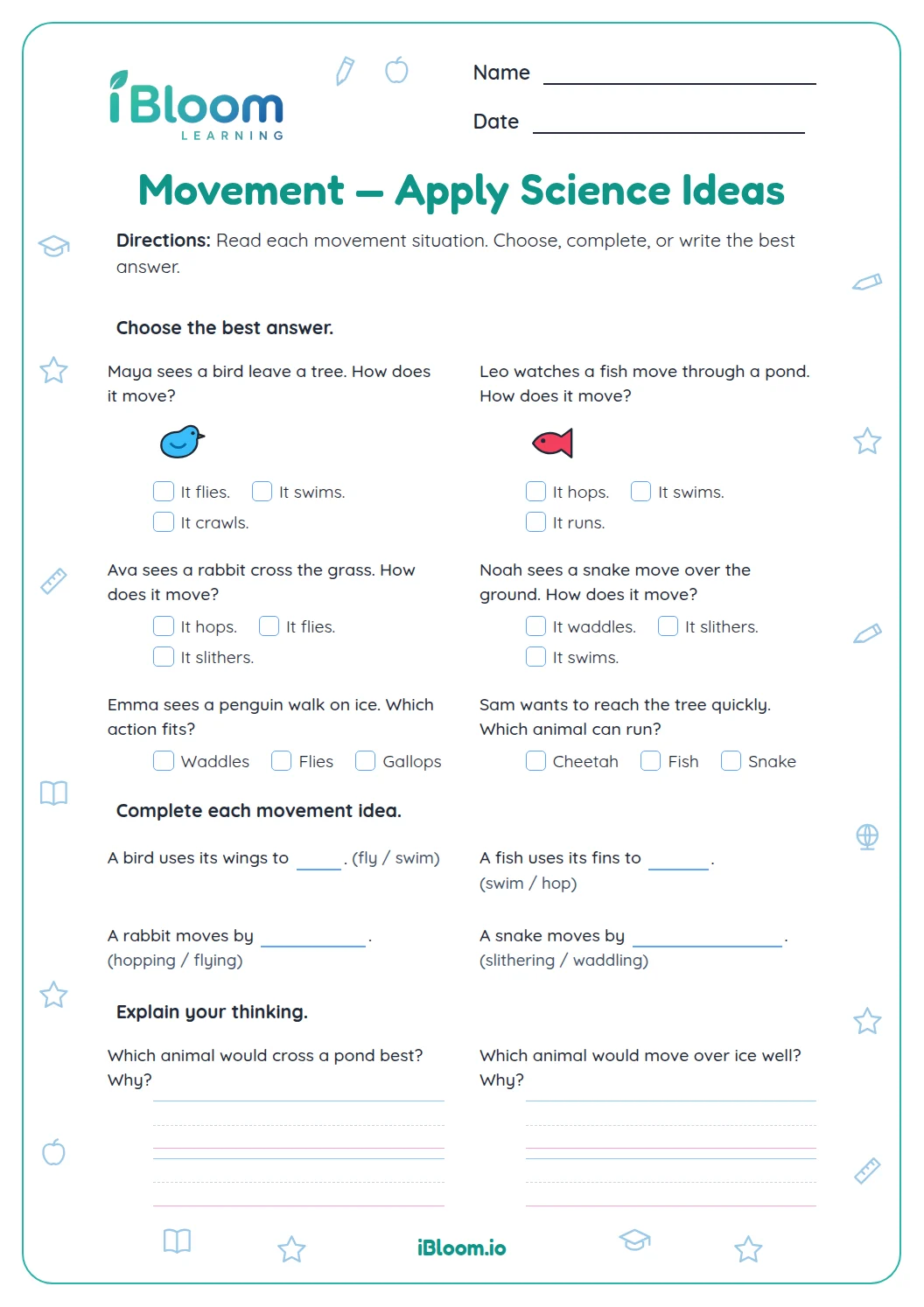 Movement — Apply Science IdeasGrade 1 science worksheets that help children describe how animals move using clear action words and real animal examples. This apply science ideas worksheet provides a distinct, age-appropriate way to practise the same lesson.Grade 1Free PDF preview
 Movement — Science Reasoning ReviewGrade 1 science worksheets that help children describe how animals move using clear action words and real animal examples. This science reasoning review worksheet provides a distinct, age-appropriate way to practise the same lesson.Grade 1Free PDF preview
Practice that builds confidence
What Children Learn About Movement
These Grade 1 animal movement worksheets help children observe and describe how animals get from place to place. Students practice connecting animals with movements such as walk, run, hop, swim, fly, crawl, climb, and slither.
The printable activities include matching, sorting, labeling, picture-based questions, and simple sentence prompts. Children learn that body parts, habitats, and movement patterns are connected, so a fish, bird, frog, snake, and dog do not all move in the same way.
Animal movement is an early life science idea that children can see and act out. Grade 1 students learn that animals move to find food, escape danger, reach shelter, and care for their young. The worksheets focus on observable actions: birds fly, fish swim, snakes slither, frogs hop, insects crawl, and monkeys climb.

Connecting Bodies and Actions
The skill grows when children notice why movement differs. Wings help many birds fly, fins help fish swim, legs help dogs run, and a long body helps a snake slither. The worksheets ask children to match animal pictures to movement words and to sort animals by how they move. This builds vocabulary while keeping the science concrete.
Parent Routine at Home
Pick three animals from a worksheet and ask your child to show the movement safely with their body or hands. Then ask, "What body part helps it move that way?" Have your child say a full sentence, such as "A frog hops with its strong back legs." Finish by drawing one more animal that moves in the same way.

Classroom Uses
Teachers can use these pages during an animals unit, in science centers, or after a read-aloud about habitats. Movement cards can become a quick whole-class sort on the board: fly, swim, crawl, hop, run, and climb. The same worksheets also support oral language because students explain their choices using action verbs.

Common Errors to Watch
Children may say every animal "walks" or may confuse crawling and slithering. Some students classify by where an animal lives instead of how it moves, such as putting a duck only with swimmers even though it can also walk and fly. Encourage them to look at the picture and choose the movement asked for in that question.
Free printable PDF download
Use this Grade 1 animal movement worksheet page to preview the activity, print it, or download it as a PDF for quick practice. It works well for homework, homeschool lessons, tutoring, morning work, revision, and classroom centers.
Answers and answer key support
After the child completes the worksheet independently, parents and teachers can use the answer support or answer key information to check the work, review mistakes, and choose the next practice step.
Why iBloom Worksheets Help
These worksheets keep the thinking visual and active. Children see an animal, name the action, and connect it to a body feature or place. A simple strategy is: look at the animal, name the body parts, choose the action word, then say the sentence out loud.
Helpful answers
Frequently asked questions
What movement words should a Grade 1 student know?
Common words include walk, run, hop, jump, swim, fly, crawl, climb, and slither. Students should be able to match these words to familiar animals.
Can one animal belong to more than one movement group?
Yes. A duck can walk, swim, and fly. In these worksheets, children should answer based on the picture or the movement being asked about.
How do these worksheets connect to animal body parts?
Children learn that movement often depends on body parts, such as wings for flying, fins for swimming, legs for running, and strong back legs for hopping.
How can I help my child stop using only the word walk?
Ask your child to act out or describe the movement more exactly. For example, a snake does not walk; it slithers. A fish does not run; it swims.
Are the activities mostly reading-based?
No. Many tasks use pictures, matching, sorting, and simple labels, so children can show science understanding while building movement vocabulary.
Is this Grade 1 animal movement worksheet free?
Yes. You can preview it for free and use the printable worksheet for home or classroom practice.
Can I download this Grade 1 animal movement worksheet as a PDF?
Yes. Use the worksheet download option to save a printable PDF, or print the worksheet directly from the page.
Does this Grade 1 animal movement worksheet include answers or an answer key?
When the activity has fixed answers, iBloom includes answer support so parents and teachers can check the completed worksheet.