Free printable practice
Inherit Traits Practice Activities
Printable Grade 1 science activities that help children notice how animal babies inherit traits from their parents while still showing small differences.
Free printable worksheet PDFs
Preview every available page, then download the free worksheet PDF for home, homeschool, tutoring, or classroom practice.
Preview the exact activity before downloading it.
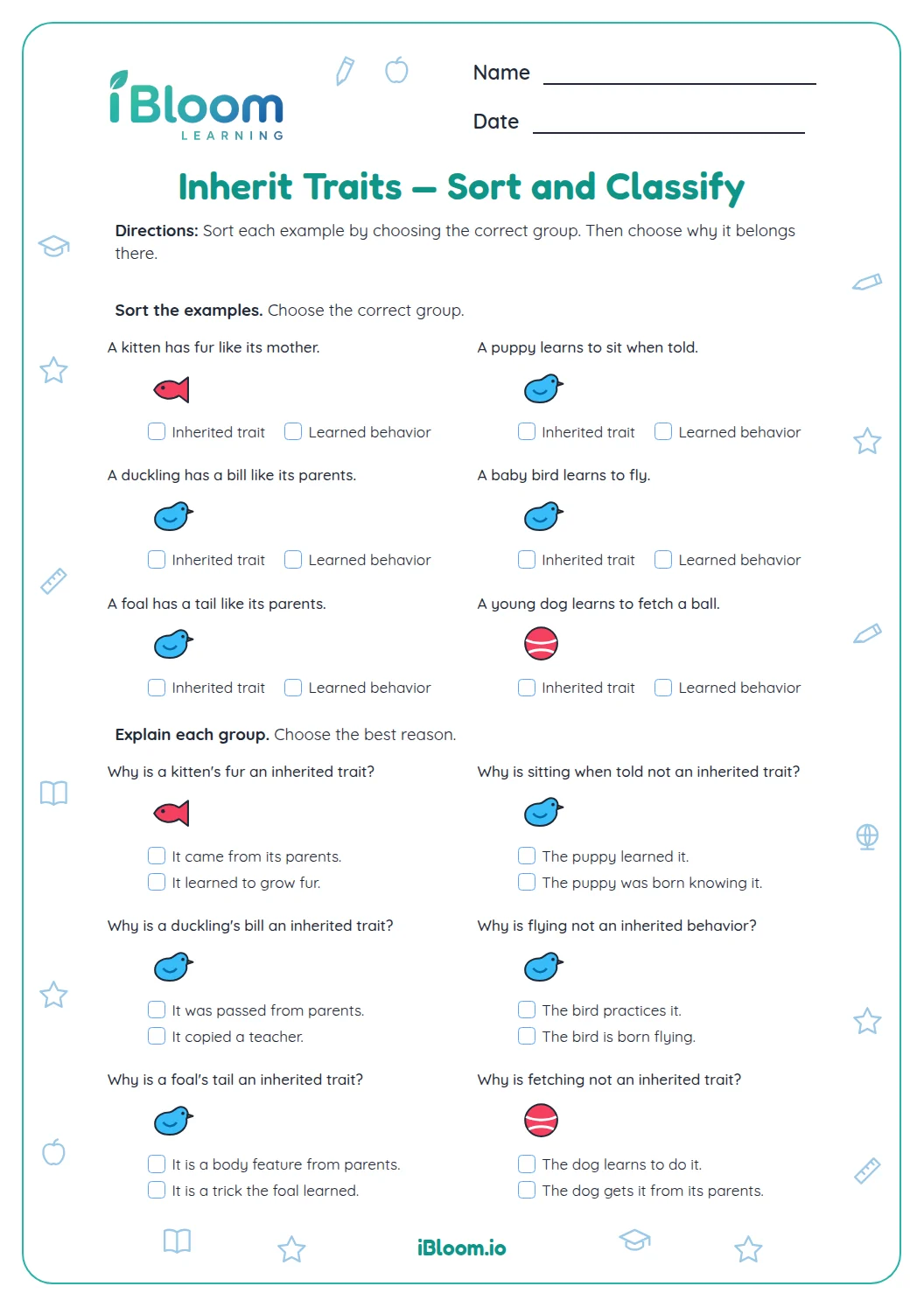 Inherit Traits — Sort and ClassifyPrintable Grade 1 science activities that help children notice how animal babies inherit traits from their parents while still showing small differences. This sort and classify worksheet provides a distinct, age-appropriate way to practise the same lesson.Grade 1Free PDF preview
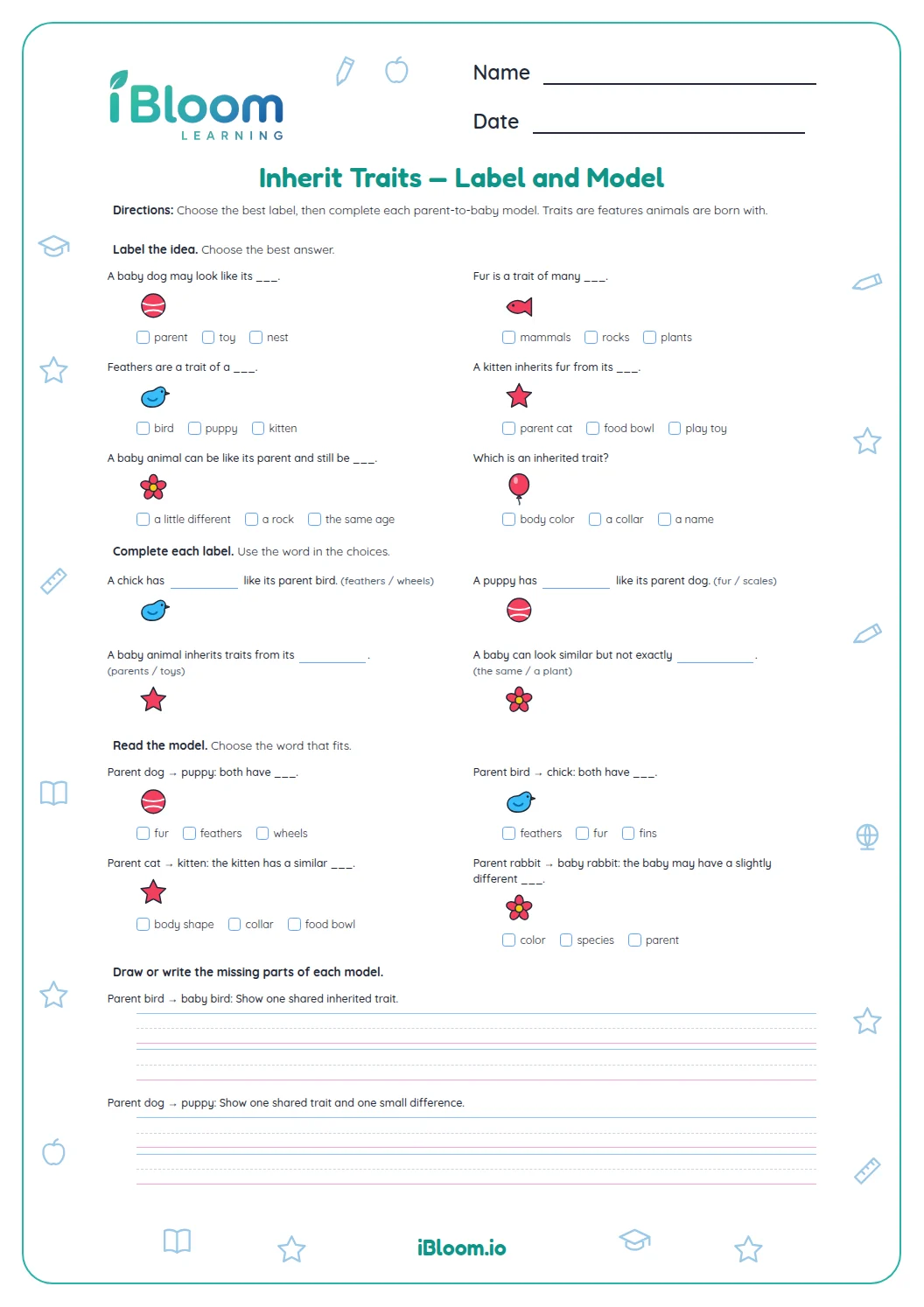 Inherit Traits — Label and ModelPrintable Grade 1 science activities that help children notice how animal babies inherit traits from their parents while still showing small differences. This label and model worksheet provides a distinct, age-appropriate way to practise the same lesson.Grade 1Free PDF preview
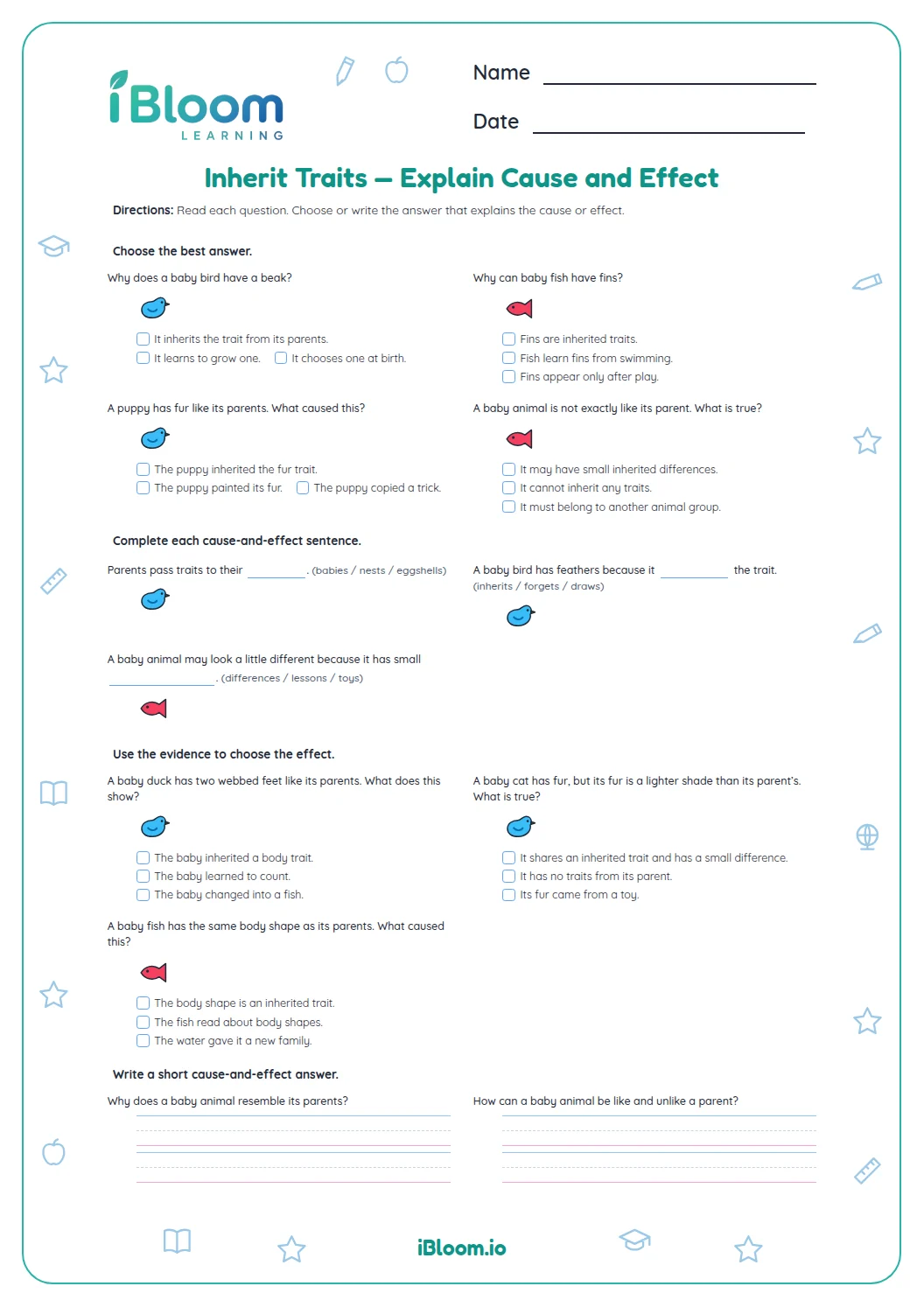 Inherit Traits — Explain Cause and EffectPrintable Grade 1 science activities that help children notice how animal babies inherit traits from their parents while still showing small differences. This explain cause and effect worksheet provides a distinct, age-appropriate way to practise the same lesson.Grade 1Free PDF preview
 Inherit Traits — Apply Science IdeasPrintable Grade 1 science activities that help children notice how animal babies inherit traits from their parents while still showing small differences. This apply science ideas worksheet provides a distinct, age-appropriate way to practise the same lesson.Grade 1Free PDF preview
 Inherit Traits — Science Reasoning ReviewPrintable Grade 1 science activities that help children notice how animal babies inherit traits from their parents while still showing small differences. This science reasoning review worksheet provides a distinct, age-appropriate way to practise the same lesson.Grade 1Free PDF preview
Practice that builds confidence
What children learn
These Grade 1 science worksheets help children explore inherited traits in animals: features that young animals get from their parents, such as body covering, beak shape, ear shape, color patterns, or number of legs.
The printable activities use clear animal pictures, matching tasks, sorting prompts, and simple observation questions so children can compare parents and offspring and talk about how family members can look alike but not exactly the same.
Children practise the idea that many animal babies resemble their parents because traits are passed from parent to offspring. A kitten may have fur and whiskers like a cat, a duckling has a beak and webbed feet like a duck, and a calf has body parts that match a cow. At this level, the goal is careful observation, not genetics vocabulary.

From looking to explaining
The worksheets move from noticing visible features to making simple claims: “The puppy inherited fur from its dog parents” or “The chick and hen both have beaks.” Children compare pictures, circle shared traits, match babies to adult animals, and discuss small differences such as size or markings. This supports the science habit of using evidence from what they can see.
Parent routine at home
Choose one animal pair on a worksheet and ask three questions: “What do you notice on the parent?”, “What do you notice on the baby?”, and “What is the same?” Then have your child point to the picture before answering in a full sentence. For extra practice, compare family pets, stuffed animals, or animal photos, but keep the focus on inherited body features rather than things an animal learns to do.

Classroom uses
Teachers can use these pages during a Grade 1 animals unit, in science centers, for partner talk, or as a quick check after a read-aloud about animal families. Students can sort cards into “same as parent” and “different from parent,” label observable traits, or explain their thinking to a classmate using sentence frames such as “Both animals have ___.”

Common mix-ups to watch for
Children may call every similarity inherited, including behaviors such as swimming, tricks, or where an animal lives. Guide them back to body traits they can observe. They may also think a baby must look exactly like its parent. Point out that offspring usually share some traits, while color, size, spots, or patterns can vary.
Free printable PDF download
Use this grade 1 inherited traits worksheet page to preview the activity, print it, or download it as a PDF for quick practice. It works well for homework, homeschool lessons, tutoring, morning work, revision, and classroom centers.
Answers and answer key support
After the child completes the worksheet independently, parents and teachers can use the answer support or answer key information to check the work, review mistakes, and choose the next practice step.
Why iBloom worksheets help
iBloom activities keep the science concrete and age-appropriate. Picture-based prompts reduce reading load, while repeated compare-and-explain tasks build vocabulary such as parent, offspring, trait, inherit, similar, and different. A child-friendly strategy is: look at the parent, look at the baby, find one matching body part, then say, “They both have ___.”
Helpful answers
Frequently asked questions
What are inherited traits for Grade 1 students?
Inherited traits are body features that young animals get from their parents, such as fur, feathers, beaks, ears, tails, or color patterns. Grade 1 children learn this through observation and comparison.
Do these worksheets teach genetics?
No. The activities stay age-appropriate for Grade 1 by focusing on visible similarities between parent animals and their offspring, not genes, DNA, or detailed heredity.
How can I explain the difference between inherited and learned traits?
Use simple language: inherited traits are body features an animal is born with, while learned traits are things an animal learns to do. A bird has a beak as an inherited trait, but finding food in a certain place can be learned.
Can animal babies look different from their parents?
Yes. The worksheets help children see that offspring can share many traits with parents but still differ in size, markings, shade, or pattern.
How should teachers use these pages in a science lesson?
Teachers can use them for picture comparison, partner discussion, science centers, or exit checks after teaching parent-offspring relationships in an animals unit.
Is this grade 1 inherited traits worksheet free?
Yes. You can preview it for free and use the printable worksheet for home or classroom practice.
Can I download this grade 1 inherited traits worksheet as a PDF?
Yes. Use the worksheet download option to save a printable PDF, or print the worksheet directly from the page.
Does this grade 1 inherited traits worksheet include answers or an answer key?
When the activity has fixed answers, iBloom includes answer support so parents and teachers can check the completed worksheet.