








About this worksheet
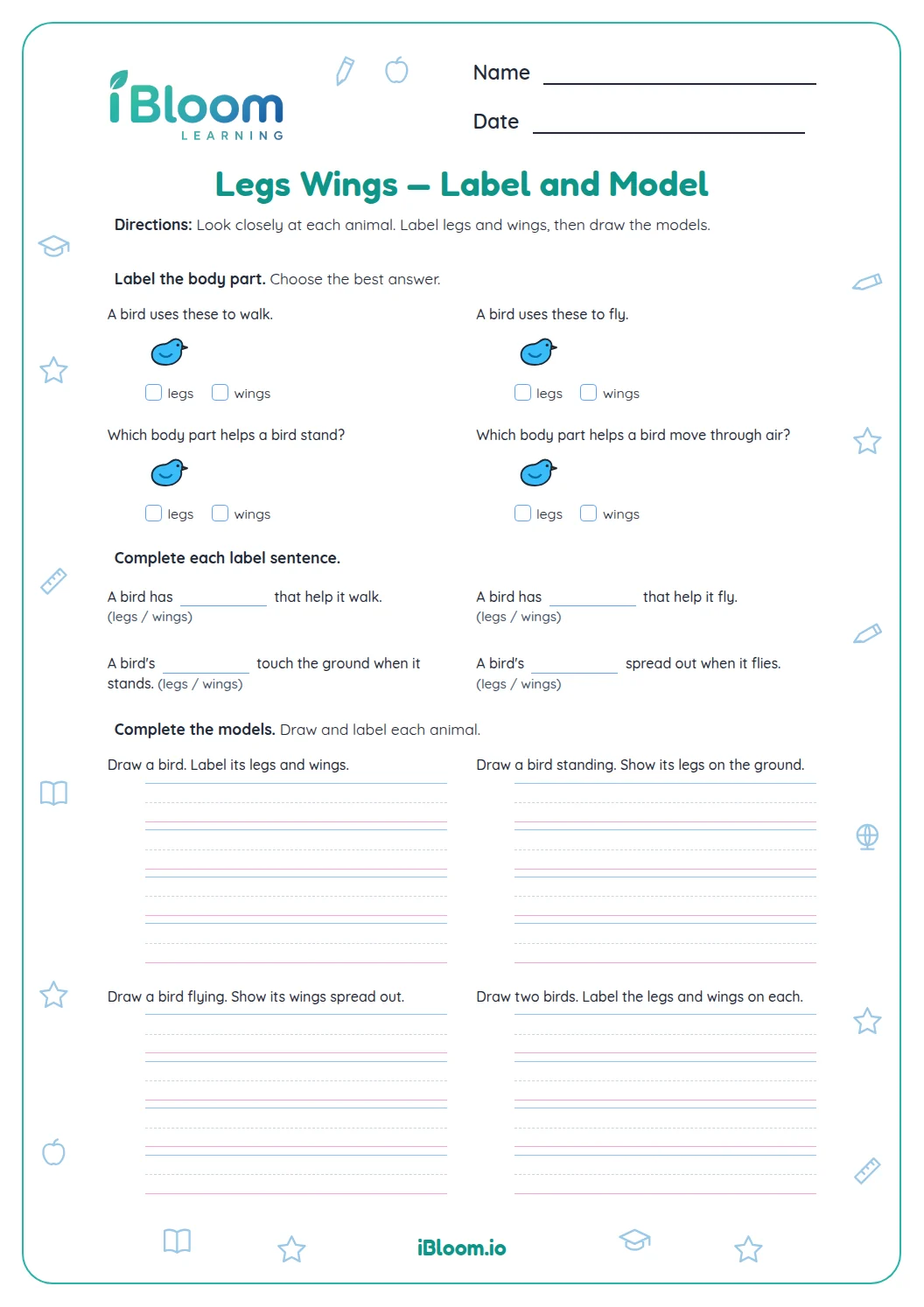
This Grade 1 science worksheet uses animal pictures and short questions to connect legs and wings with movement. Students identify animals, compare leg counts, and consider how body parts help animals walk, hop, fly, or swim. The answer key supports a quick check of each observation.
Aligned to 1-LS1-1
What will students notice?
Students identify animals with legs or wings and connect those parts to movement. Some questions ask for a simple count, while others ask how an animal uses a body part. The examples include animals with different numbers of legs and birds that use wings in different ways.
How can adults extend the science talk?
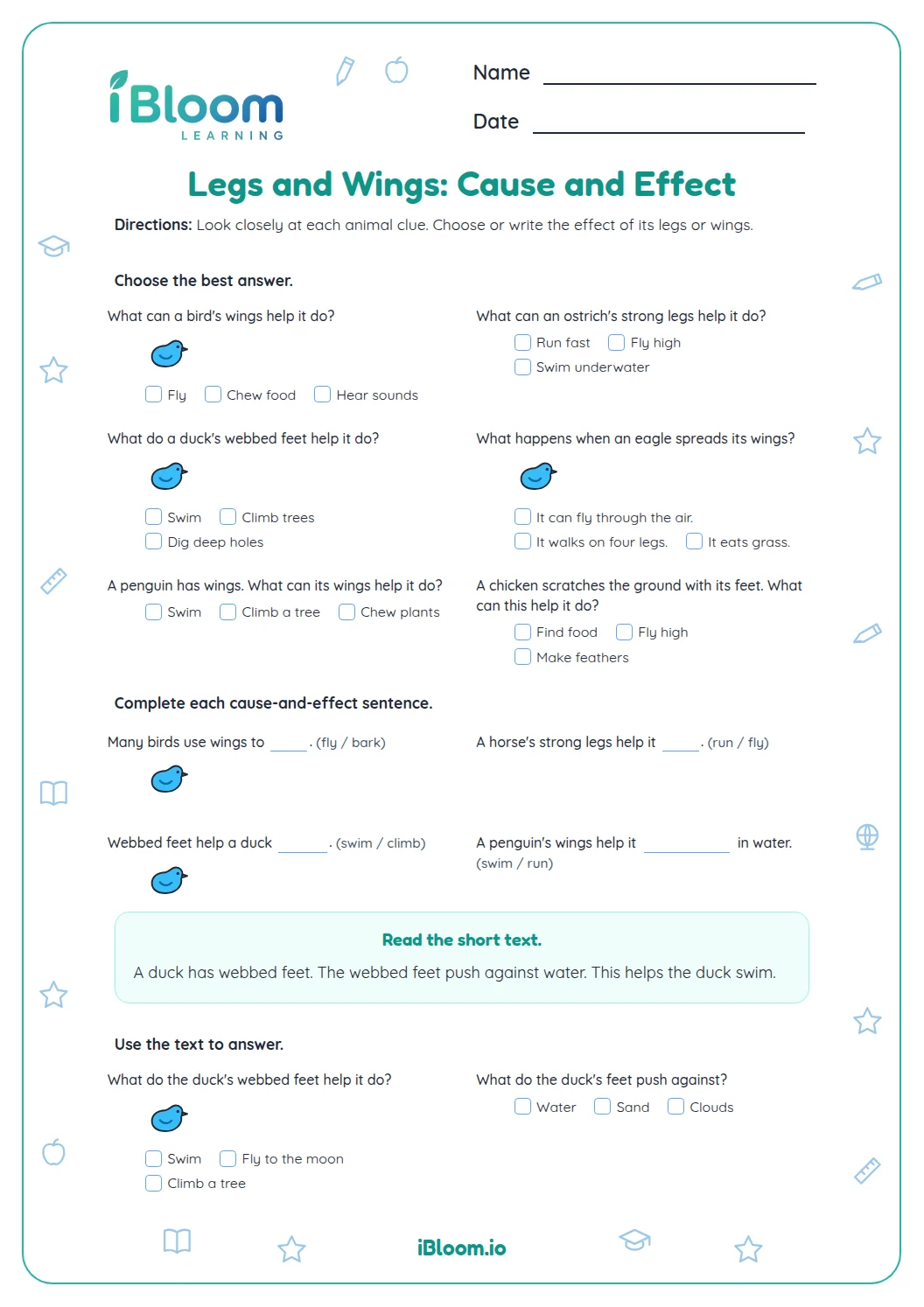
Invite a child to watch an animal move and name the body part doing the work. A bird may use its wings to fly, while a penguin uses its wings to help move through water. Encourage careful language such as “many birds” instead of “all animals.”
Use the page together
- 1Look at each pictured animal before choosing.
- 2Name the body part in the question.
- 3Connect that part to a movement such as walking, hopping, paddling, or flying.
- 4For the written question, accept a clear idea about how the body parts help in different ways.
Ideas to check
The mistake
Thinking every animal with wings can fly.
The fix
Compare birds that fly with penguins, whose wings help them move in water.
The mistake
Counting one animal’s legs when the question asks about several.
The fix
Count the legs for one animal, then count that many again for each animal in the group.
Next Generation Science Standards connection
This worksheet builds understanding of how animal structures support movement.
Use materials to design a solution to a human problem by mimicking how plants and animals use external parts.
On this sheet: Students observe animal structures and connect them with movement functions.
Show the official wordingHide the official wording
Use materials to design a solution to a human problem by mimicking how plants and/or animals use their external parts to help them survive, grow, and meet their needs.
What to practice next
Make more practice
Further reading
Questions parents and teachers ask
Do all animals with wings fly?
The questions connect animal structures with movement. Students identify animals, count legs on ants, spiders, and hens, and consider how wings or legs help animals fly, walk, hop, paddle, or swim. Ask the student to name the clue or operation that supports the choice, then check the completed sentence or equation against the key. This quick check connects the.
How many legs does an insect have?
Insects have six legs. Several questions use that fact with beetles, bees, and chickens or other animals so students can practice observing and counting body parts. A spider has eight legs, but it is not an insect. Careful observation helps children sort what they see from what they assume, an important habit in science.
What should a student notice about animal legs?
Legs can help animals walk, hop, jump, or paddle. The best answer depends on the animal named in the question. Encourage children to connect the body part to the movement instead of guessing from the animal name alone. Ask the student to name the clue or operation that supports the choice, then check the completed sentence or equation against.
How can we talk about animals accurately?
Use careful words such as “many” or “some” when a trait does not belong to every animal. For example, many birds fly, while penguins are birds whose wings help them swim. This keeps science statements accurate. Explain which body part is doing the work in the example.
How many questions are included?
There are 14 questions in two parts. Students identify animals, count legs, and connect wings and legs with ways animals move, using the pictures and short response choices. Ask the student to name the clue or operation that supports the choice, then check the completed sentence or equation against the key. This quick check connects the answer to the.