











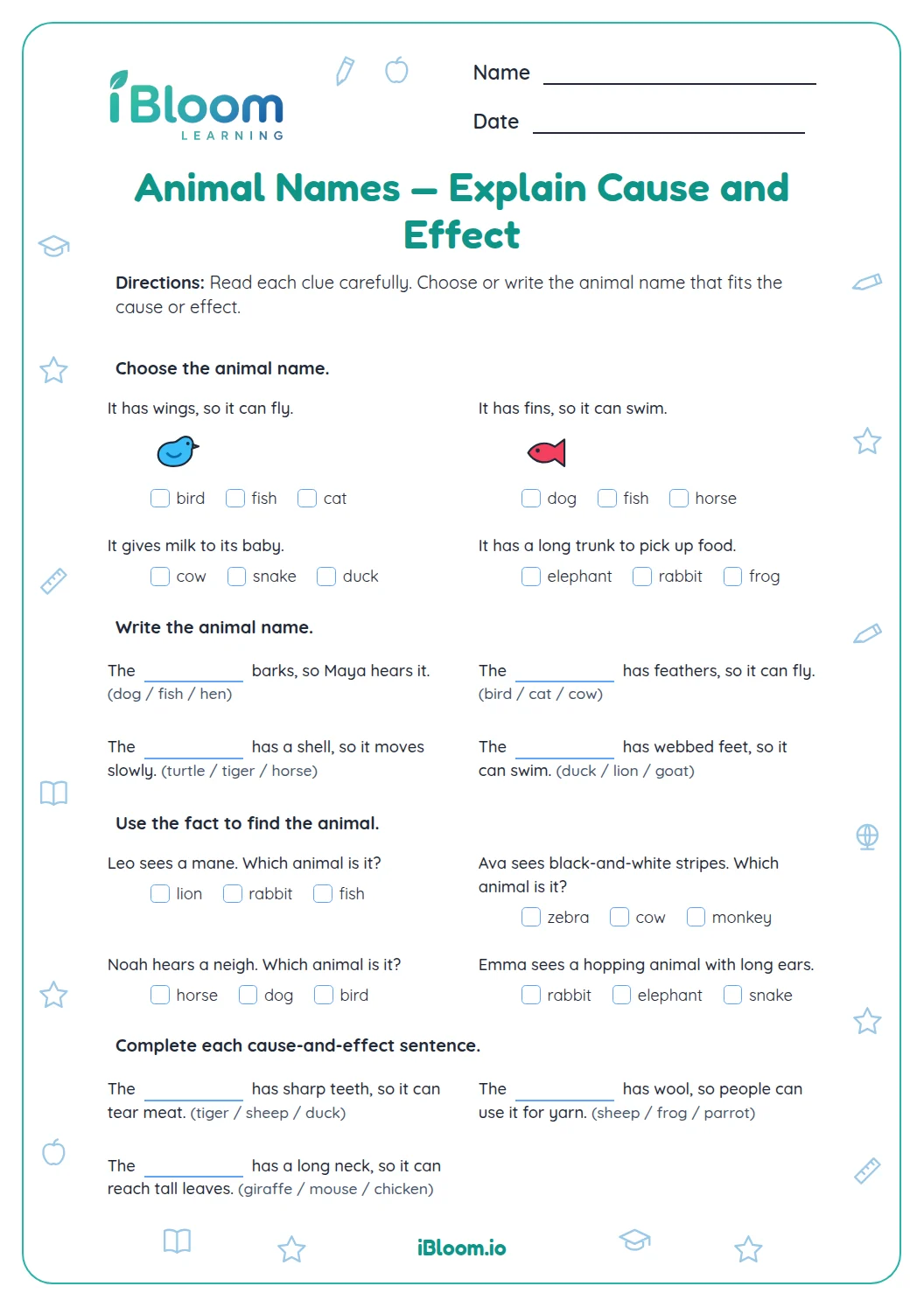

About this worksheet
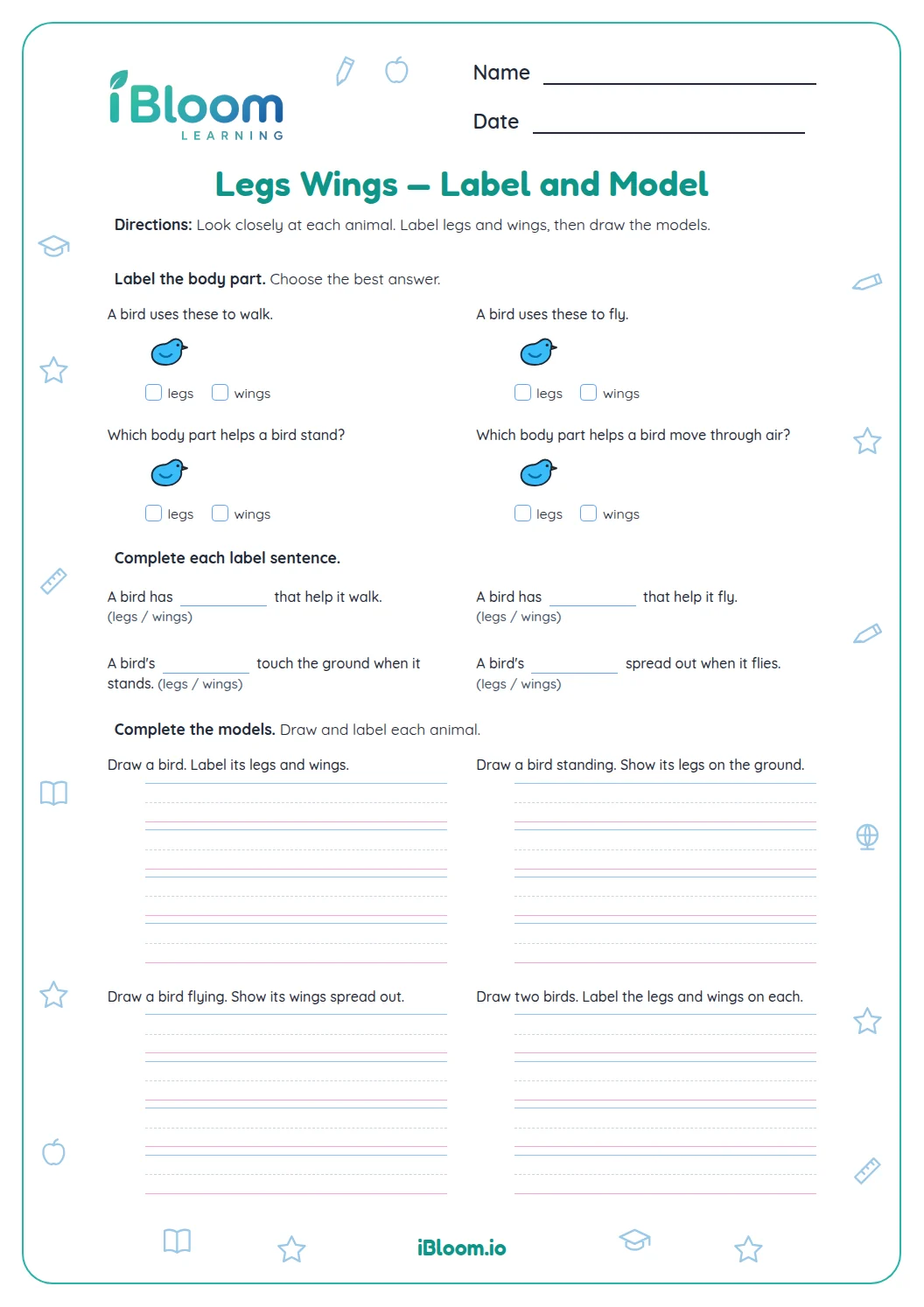
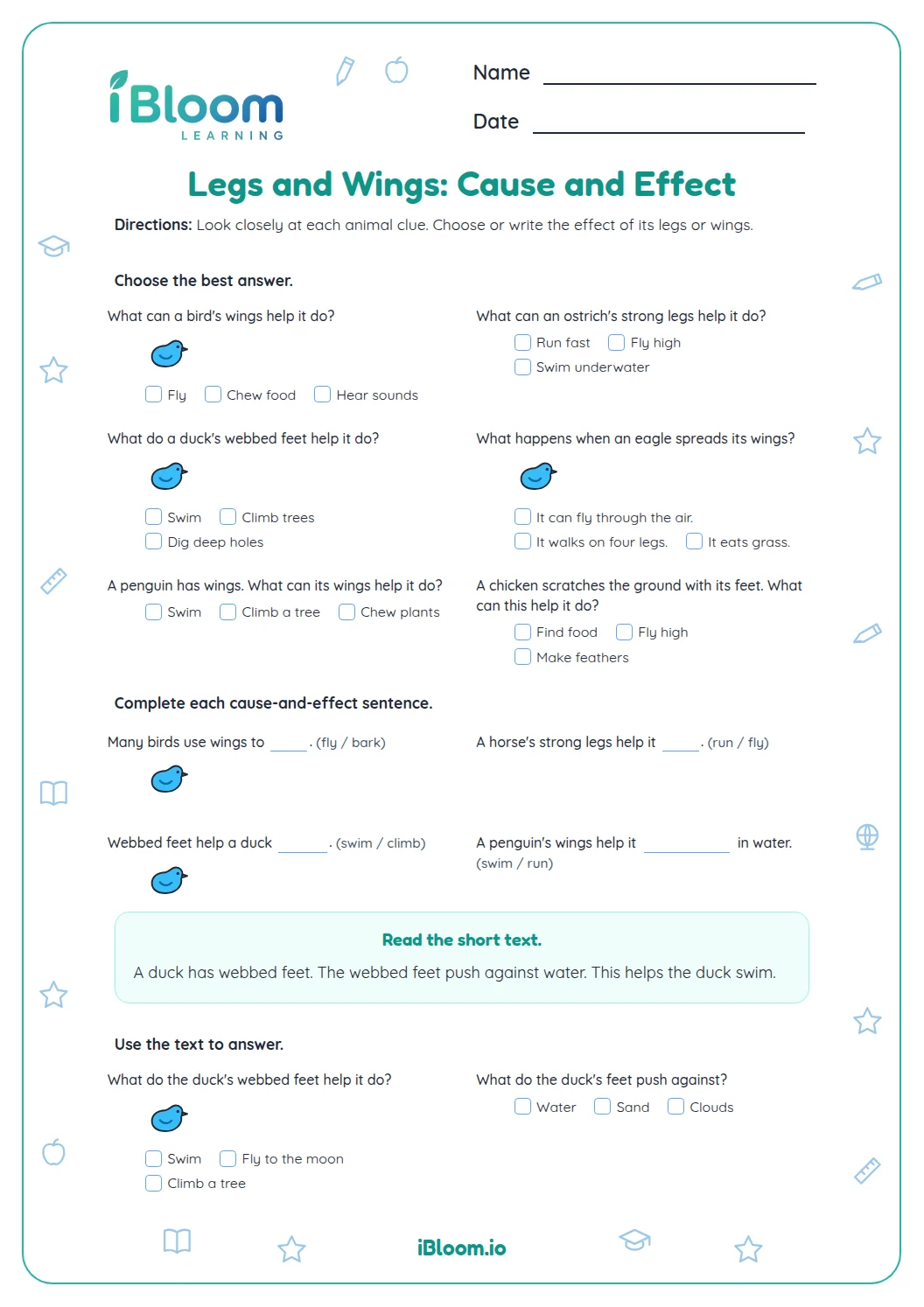
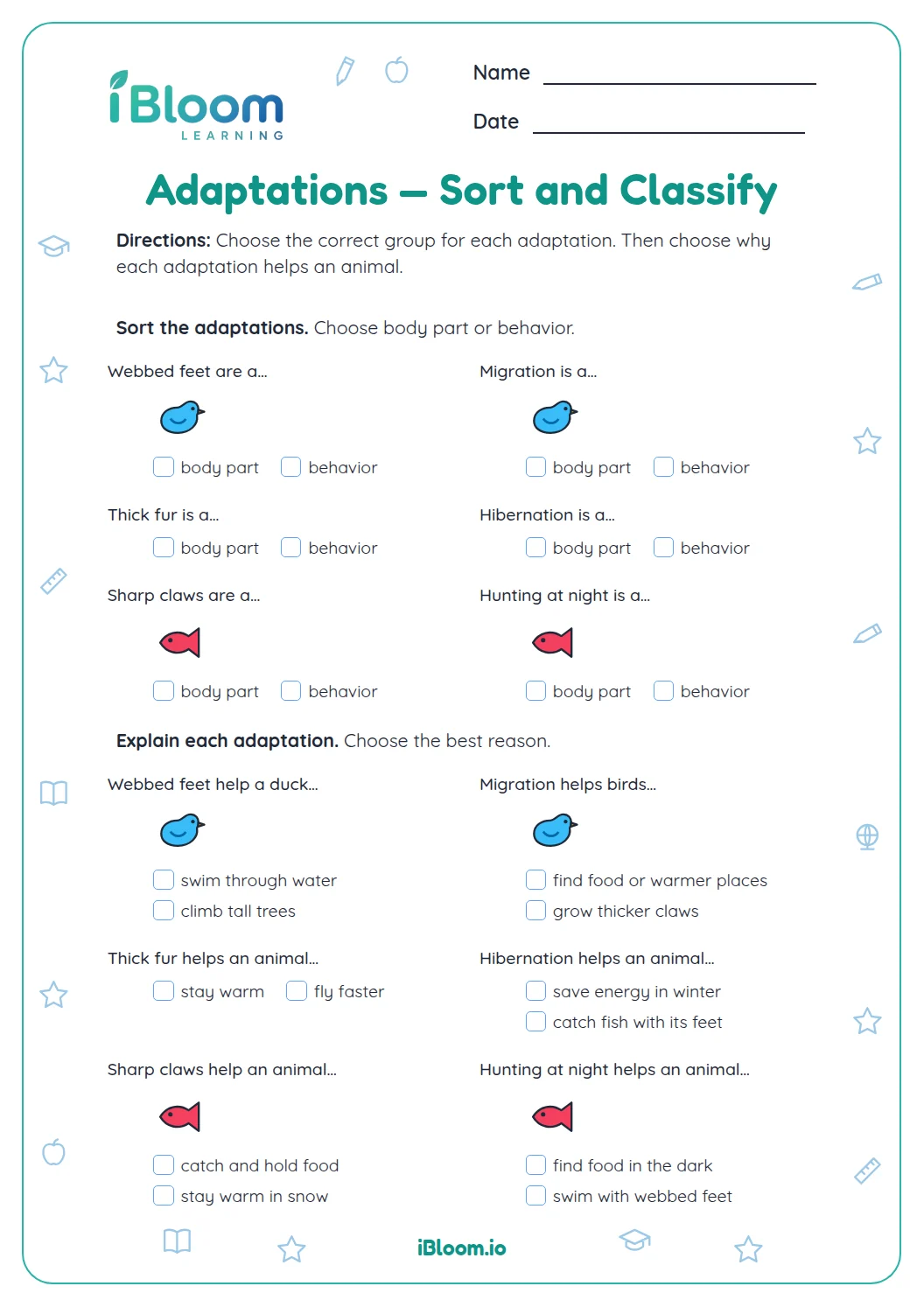
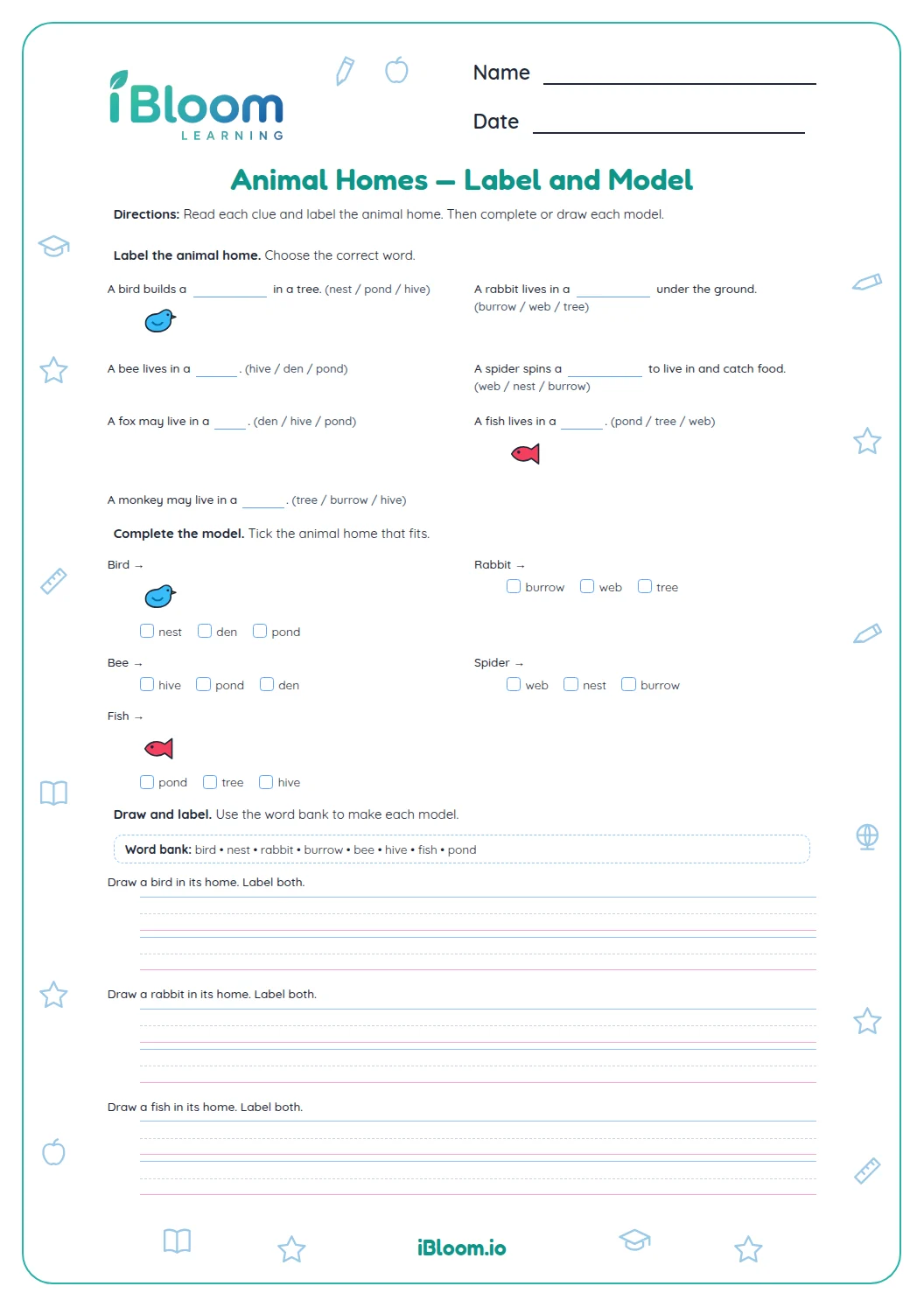
This Grade 1 printable gives students 16 picture-supported questions about animal legs, wings, and other body parts. Children match features and identify how parts help animals move or stay protected. A separate key supports checking each choice.
How do the picture choices work?
In questions 1–8, students match a pictured animal to a clue about legs, wings, or fins. Each item has one animal that fits all the stated clues.
How can students sort animals by a shared feature?
Question 9 shows a bird, fish, and duck and asks which two have wings. The bird and duck share that feature; the fish has fins instead.
- 1Bird: wings
- 2Fish: fins
- 3Duck: wings
What do body parts help animals do?
Questions 12–16 ask about body-part jobs. Many birds use wings to fly, fish use fins to move through water, a turtle’s shell helps protect it, and a snake uses muscles along its body to slither.
How can a child explain a classification?
Name the feature that matches the group, such as “six legs” or “wings.” For a body-part question, say both the part and its job: fins help a fish move through water.
How to use this worksheet
- 1Look at each animal picture and name the animal.
- 2Match every clue in the question, such as the number of legs and wings.
- 3For a sort, name the feature shared by the selected animals.
- 4For a body-part question, connect the part to what it helps the animal do.
- 5Check the picture choices and short answers with the key.
Common mistakes and quick fixes
The mistake
Choosing an animal that matches only one clue.
The fix
Check every clue; for example, the animal may need both wings and two legs.
The mistake
Putting a spider in the insect group because it is small.
The fix
Compare leg counts: a spider has eight legs, while insects such as ants and bees have six.
The mistake
Naming a body part without saying its job.
The fix
Complete the idea: fins help a fish move, and a shell helps protect a turtle.
What to practice next
Make more practice
Questions parents and teachers ask
What animal features do students compare?
Students compare how many legs animals have and whether they have wings or fins. Picture choices help them identify shared features, and later questions connect wings, fins, shells, and snake movement to body-part jobs. The 14 questions include a separate key with one response for each item.
How many legs does an insect have?
Insects such as bees, butterflies, and ants have six legs. A spider has eight legs, so it is not an insect. Question 10 compares an ant, spider, and bee; the ant and bee share the six-leg feature, while the spider does not.
Does every bird fly?
No. Some birds, such as ostriches and penguins, do not fly. Question 13 says “many birds” so the expected answer is that wings help many birds fly, while the other questions focus on body features shared by the pictured examples.
Why are animal pictures included?
The pictures help beginning readers identify the animals before comparing their features. The first eight questions use picture choices, and the three sorting questions show each group of animals. Children can point to the animal and then name the matching feature in words.
What can students say about a body part?
They can name the part and explain its job. For example, fins help a fish move through water, a shell helps protect a turtle, and muscles along a snake’s body help it slither. The final questions practice these simple feature-and-function explanations.