








About this worksheet
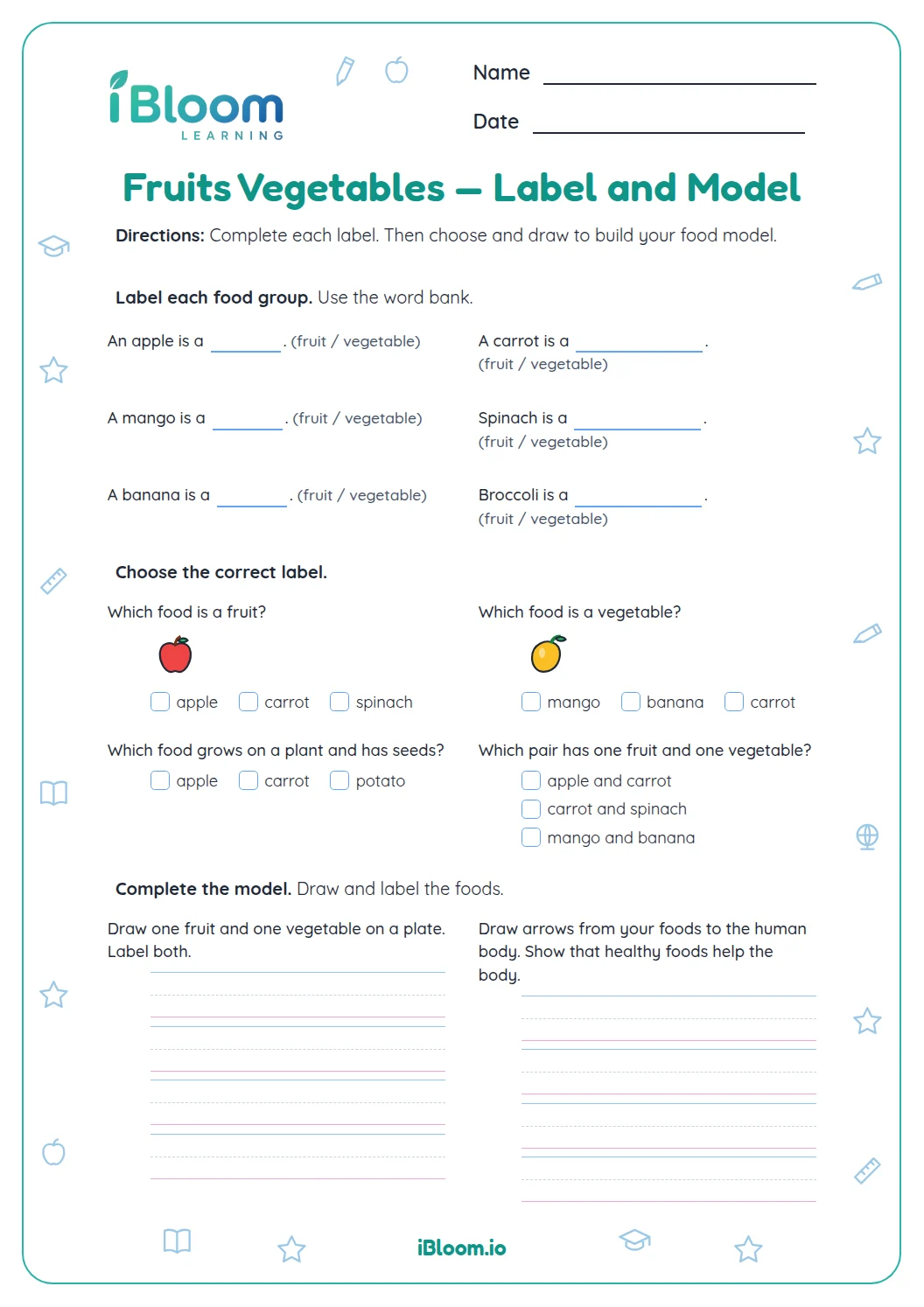
This free Grade 1 worksheet uses familiar foods to practice labeling food groups and building a varied meal model. Children label eight named food pictures as fruit, vegetable, grain, protein, or dairy. Four choice questions ask children to add food groups, recognize a three-group meal, and identify plain water. A drawing box lets children model a meal with three groups. The word-category work practices Common Core L.1.5a. The answer key lists the labels and choices and gives a sample meal drawing description. An adult can read the names and directions aloud.
Aligned to L.1.5a
What food groups do children label?
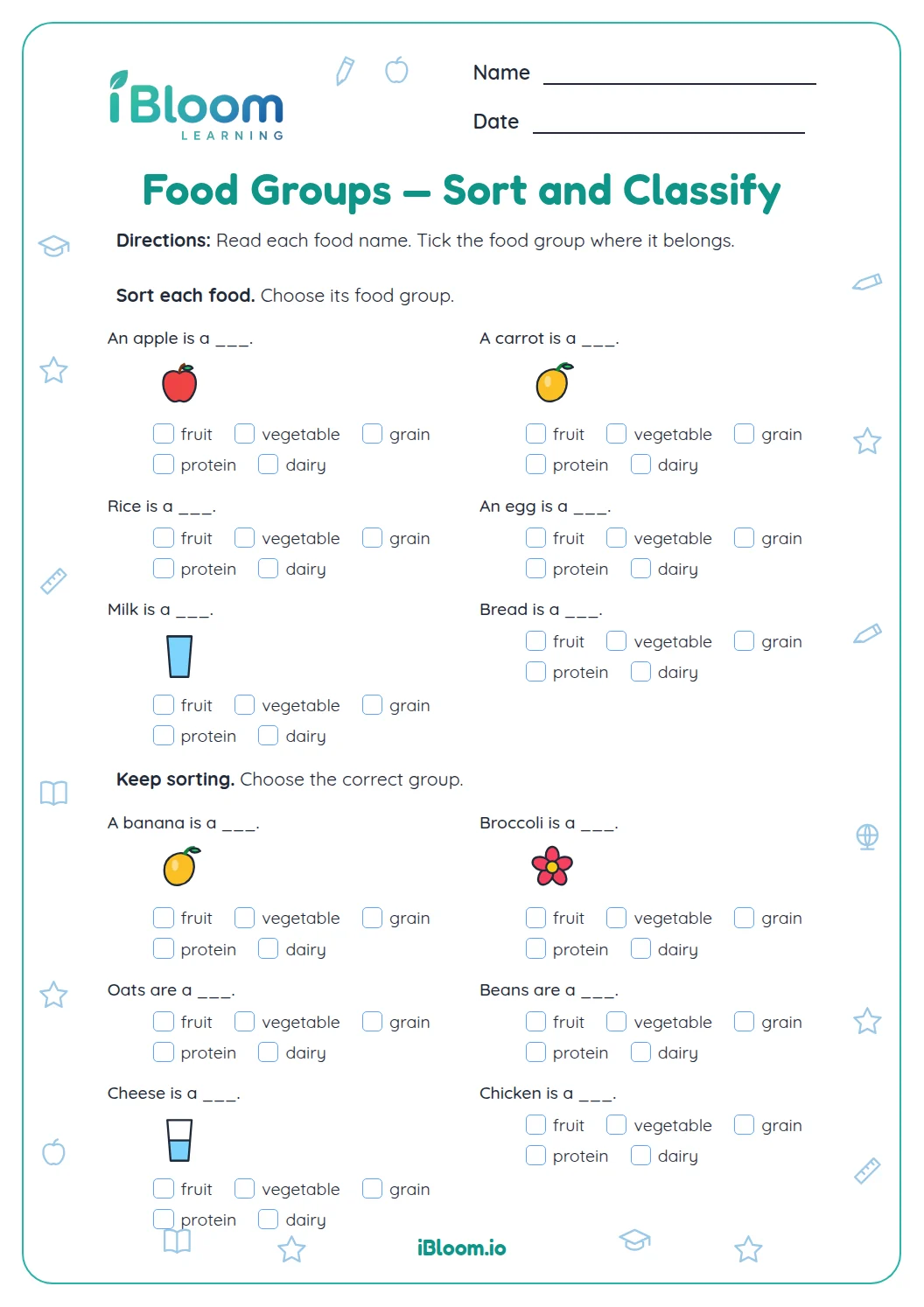
Part A pairs each food name with a picture. Children write fruit, vegetable, grain, protein, or dairy on the blank. Apples and bananas are fruits; carrots and broccoli are vegetables; bread and rice are grains. Egg is a protein food, and cheese is dairy.
The repeated categories let children apply a label to more than one example. Read the category words together before asking children to work independently.
What do the meal-choice questions check?
Part B first asks children to add a food from a named group. Apple and banana are fruits, so carrot adds a vegetable; rice is a grain, so egg adds a protein food.
Next, children choose rice, egg, and carrot as a meal containing a grain, a protein food, and a vegetable. The last choice identifies plain water as a drink with no added sugar. These questions ask children to read the requested group or drink before deciding.
- 1Apple + banana → fruit group
- 2Pear → another fruit
- 3Carrot → vegetable
- 4Choose carrot to add the vegetable group.
How should adults check the meal drawing?
Part C asks for three foods from three different groups. Look for recognizable food ideas and labels that match the categories. A drawing of rice, egg, and broccoli works because it includes grain, protein, and vegetable.
Children may choose familiar foods their family eats. If spelling takes attention away from sorting, help with a food name after the child has chosen its group. The drawing models a meal using three different food groups.
How to use this worksheet
- 1Read the five food-group words in Part A and say an example for each.
- 2Point to the apple and help the child write fruit on its blank.
- 3Let the child label the remaining seven foods, using the word bank.
- 4Read each Part B prompt before comparing its two picture choices.
- 5Ask the child to name three different groups, draw a food for each, and add labels.
Mistakes to discuss
The mistake
Putting egg in the dairy group with cheese.
The fix
Dairy foods such as cheese are made from milk. Egg belongs to the protein group on this sheet.
The mistake
Choosing pear to add a vegetable to apple and banana.
The fix
Name the group of each choice. Pear is fruit; carrot is vegetable.
The mistake
Drawing apple, banana, and pear as three different groups.
The fix
Count group names as well as foods. Replace two fruits with foods from two other groups.
Common Core alignment
Sort named foods into food-group word categories.
On this sheet: Part A sorts eight pictured food words into five named categories.
Show the official wordingHide the official wording
Sort words into categories (e.g., colors, clothing) to gain a sense of the concepts the categories represent.
What to practice next
Make more practice
Further reading
Questions parents and teachers ask
Does my child need to read all five group words?
An adult can read the group words and food names aloud. Children can say the category before copying its label onto the blank. The pictures support recognition, while the printed names make the word-sorting task clear. Keep the focus on matching each food to its group.
Why are egg and cheese in different groups?
This worksheet labels egg as a protein food and cheese as dairy. Food-group labels organize foods into familiar categories, even when foods share nutrients. Ask the child to use the group names in Part A consistently, then check those two labels against the answer key.
Can my child draw foods other than the eight examples?
Yes, the final drawing can use other familiar foods. Ask for three foods from three different groups and a label for each food and group. A child might choose rice, beans, and carrots, for example. Help with unfamiliar category words while keeping the child’s own meal choices.
What is the answer to the first picture-choice question?
Carrot is the answer because the prompt asks for a vegetable to add to apple and banana. Pear is another fruit, so it does not add the named group. Have the child say fruit for the two starting foods, then name the group of each choice.
How do I mark the drawing with the answer key?
Use the sample as one possible three-group meal. Check that the drawing contains three foods, that the groups differ, and that each food has an appropriate group label. Accept simple sketches and supported spelling. Discuss the food ideas with the child if a drawing is hard to recognize.