


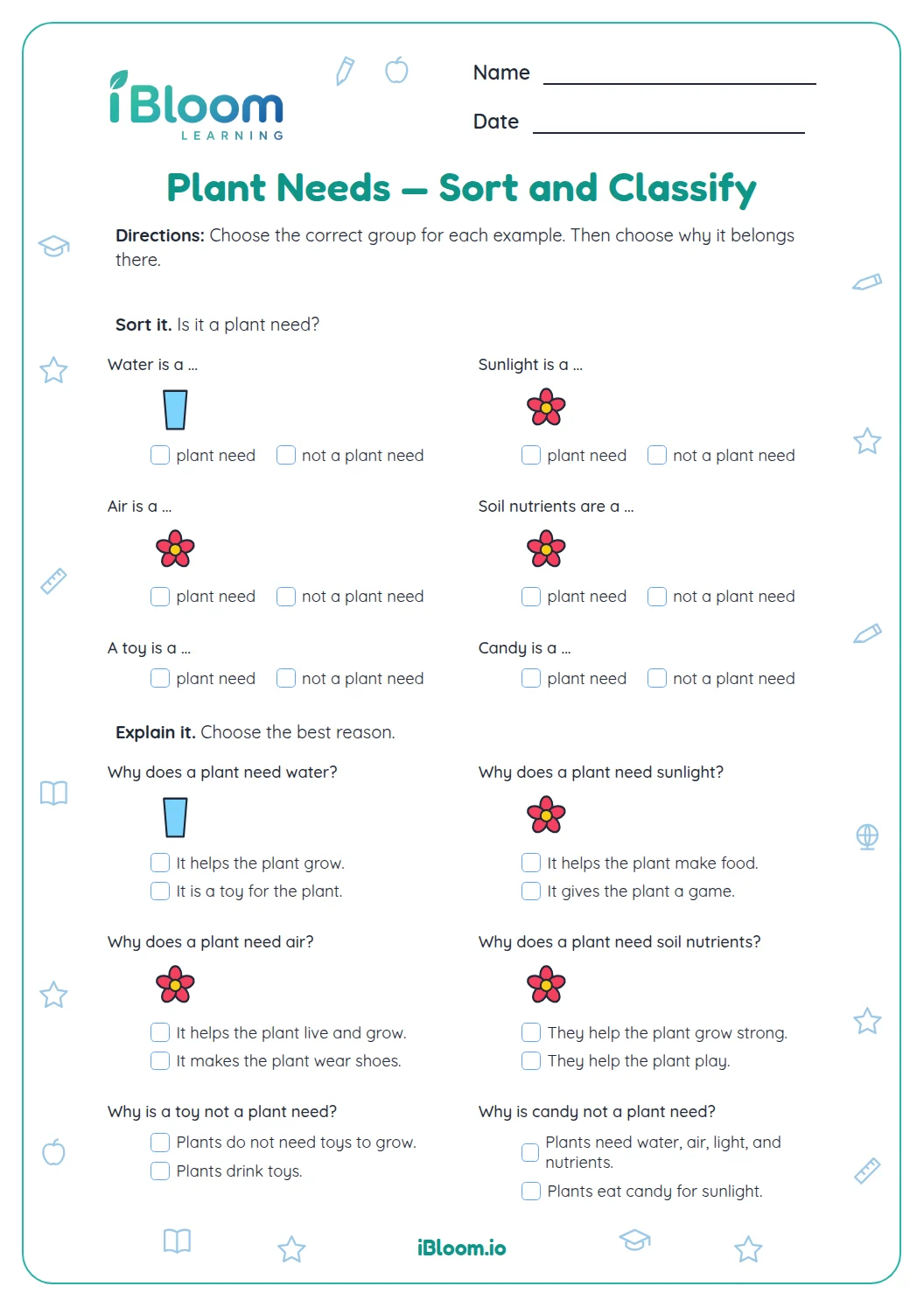

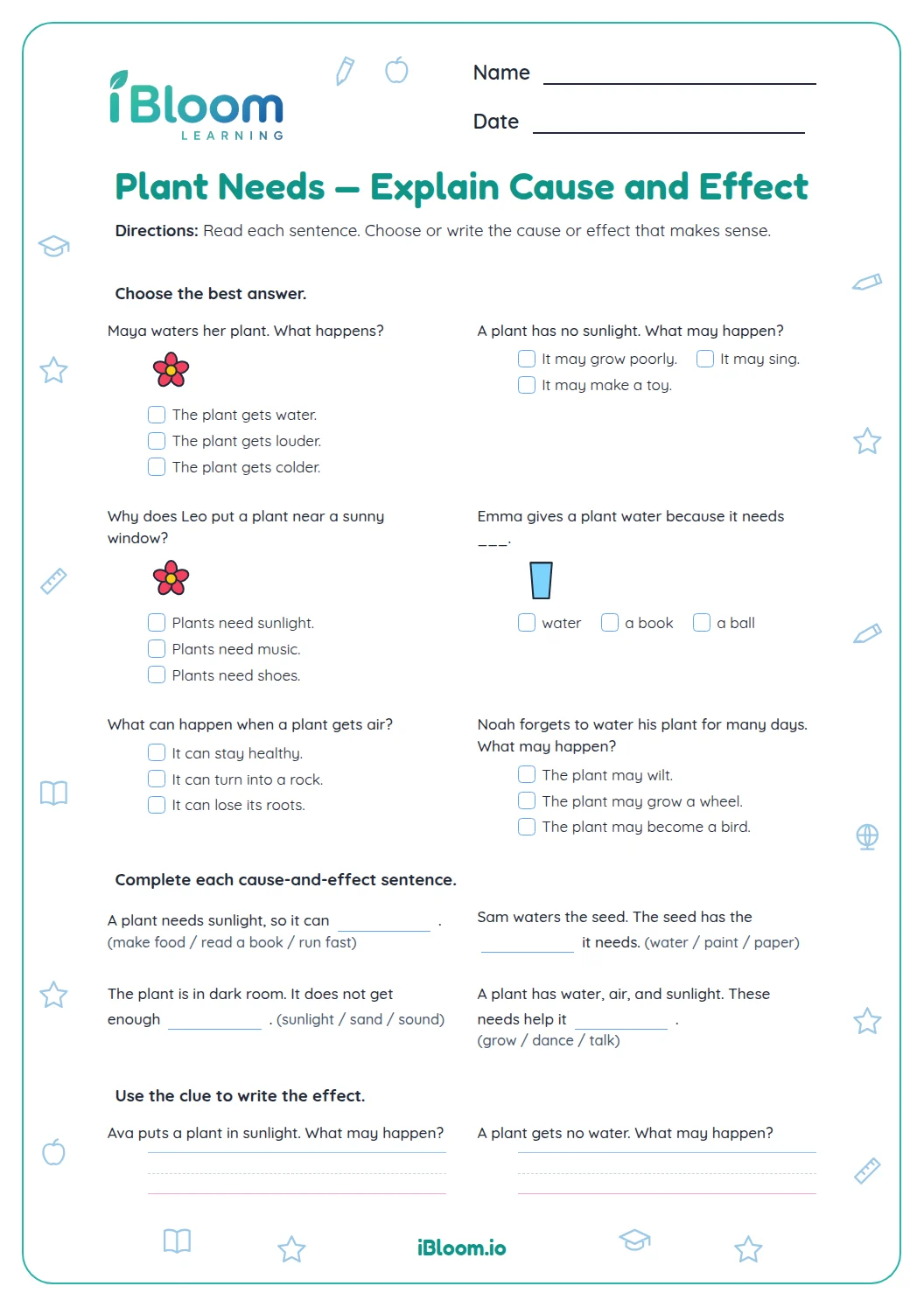


About this worksheet
This Grade 1 science worksheet asks children to sort living and nonliving things, identify plant needs and parts, and use clues to explain their thinking. Sixteen questions move from picture choices to short written responses; a separate answer key includes sample answers. The page practices observing patterns in what plants and animals need to survive (NGSS K-LS1-1).
Aligned to K-LS1-1
What makes a living thing?
A living thing grows and needs resources to survive. The sheet begins with picture choices, then asks about plant parts, sunlight, water, and animal behavior. For question 5, “A plant is a ___,” choose “living”: plants grow and use resources.
How can a clue help you reason?
Questions 11–16 ask students to use a clue and make a simple inference. A seed given water and warmth may sprout; a plant left in a dark closet lacks sunlight. For open responses, accept another accurate example that answers the prompt.
- 1A plant is living.
- 2It grows and needs water.
What is on this review?
There are 16 questions in four parts: picture clues, plant and animal facts, applying clues, and written reasoning. The answer key gives sample responses for the final four questions.
How can you check your thinking?
Ask the child to point to the clue behind each answer. For example, a toy car can roll when pushed, but it does not grow or need food; movement alone does not make it living.
How to use this worksheet
- 1Read the directions together and notice what each part asks.
- 2Complete one question at a time, pointing to the key information.
- 3For written responses, use a complete thought that answers the prompt.
- 4Pause after each part and check that every item has a response.
- 5Use the answer key to identify a step to practice again.
Common mistakes and quick fixes
The mistake
Answering before reading the full prompt.
The fix
Read every word and identify exactly what the question asks.
The mistake
Mixing up the information in the prompt.
The fix
Point to the numbers, clues, or words used to decide.
The mistake
Stopping after choosing an answer.
The fix
Check that the response answers the question and fits the example.
Curriculum alignment
This page practices the listed grade-level skill.
Use observations to describe what plants and animals need to survive.
On this sheet: Students reason about living things and plant needs.
Show the official wordingHide the official wording
Use observations to describe patterns of what plants and animals (including humans) need to survive.
What to practice next
Make more practice
Further reading
Questions parents and teachers ask
How many questions are on the sheet?
There are 16 questions in four parts. Students start with picture choices, identify plant and animal facts, apply clues, and finish with short written responses. A separate answer key gives sample answers for questions with more than one reasonable response.
What plant needs appear in the questions?
The choices and reasoning prompts include water, sunlight, and warmth. For instance, a seed receives water and warmth and may sprout, while a plant kept in a dark closet is missing sunlight. Students use the details in each prompt to select a fitting answer.
How does the sheet explain living things?
Students identify plants and animals as living and use clues such as growing, needing food, or breathing. One question contrasts a puppy with a toy car, which can roll but does not grow or need food. These examples help children explain their choices.
Can written answers differ from the key?
Yes. Questions 13–16 invite short explanations, so the key shows examples rather than the only acceptable wording. Accept a response when it answers the question with an accurate clue, such as roots taking in water from soil. A child may explain the clue in their own words and still be correct.
Which science standard does the page practice?
The questions about plant and animal needs connect to NGSS K-LS1-1: using observations to describe patterns in what plants and animals need to survive. Children apply those ideas to picture choices and short situations, including a seed and a plant without sunlight.