






About this worksheet
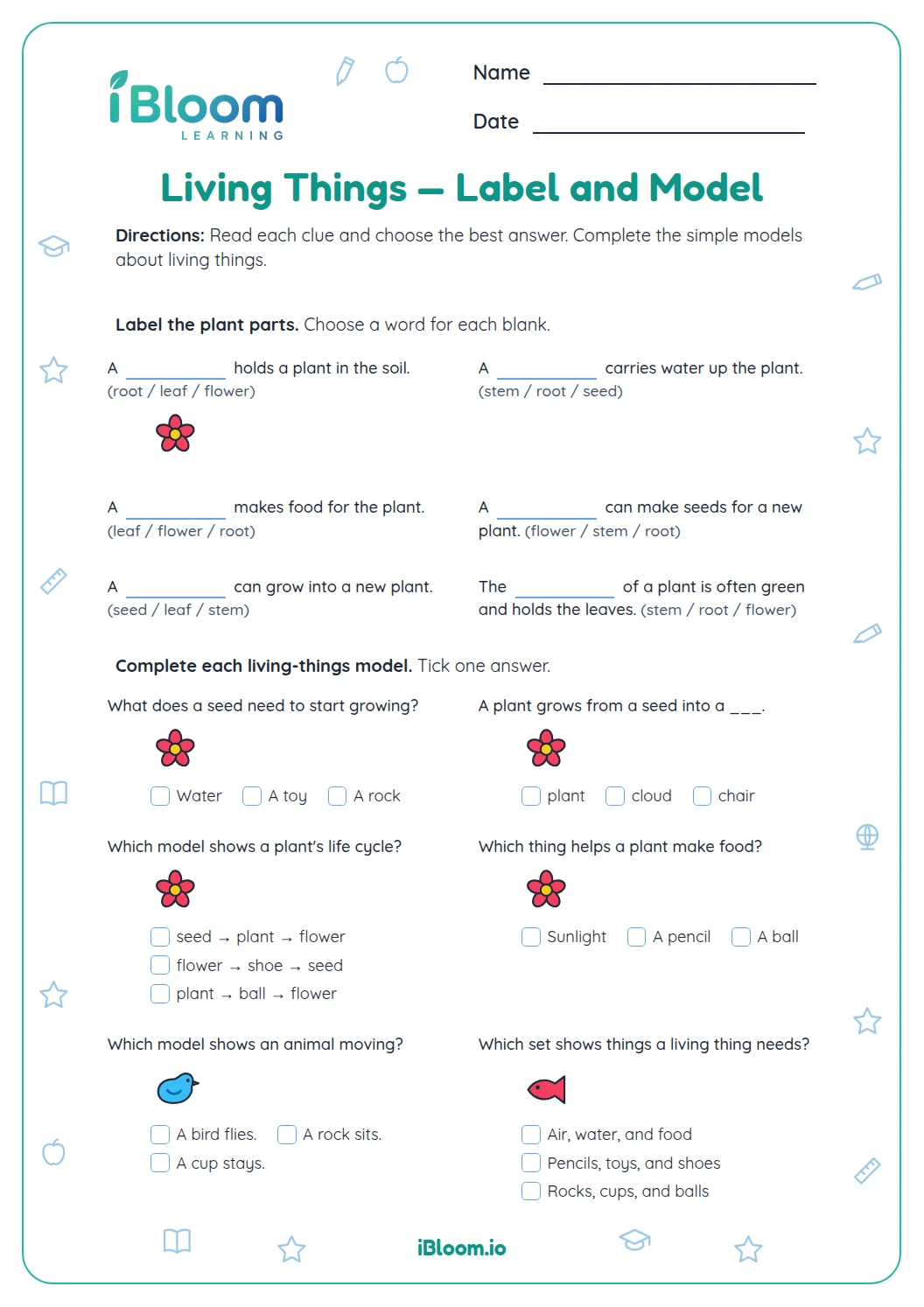
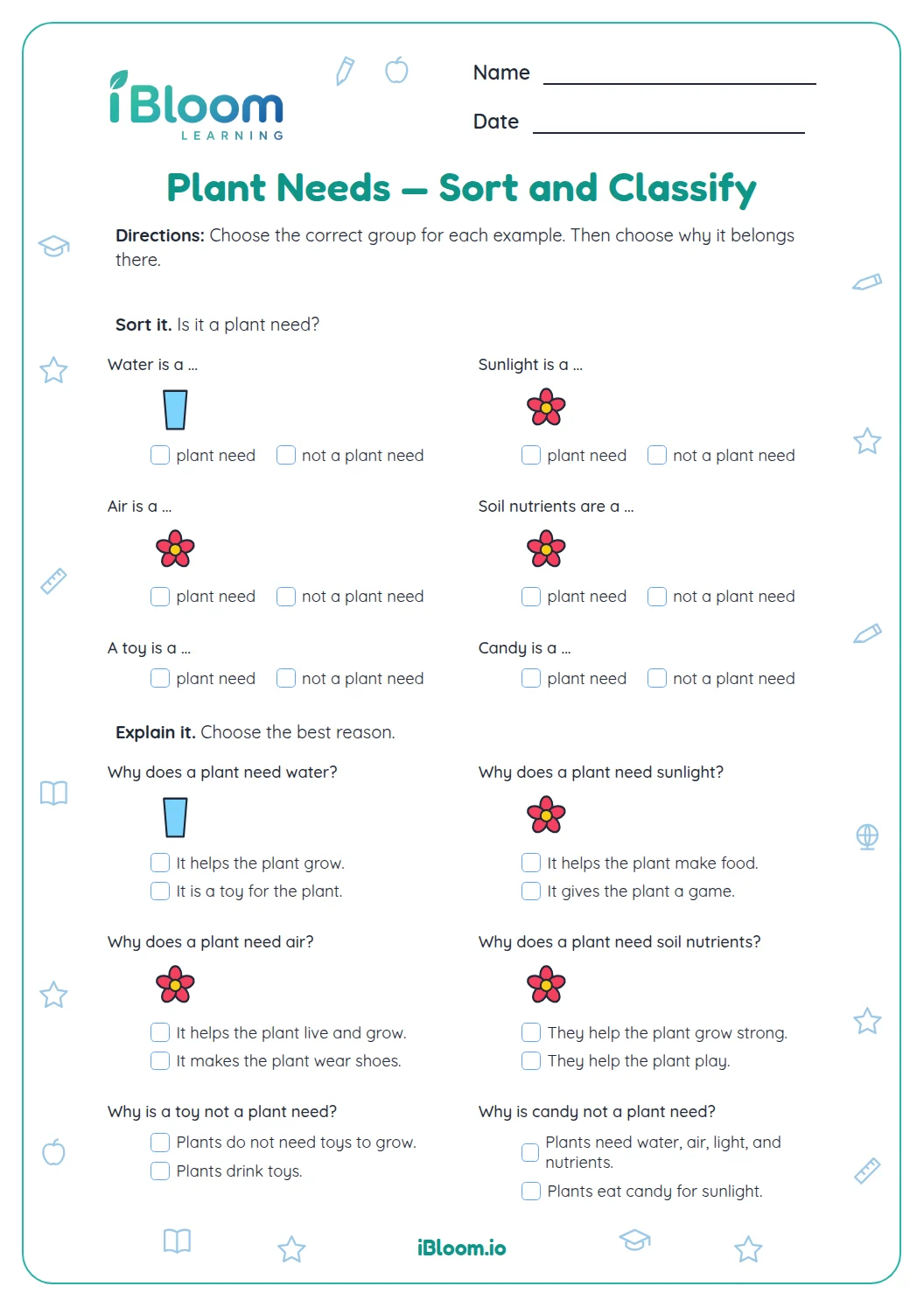
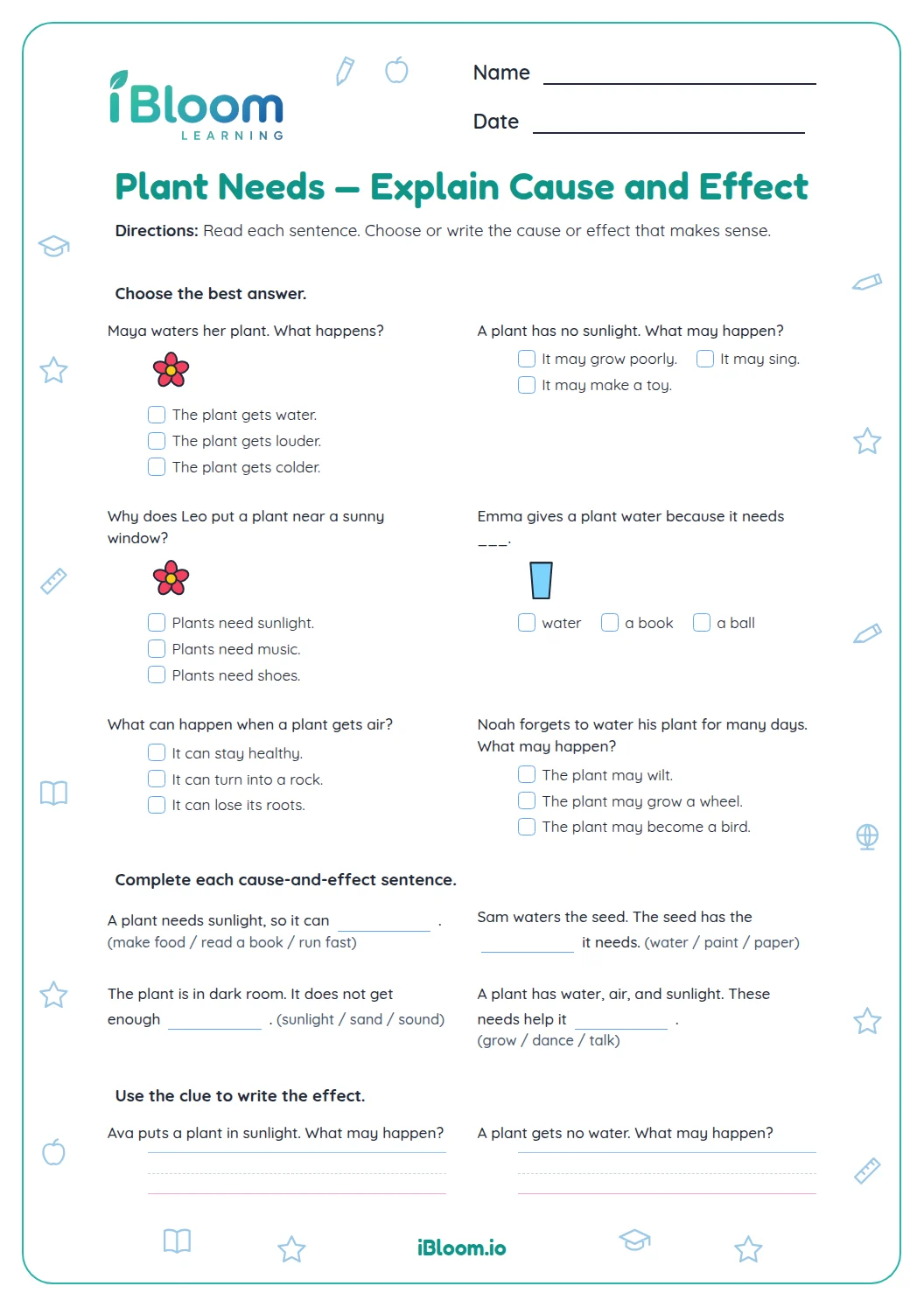
This Grade 1 science worksheet helps children classify plants, animals, and nonliving things. Fifteen picture-supported prompts move from familiar examples such as a tree, bird, and rock to plant needs and a short explanation. A separate answer key gives category names and sample responses.
How can a child sort a familiar example?
Look at the object and decide whether it is a plant, an animal, or nonliving. A tree is a plant, a bird is an animal, and a rock is nonliving. The small pictures support the examples while children supply each category.
- 1What category fits an oak tree?
- 2An oak tree is a plant.
What do the plant questions ask children to notice?
Questions 4–6 connect the categories to plant life: a seedling needs water, leaves take in light, and leaves make food using sunlight. The answer to “What does a seedling need to grow?” is water.
How can learners explain a classification?
In the final part, children name a plant need, classify another familiar object, and give examples of living and nonliving things. Accept another accurate pair, such as a dog and a spoon.
How to use this science worksheet
- 1Read each item name and say its group aloud.
- 2For a plant, animal, or nonliving response, write the full category.
- 3Use the seedling and leaf questions to recall what plants need and how leaves help.
- 4Answer the last questions with one clear example or reason.
- 5Check the categories against the key and talk through any surprise.
Classification clues to review
The mistake
Calling a tree nonliving because it stays in one place.
The fix
Living things do not need to move from place to place; a tree grows and needs water.
The mistake
Calling a rock living because it can change shape when broken.
The fix
A rock does not grow or need food and water to stay alive.
The mistake
Mixing up a plant and an animal.
The fix
Both are living, but a tree is a plant and a robin is an animal.
What to practice next
Make more practice
Questions parents and teachers ask
What does nonliving mean on this worksheet?
Nonliving describes something that is not alive, such as a rock, chair, or spoon. It does not grow or need food and water to stay alive. Children use those clues to classify the familiar examples pictured on the worksheet.
Why is a seedling classified as a plant?
A seedling is a young plant. It grows and needs water, so it belongs in the plant group. Questions 4 and 12 use the seedling in different ways: one asks what it needs, and the other asks children to name its category.
What plant parts appear in the questions?
The sheet asks about leaves and plant needs. A leaf takes in light and uses sunlight to help make food, while a seedling needs water to grow. These prompts connect the plant category to a simple idea about how plants live.
Can children give different examples for the last question?
Yes. The final question asks for one living thing and one object that is not alive, so many pairs are correct. A tree and a rock are shown in the key as one sample; a child could also name a dog and a spoon.
Is an answer key included?
Yes. The printable includes a separate two-page answer key with the expected categories and sample responses. For open questions, compare the child’s idea with the key and accept another answer when it correctly names a plant need or gives a valid living and nonliving example.