







About this worksheet
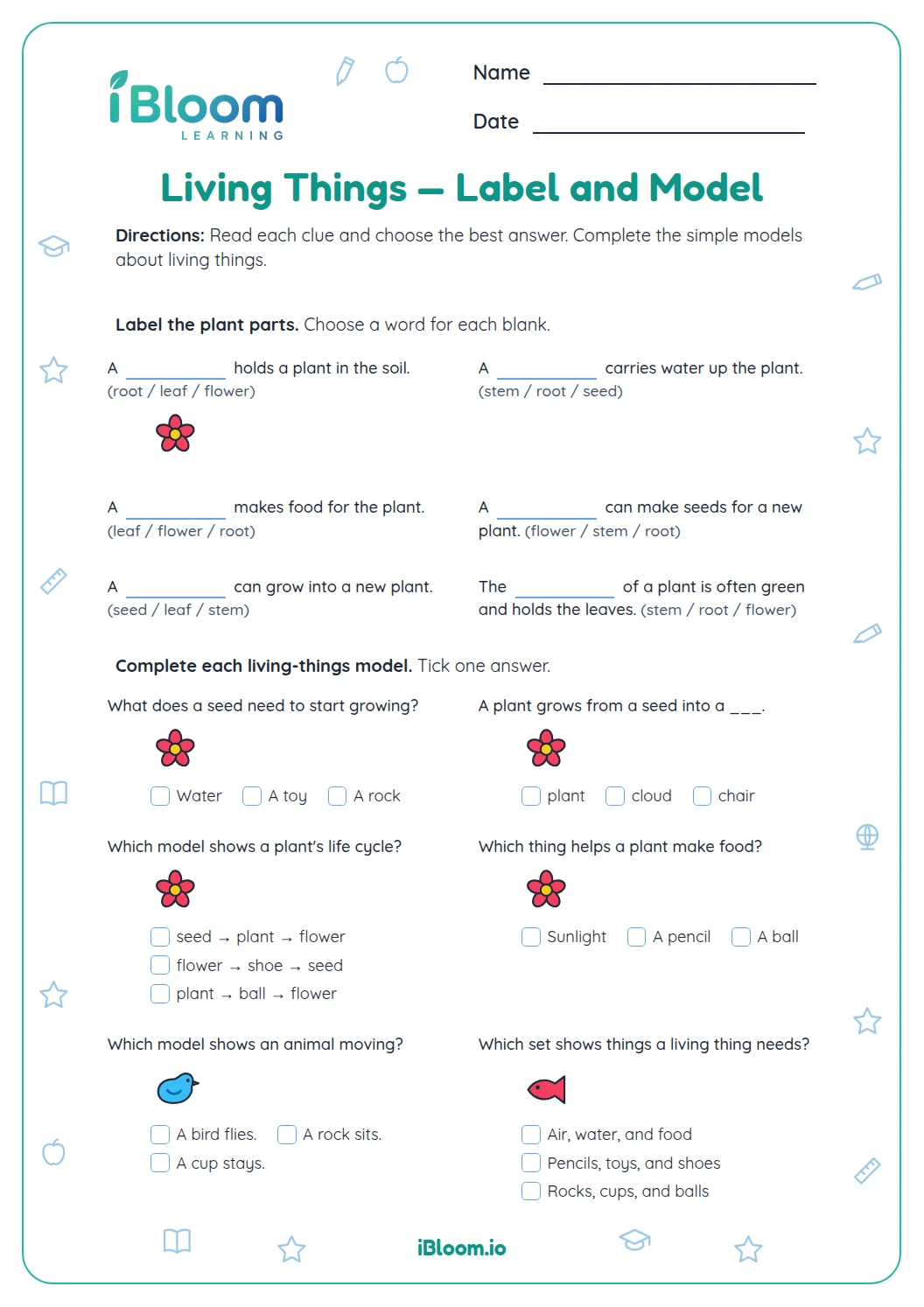
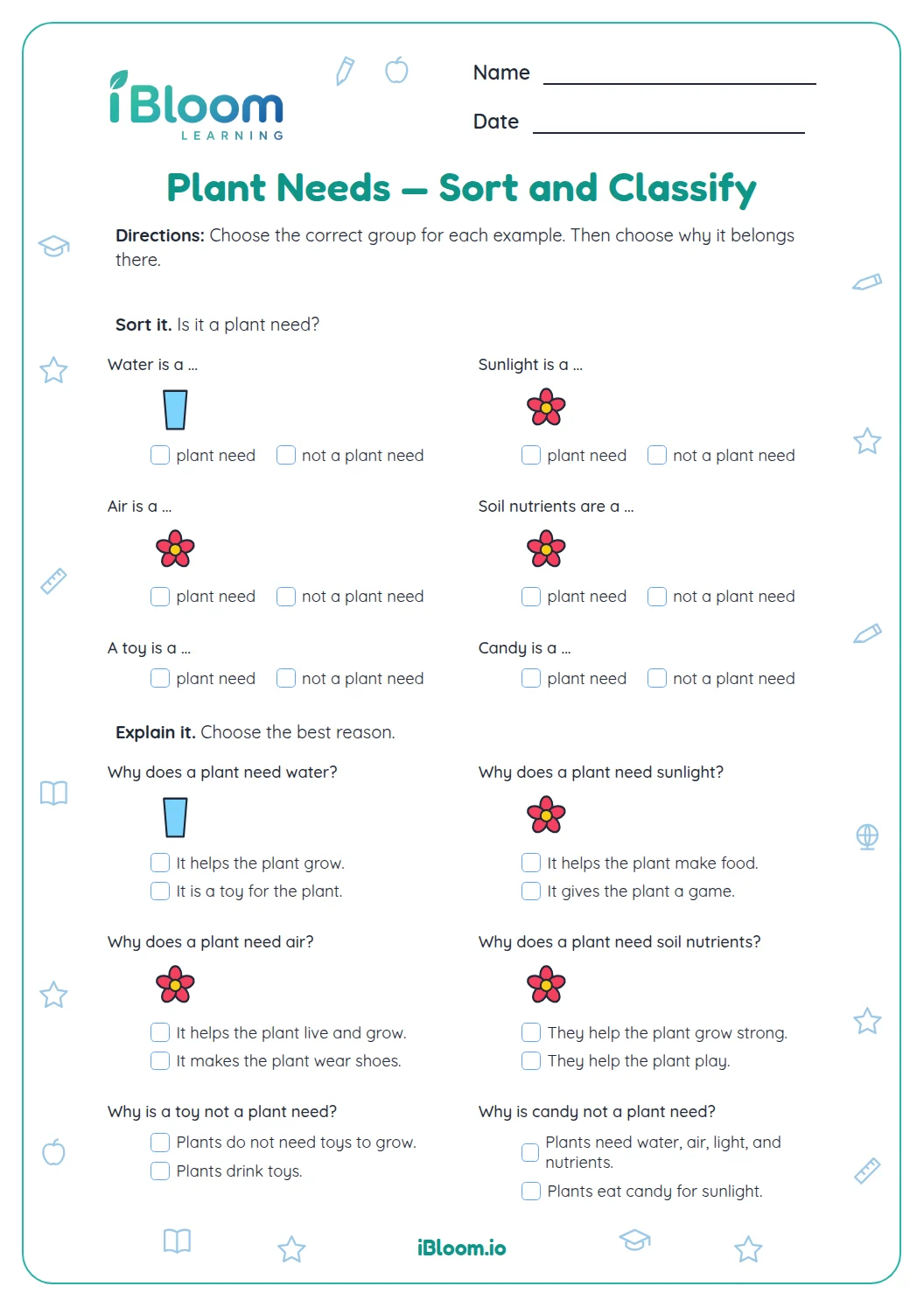
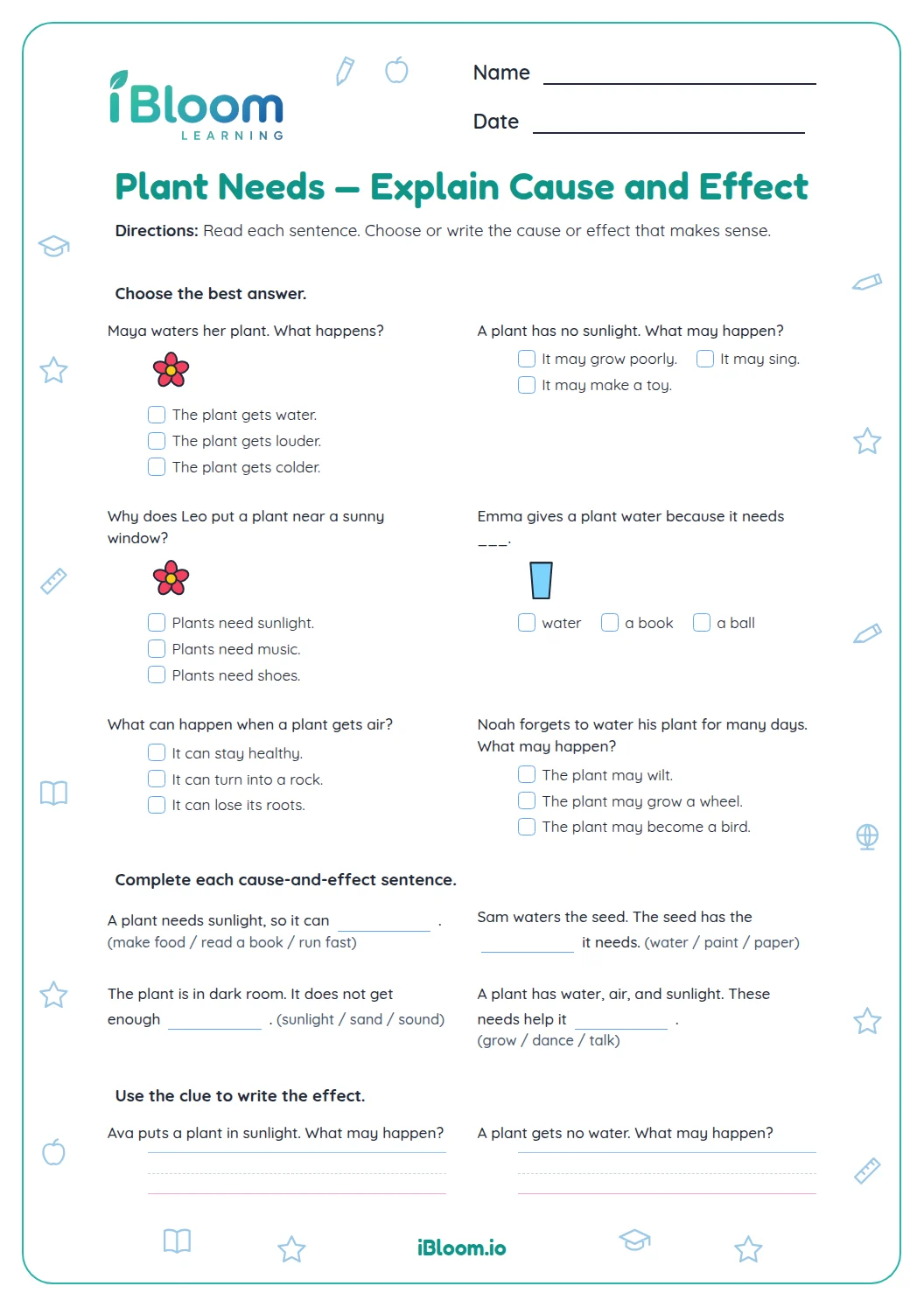
This Grade 1 science worksheet asks children to connect observations about plants, animals, and nonliving things with likely effects. Part A pairs short cause-and-effect questions with pictures. Part B asks children to complete sentences about features such as roots, leaves, legs, and gills. The activity builds observation of patterns in what plants and animals need to survive, as described in NGSS K-LS1-1.
Aligned to K-LS1-1
What can children observe about living things?
Plants and animals have different features and needs. Roots take in water from soil, leaves use sunlight, and animals use body parts to move or get food. A rock does not grow or need food, so it is a nonliving example.
Children can describe what they notice and connect a condition with a likely effect. A plant that gets water and light may grow; a plant without water may wilt.
How can a child explain one cause and effect?
Name the feature or condition first. Then tell what it helps an organism do or what may happen when a need is missing. Use the sentence details to support the connection.
- 1A seedling gets water and sunlight. What may happen?
- 2Water and sunlight help a plant grow.
- 3The seedling may start to grow.
- 4Choose “It may start to grow.”
What is included in the two parts?
Part A has four illustrated multiple-choice questions about plant and animal needs, features, and a nonliving object. Part B has ten cause-and-effect sentence blanks. The answer key gives concise target responses.
How to use this worksheet
- 1Read the whole question and look at its picture.
- 2Name the plant, animal, or object in the sentence.
- 3Find its feature or condition, such as roots or no water.
- 4Connect that cause with a likely effect.
- 5Choose an answer or write one word in the blank.
Common mistakes and quick fixes
The mistake
Mixing up plants and animals
The fix
Check the features named in the sentence: roots and leaves are plant parts; gills and wings are animal parts.
The mistake
Saying a plant needs food in the same way an animal eats
The fix
Recall that plants use sunlight, water, and air to make food.
The mistake
Naming an effect without its cause
The fix
Point to the condition or body part first, then say what it helps happen.
Next Generation Science Standards alignment
The questions use observations to compare needs and patterns in plants and animals.
Observe patterns in what plants and animals need to survive.
On this sheet: The items connect plant and animal needs or features with effects on growth, movement, and survival.
Show the official wordingHide the official wording
Use observations to describe patterns of what plants and animals (including humans) need to survive.
What to practice next
Make more practice
Further reading
Questions parents and teachers ask
What does this plant and animal worksheet practice?
Children connect a feature or condition with a likely effect, such as roots taking in water or a plant wilting without water. They also distinguish plants and animals from a nonliving thing using familiar examples. Ask the child to name the cause and effect in the example.
How many questions are on the worksheet?
There are 14 questions across two worksheet pages: four illustrated choices and ten cause-and-effect blanks. A separate two-page answer key gives a target response for every question. Some short responses use simple science words. Ask the child to name the cause and effect in the example.
Why are pictures included in Part A?
The pictures show a seedling, bird, flower, fish, and stone alongside questions about those items. They provide a visual cue, while children use the sentence to think about needs, features, and likely effects. Ask the child to name the cause and effect in the example.
How can I help a child explain an answer?
Ask what happened first and what may happen next. For example, roots take in water from soil, while a plant without water may wilt. Having the child name both parts helps make the cause-and-effect link clear. Ask the child to name the cause and effect in the example.
Are all living things plants or animals?
Plants use sunlight, water, and air to make food. Animals get food by eating plants or other animals. The worksheet connects these needs and features with simple effects, such as growth, movement, or staying alive. Ask the child to name the cause and effect in the example.
Does the worksheet include an answer key?
Yes. The answer key is printed on separate pages and gives a target response for every item. Accept a clear equivalent response when a blank allows more than one sensible word, such as “stay warm.” Ask the child to name the cause and effect in the example.