







About this worksheet
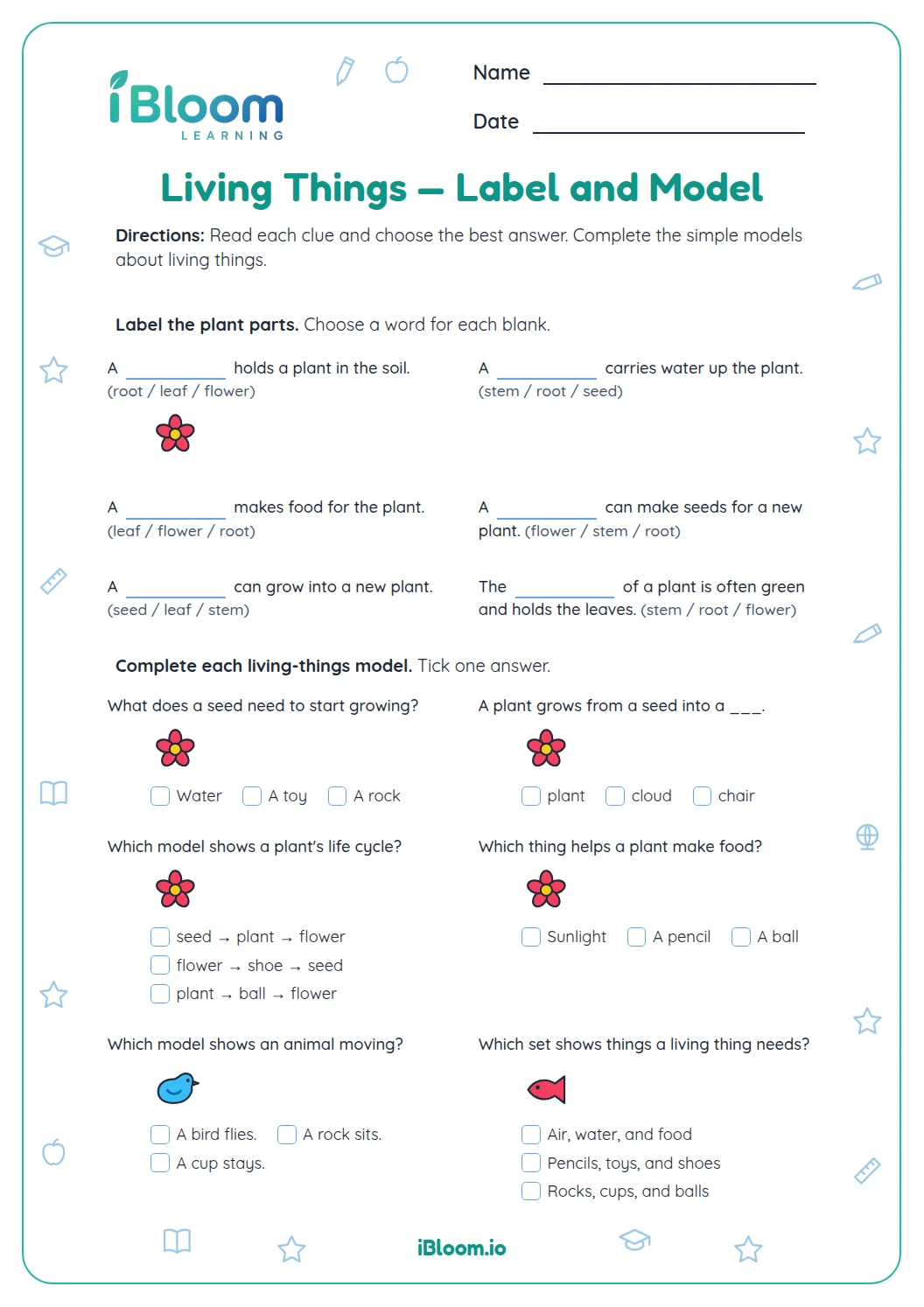
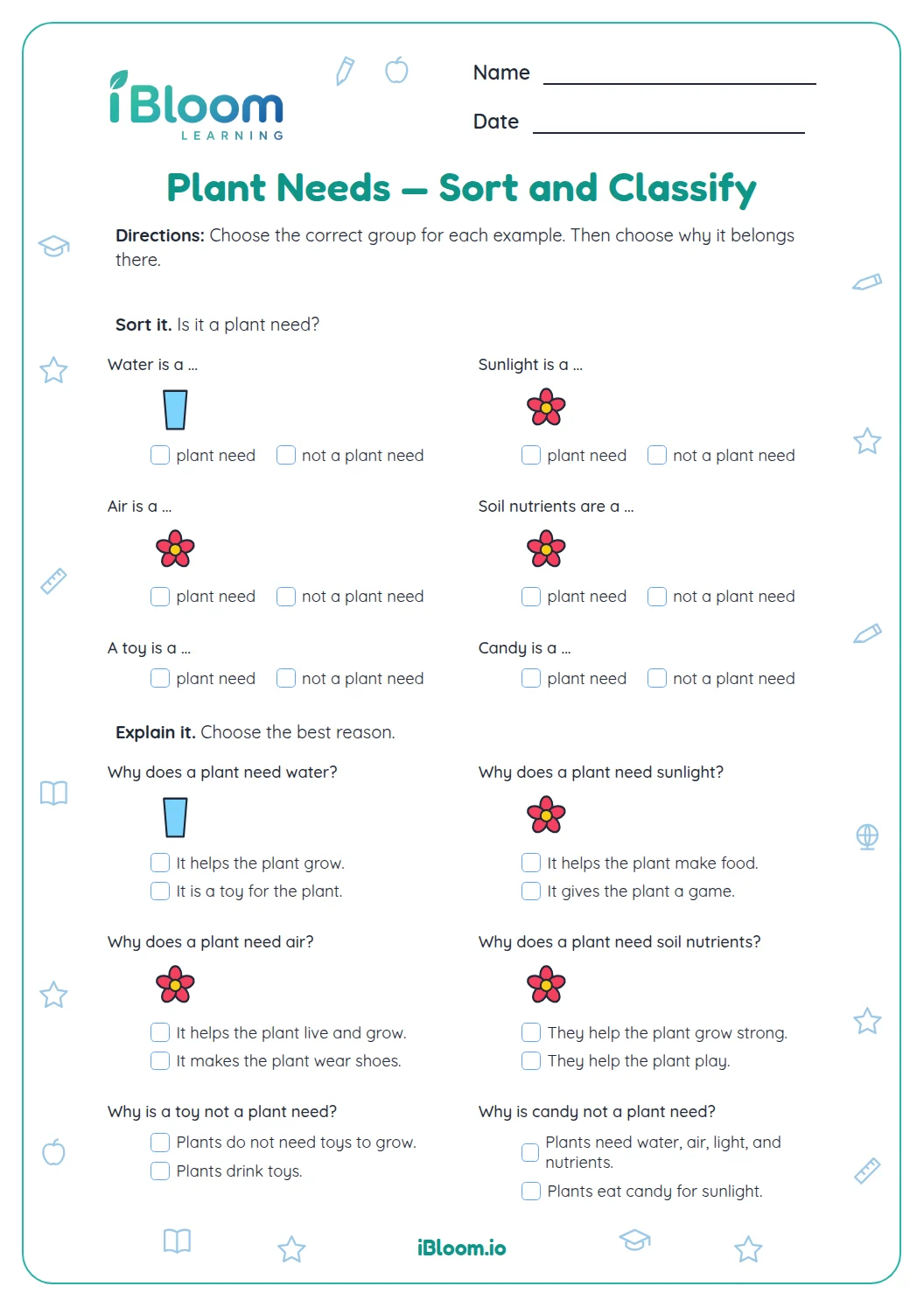
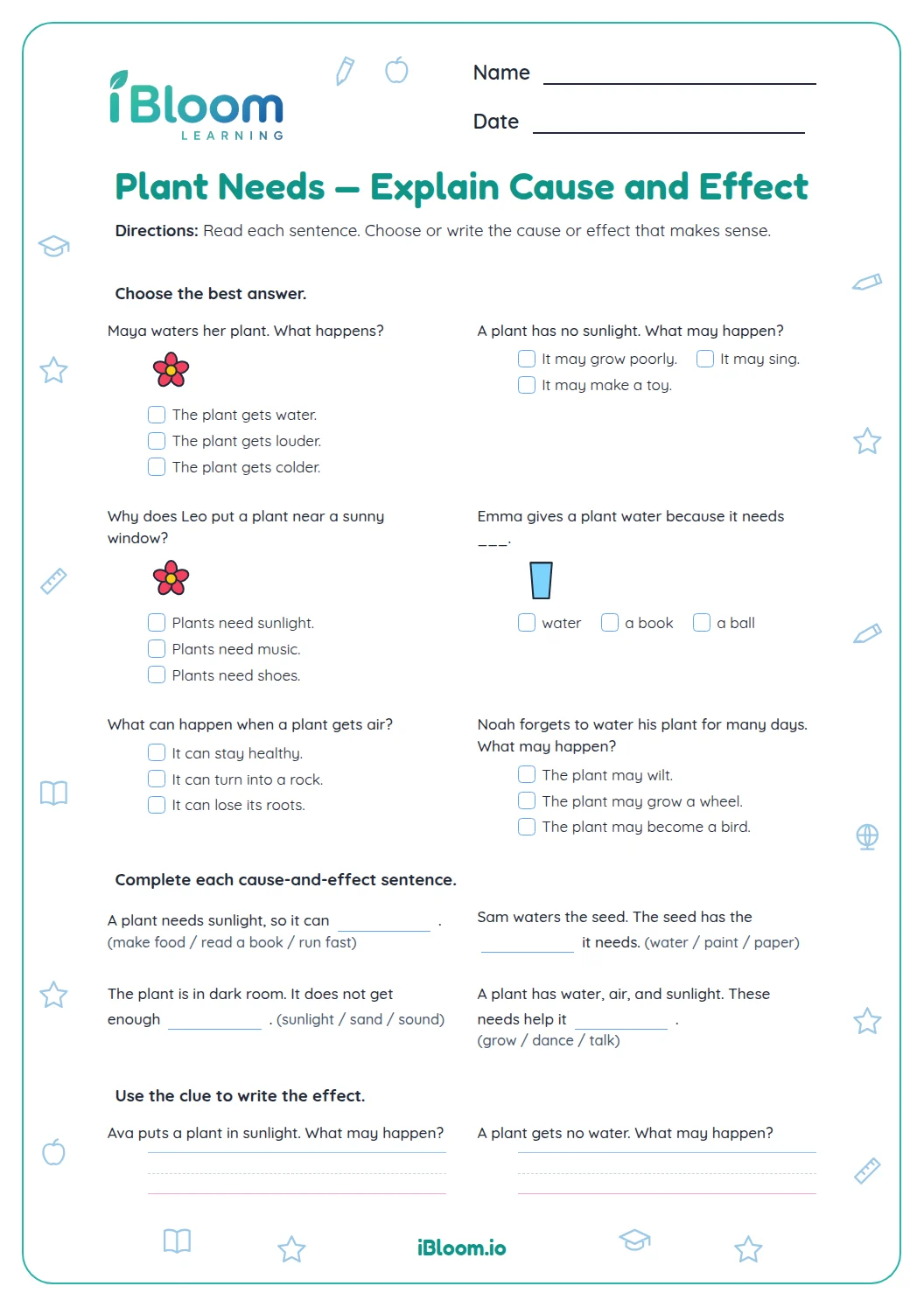
This Grade 1 science worksheet helps children apply the difference between plants, animals, and nonliving things to familiar examples. Students classify six examples, choose science ideas about growth, needs, and movement, and use evidence to explain a cat and a tree. The new sheet replaces the old shorter activity with 14 questions while keeping its plant, animal, and thing focus. A separate answer key includes expected classifications and sample explanations.
Is it a plant, an animal, or a nonliving thing?
A living thing grows and needs resources. A plant can stay rooted and still be alive; an animal can move from place to place by itself. Part A uses short descriptions to classify six examples, including a rose, bird, pencil, fish, tree, and glass.
- 1A rose grows in soil and needs water.
- 2It is a plant.
What evidence supports the answer?
Use a feature or need to support a classification. A pencil is nonliving because it does not grow or need water to live. Part B asks about plant needs, animal movement, and toy cars; the final two questions use pictures of a cat and a tree as evidence prompts.
- 1Why is a tree a plant?
- 2It grows and needs water and sunlight.
- 3Those clues show that it is a living plant.
What examples appear on the worksheet?
Part A has six classification choices. Part B has six questions about needs, growth, and movement, including a plant that stays in one place and a toy car that rolls when pushed. The final two questions show a cat and a tree and ask children to choose evidence for each classification.
How to use this worksheet
- 1Name what you see in the picture or sentence.
- 2Ask whether it grows and needs resources to live.
- 3For animals, think about movement and getting food; for plants, think about growing and needing water and light.
- 4Choose plant, animal, or nonliving thing based on the clues.
- 5For evidence questions, give one clear reason.
- 6Check the key and talk through any example that was confusing.
Common mistakes and quick fixes
The mistake
Calling a plant nonliving because it stays in one place.
The fix
Plants are living even though they do not move from place to place; they grow and need water and light.
The mistake
Calling a toy an animal because it can move when someone pushes it.
The fix
Ask whether it grows and moves by itself, not whether a person can move it.
The mistake
Giving a category without evidence in an explain question.
The fix
Add a clue such as grows, needs water, eats food, or moves on its own.
What to practice next
Make more practice
Questions parents and teachers ask
What do children practice on this plant and animal worksheet?
The 14 questions ask children to classify six examples, choose six science ideas, and answer two picture evidence questions. The examples include a rose, bird, pencil, fish, glass, cat, and tree. The page focuses on growth, basic needs, and how living things move.
How can a child know that a plant is living?
A plant grows and needs resources such as water and sunlight. It does not need to walk or move from place to place to count as living. Question 11 asks children to use growth and water needs as evidence even though the plant stays still.
Can a toy move and still be nonliving?
Yes. A toy car can roll when someone pushes it, but it does not grow or eat. Question 12 asks children to explain why movement alone does not make the toy an animal; ask what causes it to move and whether it has living needs.
What counts as evidence in the final questions?
A short science clue is enough. For the cat, children can point to growing, eating, or moving by itself; for the tree, they can point to growth and its need for water and sunlight. The answer choices connect each clue to the living category.
Is this worksheet suitable for Grade 1?
The examples and sentences are brief, and most answers are selected from choices. An adult can read the prompts aloud while a child points to a picture or explains a clue. The final two items use cat and tree pictures to support the evidence questions.
Is an answer key included?
Yes. The separate two-page answer key marks each classification and science-idea choice. It also gives the expected evidence for the cat and tree questions, making it possible to check both the selected answer and the reason behind it clearly together.