






About this worksheet
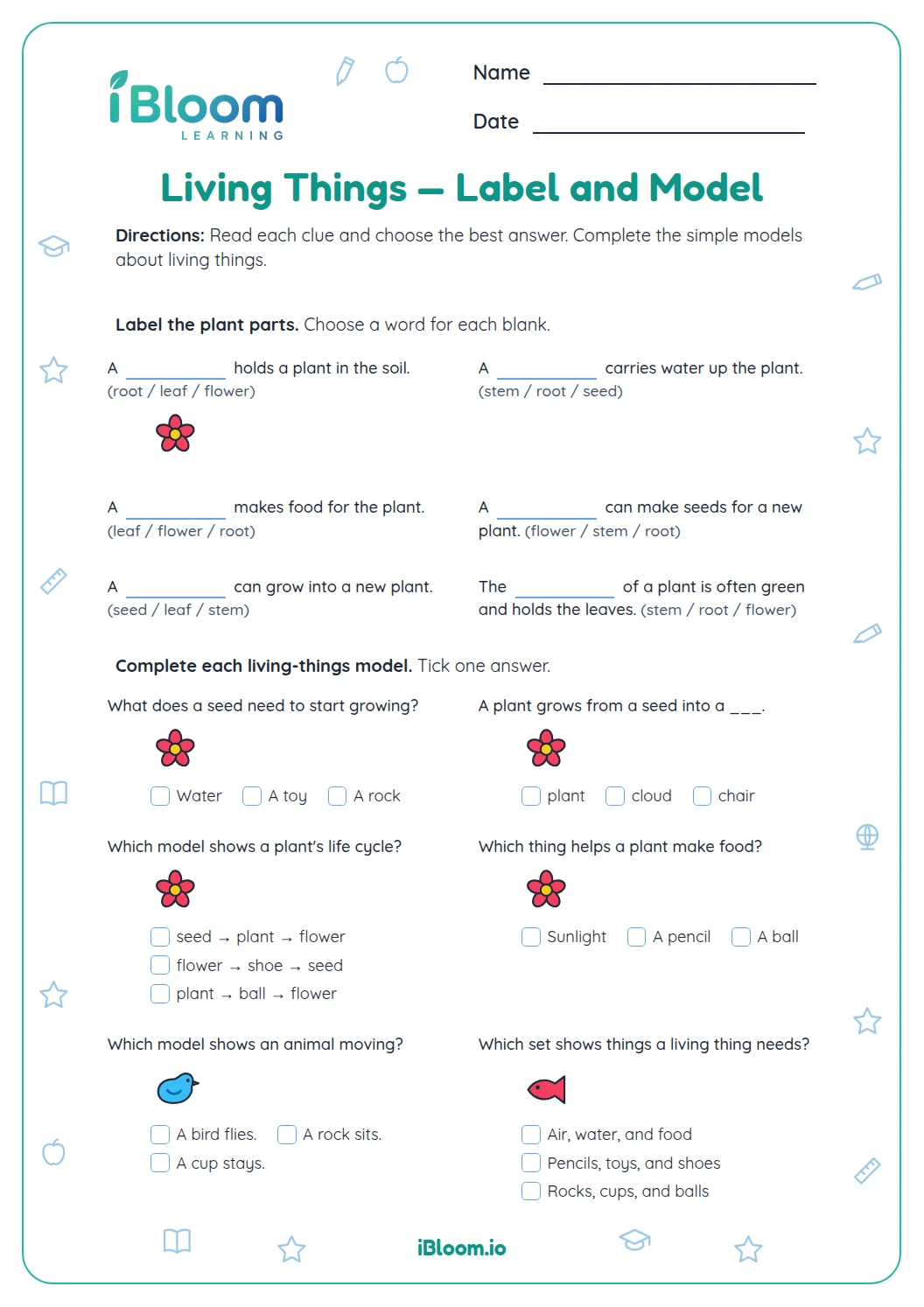
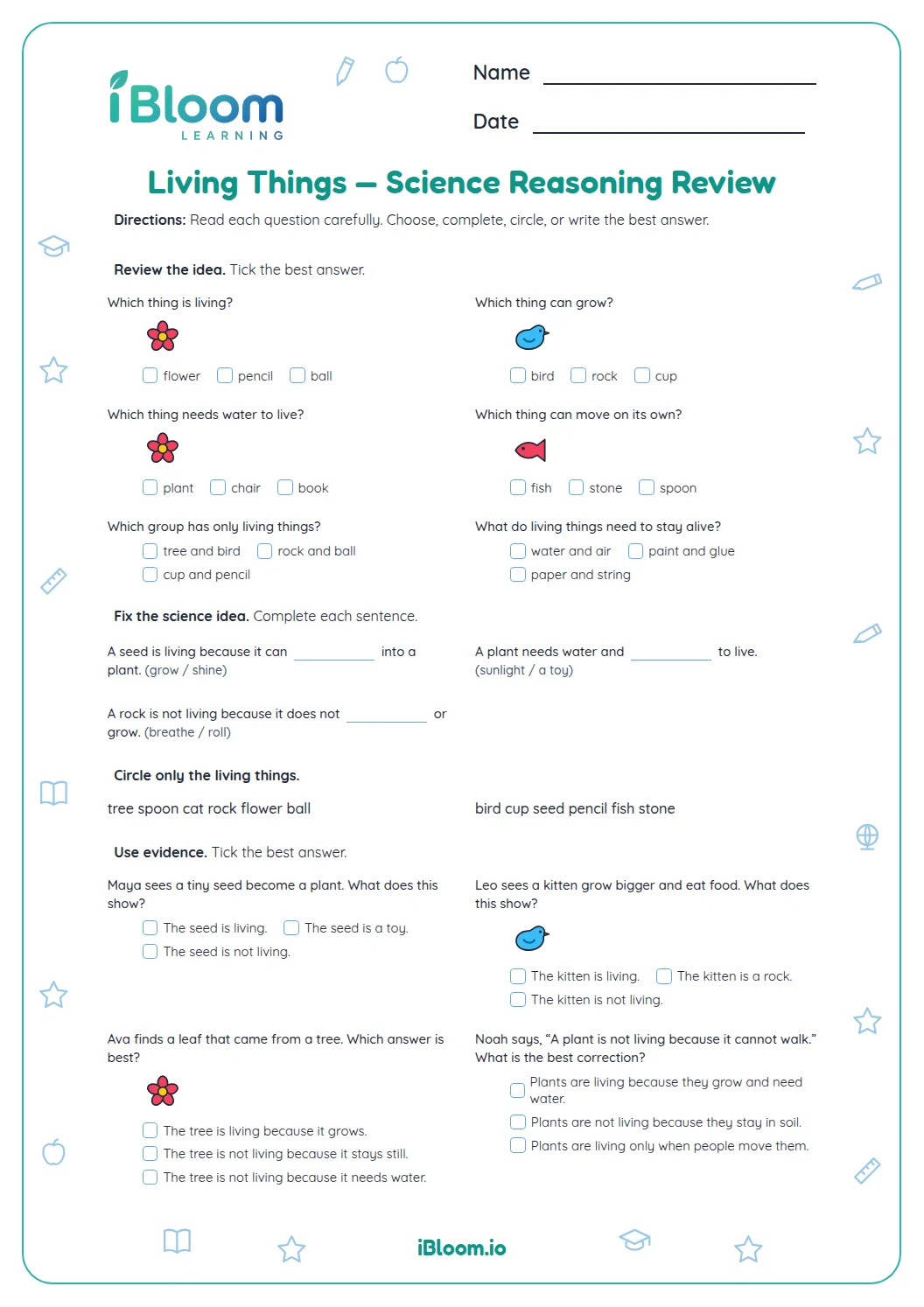
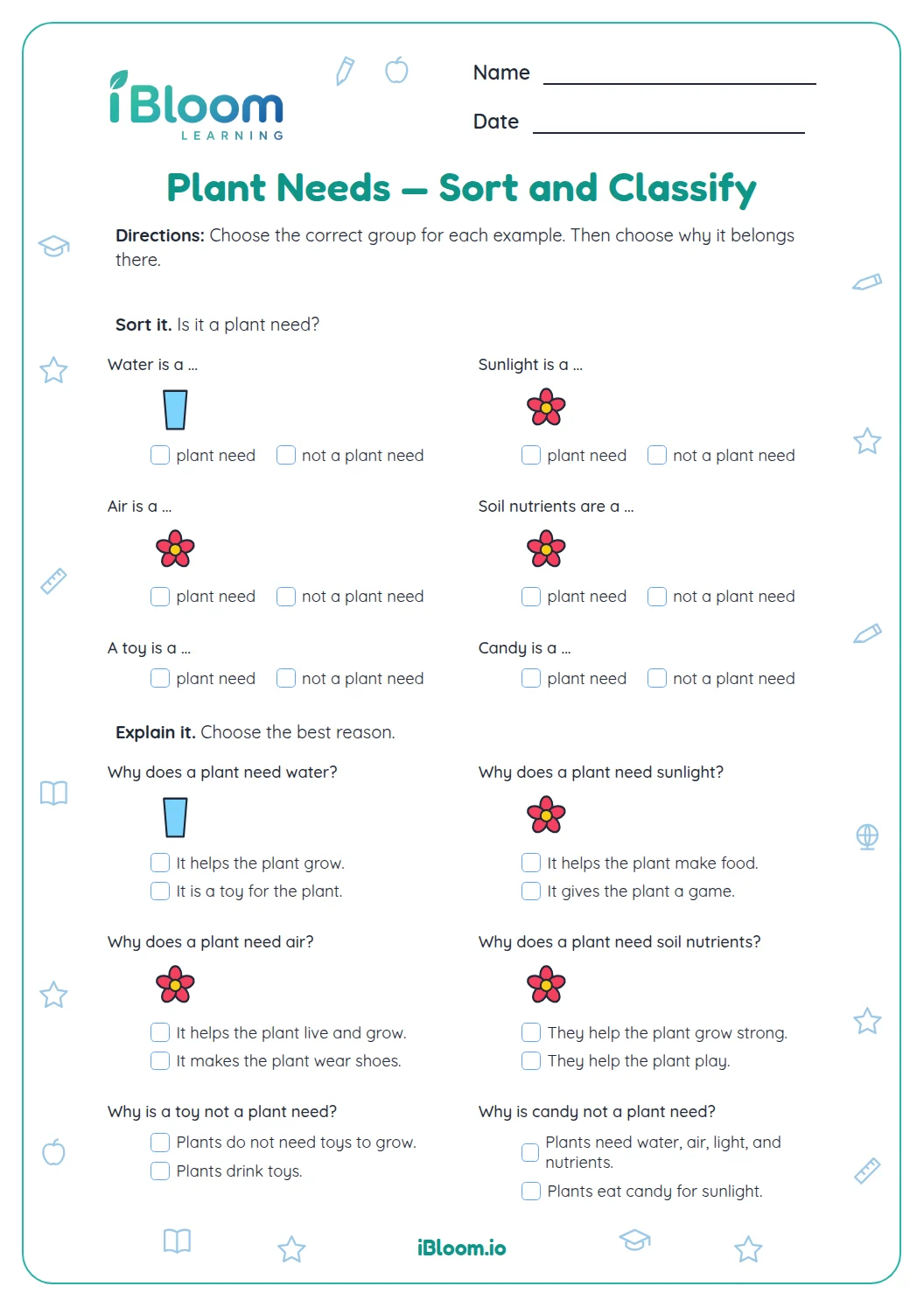
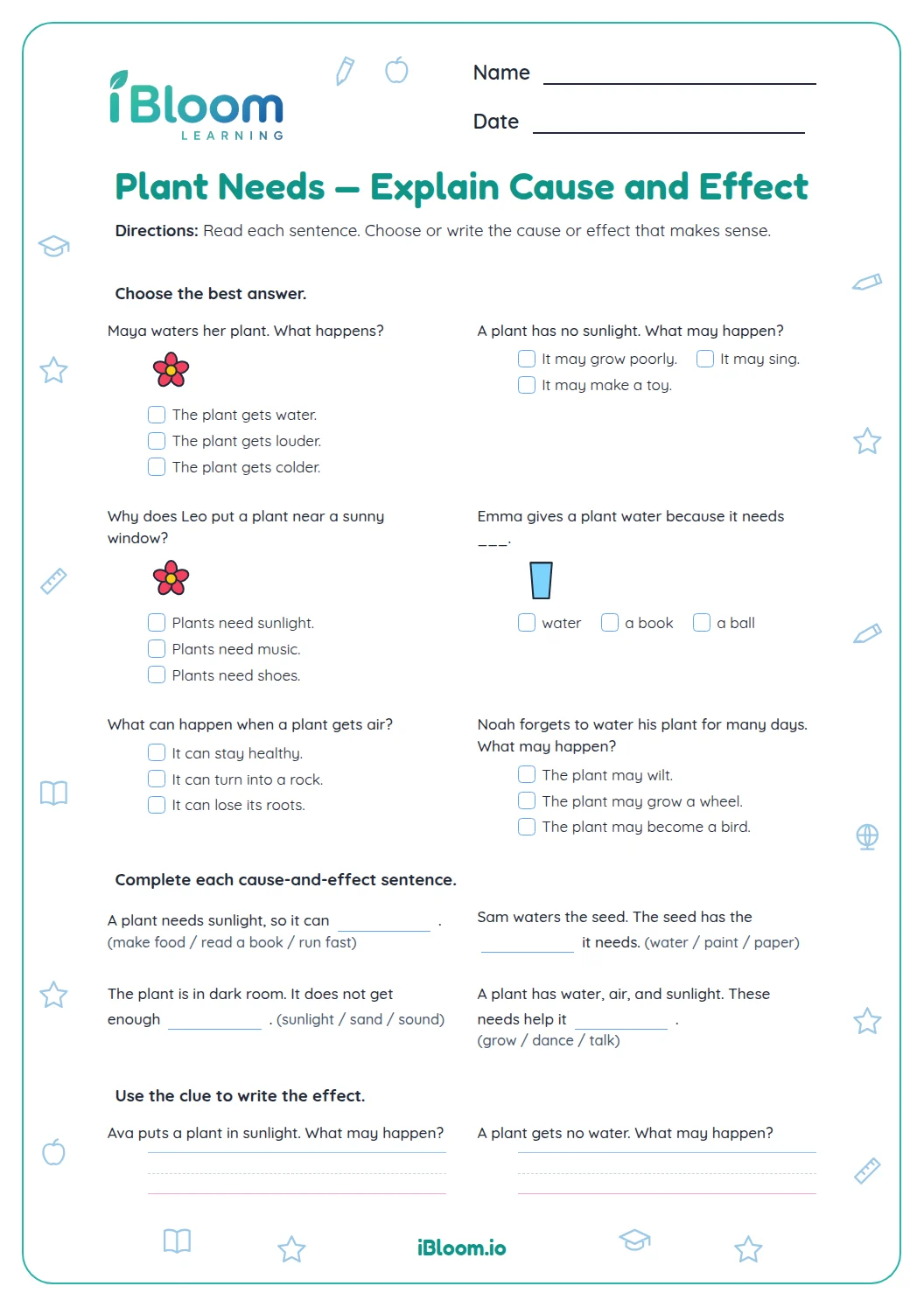
This Grade 1 printable uses familiar pictures and short prompts to help children recognize living things, identify what plants need, and explain how roots help a plant. Students choose answers, complete sentences, and apply the root idea to a soil problem. The final item links plant structures to a practical solution, as described in the Next Generation Science Standards performance expectation 1-LS1-1.
Aligned to 1-LS1-1
How can you tell something is living?
Living things grow and need resources. A seed can sprout and grow into a plant. A rock may change if it breaks, but it does not grow like a living thing.
- 1A small sprout appears from a seed.
- 2The sprout is evidence of growth.
- 3That change helps identify a living thing.
What does a plant need to grow?
Plants need water and sunlight, along with air and space to grow. When a plant leans toward a bright window, that observation can help children think about light as one of its needs.
How can a plant idea help solve a problem?
Roots hold a plant in soil. If rain washes soil down a hill, planting grasses or other small plants can help hold the soil in place. Students use that idea in the last question.
How to use this worksheet
- 1Look at each picture and name the object or living thing.
- 2Think about growth and needs before choosing.
- 3Read the whole sentence before filling its blank.
- 4Use a plant part, such as roots, when explaining a plant idea.
- 5For the last question, connect roots to holding soil.
Common mistakes and fixes
The mistake
Calling something living because it can move when pushed.
The fix
Ask whether it grows and needs resources on its own.
The mistake
Thinking water is the only thing a plant needs.
The fix
Recall sunlight and air as well as water.
The mistake
Saying roots make a plant grow without explaining their job.
The fix
Describe how roots hold the plant in the soil.
Next Generation Science Standards alignment
The final application connects plant roots with a solution to a soil problem.
Apply how plant parts help plants grow and meet needs.
On this sheet: Students apply the idea that roots hold a plant in place to suggest a way to hold soil on a hill.
Show the official wordingHide the official wording
Use materials to design a solution to a human problem by mimicking how plants and/or animals use their external parts to help them survive, grow, and meet their needs.
What to practice next
Make more practice
Further reading
Questions parents and teachers ask
What makes something living?
A living thing grows and needs resources such as water or food. Students compare a bird with nonliving objects, then use growth and needs to explain why plants and animals are living. For example, a seedling grows, while a rock does not grow or need food and water.
What plant needs does this worksheet cover?
The questions identify water and sunlight as plant needs and ask what a wilted plant or a plant leaning toward a sunny window might need. One response also asks how roots help hold a plant in soil. The remaining questions also ask about growth, roots, and a simple soil-holding solution.
How many questions are included?
There are 14 questions: six multiple-choice, three fill-in-the-blank, and five written-response items. Picture clues support the early identification questions, followed by explanation and a simple design idea. The answer key accepts clear explanations that match the science idea in the prompt.
What is the final design question asking?
Students suggest a material or planting idea to help hold soil on a hill after rain, then explain how roots could help. Accept sensible ideas that connect plant roots with holding soil in place. The picture clues include familiar living and nonliving things to compare.
Does the worksheet include picture clues?
Yes. The first six questions include simple drawings such as a bird, tree, seedling, rock, and water. Students should use both the words and the picture clues to make their choices. Answers can be said aloud first, then written in a short sentence.